Automated Assembly Systems: Fixed or Flexible?
Product life cycles are getting shorter and shorter. By one estimate, 50 percent of a typical company’s annual revenues are derived from products launched within the previous three years. Long-term cash cows—products that stay in a company’s portfolio for many years—are becoming a thing of the past.
Nowhere is this more evident than in the consumer electronics industry. For example, Apple Inc. has rolled out six generations of the iPad since it introduced the tablet computer back in April 2010. In fact, the fourth-generation iPad came out just 7.5 months after the third.
Electronics manufacturing isn’t the only industry experiencing the dizzying effects of model turnover. Every industry is feeling the pressure. A study by consulting firm Capgemini found that product life cycles in the automotive industry have steadily decreased, going from 7.5 years in 1970 to just 3.1 years in 2005. (Product life cycle was defined as the time-span from market introduction to model replacement or major facelift.) Presumably, product life cycles in the auto industry are even shorter now.
That being the case, one might expect the use of flexible assembly systems to have increased during the past decade. In fact, the opposite may be true.
Contradictory Data
In our annual Capital Equipment Spending Survey, we ask readers to tell us what methods they use to perform assembly tasks: manual, semiautomatic, programmable automation or fixed automation.
Manual assembly—performed at 87 percent of plants—consists of tasks performed by operators using hand-operated tools or handheld power tools. Semiautomatic assembly—performed at 62 percent of plants—is defined as a combination of manual assembly and operator-served machines.
Programmable automation is flexible automated equipment, either synchronous or nonsynchronous, that runs with minimal operator intervention. It can typically be reprogrammed and retooled in less than 24 hours to accommodate product variation. Fixed automation is traditional, dedicated “hard automation.” These are relatively inflexible systems, typically synchronous, that run with minimal operator intervention. Such systems generally require substantial modification or alteration to accommodate product variation.
Looking for quick answers on assembly and manufacturing topics? Try Ask ASM, our new smart AI search tool. Ask ASM
According to our survey, the percentage of factories that use fixed automated assembly systems has held steady over the past 10 years at around 18 percent. That is not the case with programmable automation. In 2005, 39 percent of plants employed programmable assembly systems. In 2014, only 27 percent did.
While programmable automation is still more popular than fixed automation, the percentage of plants employing programmable technology has gone down. Such data seemingly contradict a perceived need for more flexibility on the line.
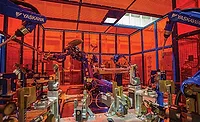
Bob Rice, director of engineering at systems integrator ATC Automation, admits the data is perplexing. “If you walk through our facility today, you’re going to see 100 robots on the shop floor,” he says. “Ten years ago, you might have seen one. That’s just the nature of what we’re building now. The price of robots has come down so much, you can use a robot in place of a dedicated pneumatic pick-and-place unit, and it’s totally flexible and programmable.
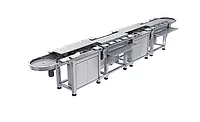
“The other thing that you would see is modular systems. In the past, you used to see a lot of precision-link conveyors and these big battleship systems where everything is tied together. Today, you see more modular systems built on pallet-transfer lines. You can pull a station out and roll another station in much easier.”
Al Stone, Ph.D., sales and applications manager at systems integrator Genesis Automation, is also puzzled by the survey data. “I’ve been in the automation business 35 years, and it’s kind of like artwork—machines go in and out of fashion,” he says. “Years ago, big cam-driven systems were the thing. They were built to crank out parts for years. That kind of machine just isn’t around anymore. Manufacturers want to get to market faster, and they don’t want to invest huge dollars in hard automation.”
Andy Osterholzer, president of systems integrator Flexible Automation Inc., suggests the survey conundrum may simply be a matter of semantics. One survey taker’s definition of “fixed” and “programmable” automation might differ from another’s.
“To me, automation is almost synonymous with programming,” he explains. “Even dedicated machines are smart machines these days. They all have PLCs, and almost every machine is equipped with a vision system…a laser marker…and data-logging technology for traceability.”
To illustrate his point, Osterholzer points to a couple of high-volume assembly systems his company recently designed. Both were built around the Pick-O-Mat cam-driven rotary indexing dial from Weiss North America Inc. Both required cycle times of less than 3 seconds.
One was designed to assemble a two-pin electrical connector and a four-pin connector, both of which come in various colors. The other was designed to assemble the rubber wheels that support the rotating drums in front-loading washers and dryers. The wheels are produced with different materials and axle lengths. All totaled, six part numbers are assembled on the machine.
“Those systems are definitely ‘flexible automation,’ but they are also dedicated machines,” he says. “Once you tool that chassis up, you’re not going to use it for anything else.”
System Design Determinants
Numerous factors influence the overall design of a multistation automated assembly system, including production volume, model mix, floor space requirements, and the size and quantity of the parts to be assembled. If production volume is high, model mix is low, and the parts are small and few in number, fixed automation is the way to go. Unless assemblies are gang-processed, a linear conveyorized system will be hard-pressed to match the output of more traditional “hard automation.”
If production volume is lower, model mix is high, and the parts are relatively large, a more flexible, cellular approach is required. In fact, engineers could even opt for a series of standalone semiautomatic machines rather than an integrated line.
“You see a lot more lean cells now,” says Rice. “That used to be a no-no, because lean cells need operators. Well, the most flexible piece of equipment you can buy is a person. If you have a product that’s only going to last three months, you’re better off having operators deal with that next change.”
If production volume is the only consideration, choosing between a conveyor-based linear system and a rotary-indexing dial is toss-up, says Osterholzer.
“If cycle time is in the 4- to 8-second range, you can choose either,” he says. “A rotary dial system will probably be less expensive than an equivalent conveyor-based system.
“On the other hand, at a certain point, you just don’t want to put any more stuff around a rotary dial machine. It becomes a big monster that’s hard to service. A conveyor system is easier to maintain, in terms of access to the equipment. You can spread things out. You don’t have this huge block in the middle of your production floor.”
Cost is also a factor. Often, first-time buyers of automation have grandiose ideas of what can be accomplished with an automated assembly system—only to suffer sticker shock later when reviewing quotes from integrators.
“We work with our customers. What is your budget? What are your core competencies? What technologies do you really need to have?” explains Stone. “Then we’ll come up with a system that fits their budget—as long as that budget is reasonable. Many customers think we can implement a vision system for less than $2,000. That’s just not realistic.”
Even personal preferences can enter into the equation. “I know some people who will never let an over-under conveyor into their facilities,” says Osterholzer. “Even if the conveyor will reduce the overall footprint of the machine, they just won’t use it.”
Attaining Flexibility
They may not say so to their customers, but automation engineers don’t like words such as “flexibility” and “model variation.” They’d much rather design a machine to run a single product.
“Sometimes, creating flexibility in a machine means you have to compromise quite a bit,” says Stone. “Let’s say you want to assemble six variants on the same machine, but one of them is really tough to assemble. Invariably, engineers will compromise the design of the machine to accommodate that low-running, difficult part when they could have had a much more robust machine.”
Flexibility also adds complexity and cost. When variants are assembled on a single machine, error-proofing becomes critical. Multiple sensors and vision systems are required to ensure the right parts are being installed in the right products.
That’s not to say assemblers cannot expect or demand a certain amount of flexibility from automated assembly systems. New technologies, like the HP linear-motor-based pick-and-place unit from Weiss, the EZ servo-driven rotary indexer from Centricity Corp., or the QuickStick linear motor transport system from MagneMotion Inc., give engineers unprecedented control over indexing and assembly motions.
ATC’s Rice recalls a recent project involving a servo-driven rotary indexer. The dial table was tooled with 16 positions—but half were used for one product while the remaining eight were used for another. Changeover was simply a matter of shifting the indexing positions one stop—an easy programming fix.
Robots, of course, are the ultimate flexible assembly technology. Indeed, if the product design and cycle time allow it, one robot can assemble an entire product from start to finish.
Automation engineers love robots not so much for their ability to handle product variants, but for their ability to handle the unexpected. They are risk management tools.
“Must pneumatic mechanisms can only go from point A to point B,” says Osterholzer. “But what if I need to go to point C? If a customer suddenly decides his machine should have three discharge lanes instead of two, it’s no problem. I can just reprogram the robot.”
As an example, Osterholzer points to a recent assembly application that called for a plastic washer to be pressed onto a plastic fitting. “The washer didn’t always strip off the tooling well, or sometimes it would get hung up on the flashing inside the fitting,” he recalls. “Because we used a robot for this application, we were able to program it to perform a slight double-tap action on the Z stroke. The motion was barely even perceptible, but it helped to get the washer in place. We could never have done that with a pneumatic pick-and-place unit.
“Now, that has nothing to do with product mix. That’s just risk mitigation. You never know how parts will behave when you’re at the quoting stage of a project, which is why we lean toward robots more often than not.”
Looking for a reprint of this article?
From high-res PDFs to custom plaques, order your copy today!