Assembly Magazine logo
search
Ask ASSEMBLY AI
cart
facebook twitter linkedin youtube
  • Sign In
  • Create Account
  • Sign Out
  • My Account
Assembly Magazine logo
  • TRENDS
    • Ask ASSEMBLY AI
    • Trends
    • News
    • New Products
  • INDUSTRIES
    • Aerospace
    • Appliance
    • DFMA Assembly
    • Medical Devices
    • Green Manufacturing
    • Lean Manufacturing
    • Machinery Assembly
    • Electronics Assembly
    • Automotive
  • TECHNOLOGIES
    • Adhesives & Dispensing
    • Assembly Presses
    • Automated Assembly Systems
    • Manufacturing Management
    • Manufacturing Software
    • Motion Control
    • Screwdriving & Riveting
    • Robotics
    • Test & Inspection
    • Plastics & Metal Welding
    • Wire Processing
    • Workstations
  • AUTONOMOUS & ELECTRIC MOBILITY
    • AEM Magazine Archives
    • Autonomy
    • Electrification
    • Mobility Services
    • Assembly & Testing
    • AV/EM News
  • MEDIA
    • Ask ASSEMBLY AI
    • Podcasts
    • Assembly News Now
    • Assembly TV
    • Webinars
    • eBooks
  • EVENTS
    • Calendar
    • The ASSEMBLY Show
  • MORE
    • Exclusives >
      • Plant of the Year
      • Capital Spending
    • Buyers Guide >
      • Supplier Insights
    • Classifieds
    • Featured Products
    • Newsletters
    • Store
    • White Papers
    • Columns
    • Sponsor Insights
  • INFOCENTER
    • Assembly & Test Solutions
  • EMAGAZINE
    • eMagazine
    • Archive Issues
    • Advertise
    • Contact Us
    • Sign Up
IndustriesMachinery AssemblyPlastics & Metal Welding Assembly

Overhead Fans Won't Dispel Shielding Gases During Welding

With proper planning, welding facilities can have it all: overhead fans and strong welds.
By Justin Morris
Overhead Fans Won't Dispel Shielding Gases During Welding

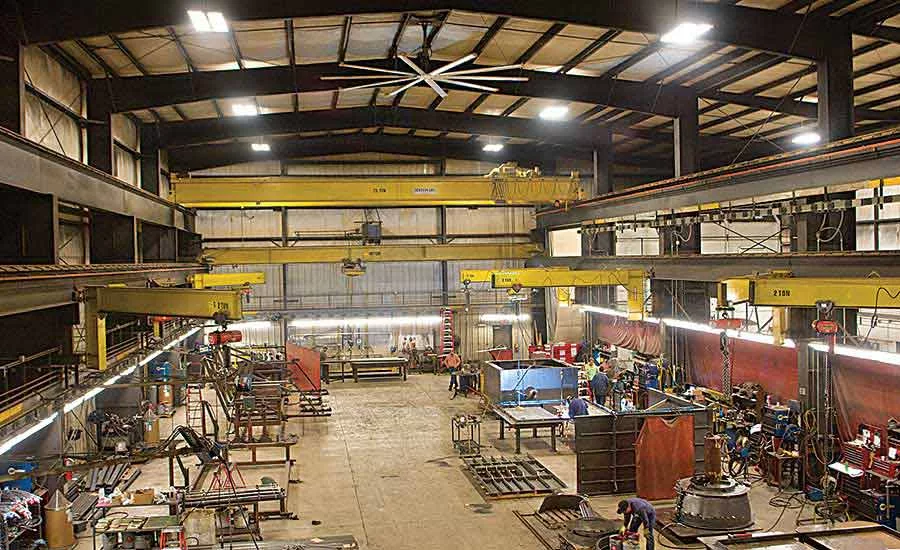
Although overhead fans can disperse shielding gases used in welding operations, it’s by no means a certainty. Thousands of welding facilities have installed fans successfully. Photo courtesy Big Ass Solutions

April 10, 2017

At a recent Fabtech convention, many visitors to our booth told us the same thing: “We’d really like a large fan in our facility, but we can’t—we weld.”

It’s a common belief that airflow from large, overhead fans disperses shielding gases, which can lower weld quality. But, by avoiding industrial fans altogether, facilities could be missing out on more than just summer cooling—fans can also help disperse welding fumes, control condensation and reduce heating costs in winter by pushing heat back toward the floor.

While it’s true that fans can disperse shielding gases, it’s by no means a certainty. Thousands of welding facilities have installed fans successfully. It simply required a few more steps and a little more expertise than installing a ceiling fan in, say, a dry-goods warehouse or a living room.

It’s all about finding the sweet spot—the combination of fan speed, fan size and adequate distance from the welding area—to achieve a cooling airflow without blowing away shielding gases. However, because no two facilities are alike, there is no one-size-fits-all solution. The ideal type, size and speed of a fan will vary based on factors such as the facility’s dimensions and layout, and what type of welding is being done.

For example, at the request of a major manufacturer of earth movers and farm equipment, extensive testing by our research and development team showed that the manufacturer could run 18-foot fans at 60 to 70 percent of maximum speed without affecting shielding gases in their welding facility. At that speed, the fans still provided enough airflow to create approximately 5 to 7 degrees of perceived cooling for employees. That customer has since bought some 60 fans from us.

However, in a smaller facility where the only viable mounts for overhead fans were bar joists directly over the welding bays, installing overhead high-volume, low-speed (HVLS) fans proved problematic. In that case, the presence of numerous I-beams meant variable-speed directional fans could be mounted so that they delivered the correct airflow without disrupting gas delivery.

The best way to guarantee that HVLS fans will work in a welding facility is to enlist the help of a fan company with an applications engineering team that can provide custom fan layouts accounting for all variables. In complex situations, a mobile team of engineers can be called in to perform on-site measurement and evaluation.

Looking for quick answers on assembly and manufacturing topics? Try Ask ASM, our new smart AI search tool. Ask ASM →

While no two situations are alike, the following tips will help welding facilities get the right fan.

Variable Speed Controls

One of the most important technologies for guaranteeing a fan won’t disperse shielding gas and increase weld porosity is a variable speed control. Also known as infinite speed controls, these devices allow the user to set a speed anywhere from 1 to 100 percent of the fan’s maximum speed.

Most column-mounted fans, and even some HVLS fans, are equipped only with the same speed options as a common residential ceiling fan: high, medium and low. This can limit installations in industrial facilities. For example, medium speed could be too low to produce a cooling breeze, while high speed could be too powerful, dispersing shielding gases.

The trick in welding facilities is to find a speed powerful enough to cool people off, but light enough not to disperse the gas. Variable speed controls are often the only way to achieve that ideal speed.

Speed Limit Enforcement

As any office manager knows, if you tell employees not to adjust a thermostat, that’s the first thing they’ll do. The same holds true with industrial fan controls. It’s hard to blame employees. Comfort is personal, and working in uncomfortable conditions is no fun.

Fan manufacturers should offer the ability to limit the speed of the fan. In the case of our customer, the heavy-equipment manufacturer, 70 percent of maximum speed provided the ideal airspeed, so Big Ass Fans limited the fans to 70 percent. That prevented uncomfortable employees from dialing up the speed and potentially dispersing shielding gases inadvertently.

Proper Fan Placement

Installing a fan directly over a welding area will almost always affect shielding gases. However, many facilities managers who have resisted HVLS fans don’t realize that a fan needn’t be directly overhead to provide cooling airflow.

Much of the breeze from an HVLS fan isn’t a result of air being pushed downward by the fan. Rather, it’s from air that impacts the floor and flows outward, creating what’s known as a floor jet.

To have the smallest impact possible on shielding gases, fans should be installed away from the welding area, giving the floor jets enough space to slow down before reaching the welding station. At the correct distance, the fans can provide all their normal benefits—year-round thermal comfort and improved air circulation—while floor jets can even send a few degrees of cooling to welding technicians.

Education on Other Options

Occasionally, it’s simply impossible to install an overhead fan without affecting welding gases, and any company that claims otherwise is misleading the customer. In those cases, large mobile and column-mounted fans can provide a more direct airflow.

Again, it’s important that these fans include variable speed controls—most portable and column-mounted fans don’t—because ricochet air jets can still interrupt the welding process without careful speed control.

For more information, call 877-BIG-FANS or visit www.bigassfans.com.

KEYWORDS: fans

Share This Story

Looking for a reprint of this article?
From high-res PDFs to custom plaques, order your copy today!

Justin Morris, Metal Market Manager, Big Ass Solutions, Lexington, KY

Recommended Content

JOIN TODAY
To unlock your recommendations.

Already have an account? Sign In

  • Made in the U.S.A.

    Consumer Products Manufacturing: Made in the USA

    Supply chain lessons learned during the coronavirus...
    Automated Assembly Systems
    By: Austin Weber
  • Best Practices for Press-Fit Assembly

    Best Practices for Press-Fit Assembly

    In manufacturing, ironclad formulas for success are hard...
    Assembly Presses
    By: Jim Camillo
  • aem0523leader-tesla1.jpg

    Tesla Rethinks the Assembly Line

    Engineers at Tesla Inc. have developed a new process that...
    Industries
    By: Austin Weber
Manage My Account
  • eMagazine Subscription
  • Assembly Newsletters
  • Online Registration
  • Subscription Customer Service
  • Manage My Preferences

More Videos

Sponsored Content

Sponsored Content is a special paid section where industry companies provide high quality, objective, non-commercial content around topics of interest to the ASSEMBLY audience. All Sponsored Content is supplied by the advertising company and any opinions expressed in this article are those of the author and not necessarily reflect the views of ASSEMBLY or its parent company, BNP Media. Interested in participating in our Sponsored Content section? Contact your local rep!

close
  • ultrasonic welding
    Sponsored bySonobond Ultrasonics

    Engineering Efficiency in High-Performance Assembly: How Ultrasonic Welding Enhances Throughput, Reliability and Quality

  • UV curing system
    Sponsored byDymax

    Why UV Intensity Alone Doesn’t Define Curing Performance

  • wooden pallets
    Sponsored byLEAN Manufacturing Products

    Eliminating Waste on the Shop Floor: Applying Lean Principles to Improve Manufacturing Efficiency

Popular Stories

ASSEMBLY News Now, episode-30: Volvo Redesigns EV Manufacturing

Volvo Redesigns EV Manufacturing

Boeing CEO Kelly Ortberg announces 1 billion investment

Boeing Plans $1 Billion Wichita Investment, Workforce Training Center

GE Appliances Worker on Line

GE Appliances Expands Factory AI With 800 Gemini Enterprise Agents

Watch the latest episode of ANN now!

Events

July 24, 2025

From Shop Floor to CFO: How Manufacturers Are Closing the Loop Between Operations and Finance

On Demand Learn how manufacturers are bridging the gap between the shop floor and ERP systems to gain real-time visibility, streamline operations, and kick-start digital transformation—without waiting years.

Sponsored by:

PicoStratusGreen
July 30, 2025

Buffer Analysis and Design Fundamentals for Manufacturing Excellence

On Demand In this presentation, Dr. Herman Tang shares practical insights from his industry experience and research on buffer management in manufacturing operations.

View All Submit An Event

Poll

Difficult Assembly Processes

Which assembly process gives you the most difficulty?
View Results Poll Archive

Products

Manufacturing Cost Policy Deployment (MCPD) Profitability Scenarios: Systematic and Systemic Improvement of Manufacturing Costs

Manufacturing Cost Policy Deployment (MCPD) Profitability Scenarios: Systematic and Systemic Improvement of Manufacturing Costs

See More Products
Register for webinar - Modernizing Automotive Assembly: Why Upgrading Legacy MES is a Business Imperative

Related Articles

  • Orion High Static Pressure Family

    Growing Popularity of High Static Pressure Fans & Blowers in Smaller Applications

    See More
  • Xerox, Power Co. to Limit Greenhouse Gases

    See More
  • NoiseVibrationControl_FT

    Passive Noise Reduction Options for Axial and Centrifugal Fans

    See More

Related Products

See More Products
  • Resistance Welding: Fundamentals and Applications, Second Edition

  • Welding Processes Handbook, 2nd Edition

  • Welding and Joining of Aerospace Materials, 1st Edition

See More Products

Related Directories

  • GlasWeld

×

Never miss the latest news and trends driving the manufacturing industry

Stay in the know on the latest assembly trends.

JOIN TODAY!
  • RESOURCES
    • Advertise
    • Contact Us
    • Directories
    • Manufacturing Division
    • Store
    • Want More?
  • SIGN UP TODAY
    • Create Account
    • eMagazine
    • Newsletters
    • Customer Service
    • Manage Preferences
  • SERVICES
    • Marketing Services
    • Reprints
    • Market Research
    • List Rental
    • Survey/Respondent Access
  • STAY CONNECTED
    • LinkedIn
    • Facebook
    • Instagram
    • YouTube
    • X (Twitter)
  • PRIVACY
    • PRIVACY POLICY
    • TERMS & CONDITIONS
    • DO NOT SELL MY PERSONAL INFORMATION
    • PRIVACY REQUEST
    • ACCESSIBILITY

Copyright ©2026. All Rights Reserved BNP Media, Inc. and BNP Media II, LLC.

Design, CMS, Hosting & Web Development :: ePublishing