Force-Controlled Assembly With Robots
Tactile sensing technology opens up new applications for automation
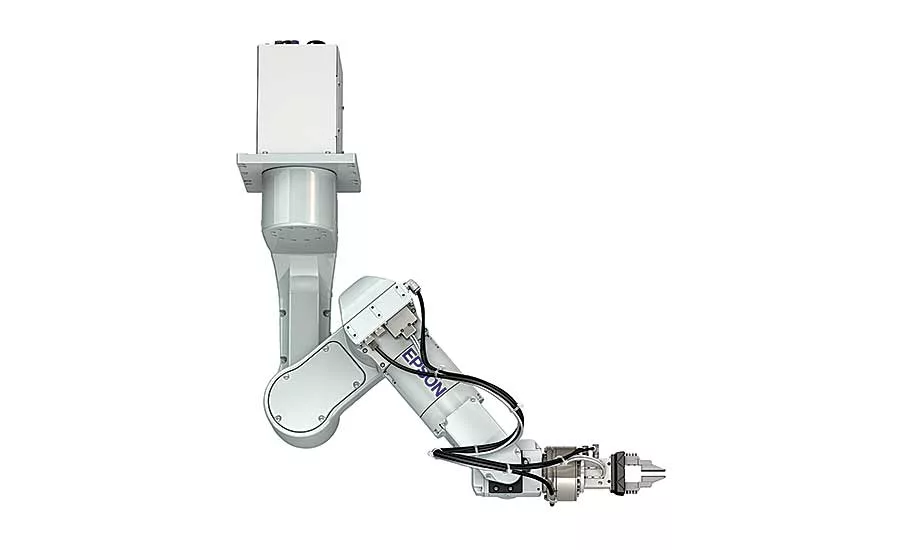
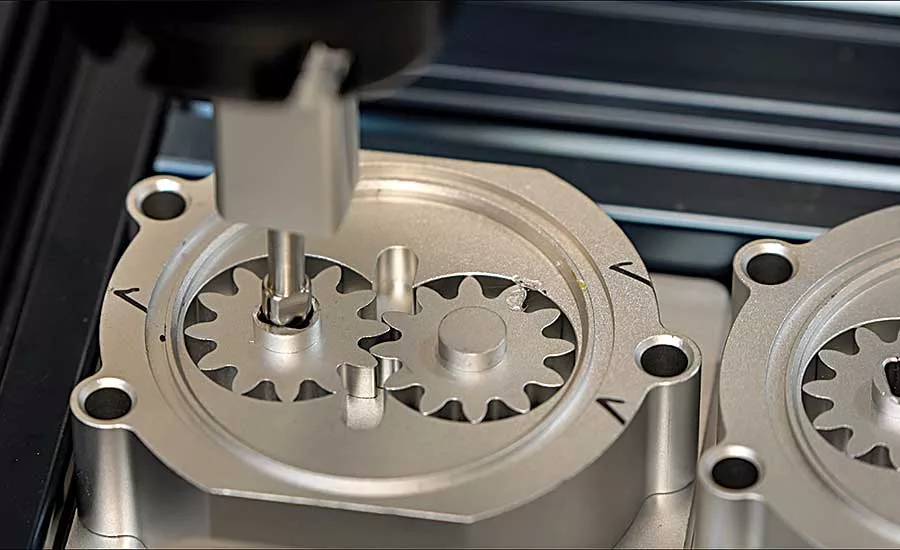
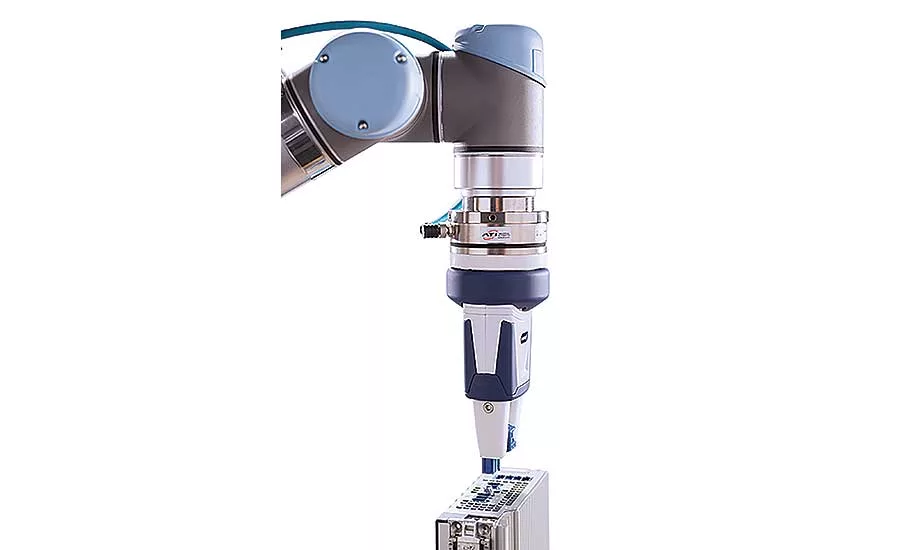
Robots have always struggled to match human touch. But, recent advances in sensor technology now enable machines to process the sensitive forces needed for delicate assembly tasks, such as placing, inserting and tightening parts.
Force-control technology provides fast, tactile feedback to guide robots with unprecedented precision. Machines equipped with force control can assemble parts with extremely tight tolerances.
Normally, robots are position controlled with a predefined path and speed. With force control, a robot reacts to its surroundings and deviates from the programmed path or speed based on feedback from a force sensor.
Most force-control sensors are six-axis, offering three linear and three rotational movements. However, there are also two-axis force sensors available with more limited movement.
“Any automated assembly processes that require the dexterity and feel of touch are good candidates for robotic force-sensing technology,” says Ian Stern, force-torque sensor product manager at ATI Industrial Automation Inc. “The biggest advantage of force-control technology is flexibility and quality.
“Force-torque sensors create the ability for robots to adapt to their environment,” explains Stern. “Force is the next step beyond vision. It enables a variety of high-value assembly tasks.”
However, force control is different than vision systems. For instance, a common misunderstanding about robotic-force control is that it can replace existing technology such as vision guidance.
Looking for quick answers on assembly and manufacturing topics? Try Ask ASM, our new smart AI search tool. Ask ASM
“This is not the case,” says Stacey Tieu, robots product manager at Epson America Inc. “There will be some applications where vision guidance is the better option and other applications where both vision guidance and force guidance are used. It comes down to the application requirements.
“Development is still a challenge,” adds Tieu. “Some solutions lack a point-and-click interface and require a high volume of coding to set up force-control applications.”
“When precision is key to a successful assembly, force control unlocks many new possibilities, allowing [manufacturers] to automate more complex processes that [up until recently] couldn’t be automated,” notes Annick Mottard, product manager at Robotiq Inc. “You can now program insertions with many different movements by applying the exact force at each moment. All of this can be programmed in a few minutes with little training.
“For tasks in which less precision is necessary, force control is an important asset to add robustness, ensuring great repeatability even if some parts, vises or jigs are moving a bit,” Mottard points out. “The robot will proceed according to force perceived, not to exact waypoints that might change as it performs more and more cycles.
“Force control is opening up possibilities for robot automation in areas that were not possible before,” claims Gregg Brunnick, director of product management at Epson Robots. “It enables robots to tackle applications with high precision or high performance motion guidance requirements, making it a great fit for a wide range of high-precision applications.”
Force Control in Action
Advanced force-control technology pays a key role in collaborative robots such as ABB Robotics’ dual-armed YuMi machine.
“The robot can feel the same way that a human can,” claims Nicolas De Keijser, assembly and test business line manager at ABB Robotics. “That enables the machine to feel whether or not it’s been successful at inserting something.
“Force-control technology was originally used for automotive power train assembly applications,” says De Keijser. “But, we’re now seeing more demand for it in the electronics industry, especially for box-build applications that use small snap-fit components.
“Robotic force-control technology is also used for interference-fit applications,” explains De Keijser. “Force control guides the robot so that it finds the actual location to start the insertion.
“A typical automotive application involves inserting a rod and a piston into a cylinder block,” adds De Keijser. “A certain amount of wiggling is required to successfully complete this assembly task. The robot needs to know when and if it’s pressing against something.”
Robotic force control plays a key role in the daily operation of Ford Motor Co.’s Van Dyke transmission plant, the recipient of the 2018 Assembly Plant of the Year award. The high-mix, high-volume facility produces 70 different automatic transmission models use in a wide variety of Ford and Lincoln vehicles that feature front- and all-wheel drive.
Force-control technology ensures error-free assembly of components without damage and prevents equipment damage. It’s used in assembly applications that require flexible parts and where several adjustments are needed or where X-Y-Z directions are unique based on part variation.
“Force monitoring is used in installation applications where assembly requires some finesse to install and prevent damage,” says Lawrence Linneburg, production team manager. “Force is monitored in multi-axis directions and adjustment is made based on critical parameters defined within cycle.
“This strategy provides a robust solution to component and part variation,” Linneburg points out. “Each installation is unique and mimics a human approach in automatic assembly operations. Having a predefined parameter to control installation provides a consistent installation and removes some variation based on manual installation.”
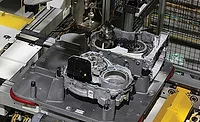
One application at the Ford Van Dyke transmission plant is a multistage force-control adaptive learning robot that is used to install clutches It requires the robot to make adjustments during the installation of clutches into transmission cases. This demands complex analysis, including robot force monitoring and position movement as it continues within the barrel of the transmission housing.
The assembly is installed with a wave-like motion and it travels deep into the case. Gear installation is handled in a similar method and requires the same monitoring and adjustments. In the past, the transmission gears were manually installed. The automated force-control system has decreased end-of-line part quality concerns related to noise, vibration and harshness (NVH).
New Products
A variety of force-control sensors are available today and software has been improved for greater ease of use.
For instance, ATI recently launched the Axia80, which is targeted at electronics assembly applications that use lighter payload robots. The high-performance, low-cost force sensor features built-in electronics to reduce the system’s footprint.
“This has opened up the door to a lot of new applications,” says Stern. “All the electronics are onboard, so it directly outputs Ethernet or EtherCat. The system’s hardware includes a sensor and a cable that goes to the robot. That’s all you need to get it up and running.”
Later this year, ATI will be expanding this line to encompass a family of six different product models. It will also be releasing a safety-rated force-torque sensor designed for heavy payload applications.
“The goal is to make a several hundred kilogram robot collaborative,” says Stern. “This will enable automotive applications such as installing doors on a final assembly line.”
Epson Robots recently unveiled a tightly integrated force-control system that enables the company’s SCARA robots to sense and make precision moves using force feedback data. Powered by proprietary Epson quartz technology, it enables robots to detect six axes of force with precision down to 0.1 newton.
“This value level enables force measurements to be captured with superior sensitivity,” says Tieu. “Driven by real-time servo system integration, Force Guide delivers fast, tactile feedback to guide robots for high-precision parts placement.
“[Our] sensors are robust and durable, with exceptional resistance to both shock and external forces,” claims Tieu. “The sensors are built to withstand forces up to 1,000 newtons. Even with significant force and torque applied, you can still get precise results.
“Force Guide is fast and easy to implement, reducing the amount of coding required,” adds Tieu. “It is fully integrated within the Epson RC+ development environment so force guide applications can be created and tested in an easy-to-use point-and-click interface.”
The development environment offers preconfigured force guidance object tools to provide a simple method for creating robot force-based motions and applications.
Force Guide also offer real-time force guide monitoring, allowing users to see and adjust force guidance based on object parameters. Simple teaching through manual guidance is also available; users can reduce the time and complexity involved in teaching robot positions. According to Tieu, Force Guide offers soft servo mode so users can simply move the robot by hand to the desired positions and record these positions on a touch-screen teach pendant.
Robotiq recently launched Force Copilot, an intuitive software program that operates Universal Robots' e-Series embedded force-torque sensor. It accelerates the programming of a variety of applications, including part insertion and surface finding.
"Force Copilot's sensing functions increase flexibility and reliability in assembly, finishing, machine-tending and pick-and-place applications," explains Mottard. "A suite of setup tools allows the user to hand guide the robot on complex trajectories.
"The software makes it easy to place objects precisely in jigs, trays and chucks, and it facilitates assembly applications through its alignment, indexing and insertion functions," claims Mottard. "The intuitive interface unlocks finishing applications, with adjustable adaptive compliance and constant force for all robot axes.
“We want to free every production line operator in the world from repetitive manual tasks," says Mottard. "With Force Copilot, we are making complex robot-movement programming accessible to anyone. Force Copilot works as the human operator's guide, helping program the robot quickly and easily.”
To learn more about assembly operations at the Ford Van Van Dyke transmission plant, click here.
Looking for a reprint of this article?
From high-res PDFs to custom plaques, order your copy today!