Conveyors for Large Loads
Manufacturers have many choices when moving large items throughout their plants
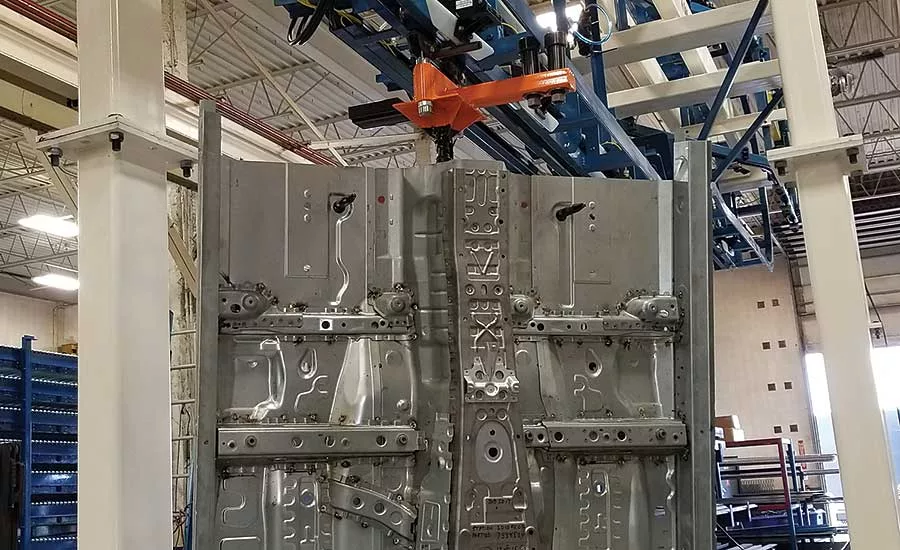
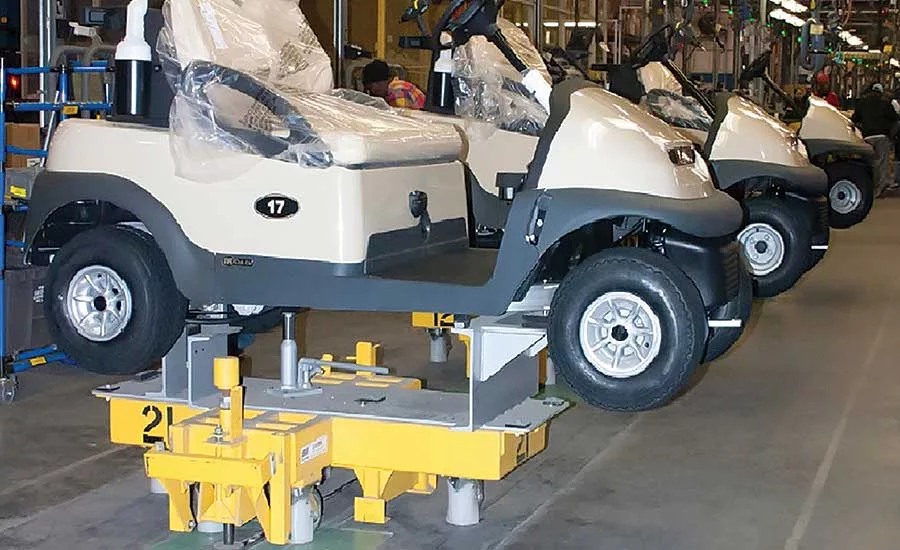
Most people take gravity for granted. But, manufacturers know better, especially when it comes to moving large items through a plant for assembly, finishing, storage and order-fulfillment purposes. The proof is in their use of gravity conveyors to perform these tasks.
Many companies rely on these conveyors to move loads up to 4 feet wide weighing hundreds of pounds along an assembly line or to a warehousing area. Sometimes these items are shrink-wrapped wooden or plastic pallets that are loaded with parts assemblers need at one or more workstations. Other times the item may be a large open tote that workers fill with stamped metal parts and send along to another station for further processing, assembly or shipping.
“Simplicity is one of the main appeals of gravity conveyors when it comes to handling any size load,” notes Ed Zurzuski, sales manager at UNEX Manufacturing Inc. “These conveyors are safe and reliable, with very few parts to break down and maintain, as well as being economical, green and flexible. They allow items to be conveyed in either direction by alternating slope direction, or on a level push line.”
Several automotive OEMs and Tier 1s use MRS conveyors from UNEX to move large products like a finished seat assembly. This item is typically mounted to a fixture on a pallet that is always supported by at least three rollers as it moves down the conveyor. Each 1.9-inch-diameter roller on the MRS conveyor has a maximum load capacity of 170 pounds.
Gravity conveyors are not the only type of conveyor that automotive manufacturers use to move large loads, however. Others include pallet-transfer, towline, power-and-free, and electrified monorail systems. With such an extensive list of conveyance technologies to choose from, manufacturers are sure to find the best one for transferring large items.
Some Prefer Pallets
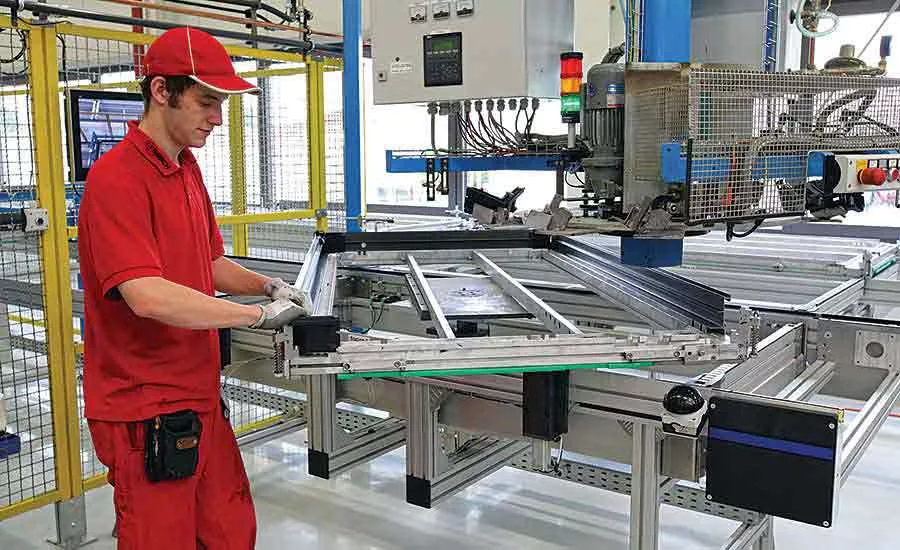
Pallet-transfer conveyors are asynchronous, allowing for independent workpiece-pallet movement between different staging areas. This flexible design lets manufacturers designate some pallets for continuous cyclical tasks, while others are routed to more time-consuming processes.
Pallets come in sizes up to 4 feet square, and ride on powered rollers, a power-and-free roller chain or a dual track powered by a motor-driven belt or chain. Engineers can program these mechanisms to precisely control all pallet movements on the conveyor: starting, accelerating, decelerating, stopping, lifting, rotating and changing directions. The result is high efficiency and throughput.
Looking for quick answers on assembly and manufacturing topics? Try Ask ASM, our new smart AI search tool. Ask ASM
Automotive OEMs and Tier 1 suppliers are the most common users of pallet-transfer conveyers for large parts, says Todd St. Pierre, vice president of operations at mk North America Inc. These companies regularly use mk’s conveyers to move door panels, bumpers and inside fascia; long and linear parts such as transaxles and camshafts; and pallets loaded with smaller items, like brake calipers and suspension components.
“One automaker even moves large battery modules for electric vehicles,” notes St. Pierre. “Each module measures
2 meters by 400 millimeters and weighs up to 770 pounds each. The conveyor moves the module from one assembly line to another.”
Makers of solar panels, large power tools, TV screens, appliance pumps and doors, and furniture often use pallet-transfer conveyers. St. Pierre also recalls a coffin manufacturer using mk’s VersaMove conveyers.
“The company moved its coffins from one workstation to another, where workers installed lining, applied lacquer and did other tasks,” explains St. Pierre. “Many conveyors were used to create a good-size system.”
The VersaMove conveyor series is available in three platforms for maximum versatility. The Standard platform can handle pallets that have an 80-pound capacity and measure 240 to 400 square millimeters. These conveyors move pallets using either a flat-top chain, accumulating roller chain or timing belt.
Pallets on the VersaMove Plus platform each have a 250-pound capacity and measure 400 to 1,040 square millimeters. Those on the Ultra platform each carry up to 800 pounds and measure 640 to 1,200 millimeters square. Both platforms use either an accumulating roller chain or timing belt.
Conveyor speed is up to 90 fpm for the Standard and Plus platforms, and up to 80 fpm for the Ultra. Possible configurations include inline, carousel, serpentine, parallel, rectangular and over-under.
A couple years ago, mk developed the SPU 2040 series of pallet recirculating systems, which eliminate the need for elevators in over-under pallet-transfer systems. The SPU 2040 series efficiently feeds, buffers, positions and separates parts and workpieces in various automation and material flow applications. All three models in the series (single lane, dual lane and wide) are robust enough to move the items at speeds up to 150 fpm.
Pallets are loaded at an in-feed station before moving to assembly and testing workstations. After all required work is performed, the workpieces and parts are removed, and the pallet travels under the conveyor and back to the in-feed station. The single-lane model can handle a total load of up to 660 pounds, while the dual-lane and wide units are each able to carry nearly 1,000 pounds.
According to St. Pierre, moving large and light parts on pallet-transfer conveyors with curves is not a problem. When the item is large and heavy, however, St. Pierre recommends configuring the conveyor with 90-dgree right angles, using a lift and transfer, that require the pallet be stopped, and its direction changed onto a straight section of conveyor.
“Customers don’t want the leading edge of a product to change as it is transferred, so the conveyor needs to ensure this,” says St. Pierre. “With the pallet-transfer type, the company can rotate the product, using a lift and rotate, or easily integrate a rotary indexer or table to rotate the entire conveyor with the pallet, in order to maintain the leading edge.”
When selecting a pallet-transfer conveyor, end-users should focus on several product and process requirements, according to Mark Dinges, product manager of assembly automation at Bosch Rexroth Corp. Size is of primary importance, followed by shape and weight. Common process requirements include system configuration, speed and cycle time, repeatability, work environment and worker
ergonomics.
“High-volume assembly production, which is greater than 250,000 pieces per year, is ideal for automated pallet-transfer conveyors,” says Dinges. “Auto segments that utilize these conveyors include standard and electric-powered drivetrains, chassis, electronics and interiors. Other high-volume industries are medical devices, pharmaceutical, electrical and electronics, energy and consumer goods.”
Bosch offers a variety of these conveyors, with three being capable of transferring large items. All of them provide short cycle times and electric actuation. And all can be used in low-humidity dry rooms and are Industry 4.0 compatible.
The TS5 is a powered-roller (split or full design) system with a 400-kilogram pallet payload capacity. The TS4plus features twin rails that handle 250-kilogram-capacity pallets, which are transferred via a 0.75-inch-pitch, power-and-free roller chain.
Another twin-rail platform, the TS2plus, transfers 240-kilogram pallets with an accumulation roller chain. These pallets, as well as those on the TS4plus, are up to 1,200 millimeters square. Those on the TS5 can be as large as 1,040 by 845 millimeters.
Feel the Power
Installed overhead, power-and-free conveyors (PFCs) transport parts along an assembly line from one process to another. They are routinely used in harsh environments, including paint ovens, above dip tanks and throughout paint pre-treatment facilities.
PFCs have two tracks, with the power one located above the free track. On the power track, a conveyor chain runs continuously when the conveyor is in operation. On the free track, trolleys hold and convey large and small items.
Small mechanical devices called pusher dogs are located at regular increments on the moving chain and push the trolleys along the conveyor track. When a trolley comes up against another carrier in front, the trolley disengages. It can be stopped and started at any preprogrammed location, even though the power chain keeps running.
“Power-and-free conveyors are great for moving parts into and out of various types of finishing systems,” notes John Daugherty, vice president of sales and engineering at Ultimation Industries. “These include painting, washing, which can be caustic, and baking, where parts may need to reach a temperature as high as 450 F.”
Ultimation PFCs integrate Jervis Webb components that are designed to withstand these harsh industrial environments. The conveyors handle loads up to 16,000 pounds per unit, and offer variable chain speeds and high-speed indexing. Automotive customers use the conveyors to move large truck and trailer frames (up to 18 feet long), automotive bodies and doors.
“Advanced 3D design technology enables our engineers to build and test our trolley conveyor systems in a virtual factory,” explains Daugherty. “We can check the ergonomics of loading and unloading, confirm load clearances and throughput rates, and let the customer see how its conveyor will look and perform before it’s built.”
A big advantage of PFCs over other conveyors is they can buffer large loads when necessary to limit downtime and improve throughput. Daugherty points out that parts can then be separated again in a controlled manner. Another reason companies choose a PFC over an electrified monorail system (EMS) to move large loads is the former can move them in two directions more economically.
“They typically require only one motor and are easy to maintain,” says Daugherty. “Other overhead conveyance technologies, such as an EMS, feature many more moving parts that tend to all break down at the same time.”
The biggest drawback of PFCs is they require vertical curves or elevators to move items up and down from the floor to the ceiling. The curves can take up production space, and the elevators are relatively expensive. An 18- to 20-foot-high building is typical for a PFC to handle large loads, according to Daugherty.
Manufacturers also need to install OSHA-mandated guarding below the elevated loaded conveyor path. The guarding may be netting or a structure suitable for walking, depending on the application.
Tow the Line
Towline conveyors consist of a powered chain running through either an in-floor or above-floor track that tows a series of carts. Each cart supports a large load and moves between stations, enabling workers to perform their assembly operations on the load.
Affixed to each cart is a radio frequency identification tag. When the cart pulls into each station on the line, the tag transmits assembly instructions for that specific part or subassembly.
Towlines provide operators with 360-degree assembly access to the load. Carts can be equipped with lift tables that raise and lower the part to accommodate each worker’s different ergonomic requirements.
The cart’s ID is married to the train and tracked through the system to monitor production quality and performance, as well as identify non-conforming work.
Towline conveyors are configured in either a loop or a straight line path. Their length can range from several hundred to several thousand feet long, notes Jim English, senior applications sales engineer at SI Systems LLC. SI Systems’ Lo-Tow towline systems include components that allow carts to automatically transfer between loops and divert to individual spurs for process operations.
“Towline is a unique conveyor,” says English. “It’s very adaptable. Loads can range from 1,000 to tens of thousands of pounds. In reality, what other conveyor can effectively move a 60,000-pound industrial truck or a 70,000-pound tractor?”
English points out that all towline conveyor systems have the same basic components, regardless of the load size they move. Conveyor carts feature all-steel construction, tow pins and guide-pins, and a combination of rigid and fixed casters.
Towline conveyors are best suited for high-volume applications and easily controlled in the plant with a local PLC or remotely accessed via a virtual private network. Typically, one chain drive is enough to move multiple carts along several hundred feet of track. According to English, it is common for these conveyors to last for several decades and require little maintenance.
SI offers several Lo-Tow conveyors that are typically operated in three different modes: continuous creeping, indexing triggered by a PLC timer or operator-initiated release, and nonsynchronous with operator-released cart stops. SI’s SideFinger model uses Track-Gap construction that eliminates jamming by offsetting the chain from the towing slot. This slot allows contaminants, such as fasteners and small parts, to fall harmlessly into an open void in the track.
SI’s Clas-SI-c towline is an alternative to floor-mounted conveyance and helps eliminate forklift labor and congestion. It supports long runs of conveyor track to link a company’s receiving, storage, picking and shipping departments.
English says that SI towlines convey a wide range of large items that he places into three weight categories. Low-weight products include all-terrain vehicles, motorcycles, snowmobiles and golf carts. Medium-weight products are transmissions, axles, engines and other vehicle subcomponents.
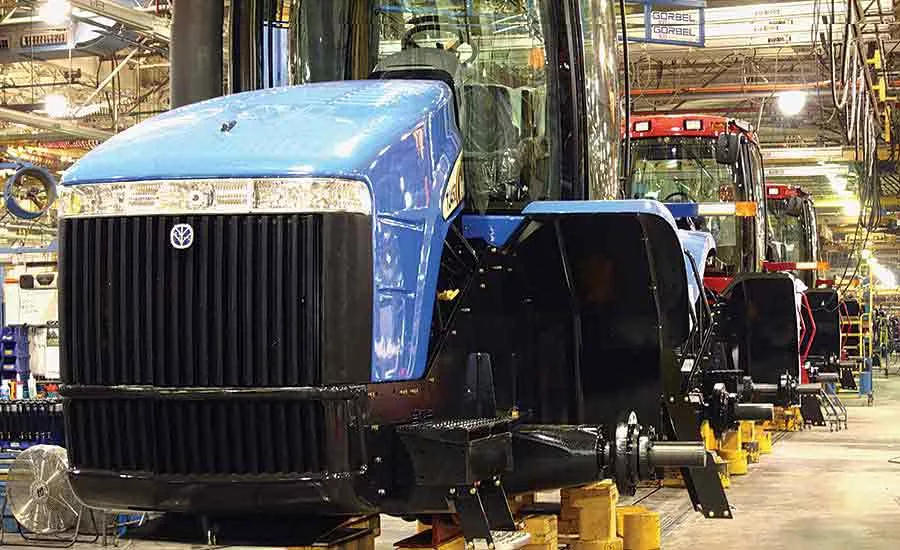
The heaviest items include tractors, trucks and motor graders. Despite their size, English says these units can usually be conveyed with only two carts. One cart is placed under the front axle and another under the rear axle, with the vehicle serving as a bridge between them.
On a Big Roll(er)
When moving large items on gravity conveyors, suppliers recommend using conveyors with rollers from 1.9 to 2.5 inches in diameter. Each roller has an individual load capacity of 170 to 300 pounds.
“Gravity conveyors are the simplest and lowest-cost method of moving large loads,” says Zurzuski. “They are also great for implementing the FIFO method of rotating stock inventory.”
As for challenges, Zurzuski says that a gravity conveyor should only be used to move large modular items with firm flat bottoms, and these items should never be wider than the rollers are long. He says that large items should never be dropped on the conveyor. If this practice occurs, additional rollers or an impact plate or bed should be positioned on the load area of the conveyor.
“Gravity conveyors need slope to provide product flow, but the line can’t be made too long or the end-user will run out of room for proper pitch,” claims Zurzuski. “The reality is that any gravity conveyor section can’t be longer than 100 feet.”
Finally, manufacturers need to closely monitor prduct speed on the conveyor. Walking speed is 60 fpm, says Zurzuski, and large items on a gravity conveyor should never exceed this. Some part buffering is acceptable, but it shouldn’t become excessive. Optional speed retarders and braking devices can slow down products enough to control this situation.
Looking for a reprint of this article?
From high-res PDFs to custom plaques, order your copy today!