Electronic Work Instructions Come of Age
New software tools help engineers enforce production processes
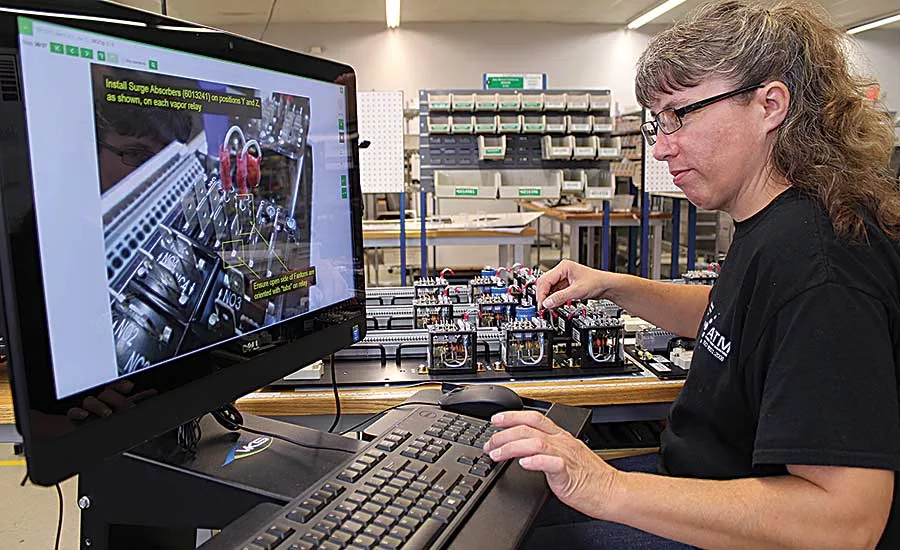
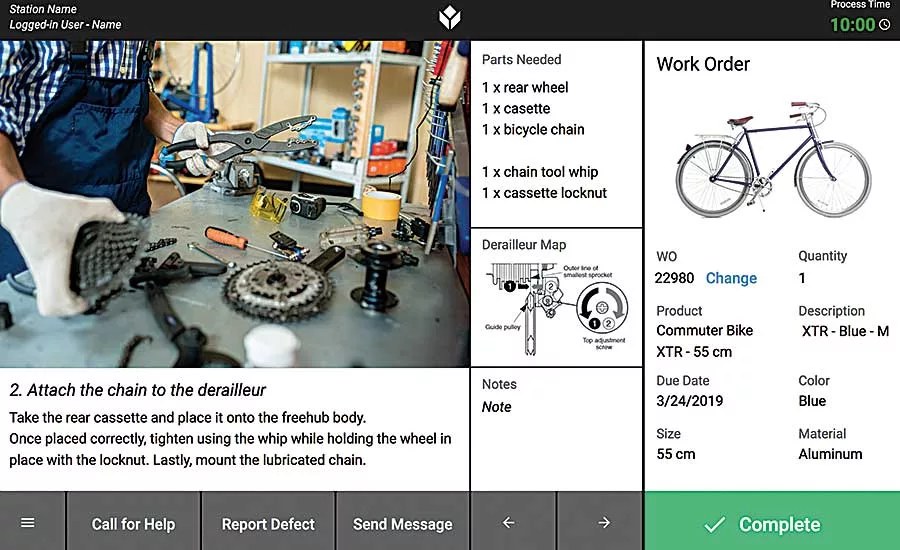
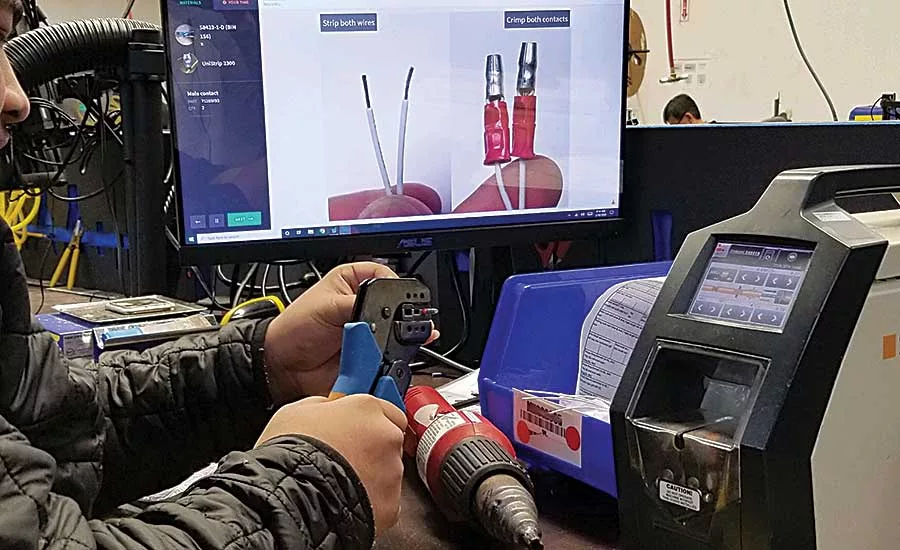
Nobody’s perfect. Even the best trained, most experienced assemblers can make mistakes on the line, especially in high-mix production environments. Fortunately, a variety of software products are available to help prevent assembly errors.
Software has become a critical component for manufacturing today, and engineers can choose between many readily available platforms. Interfaces have recently become much easier to use and software is now more affordable for small manufacturers.
However, today’s state-of-the-art tools do more than just guide operators. Digital work instructions help drive productivity, improve efficiency, simplify connectivity and enhance Industry 4.0 initiatives.
Software enables manufacturers to address traditional challenges such as throughput, variability, collaborative innovation, data silos and lack of communication, while also enabling cutting-edge technology such as augmented reality and digital twins. It provides new levels of flexibility and customization that rely on a constant flow of real-time data.
“Historically, assembly software has hardly been more advanced than a PDF on a computer screen,” says Ben Marsh, president and CEO of Scout Systems Inc. “But, the market has been evolving to become far more involved in data collection and analysis.
“Especially with hardware integration, software is now a major component in improving quality,” claims Marsh. “Work instruction software is the gateway to extensive Internet of Things [applications].”
“Error-proofing applications with the Industrial Internet of Things (IIoT) and other in-line checks creates value immediately,” adds Gilad Langer, manufacturing practice lead at Tulip Interfaces. “In the long term, most value comes from the data collected through applications. That data can identify opportunities and highlight patterns that were invisible before.
Looking for quick answers on assembly and manufacturing topics? Try Ask ASM, our new smart AI search tool. Ask ASM
“Smart devices and the IIoT make it much easier to collect more data and network processes in new ways,” adds Langer. “Assembly software can now even deploy AI-driven computer technology. These vision-based systems can guide the operator through assemblies, respond to operator gestures and identify regions of interest to track.”
Through standardized work procedures, assembly software captures quality and productivity data from operators and machines, resulting in improved efficiency and traceability. As more manufacturers face labor shortages, work instruction software has also evolved from pure error-proofing applications to become a valuable training tool.
“Eliminating errors continues to be important, but we see more emphasis on training today,” says Marlene Eeg, senior vice president of sales at Sequence Software. “Many companies are using standard work instructions now for training new employees on basic skills, such as welding. This begs for simple instructions in an easy-to-read and easy-to-use format.”
Industry 4.0
Growing interest in Industry 4.0 technology is also changing the functionality of assembly software.
“Industry 4.0 has propelled a whole new slew of trends, but they all seem to relate back to one key word: ‘smart,’ as in smart manufacturing,” says Kyle O’Reilly, director of sales at Visual Knowledge Share Ltd. “Smart manufacturing requires one very important key element, which is data. In order to be smart, you need to be able to predict and react, both of which can be done through data analytics.
“So, essentially, by having data in real-time, companies have the information they need at their fingertips to make critical decisions,” O’Reilly points out. “Software can help [engineers] collect all that data.”
According to O’Reilly, assembly software needs to be flexible and scalable. That’s because not all companies operate the same way.
“From high-mix, low-volume discrete manufacturing, to low-mix, high-volume process manufacturing, software needs to be able to be applicable in many different environments, and that is where being flexibility comes into play,” says O’Reilly. “Industry 4.0 can be scary to companies that have been operating in a certain way for decades.
“It’s important to be able to grow and evolve so that [engineers] can continue to scale their use of the software as they become more experienced and ready for some of the more advanced features and capabilities,” explains O’Reilly. “That’s where scalability comes into play.”
“Depending on what a company is looking to do, [engineers] may realize that they need work instruction software, an ERP system and something to manage inventory,” adds O’Reilly. “These systems need to be able to integrate, talk with each other and allow for seamless back and forth communication between data. That’s how companies can truly obtain smart factory status.”
Many manufacturers struggle with integration, security and data insights issues, which is why the right manufacturing execution system (MES) architecture and standards can play a crucial role in eliminating barriers between disconnected systems and devices, while also removing reliance on custom integration.
“Today, manufacturers can reap the benefits of MES solutions that integrate with open, accessible IIoT factory standards,” says Deb Geiger, vice president of global marketing at Aegis Software Corp. “Such standards normalize the data output of machines, systems and human sources, enabling true connectivity and collaboration in the same language. They also serve to eliminate reliance on middleware, enabling manufacturers to realize the benefits of IIoT and Industry 4.0 without exorbitant costs or timelines.
“The result is a truly connected factory ecosystem that enables a new wave of opportunities in automation, optimization, smart manufacturing and highly adaptable, on-demand service models,” claims Geiger. “In fact, by bridging the digital and the physical with an optimized MES solution, manufacturers enable remote monitoring, diagnostics, track-and-trace and energy management.
“This transformative digital implementation begins with a foundational layer of connectivity that enables IIoT and Industry 4.0 capabilities,” explains Geiger. “This layer serves as the foundation upon which innovative platforms and applications for manufacturing productivity rest.
“This strategic, layered approach to digital innovation can help manufacturers overcome their critical productivity issues factory-wide,” adds Geiger. “That drives smarter, faster, simpler and more responsive operations across product flows, production flows and data flows.”
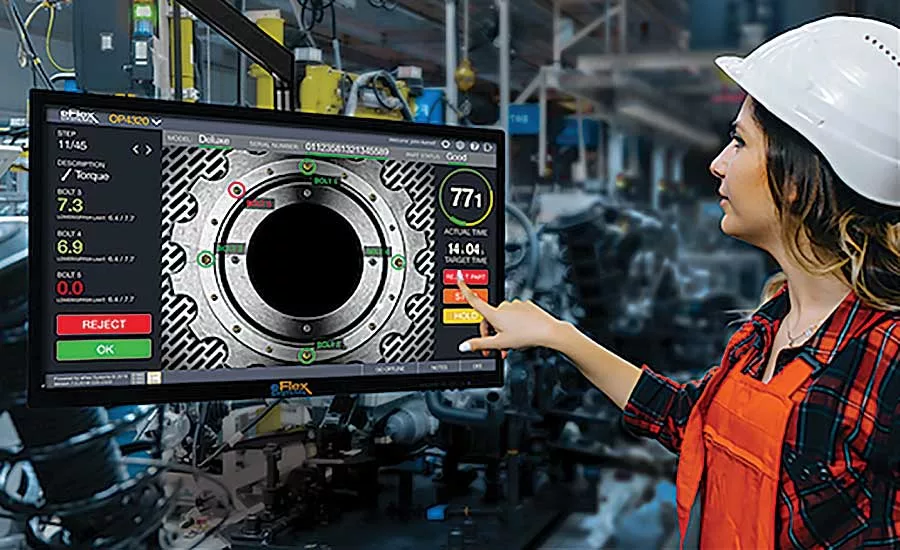
According to Dan McKiernan, president of eFlex Systems, one trend that engineers are currently paying close attention to is scalable and modular digital manufacturing platforms that are designed to leverage the power of the IIoT across a wide range of different assembly applications.
To address the issue, eFlex Systems recently unveiled Manufacturing Integrated Platform (MIP) software, which simplifies plant floor control.
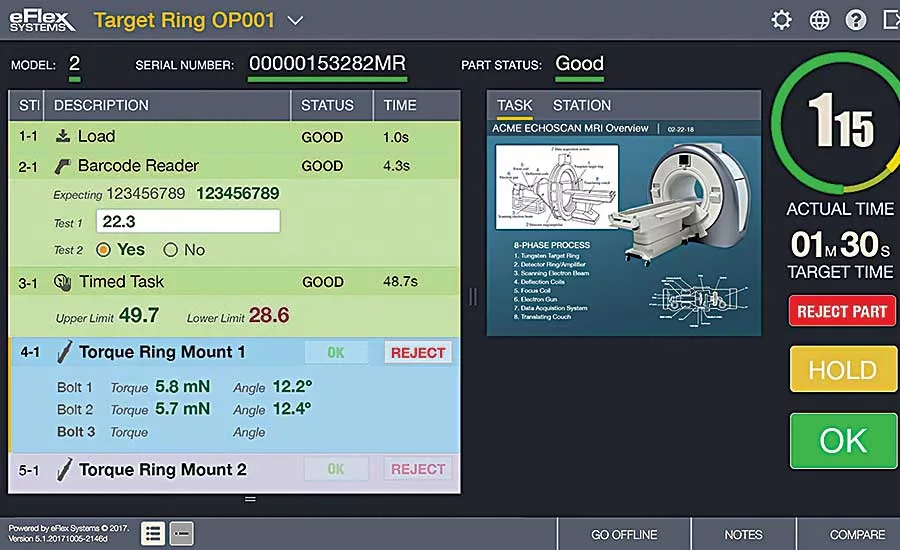
“MIP encompasses all of the elements of HMI, MES and SCADA in one package,” explains McKiernan. “Instead of three layers each with unique engineering requirements, there’s now one seamless package. It includes features such as basic work instructions, I/O control, plug-and-and-play control of DC tools and other equipment, andon board communication and customized views for plant management.
“The platform also generates reams of granular data that was previously unobtainable,” claims McKiernan. “For instance, it captures task-level reject information and timing elements for every part at every workstation.”
Hardware Trends
In the past, electronic work instruction software typically operated on computer terminals mounted at workstations. Today, assemblers can interact with a wide variety of mobile hardware options, including smartphones, tablet computers, glasses, watches and other types of portable or wearable devices.
“Shop floor networks with wireless and portable devices are becoming more widely accepted in manual assembly processes,” says Eeg. “[They are used] to deploy electronic work instructions, capture quality results, monitor operator performance and track key performance indicators. Access to more Wi-Fi networks and use of tablets have given manufacturers more flexibility to use new software applications.”
“There are significantly more hardware options available today than five years ago, and at much lower prices,” adds Floyd Dickson, vice president of Tutelar Technologies Inc. “This vast availability provides a wealth of opportunities for companies to purchase and implement hardware to improve their operations.
“Unfortunately, software has not really kept up to this influx of hardware, so the resultant solution usually involves PLC programming or custom software,” says Dickson. “The assembly software industry needs to catch up to mobile hardware availability and capabilities in other industries, such as the mobile phone and home automation markets.
“More software needs to have built-in intelligence to know how to connect to any device in the plant, be easily configured to solve the existing problems, and be flexible enough to tackle new problems or opportunities as they arise,” claims Dickson.
“Today, manufacturing engineers want software that solves real-world, plant floor problems without requiring a lot of time and effort, or specific software and hardware knowledge,” Dickson points out. “There are too many disparate hardware devices to become expert in all of them, and the number of devices is rapidly growing. Engineers are also looking for software to be securely accessible from anywhere, including on their smartphones.”
Another hardware concept that’s gaining traction in manufacturing is edge computing. It brings computation and data storage closer to the location where it is needed to improve response time and save on bandwidth.
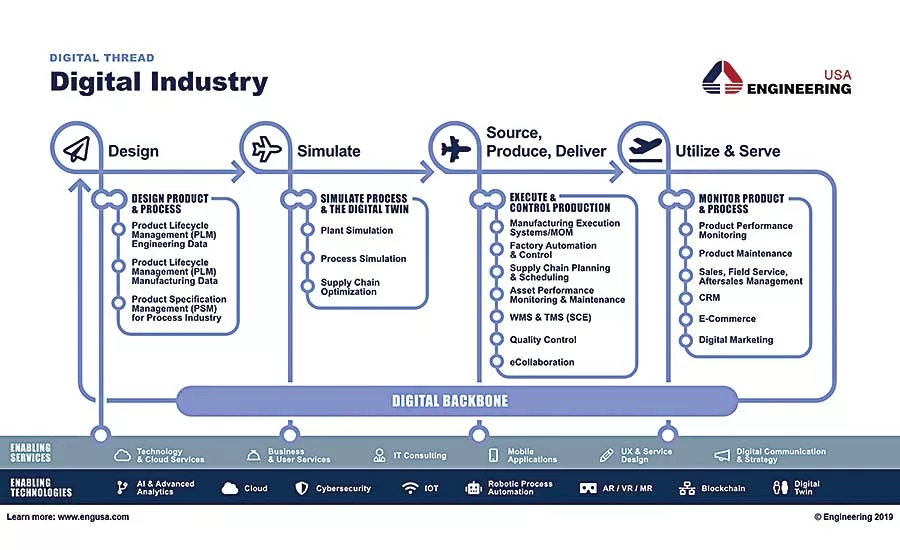
“Many manufacturers pursue this because of the large amount of data coming off today’s shop floor, networking security constraints and the lack of real-time information that is often available on the production line,” says David Kaparis, associate partner at Engineering USA. “Edge computing is enabling [engineers] to run applications within on-premise infrastructure, then pass that data to a central data repository for analysis.
“This approach has driven the manufacturing service bus forward,” adds Kaparis. “Agents can now reside close to the equipment for quick analysis, and critical data is ensured to become part of the system of record.”
Looking for a reprint of this article?
From high-res PDFs to custom plaques, order your copy today!