Assembly Magazine logo
search
Ask ASSEMBLY AI
cart
facebook twitter linkedin youtube
  • Sign In
  • Create Account
  • Sign Out
  • My Account
Assembly Magazine logo
  • TRENDS
    • Ask ASSEMBLY AI
    • Trends
    • News
    • New Products
  • INDUSTRIES
    • Aerospace
    • Appliance
    • DFMA Assembly
    • Medical Devices
    • Green Manufacturing
    • Lean Manufacturing
    • Machinery Assembly
    • Electronics Assembly
    • Automotive
  • TECHNOLOGIES
    • Adhesives & Dispensing
    • Assembly Presses
    • Automated Assembly Systems
    • Manufacturing Management
    • Manufacturing Software
    • Motion Control
    • Screwdriving & Riveting
    • Robotics
    • Test & Inspection
    • Plastics & Metal Welding
    • Wire Processing
    • Workstations
  • AUTONOMOUS & ELECTRIC MOBILITY
    • AEM Magazine Archives
    • Autonomy
    • Electrification
    • Mobility Services
    • Assembly & Testing
    • AV/EM News
  • MEDIA
    • Ask ASSEMBLY AI
    • Podcasts
    • Assembly News Now
    • Assembly TV
    • Webinars
    • eBooks
  • EVENTS
    • Calendar
    • The ASSEMBLY Show
  • MORE
    • Exclusives >
      • Plant of the Year
      • Capital Spending
    • Buyers Guide >
      • Supplier Insights
    • Classifieds
    • Featured Products
    • Newsletters
    • Store
    • White Papers
    • Columns
    • Sponsor Insights
  • INFOCENTER
    • Assembly & Test Solutions
  • EMAGAZINE
    • eMagazine
    • Archive Issues
    • Advertise
    • Contact Us
    • Sign Up

advertisment

How To pick the right damper for your application
Zimmer
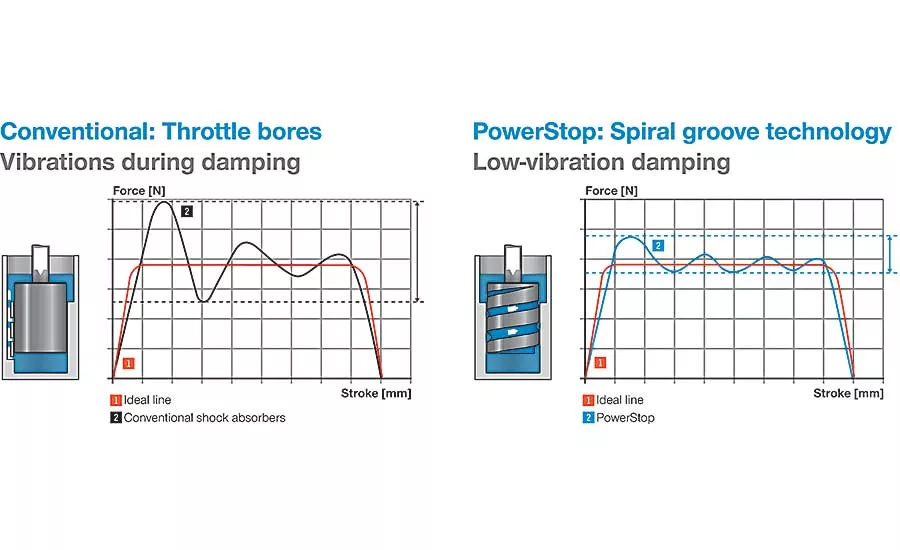
Figure 1 – Conventional Throttle bores vs. Spiral groove method
Zimmer
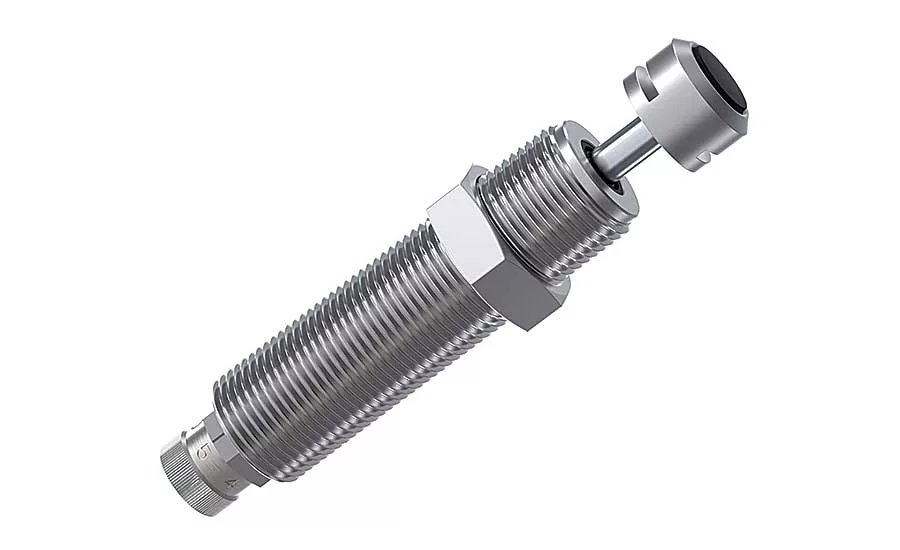
Adjustable Shock Absorber PowerStop 2.0
Zimmer
Zimmer
Zimmer
Zimmer
March 1, 2020

Dampers and shock absorbers are integral parts of almost every automation application. From simple damping of sliding doors on CNC mills, to end stops on linear slides, to dampers on conveyor pallets preventing impacts, to PET blow molding machines, selecting the right damper for your application can be of the most important choices when designing a machine.
Proper sizing of a damper that can handle the demands of your application can be the difference between a smoothly operating, long lasting machine and a machine that breaks down due to harsh impacts, vibrations, and crashes.

In today’s highly productive, high yield manufacturing environments, improperly sized dampers can lead to costly machine downtime due to errors and emergency stops.

Different types of dampers

Before sizing a damper that is right for your application, let’s take a quick look at different kinds of dampers.

The most basic dampers are springs or rubber bumpers. These usually offer little damping as they usually rebound the energy directly back following impact with little control.

Profile dampers are a further improvement to the standard rubber bumpers. They are usually made from co-polyester elastomer and with shapes engineered to absorb energy and dissipate rather than rebound, they are a better choice than springs or rubber bump stops. They are usually highly resistant to harsh conditions without the swelling, becoming brittle, or decomposing that may occur with a standard rubber bumper.

Looking for quick answers on assembly and manufacturing topics? Try Ask ASM, our new smart AI search tool. Ask ASM →

Industrial shock absorbers are the most reliable way to decelerate load, while still providing smooth damping and being able to stop to a fixed repeatable point.

Most industrial shock absorbers are hydraulic cylinders with a piston assembly. When a load is put on the cylinder’s piston rod, the piston pressurizes the fluid and force it to travel past the piston via some sort of restricted path. These pathways act as throttles, slowing the fluid’s movement, and in turn decelerate the load. The fluid also heats up due to its viscosity, converting the load’s kinetic energy to heat and transferring that out of the shock through its body.

The most common shock absorber uses a series of restricting orifices or throttle bores to provide a pathway for the fluid. Depending on piston position and stroke of the piston, different amounts of throttle bores will be active. A problem with this is that the damping curve can be inconsistent through the stroke range. Additionally, the throttle bore method can introduce vibrations and excess heat as each throttle bore become active. Excess heat can cause the fluid to lose its viscosity and reduce its damping effectiveness.

A more refined method of moving the fluid past the piston is the use of a continuous, consistent pathway such as the decreasing diameter spiral groove machined into the piston on Zimmer Group’s new PowerStop 2.0 shock absorbers. The spiral groove ensures consistent damping rate throughout the stroke of the shock, whether just a few millimeters into the movement, or near the end. This also reduces vibrations, and keeps the fluid cooler, allowing it to absorb more energy over time and extend its lifespan.

Sizing a damper

When beginning to size a damper, one needs to first calculate the kinetic energy at impact is generated by the load.

This calculation depends upon a number of factors such as mass, impact speed, gravity, whether it’s free moving or driven, translational (linear) or rotational, and stroke of the shock.

This yields energy per stroke, which when considered with cycles per hour, gives energy per hour.

Using energy per hour we can pick a shock or shocks appropriately.

Hardness of the shock based on the impact speed.

Zimmer Group offers a convenient online sizing tool that can guide a user through the selection process for a wide variety of application examples. Link

Other considerations

Other factors to be considered in selection would be environmental concerns, such as installation in a corrosive environment, or extreme temperatures. An all stainless steel shock may be necessary.

If the shock absorber will be subjected to a wide range of impact speeds, an adjustable shock absorber may be needed.

If there are dust/dirt/coolants present, the shock absorber may need to be protected to prevent ingress of contaminants.

Shock absorbers used in food handling applications may require to be filled with foodsafe/biosafe hydraulic fluid.

Zimmer Group offers a wide variety of innovative dampers, from the industry leading “PowerStop 2.0” shock absorbers to “BasicStop” profile dampers and all associated accessories.

If you need assistance in selecting the proper damper for your application, please do not hesitate to get in touch with any of our sales engineers at Zimmer Group.

(828) 855-9722
info.us@zimmer-group.com
www.zimmer-group.com

Share This Story

Looking for a reprint of this article?
From high-res PDFs to custom plaques, order your copy today!

Recommended Content

JOIN TODAY
To unlock your recommendations.

Already have an account? Sign In

  • Made in the U.S.A.

    Consumer Products Manufacturing: Made in the USA

    Supply chain lessons learned during the coronavirus...
    Automated Assembly Systems
    By: Austin Weber
  • Best Practices for Press-Fit Assembly

    Best Practices for Press-Fit Assembly

    In manufacturing, ironclad formulas for success are hard...
    Assembly Presses
    By: Jim Camillo
  • aem0523leader-tesla1.jpg

    Tesla Rethinks the Assembly Line

    Engineers at Tesla Inc. have developed a new process that...
    Assembly and Testing
    By: Austin Weber
Manage My Account
  • eMagazine Subscription
  • Assembly Newsletters
  • Online Registration
  • Subscription Customer Service
  • Manage My Preferences

More Videos

Sponsored Content

Sponsored Content is a special paid section where industry companies provide high quality, objective, non-commercial content around topics of interest to the ASSEMBLY audience. All Sponsored Content is supplied by the advertising company and any opinions expressed in this article are those of the author and not necessarily reflect the views of ASSEMBLY or its parent company, BNP Media. Interested in participating in our Sponsored Content section? Contact your local rep!

close
  • ultrasonic welding
    Sponsored bySonobond Ultrasonics

    Engineering Efficiency in High-Performance Assembly: How Ultrasonic Welding Enhances Throughput, Reliability and Quality

  • UV curing system
    Sponsored byDymax

    Why UV Intensity Alone Doesn’t Define Curing Performance

  • wooden pallets
    Sponsored byLEAN Manufacturing Products

    Eliminating Waste on the Shop Floor: Applying Lean Principles to Improve Manufacturing Efficiency

Popular Stories

ASSEMBLY News Now, episode-30: Volvo Redesigns EV Manufacturing

Volvo Redesigns EV Manufacturing

Boeing CEO Kelly Ortberg announces 1 billion investment

Boeing Plans $1 Billion Wichita Investment, Workforce Training Center

GE Appliances Worker on Line

GE Appliances Expands Factory AI With 800 Gemini Enterprise Agents

Watch the latest episode of ANN now!

Events

July 24, 2025

From Shop Floor to CFO: How Manufacturers Are Closing the Loop Between Operations and Finance

On Demand Learn how manufacturers are bridging the gap between the shop floor and ERP systems to gain real-time visibility, streamline operations, and kick-start digital transformation—without waiting years.

Sponsored by:

PicoStratusGreen
July 30, 2025

Buffer Analysis and Design Fundamentals for Manufacturing Excellence

On Demand In this presentation, Dr. Herman Tang shares practical insights from his industry experience and research on buffer management in manufacturing operations.

View All Submit An Event

Poll

Difficult Assembly Processes

Which assembly process gives you the most difficulty?
View Results Poll Archive

Products

Manufacturing Cost Policy Deployment (MCPD) Profitability Scenarios: Systematic and Systemic Improvement of Manufacturing Costs

Manufacturing Cost Policy Deployment (MCPD) Profitability Scenarios: Systematic and Systemic Improvement of Manufacturing Costs

See More Products
Register for webinar - Modernizing Automotive Assembly: Why Upgrading Legacy MES is a Business Imperative

Related Articles

  • asb0422how-to-weiss-Dual-Pick.jpg

    How To: Select the Right Pick & Place for your Application

    See More
  • How To Select the Right Pick & Place for Your Application

    How To Select the Right Pick & Place for Your Application

    See More

Related Products

See More Products
  • leaner

    Leaner Manufacturing: How to Make the Lean Production Process Easier, Faster, and More Cost-Effective

  • pocket.jpg

    How To Implement Lean Manufacturing, Second Edition

  • processind.jpg

    Digital Transformation for the Process Industries

See More Products

Related Directories

  • HowToRobot

  • GEM Gravure

    At Gem, we are committed to serving all customers with solutions for their product identification needs. From wire & cable marking to food & pharmaceutical packaging, we work with you to determine the right technology and the right ink for your application.
  • Made to Measure Metrology

×

Never miss the latest news and trends driving the manufacturing industry

Stay in the know on the latest assembly trends.

JOIN TODAY!
  • RESOURCES
    • Advertise
    • Contact Us
    • Directories
    • Manufacturing Division
    • Store
    • Want More?
  • SIGN UP TODAY
    • Create Account
    • eMagazine
    • Newsletters
    • Customer Service
    • Manage Preferences
  • SERVICES
    • Marketing Services
    • Reprints
    • Market Research
    • List Rental
    • Survey/Respondent Access
  • STAY CONNECTED
    • LinkedIn
    • Facebook
    • Instagram
    • YouTube
    • X (Twitter)
  • PRIVACY
    • PRIVACY POLICY
    • TERMS & CONDITIONS
    • DO NOT SELL MY PERSONAL INFORMATION
    • PRIVACY REQUEST
    • ACCESSIBILITY

Copyright ©2026. All Rights Reserved BNP Media, Inc. and BNP Media II, LLC.

Design, CMS, Hosting & Web Development :: ePublishing