Assembly Magazine logo
search
Ask ASSEMBLY AI
cart
facebook twitter linkedin youtube
  • Sign In
  • Create Account
  • Sign Out
  • My Account
Assembly Magazine logo
  • TRENDS
    • Ask ASSEMBLY AI
    • Trends
    • News
    • New Products
  • INDUSTRIES
    • Aerospace
    • Appliance
    • DFMA Assembly
    • Medical Devices
    • Green Manufacturing
    • Lean Manufacturing
    • Machinery Assembly
    • Electronics Assembly
    • Automotive
  • TECHNOLOGIES
    • Adhesives & Dispensing
    • Assembly Presses
    • Automated Assembly Systems
    • Manufacturing Management
    • Manufacturing Software
    • Motion Control
    • Screwdriving & Riveting
    • Robotics
    • Test & Inspection
    • Plastics & Metal Welding
    • Wire Processing
    • Workstations
  • AUTONOMOUS & ELECTRIC MOBILITY
    • AEM Magazine Archives
    • Autonomy
    • Electrification
    • Mobility Services
    • Assembly & Testing
    • AV/EM News
  • MEDIA
    • Ask ASSEMBLY AI
    • Podcasts
    • Assembly News Now
    • Assembly TV
    • Webinars
    • eBooks
  • EVENTS
    • Calendar
    • The ASSEMBLY Show
  • MORE
    • Exclusives >
      • Plant of the Year
      • Capital Spending
    • Buyers Guide >
      • Supplier Insights
    • Classifieds
    • Featured Products
    • Newsletters
    • Store
    • White Papers
    • Columns
    • Sponsor Insights
  • INFOCENTER
    • Assembly & Test Solutions
  • EMAGAZINE
    • eMagazine
    • Archive Issues
    • Advertise
    • Contact Us
    • Sign Up

advertisement

How To How to choose the right type of EAOT for your collaborative robot?
zimmer
zimmer
zimmer
zimmer
zimmer
zimmer
May 1, 2017

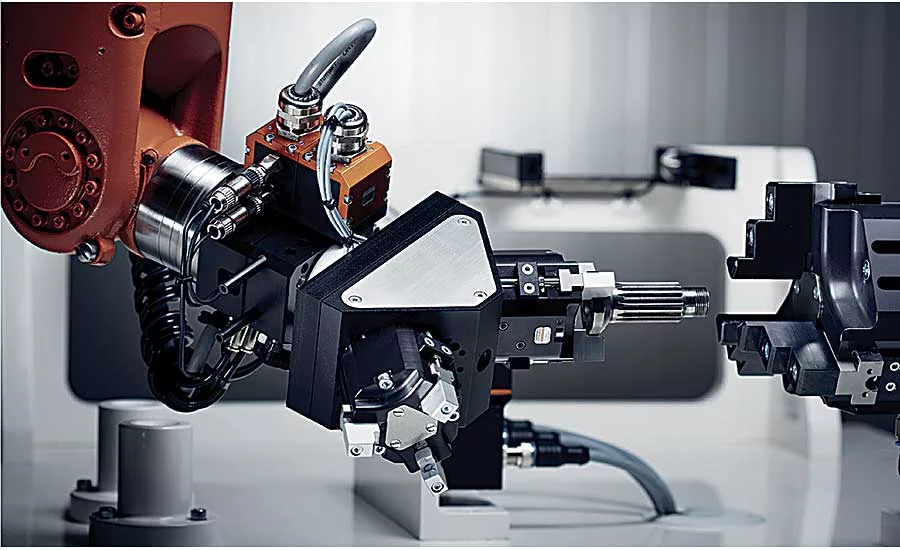
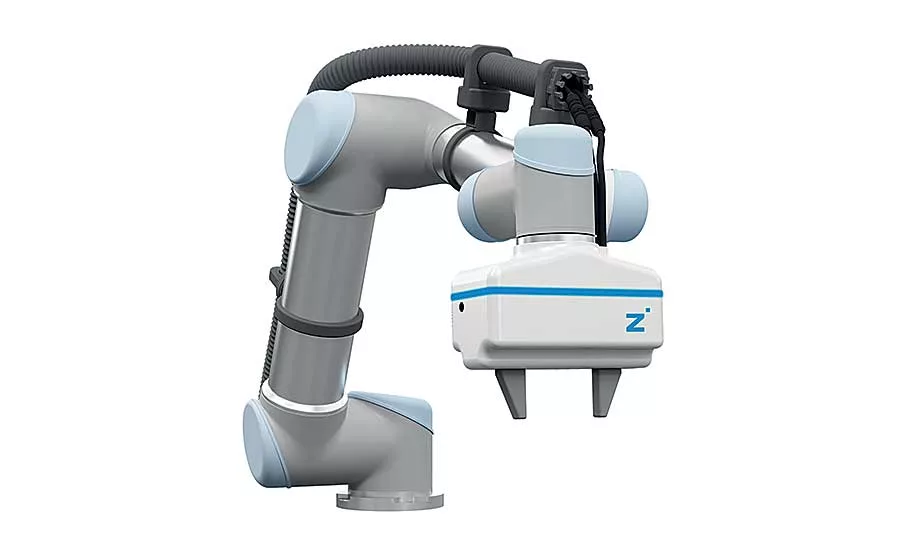
So, you just bought your first cobot, and now you need a way to pick up your parts. What you need to decide on is what type of end-of-arm tool (EOAT) you require.

Depending on the part shape, weight and material being picked up, you may need a surface contact based system such as a vacuum cup or a magnetic gripper. Alternatively you may require a mechanical based system such as a parallel gripper.

There are many types of gripper on the market with the most common being parallel 2-jaw, 3-jaw concentric, long stroke and angular grippers. Again, what you require depends on the part shape, weight and material but also you have to consider the task or tasks you expect your robot to perform, how fast you want it to perform said tasks (cycle time) and how flexible you need the robot to be if you are picking up multiple parts.

As a simple example, if your robot is machine tending which is a very common task for a robot, and your intention is to keep it on one machine only with only one part, a common set up for this is to have two grippers mounted at a 90° angle from each other. In this setup, you are reducing your cycle time significantly compared to only using one gripper because a) the finished part can be removed and the new raw part loaded with the robot only having to move into the machine once rather than twice and b) the robot can pick up the raw part and place the finished part whilst the machining continues. If your robot only has one gripper all these tasks must be performed with the machine doors open, increasing your overall cycle time.

Pneumatic vs. Electric

Once you know the type and number of grippers required, you also have a choice of drive type. Traditionally, the most common drive type has been pneumatic, however, the electromechanically driven segment has been growing rapidly in recent years.

Pneumatic grippers continue to have a wider variety of styles, stroke ranges, and force outputs.

Electric grippers now have to be considered as they have become more affordable and generally reduce your running costs, accessories, setup times and downtime.

Looking for quick answers on assembly and manufacturing topics? Try Ask ASM, our new smart AI search tool. Ask ASM →

With an electric gripper if you are planning on tasking your collaborative robot to handle multiple applications and locations, moving your collaborative robot from station to station becomes much easier when not having to worry about compressed air lines and additional valves at each station. Another added benefit over pneumatic grippers is that most electric gripper offerings have built in sensors and all this can often be connected directly to your robot.

Electric grippers have evolved over the years from the basic grip open/closed driven by gearmotors to very advanced DC servo driven grippers with full programmability of position/speed/force, integration with Industry 4.0, and capability to outperform its pneumatic counterparts both in speed and force.

Safety Considerations

Lastly and most importantly, we cannot talk about collaborative robots without talking about safety. There is also a need to distinguish what makes a collaborative gripper and whether your application needs a true collaborative gripper.

With safety fences eliminated, collaborative grippers currently in development will have visual status cues, housings that have no sharp edges, gripping forces that are limited to maximum threshold guidelines so as to not cause injury to humans, and no exposed mechanical linkages that may serve as pinch points.

If you need any help or advice regarding your EOAT, please do not hesitate to get in touch with any of us at Zimmer Group.

Written by Costas Charalambous –

costas.charalambous@zimmer-group.com

Edited by Russell Tyler –

russell.tyler@zimmer-group.com


Zimmer Group US, Inc.
1095 6th Street Ct SE
Hickory, NC 28602
+1 828 855 9722
sales.us@zimmer-group.com
www.zimmer-group.com

Share This Story

Looking for a reprint of this article?
From high-res PDFs to custom plaques, order your copy today!

Recommended Content

JOIN TODAY
To unlock your recommendations.

Already have an account? Sign In

  • Made in the U.S.A.

    Consumer Products Manufacturing: Made in the USA

    Supply chain lessons learned during the coronavirus...
    Automated Assembly Systems
    By: Austin Weber
  • Best Practices for Press-Fit Assembly

    Best Practices for Press-Fit Assembly

    In manufacturing, ironclad formulas for success are hard...
    Assembly Presses
    By: Jim Camillo
  • aem0523leader-tesla1.jpg

    Tesla Rethinks the Assembly Line

    Engineers at Tesla Inc. have developed a new process that...
    Automotive Assembly
    By: Austin Weber
Manage My Account
  • eMagazine Subscription
  • Assembly Newsletters
  • Online Registration
  • Subscription Customer Service
  • Manage My Preferences

More Videos

Sponsored Content

Sponsored Content is a special paid section where industry companies provide high quality, objective, non-commercial content around topics of interest to the ASSEMBLY audience. All Sponsored Content is supplied by the advertising company and any opinions expressed in this article are those of the author and not necessarily reflect the views of ASSEMBLY or its parent company, BNP Media. Interested in participating in our Sponsored Content section? Contact your local rep!

close
  • ultrasonic welding
    Sponsored bySonobond Ultrasonics

    Engineering Efficiency in High-Performance Assembly: How Ultrasonic Welding Enhances Throughput, Reliability and Quality

  • UV curing system
    Sponsored byDymax

    Why UV Intensity Alone Doesn’t Define Curing Performance

  • wooden pallets
    Sponsored byLEAN Manufacturing Products

    Eliminating Waste on the Shop Floor: Applying Lean Principles to Improve Manufacturing Efficiency

Popular Stories

ASSEMBLY News Now, episode-30: Volvo Redesigns EV Manufacturing

Volvo Redesigns EV Manufacturing

Boeing CEO Kelly Ortberg announces 1 billion investment

Boeing Plans $1 Billion Wichita Investment, Workforce Training Center

automated consumer goods assembly system

Best Practices for Cycle Time Optimization

Watch the latest episode of ANN now!

Events

July 24, 2025

From Shop Floor to CFO: How Manufacturers Are Closing the Loop Between Operations and Finance

On Demand Learn how manufacturers are bridging the gap between the shop floor and ERP systems to gain real-time visibility, streamline operations, and kick-start digital transformation—without waiting years.

Sponsored by:

PicoStratusGreen
July 30, 2025

Buffer Analysis and Design Fundamentals for Manufacturing Excellence

On Demand In this presentation, Dr. Herman Tang shares practical insights from his industry experience and research on buffer management in manufacturing operations.

View All Submit An Event

Poll

Difficult Assembly Processes

Which assembly process gives you the most difficulty?
View Results Poll Archive

Products

Manufacturing Cost Policy Deployment (MCPD) Profitability Scenarios: Systematic and Systemic Improvement of Manufacturing Costs

Manufacturing Cost Policy Deployment (MCPD) Profitability Scenarios: Systematic and Systemic Improvement of Manufacturing Costs

See More Products
Register for webinar - Modernizing Automotive Assembly: Why Upgrading Legacy MES is a Business Imperative

Related Articles

  • motion index

    How To Choose the Right Precision Indexing System for your Automated Process

    See More

Related Products

See More Products
  • leaner

    Leaner Manufacturing: How to Make the Lean Production Process Easier, Faster, and More Cost-Effective

  • pocket.jpg

    How To Implement Lean Manufacturing, Second Edition

See More Products

Related Directories

  • HowToRobot

  • Made to Measure Metrology

  • NoMuda VisualFactory

    NoMuda VisualFactory helps the world’s largest manufacturers implement the fastest, safest, lowest cost process to ensure right-first-time quality. Our customers gain control over their shop floor operations with 20% productivity increases whilst eliminating manufacturing errors and providing real-time visibility of production status to the Shop Floor and Management.
×

Never miss the latest news and trends driving the manufacturing industry

Stay in the know on the latest assembly trends.

JOIN TODAY!
  • RESOURCES
    • Advertise
    • Contact Us
    • Directories
    • Manufacturing Division
    • Store
    • Want More?
  • SIGN UP TODAY
    • Create Account
    • eMagazine
    • Newsletters
    • Customer Service
    • Manage Preferences
  • SERVICES
    • Marketing Services
    • Reprints
    • Market Research
    • List Rental
    • Survey/Respondent Access
  • STAY CONNECTED
    • LinkedIn
    • Facebook
    • Instagram
    • YouTube
    • X (Twitter)
  • PRIVACY
    • PRIVACY POLICY
    • TERMS & CONDITIONS
    • DO NOT SELL MY PERSONAL INFORMATION
    • PRIVACY REQUEST
    • ACCESSIBILITY

Copyright ©2026. All Rights Reserved BNP Media, Inc. and BNP Media II, LLC.

Design, CMS, Hosting & Web Development :: ePublishing