5G Will Drive Tomorrow’s Connected Assembly Lines
Next-generation wireless technology is transforming production processes

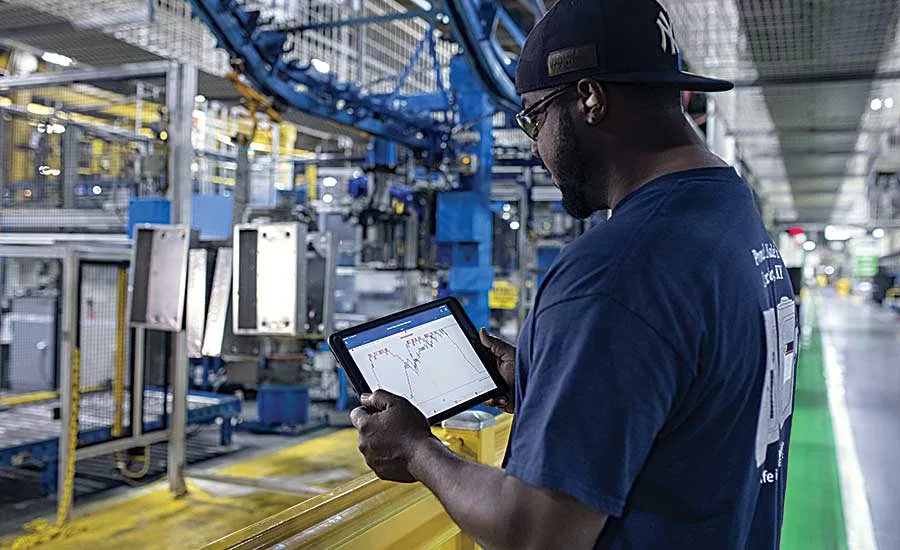
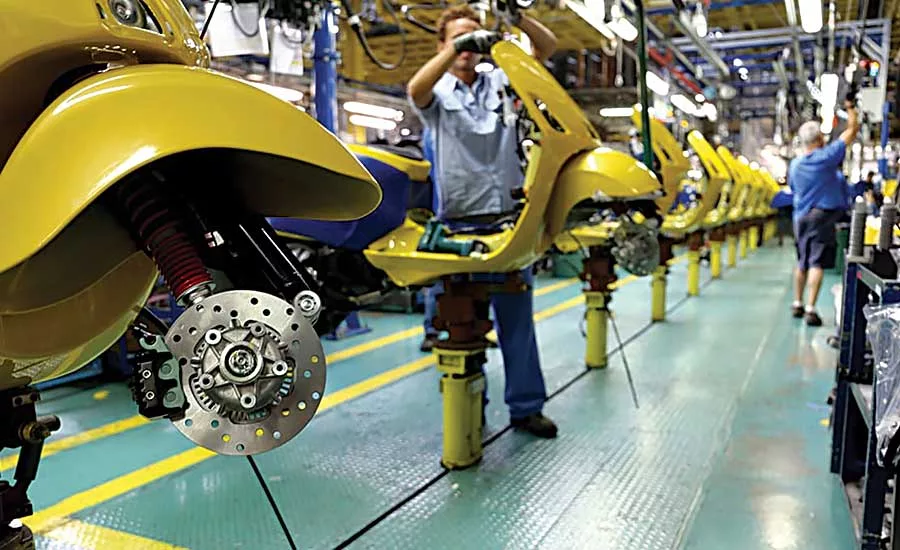
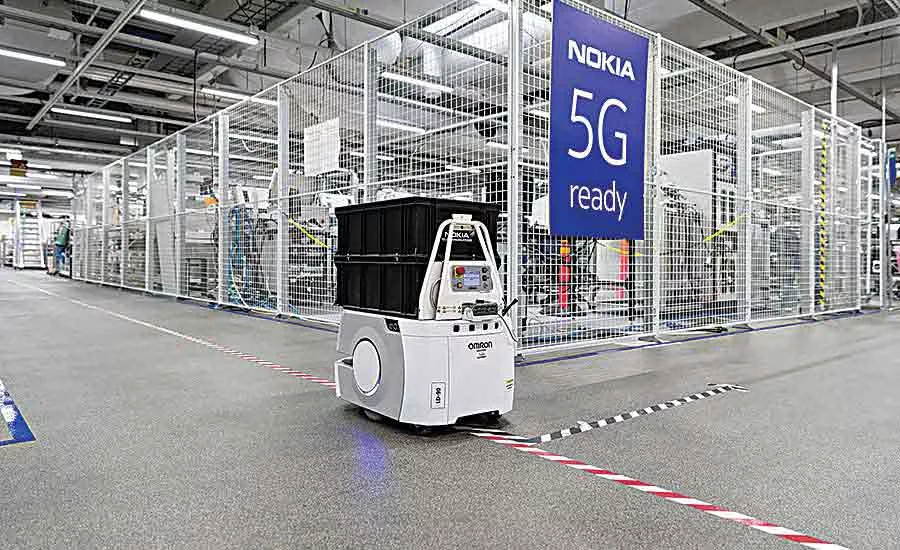
The fifth generation of wireless technology is quickly emerging. It will greatly expand the broadband capabilities of mobile networks and provide advanced wireless service for a wide variety of applications ranging from cell phones to assembly lines.
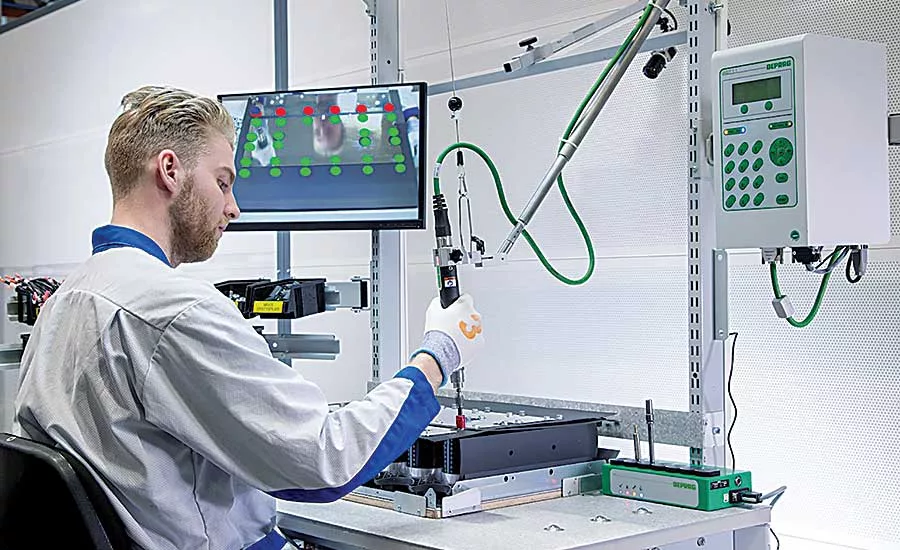
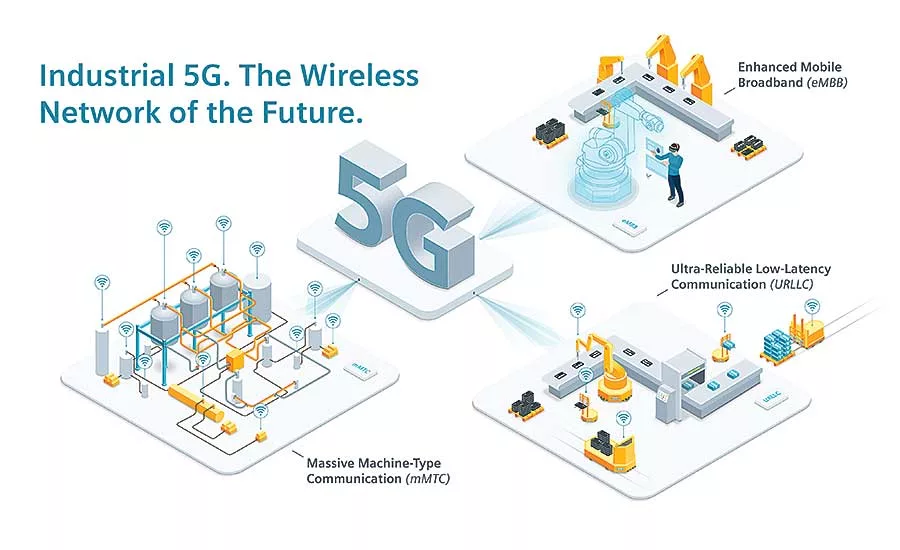
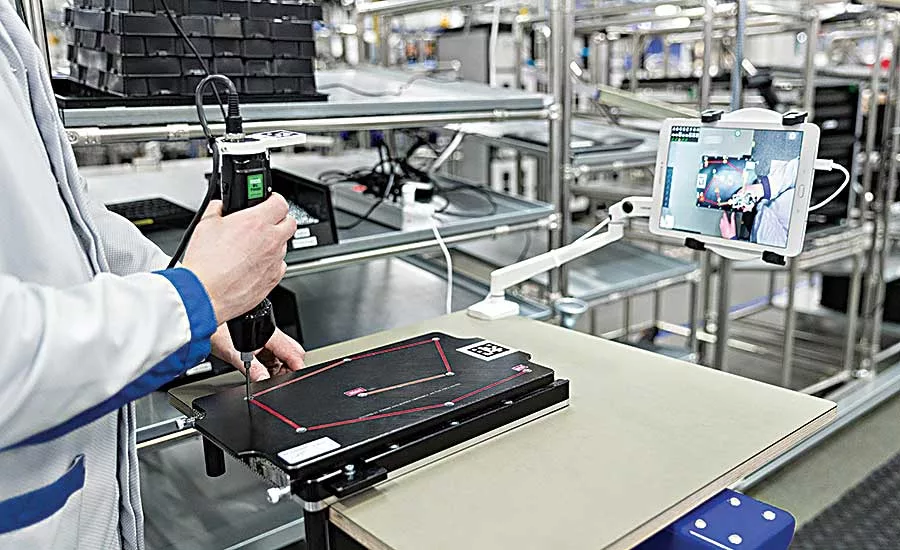
During the next decade, 5G promises to dramatically transform the way that conveyors, fastening tools, robots and other production equipment perform and interact on the plant floor. It will drive numerous Industry 4.0 initiatives, improving the automation of production processes and real-time monitoring of machine conditions.
The technology provides the ability to connect multiple devices at once and move more data faster than ever. As 5G is adopted, it will improve the ability of engineers to deploy artificial intelligence (AI), data analytics, digital twins and other smart factory tools. It will also enable millions of devices, such as actuators, cameras, motors and sensors, to be connected wirelessly with each other.
Early 5G trial deployment projects at European manufacturers hint that bringing 5G connectivity to the factory floor will decrease maintenance costs by 30 percent and increase overall equipment efficiency by 7 percent.
“Safer, flexible and more efficient manufacturing systems will be possible thanks to the ultra-low-latency and reliability of 5G connectivity,” says Jens Jakobsen, development manager at HMS Labs, a company that specializes in connected devices and networks. “None of the wireless technologies used today have the reliability, scalability and performance which is needed for tomorrow’s industrial production.
“From a technical perspective, 5G technology has the potential to meet all the requirements,” claims Jakobsen. “The only area not suitable for 5G within industrial production is motion control with submillisecond cycle time requirements.
“The industrial world is undergoing its fourth revolution, and the goals are to increase flexibility, increase automation and improve productivity, while also maintaining a high degree of safety and sustainability,” explains Jakobsen. “Therefore, using 5G is the perfect solution for enabling smart wireless connectivity in the factory.”
Looking for quick answers on assembly and manufacturing topics? Try Ask ASM, our new smart AI search tool. Ask ASM
“In the context of industrial applications, 5G is much more than just an enhanced version of 4G,” adds Leo Gergs, 5G analyst at ABI Research, a global tech market advisory firm. “5G allows completely new applications for connectivity on the factory floor.
“Supporting the connectivity of between 1,000 and 1 million devices per square kilometer will enable setting up highly dense wireless sensor networks, enabling the permanent monitoring of production processes and production machine conditions,” says Gergs.
The supported bandwidth of 10 gigabits per second (Gb/s) in the uplink and 20 Gb/s in the downlink will enable data-intensive processes, such as augmented reality, for predictive and preventive maintenance. In addition, it will bring low latency, high reliability support for time-sensitive networking applications.
According to Gergs, the most important body for 5G standardization is the 3rd Generation Partnership Project (3GPP), an association consisting of mobile network operators, chipset manufacturers and infrastructure vendors. The standardization work is organized into different releases. The first was Release 15, which was introduced in 2018. It standardized the high bandwidth that 5G is aiming to deliver.
“Since this is not the main concern for manufacturers, the current state of 5G is not interesting for them,” says Gergs. “Instead, they are eagerly waiting Release 16, which was scheduled for launch this month. However, due to a very ambitious timeline, as well as global disruptions following the coronavirus pandemic, it is highly likely that this will be delayed until sometime next year.
“With Release 16, 3GPP will standardize ultra-reliable low-latency communication, guaranteeing a fast and very reliable connection,” Gergs points out. “Since manufacturers demand extremely high reliability from wireless communication technology, because machine downtime is costly, this will be the game changer for 5G in the manufacturing domain.”
According to ABI Research, by 2026 there will be more than 5 million 5G connections on the factory floor. And, the market for 5G cellular connections in manufacturing will reach $11 billion by 2030, growing at a compound annual rate of 187 percent.
Why 5G Is Important
Since 5G supports much higher transmission rates—some observers claim it will be 100 times faster than 4G technology—it will enable connected manufacturing applications without requiring additional communication infrastructure, such as cables and wires.
However, 5G will not require manufacturers to reinvent the wheel. Current mobile radio networks should continue to be sufficient for many applications. But, 5G network and intelligent devices offer completely new possibilities, which will enable engineers to implement networked production to a far greater extent than before.
“Manufacturing companies are under extreme pressure to produce products faster and continuously innovate,” says Satyam Vaghani, vice president and general manager of artificial intelligence and Internet of Things (IoT) at Nutanix Inc., a leading supplier of cloud-based software. “5G technology can help these organizations increase efficiency and production, while also reducing costs.
“5G technology is beneficial for manufacturers, because it allows them to optimize the factory floor layout and improve production standards, ultimately leading to faster production,” claims Vaghani. “In addition, the technology can enhance the collection of data through connected sensors and facilitate real-time data performance monitoring for machines. This lasting connectivity enables manufacturers to realize new efficiencies and helps [operators] be more productive.”
“While 5G is the next generation communications infrastructure for many mobile devices, many manufacturers have already developed a smart manufacturing deployment plan for projects around WiFi6,” adds Lee Yee, vice president of marketing at AMAX, a company that specializes in connected systems and smart manufacturing. “These projects are mostly in the planning and testing phase.
“As 5G becomes more cost effective and readily available to the general industrial population, manufacturers will incorporate 5G wireless options especially for smart devices that can be both managed in the cloud and secured via private network,” predicts Yee. “But, for many basic on-premise applications where the majority of local data response is processed via an edge server, WiFi6 can be a more practical solution in assembly plants.”
Yee believes that manufacturers will gradually use more data to become competitively productive and efficient. As the volume of data grows, the applications, machines and people that process and share that data will also increase.
“There are so many things that can be connected and interconnected across the factory,” explains Yee. “The ‘cords’ for many machines don’t really need to be ‘cut’ in [applications] where there is not a lot of mobility. However, wireless smart tools, sensors, cameras and interface devices help to create an intelligently aware [environment] across various manufacturing and maintenance processes.
“On plant floors, there are agile and configurable work cells to expand production flexibility on a demand basis where we may have to move equipment and stations around,” notes Yee. “Wireless connectivity makes it easier to do that by dealing with less wires.”
“In the short term, 5G will be used to connect factory sites that previously have been unconnected or have poor connections due to technical or economic constraints, like remote factories with limited internet options,” adds Aaron Kamphuis, data analytics and IoT practice manager at OST, a business technology and consulting firm. “In the long term, it will take a few years for market adoption.
“However, as time goes on, more equipment will have 5G radios embedded in it,” predicts Kamphuis. “So, factories [will be able to] better leverage 5G in these new use cases to extract a lot more data from the shop floor.”
According to Kamphuis, the biggest misconception associated with 5G technology is the adoption curve. “Initially, 5G will see the most traction in the hotspot and smartphone market,” he points out.
“Connected manufacturing techniques that leverage 5G capabilities specifically will lag [behind] a few years, due to a lack of coverage densities,” says Kamphuis. “We’ll also see a slow adoption of 5G radios embedded in shop floor equipment, as well as manufacturers’ slow adoption of connected approaches to managing the shop floor.
“One of the biggest myths with 5G technology is that it’s the most important thing in tomorrow’s high technology and connected manufacturing; it is not,” claims Kamphuis. “It’s just data coverage and a lot more bandwidth.
“Manufacturers should be looking at how information could be leveraged from the shop floor to make decisions more quickly to drive better business outcomes,” notes Kamphuis. “Often, these approaches can be done with or without 5G technology.”
“5G will add highly reliable and high-performance mobile connectivity to factories and production lines. From the very beginning, requirements related to the support of industry vertical use cases, like manufacturing, have been a core element of the 5G standardization,” adds Michael Orzessek, business development manager for IIOT systems at Keysight Technologies, a firm that helps manufacturers create smart factories and drive Industry 4.0 initiatives. “Therefore, manufacturers can expect to eventually see functionality and performance that will match their specific requirements.
“This is also supported be the emergence of global organizations such as the 5G Alliance for Connected Industries and Automation,” notes Orzessek. “Its goal is to ensure the best possible applicability of 5G technology for connected industries, in particular manufacturing.
“The addition of wireless connectivity will be an enabler for manufacturing from several perspectives,” claims Orzessek. “First, it will add flexibility to assembly line design by enabling equipment mobility.
“Beyond that, not having to care about cabling will enable another key functionality in the context of a smart factory: the ability to get sensor measurement data from different places along a production line,” explains Orzessek. “This includes not only data related to actual manufacturing process performance or the manufactured product, but also about the machinery and production equipment conditions and quality.
“So, 5G will make new datasets available for analytics and AI functions that will enable additional value generation as part of the respective smart manufacturing concept,” says Orzessek. “The ability to transmit even large datasets quickly is another capability that will allow additional data sources in the smart manufacturing architecture.
“Last, but not least, 5G conceptually includes mobile edge computing capabilities,” Orzessek points out. “From a smart manufacturing point of view, this brings new options with regards to the implementation of analytics and AI, which can then be performed close to the origin of data and the devices.”
A Brave New World
The promise of reliable, low-latency and high-bandwidth wireless connectivity is opening up new possibilities and benefits across manufacturing operations, such as automation, asset efficiency, cost reduction and supply chain agility.
“To drive Industry 4.0 initiatives, many manufacturers are bringing data to the forefront on the factory floor,” says Yee. “There’s a lot of data already coming from the machinery, but much of that is not well used. Collecting and organizing the data and then making it accessible and utilized will require fast and reliable connectivity to bring it all together.
“Not all data comes from programmable logic controllers, machines and scanners,” Yee points out. “It can also come from various manufacturing processes, such as welding; that data can be captured and analyzed.
“Coupling deep learning and inference on assembly lines can anticipate problems before they occur by closing the loop,” claims Yee. “A common approach that manufacturers use is to build industrial-grade hardware systems using graphic processing units (GPUs).
“These GPU-based systems (for deep learning and inference) need to be integrated into the control loop or manufacturing process,” explains Yee. “For example, in precision welding and soldering, deep learning systems can be used to train machines and people to apply the right amount of pressure, power, time and material for increased efficiency and quality.”
Before 5G becomes widely used in manufacturing, several challenges need to be addressed, such as infrastructure. Existing 3G and 4G networks, where a macro cell is placed on a tower or building rooftop, have typically been placed every few miles.
Obstructions to the signal often create coverage gaps in the network, where additions, such as small cells, have been made to supplement or enhance coverage for users. To be effective, 5G networks require a much tighter mesh of radio antennas to support the volume of connections, low latency and connection speeds.
“Location and fiber optic cable are both extremely important,” says Tormod Larsen, chief technology officer at ExteNet Systems Inc., a company that specializes in communications infrastructure. “Since factories are typically deployed outside of urban areas, extending high capacity fiber becomes a challenge.
“It becomes complicated and expensive to extend fiber infrastructure to remote locations and carriers often favor urban areas with more density for their fiber connectivity,” warns Larsen. “We’re beginning to see an increased propensity for manufacturers to take on more of the economic costs, as they know 5G will end up increasing productivity and saving costs in the long run.”
“Many [companies] are still figuring out where they sit with the Industry 4.0 revolution, and something like 5G can just be another shiny objective if not applied correctly,” adds Lee An Schommer, senior vice president of global product management of Epicor, a company that specializes in cloud-based enterprise resource planning software.
“First things first, start with the objective in mind,” suggests Schommer. “What business problem are you trying to solve? Once you can clearly articulate that (and yes, data sure helps), sit down with your partners in IT and operations and talk them through your objective.
“Plants can be full of wire, so before you tell IT you want to throw out all the Ethernet, start with one clear pain point,” says Schommer. “Prove out the power of IIoT and 5G, after which you can pick up speed with supporters in tow. After the first win, you’ll have others who are thinking of ways to further the transformation.
“The ‘factory of the future’ isn’t some sci-fi series streaming on Netflix,” explains Schommer. “It’s happening today, but as with any new technology, the biggest challenge is where to begin. There are many ways to leverage [all] these new tools, including 5G.”
Schommer suggests starting with a goal in mind. “Have a clear objective before you jump into solutioning and discussing whether or not you need network slicing and massive machine-type communication,” she points out. “Pick a clear pain point everyone can rally around and prove it out with metrics. Then, you can nail it and scale it.”
"Some people believe that 5G is already here today," notes Jim Dempsey, director at Panasonic. "However, the networks are still being built out. While networks are growing, they aren't anywhere near where they'll need to be for most manufacturers to take advantage of 5G technology. That's still at least 36 months away.
“It’s a more expensive technology than legacy systems,” warns Dempsey. “For instance, the antenna design of 5G products is more complex. Legacy production equipment will need to be retrofitted for connectivity. But, deploying 5G on the plant floor should be much simpler than using Wi-Fi technology.”
Machine Connectivity
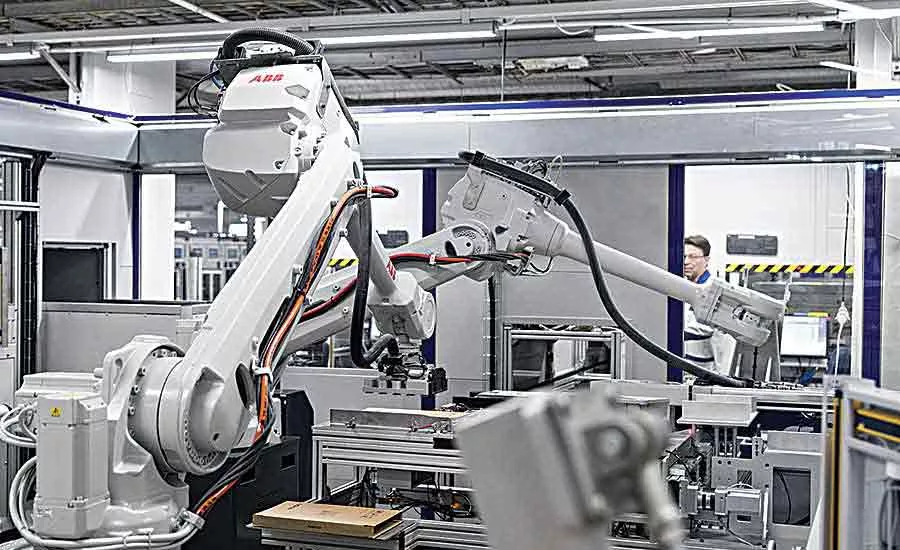
5G technology will improve the performance and connectivity of production equipment such as conveyors, fastening tools and robots. For instance, a robot connected to the cloud via 5G could use machine learning to find the best way of navigating its environment and performing tasks without being specifically programmed in advance.
At last year’s Hannover Fair in Germany, several automation suppliers showcased how 5G will change factories in the near future.
Bosch Rexroth’s lineup included a mobile control panel that enabled human-robot collaboration and integrated industrial Ethernet over 5G. Festo featured displays that highlighted artificial intelligence, integrated connectivity and predictive maintenance applications.
Weidmüller showcased a 5G-enabled energy monitoring system for use in welding control applications. The system’s analysis unit receives data directly from the welding process and feeds it via a 5G modem and 5G network to an energy flow visualization unit.
Zeiss displayed an inline process control system for the auto industry. Its AICell measures all key characteristics of every single car body component as it passes through the production line, thereby delivering much more accurate and reliable process monitoring and control data than random testing. It is equipped with an array of inline sensors that inspect and measure body features and topographies, checking for cracks, flushness and other characteristics.
In addition, Ericsson teamed up with Comau to show a 5G-powered digital twin of an automotive assembly line. Ericsson is a leading supplier of antennas, base stations, routers and other types of wireless equipment.
Using a virtual reality (VR) headset, visitors were immersed in the line and could “move” within it, monitoring key process parameters such as pressures, temperatures and vibrations. A VR digital dashboard, which could be used with a standard tablet device, identified situations that could create slowdowns or interruptions in the process by providing instructions to tackle the problem effectively.
“The features of 5G connectivity allow [us] to collect a stable, continuous and massive flow of data in real-time that is vital for automation processes,” says Maurizio Cremonini, head of marketing and the digital initiatives platform at Comau. “Thanks to 5G low latency, the digital twin shows information related to the real robot in the form of visual outputs, which make it possible to understand how the robot activity will evolve in the cell.
“From the data analysis, it is possible to foresee faults and malfunctions, and identify which components must be repaired or replaced, suggesting which actions to take to operate effectively,” claims Cremonini. “5G becomes the enabling technology for every analytics and digital intelligence remote activity on all assets of the production system.
“[Our] new digitally interconnected equipment delivers real-time production data where and when it is needed, helping reduce downtime while improving overall quality,” Cremonini points out. “Digitized analytics provide customers with a wealth of information regarding production flows and throughput—information that is made available locally and remotely.”
“Bandwidth and low latency, main features of the new 5G technology, are the crucial factors that will allow [us] to accelerate the digitization and automation processes, enabling cutting-edge use cases in smart manufacturing and Industry 4.0,” adds Magnus Frodigh, head of research at Ericsson. “5G deployment in the industrial environment will allow [manufacturers] to increase productivity and reduce costs.”
Ericsson also has a strategic partnership with ABB Robotics to apply 5G technology to its machines. During the recent World Economic Forum in Davos, Switzerland, the companies teamed up for a demonstration using two cloud-connected ABB robots operating via an Ericsson-powered live 5G network. The goal was to showcase human-robot collaboration and control over wide distances utilizing the real-time communication capabilities of 5G.
“Today, the flexibility of factories is limited by the amount of data that can be processed, because of the lack of reliable, low-latency and high-bandwidth connectivity,” claims Sami Atiya, president of ABB’s robotics and discrete automation business. “Replacing traditional hard wires with 5G mobile networks will take the interconnection between machines, materials and people to a new level.
“[This will help] drive the shift from mass production to mass customization, by supporting the shift to flexible manufacturing cells where manufacturing lines can be constantly reconfigured to accommodate changing manufacturing needs,” says Atiya.
According to Atiya, 5G technology will result in several benefits to manufacturers, including: large networks of sensors for predictive maintenance of machines and robots on the factory floor; cloud robotics will enable smaller, cheaper robots that can be centrally controlled and untethered in any environment; identification and tracking of goods in the end-to-end value chain; and remote quality inspection and diagnostics with high-resolution 3D video or haptic feedback, thermal and other sensors.
“The traditional connectivity paradigm is being challenged by flexible production and wireless industrial IoT (IIoT),” adds Asa Tamsons, senior vice president and head of business area technologies and new businesses at Ericsson, which operates a state-of-the-art 5G factory in Tallinn, Estonia. “Currently, most IIoT [applications] are based on wired connections.
“However, as the evolving cellular capabilities are challenging industrial ethernet solutions, wires will in many cases become redundant, introducing opportunities for more flexible production and faster line changes,” claims Tamsons.
“Today, most factories rely on fixed cabled networks to support critical and real-time applications for stationary machines and often complement with Wi-Fi to support non-critical (massive) applications like sensors and handheld tools,” says Tamsons. “In both cases, scaling and expanding connected operations is difficult, as wires are very costly to install, maintain and retrofit, and Wi-Fi cannot sustain high network performance.
“Variables cannot be managed with only a fixed cabled network, as a manufacturing site includes rotating, moving machines and portable items like tools, materials, phones and tablets,” Tamsons points out. “By connecting infrastructure, equipment and workers on one platform, cellular technology can be used to maximize data collection and provide actionable insights from different workflow processes.
“Digitization of factory assets, equipment, vehicles and processes means the number of connected devices will increase exponentially,” adds Tamsons. “The estimated number of connected devices needed in a typical smart factory is 0.5 per square meter. Manufacturers will gradually adopt supportive applications to increase efficiency and quality in their activities, from augmented reality (AR) to digital twins.”
For example, at Ericsson’s factory in Estonia, inspection of assets and products with AR technology has resulted in consistently improved product quality with reduced lead times and costs.
5G in Action
Compared to their European counterparts, American manufacturers have been slow to jump on the 5G bandwagon. However, many experts believe that will soon change.
For instance, Whirlpool Corp. is currently testing 5G technology at its Clyde, OH, washing machine factory. Engineers are converting a fleet of automated guided vehicles to run on the technology instead of traditional Wi-Fi, which is susceptible to interference issues.
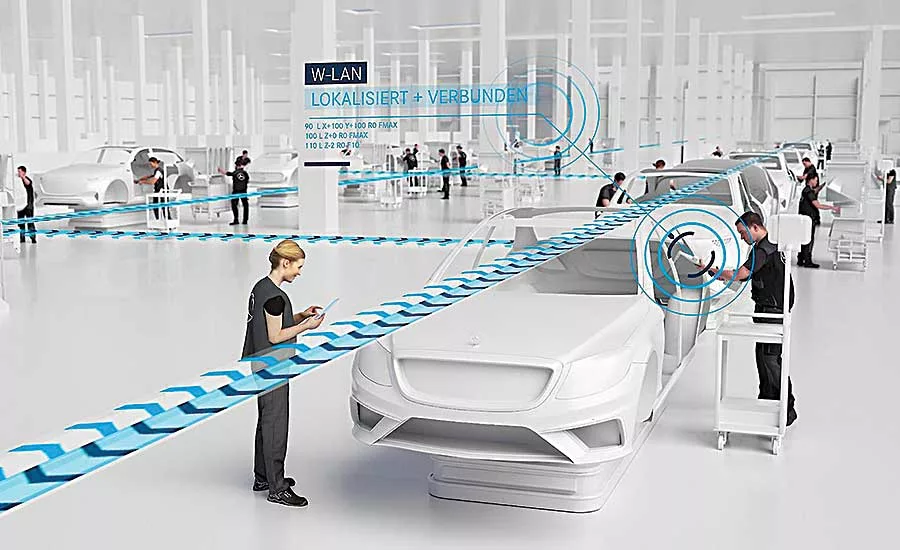
But, European manufacturers are leading the 5G charge, spurred on by widescale Industry 4.0 initiatives. For example, Daimler AG recently implemented the world’s first 5G network for automobile production at its cutting-edge “Factory 56” in Sindelfingen, Germany. The 105-year-old facility assembles Mercedes-Benz S-Class sedans.
“With the installation of a local 5G network, the networking of all production systems and machines in [our] factories will become even smarter and more efficient in the future,” says Jörg Burzer, a member of the divisional board of management for production and supply chain. This opens up completely new production opportunities.”
The use of state-of-the-art 5G network technology allows Daimler engineers to optimize existing production processes with the help of new features. This includes data linking and product tracking on the assembly line.
“With a separate network, all processes can be optimized and made more robust, and if necessary, adapted at short notice to prevailing market requirements,” claims Burzer. “Furthermore, the mobile communication standard links production systems and machines together in an intelligent manner, thereby supporting the efficiency and precision of the production process. A further benefit of using a local 5G network is that sensitive production data does not have to be made available to third parties.”
Machines and systems in the Sindelfingen factory are closely networked with one another. The assembly facilities and materials handling technology are compatible with IoT technology. To achieve this, the facility has been equipped with several 5G small-cell indoor antennas and a central 5G hub.
Another smart factory that is already using 5G technology is the Schneider Electric facility in Le Vaudreuil, France. The 45-year-old plant assembles a wide variety of products, including drives, speed starters and high-intensity silver contacts. It serves as a showcase for the company’s EcoStruxure, an IoT-enabled open, interoperable system architecture and platform.
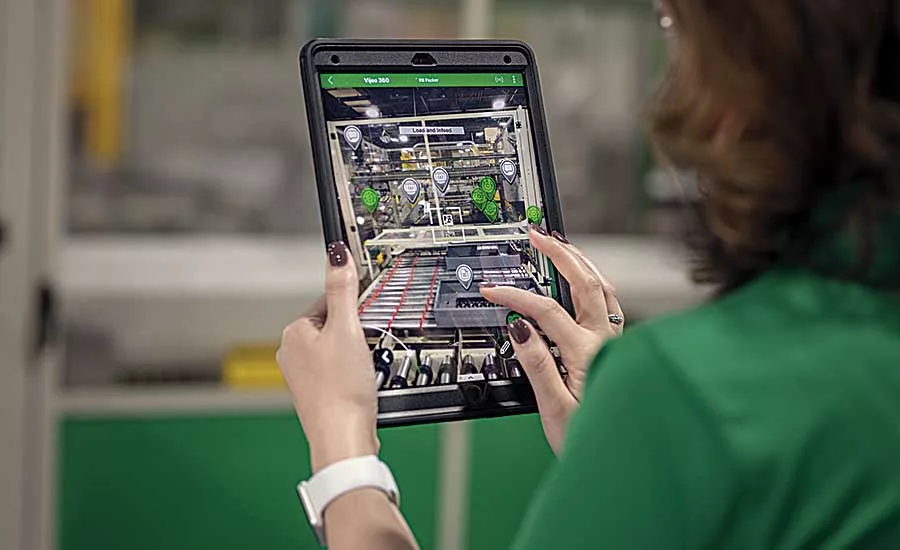
“We’ve started leveraging 5G to simplify factory IT operations, improve support to manufacturing and accelerate factory digitization,” says Luke Durcan, Ph.D., director of EcoStruxure at Schneider Electric. “For example, one pilot integration project is testing our augmented operator advisor application.”
According to Durcan, 5G applications leverage better network quality, faster response times and secure indoor coverage to validate a range of use cases along various aspects, such as:
- Enhancing the real-time augmented reality systems used by maintenance technicians and field workers.
- Improving predictive maintenance through more robust data analytics.
- Enabling factory robots to send video streams and sensor input, and receive real-time instructions to perform tasks.
“There’s no question that the industrial sector has much to gain from the higher network reliability and lower latency that 5G provides,” says Durcan. “Along with speed and dependability, the impact isn’t just about enhanced efficiency.
“Imagine serving customers better as pockets of 5G availability start to connect into a pervasive network that delivers instantaneous and seamless communication and interaction with your web, apps, digital tools, customer-facing platform, and more,” notes Durcan. “And, this is just a slice of the bigger picture from the outside looking into the enterprise layer.
“Also, the enhanced mobile broadband enables immediate use of pattern recognition on data from high-resolution cameras,” adds Durcan. “This near real-time inspection is able to promptly identify uncaught quality violations in production output.
“5G technology is something that can completely disrupt and redesign the production line,” claims Durcan. “Today, we are delivering a variety of automation products. The high density of devices on a factory floor requires the ability to connect a large number of devices.
“We use cabling and deploy wires everywhere in the factory, because industrial networks require a very fast response time,” explains Durcan. “Using the high speed, low latency and massive connectivity features of 5G, connected mobile robots can automatically deliver components to the desired spot based on communication with production line equipment, such as conveyors.”
In addition to speed and dependability, Durcan says the impact of 5G is about enhanced efficiency and improved experiences. Operators can visualize and interact with contextual and real-time information on mobile devices for both production and maintenance applications.
“Improved user experience and visibility have a direct positive impact on operator safety, training, diagnosis and reduction of time to repair,” Durcan point out.
Looking for a reprint of this article?
From high-res PDFs to custom plaques, order your copy today!