Analyzers Aid Automotive Lightweighting Efforts
The adoption of advanced materials is creating challenges for materials analysis and quality control across the automotive supply chain.

Next year, the EU enters the next phase of automotive emissions standards under the current regulation, Euro 6. Average CO2 emissions of new cars must be a maximum of 95 grams per kilometer under real driving conditions. This will drop by a further 15 percent in 2025, and 37.5 percent in 2030. Other territories are following suit. The U.S. Environmental Protection Agency announced in January that it’s working on new rules to decrease vehicle emissions and China 6a is set to come into force this year.
Weight plays a crucial role in a vehicle’s CO2 emissions. A 100-kilogram reduction in weight typically results in a CO2 reduction of 8.5 grams per 100 kilometers. Thus, cutting weight remains high on the agenda for automotive manufacturers striving to get more out of every drop of fuel or, in the case of electric vehicles, more from a single charge.
But how do you cut vehicle weight without compromising material integrity, reducing passenger safety, or adversely affecting the bottom line?
Comparing Light Materials
The automotive sector is working with a range of lightweight materials with different properties. Safety is obviously a priority. Many components must be ductile to absorb energy on impact, while other parts must have strength to maintain structural rigidity, resist corrosion or perform well in intense heat.
Some of these lightweight materials are aluminum, magnesium and high-strength steel.
Aluminum weighs about a third of steel. For example, BMW recently used the metal to more than halve the weight of the tailgate on its 5 Series sedans. By 2022, the average car is expected to contain around 100 kilograms of aluminum as a replacement for steel and other, heavier materials. But, by itself, aluminum can be relatively weak.
The introduction of lithium significantly increases the tensile strength of aluminum. But aluminum-lithium alloys can also be brittle, and subject to deformation and fracture. Phosphorous and sulphur can be added to the alloys to improve machinability. However, both elements have a detrimental effect on corrosion resistance, and the quantities of each must be strictly controlled.
Looking for quick answers on assembly and manufacturing topics? Try Ask ASM, our new smart AI search tool. Ask ASM
Magnesium is the lightest structural metal, 75 percent lighter than steel and 33 percent lighter than aluminum. Additionally, it’s both abundant and easily recyclable. Opel, a subsidiary of Groupe PSA, Europe’s second biggest car maker, has replaced steel with magnesium to cut 5 kilograms from the dashboard support of the Vectra sedan.
However, the material is also brittle without the addition of rare earth elements—such as dysprosium, praseodymium and ytterbium—and it lacks the creep resistance of aluminum.
Materials research and development is tackling these issues. In 2017, scientists at Melbourne’s Monash University announced a process to change the microstructure of magnesium to make it malleable at room temperature. Also in 2017, researchers at the Pacific Northwest National Lab published details of a novel extrusion process that greatly improves the energy absorption and ductility of magnesium through the creation of microstructures in the magnesium, making it more feasible for a larger range of car parts.
As a result, the global market for magnesium and aluminum alloy automotive components is predicted to grow at a cumulative annual rate of 7 percent, topping $48 billion by 2021.
While the market for aluminum and magnesium is expected to grow, steel isn’t going away. In a bid to regain market share, many steelmakers are developing super-lightweight steel alloys that are stronger, less expensive and almost as lightweight as aluminum. New products are expected on the market in 2021.
The need for testing
The adoption of advanced materials is creating challenges for materials analysis and quality control across the automotive supply chain. Traces of residual elements can alter the properties of an alloy, and minute changes in the relative quantities of an element can significantly affect the ductility or corrosion resistance of a component. Additionally, the increased use of recycled metal by foundries may lead to unfamiliar elements being introduced into alloys.
The need to analyze alloy chemistry down to the parts per million level is crucial. The development of new alloys means foundries must be extra vigilant with their testing processes. But, testing must go well beyond the foundry. Analysis needs to be undertaken throughout the supply chain, and it’s especially vital when the alloys reach the OEM.
As supply chains become more complex, new analytical technologies are emerging to enable automotive manufacturers to ensure materials meet quality requirements.
Testing methods
The field of materials analysis has been changing rapidly in recent years. Three technologies—optical emission spectroscopy (OES), X-ray fluorescence (XRF) and laser-induced breakdown spectroscopy (LIBS)—have emerged to help engineers to identify the various elements in metal alloys. Knowing the composition of sheet metal on delivery can help prevent subsequent problems during stamping or welding.
Each technology works in different ways, and each has its own strengths and weaknesses.
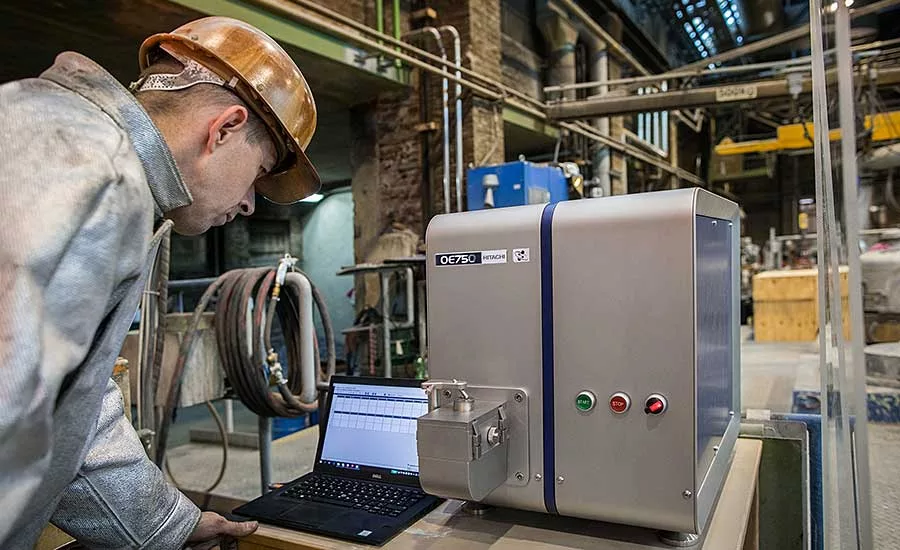
OES uses electricity to excite the molecules in a sample and measure the relative proportions of each element. It does this with sparks (a series of multi-discharge events where the voltage of the electrode is switched on and off) or an arc (a single on-off event similar to a lightning strike).
OES devices offer the highest levels of accuracy. They can detect very low levels of all the important alloying elements. While the technique can only be used to test metals, it can measure nonmetallic elements within them. Indeed, it excels at measuring the levels of carbon, boron, phosphorous and nitrogen in steel. For example, the Hitachi High-Tech OE750 has a wavelength range of 119 to 766 nanometers, which covers all elements from hydrogen to uranium for complete metals analysis.
However, OES will leave a burn mark on the sample. It also requires argon gas canisters, unless used with an arc probe.
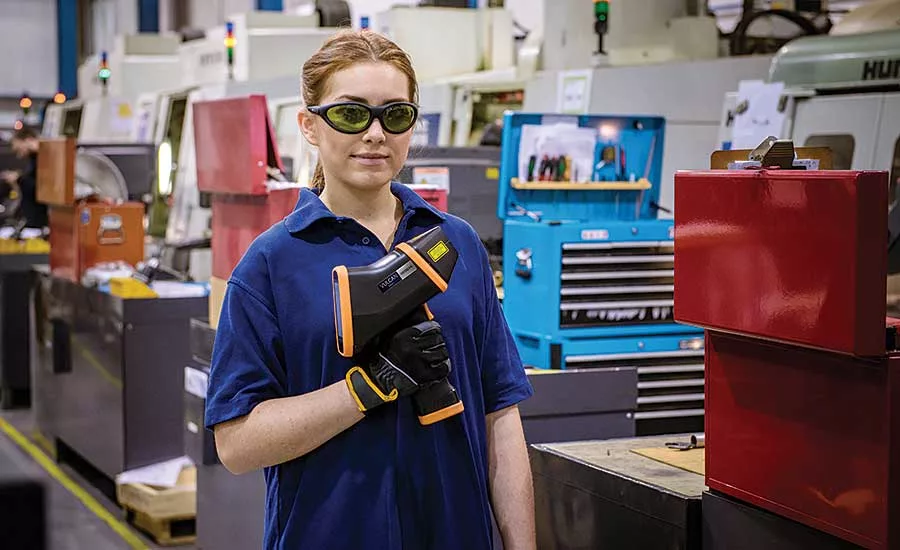
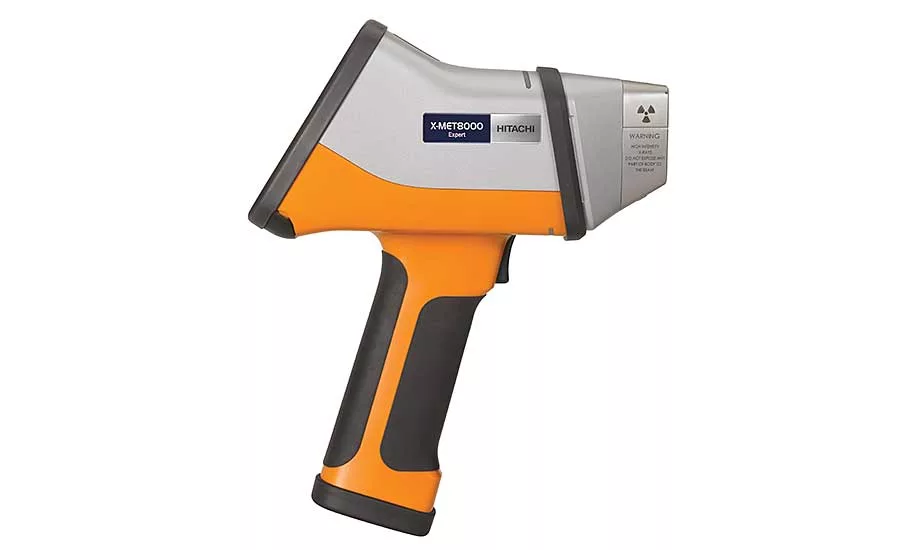
XRF is an established and well-trusted analytical technology, having been used in benchtop, portable and, more recently, handheld materials analysis for more than 45 years. The technique uses X-rays, which are generated by the source and directed at the sample, to excite the molecules at the surface of the sample. Atoms in the sample react and generate secondary X-rays, which are collected and processed by a detector.
Unlike OES and LIBS, XRF is a nondestructive form of material analysis. It can measure solids, liquids and powders, including coating thickness, which can be critical in several aspects of the automotive sector, as well as in industries like aerospace. XRF analyzers are ideal for accurately determining chemical composition, including identifying trace and tramp elements. Like LIBS, the technique is ideally suited to quality testing of lightweight steels.
However, XRF technology cannot measure all elements, including lithium and boron, which are both used to form aluminum alloys.
The newest and fastest of the three methods, LIBS uses a laser diode to emit a small, powerful laser onto the surface of a sample and dissipate a small amount to form an energized plasma. As the plasma cools, each element in the sample emits energy at a characteristic wavelength which can be measured using a spectrometer. A measurement can be carried as fast as a single second.
Samples can be conductive or nonconductive materials, but the LIBS technique needs a solid surface that is clear of dirt and contaminants. The technology is particularly good for measuring aluminum alloys.
While it is a destructive testing method, LIBS is less destructive than OES. The laser burn is usually considered to be surface roughness rather than a defect in a component.
testing protocols
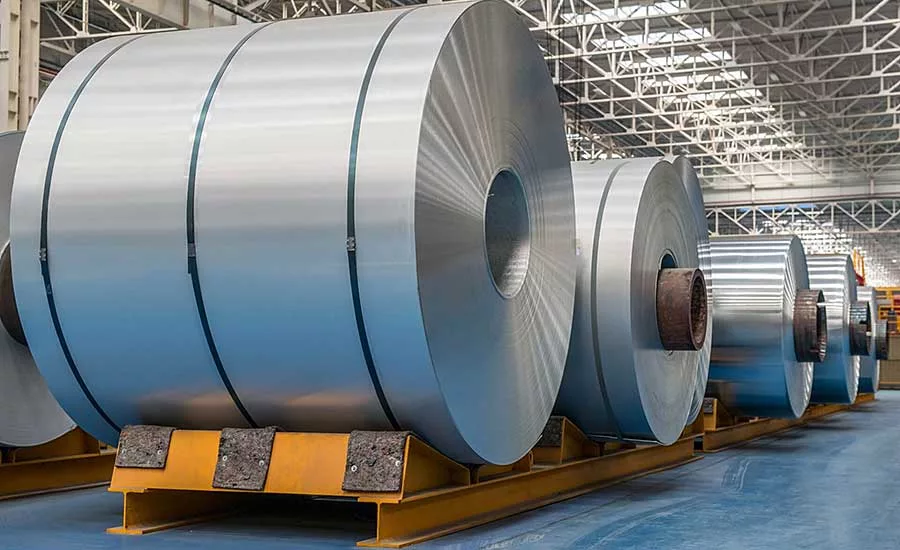
Each company will have its own protocol for testing incoming materials and parts. If, for example, an automotive supplier receives a shipment of 10 coils of aluminum sheet, it will typically check each coil to ensure the alloy has been produced to specification. Such a routine for purchased material inspection shouldn’t require too much effort. On the other hand, an automotive OEM receiving a shipment of 10,000 stamped metal parts might test only a sample.
The field of materials analysis has been changing to keep pace with new regulations and innovations in the automotive industry. The continued development of analytical technologies is making materials testing easier for companies across the industry.
Delays in the analysis of incoming materials will eat into working capital. Yet, the use of a material with an unacceptable level of impurity can be far more costly, both to a business’ bank balance and to its reputation. As such, choosing the right technologies for every stage of the automotive development process is critical, from foundries, fabricators and metal component producers to electronics suppliers and recycling facilities.
Regulatory requirements are becoming more stringent and the demand to adopt a new generation of lightweight, high-performance materials is increasing pressure on the automotive sector. The application of analytical technologies like OES, XRF and LIBS can help manufacturers prevent defects and maintain a competitive edge.
Looking for a reprint of this article?
From high-res PDFs to custom plaques, order your copy today!