Assembly Magazine logo
search
Ask ASSEMBLY AI
cart
facebook twitter linkedin youtube
  • Sign In
  • Create Account
  • Sign Out
  • My Account
Assembly Magazine logo
  • TRENDS
    • Ask ASSEMBLY AI
    • Trends
    • News
    • New Products
  • INDUSTRIES
    • Aerospace
    • Appliance
    • DFMA Assembly
    • Medical Devices
    • Green Manufacturing
    • Lean Manufacturing
    • Machinery Assembly
    • Electronics Assembly
    • Automotive
  • TECHNOLOGIES
    • Adhesives & Dispensing
    • Assembly Presses
    • Automated Assembly Systems
    • Manufacturing Management
    • Manufacturing Software
    • Motion Control
    • Screwdriving & Riveting
    • Robotics
    • Test & Inspection
    • Plastics & Metal Welding
    • Wire Processing
    • Workstations
  • AUTONOMOUS & ELECTRIC MOBILITY
    • AEM Magazine Archives
    • Autonomy
    • Electrification
    • Mobility Services
    • Assembly & Testing
    • AV/EM News
  • MEDIA
    • Ask ASSEMBLY AI
    • Podcasts
    • Assembly News Now
    • Assembly TV
    • Webinars
    • eBooks
  • EVENTS
    • Calendar
    • The ASSEMBLY Show
  • MORE
    • Exclusives >
      • Plant of the Year
      • Capital Spending
    • Buyers Guide >
      • Supplier Insights
    • Classifieds
    • Featured Products
    • Newsletters
    • Store
    • White Papers
    • Columns
    • Sponsor Insights
  • INFOCENTER
    • Assembly & Test Solutions
  • EMAGAZINE
    • eMagazine
    • Archive Issues
    • Advertise
    • Contact Us
    • Sign Up
TechnologiesAutomated Assembly SystemsRobotics Assembly

Long Live the Robot Teach Pendant
By Luke Tuttle, Ben Gibbs
Long Live the Robot Teach Pendant
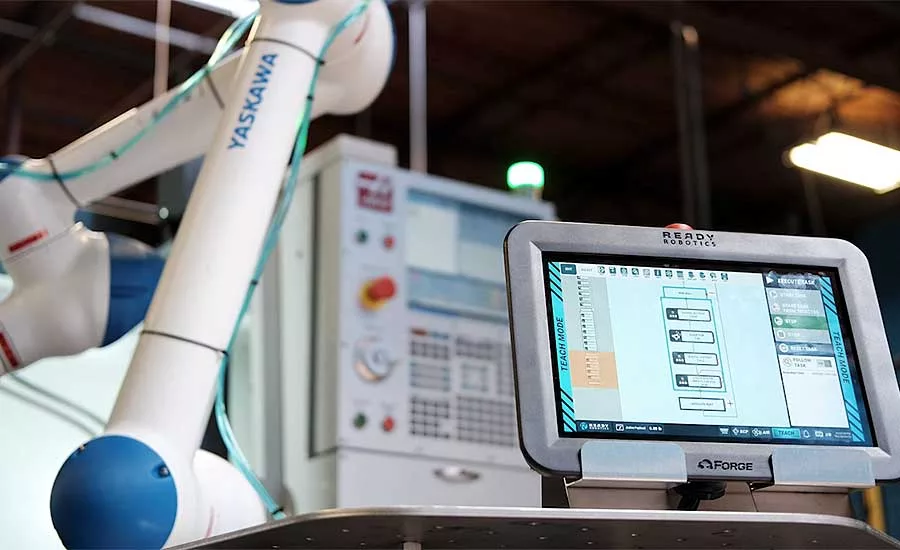
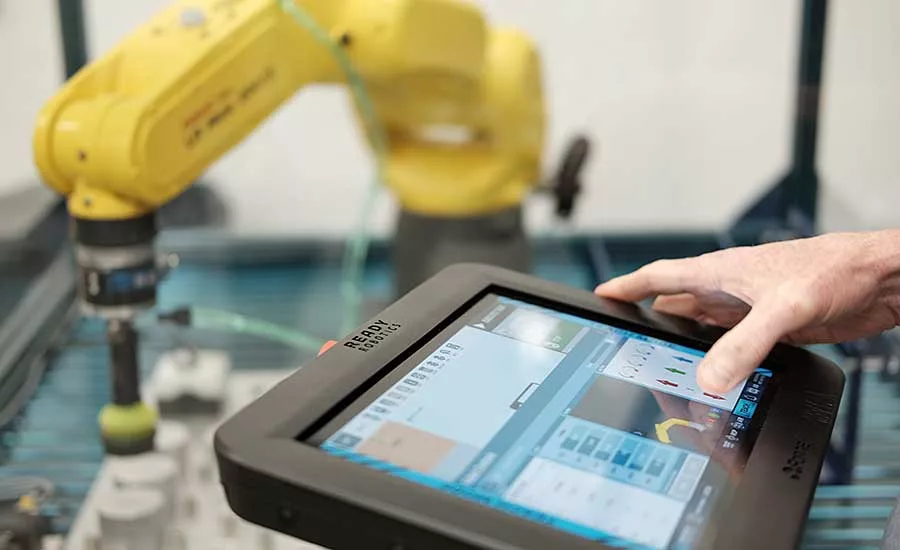
This advanced teach pendant has an intuitive touch screen interface rather than complex text-based menus an operator must access through a keypad. PHOTO COURTESY READY ROBOTICS
Long Live the Robot Teach Pendant
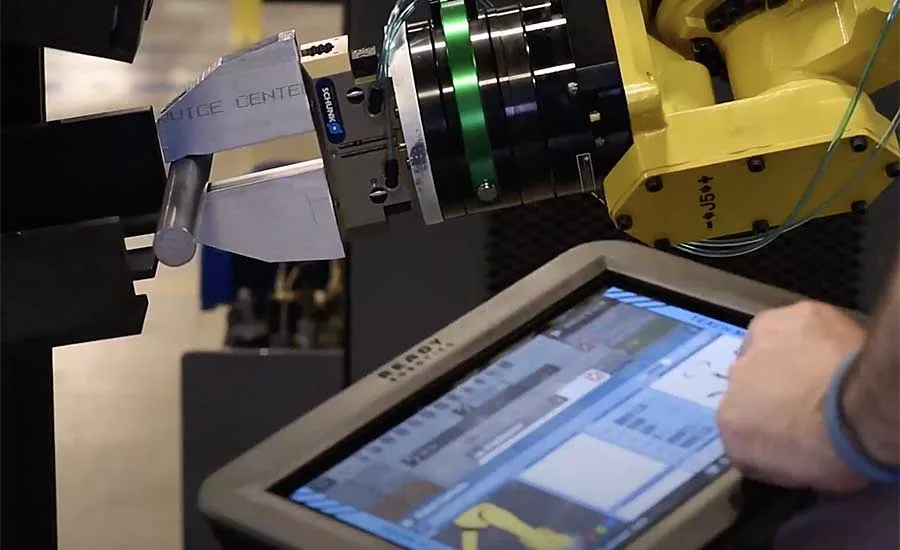
Using visual cues on a touch screen robot teach pendant, an operator moves a gripper in to grasp a rod as part of an assembly operation. PHOTO COURTESY READY ROBOTICS
Long Live the Robot Teach Pendant
Using visual cues on a touch screen robot teach pendant, an operator moves a gripper in to grasp a rod as part of an assembly operation. PHOTO COURTESY READY ROBOTICS
Long Live the Robot Teach Pendant
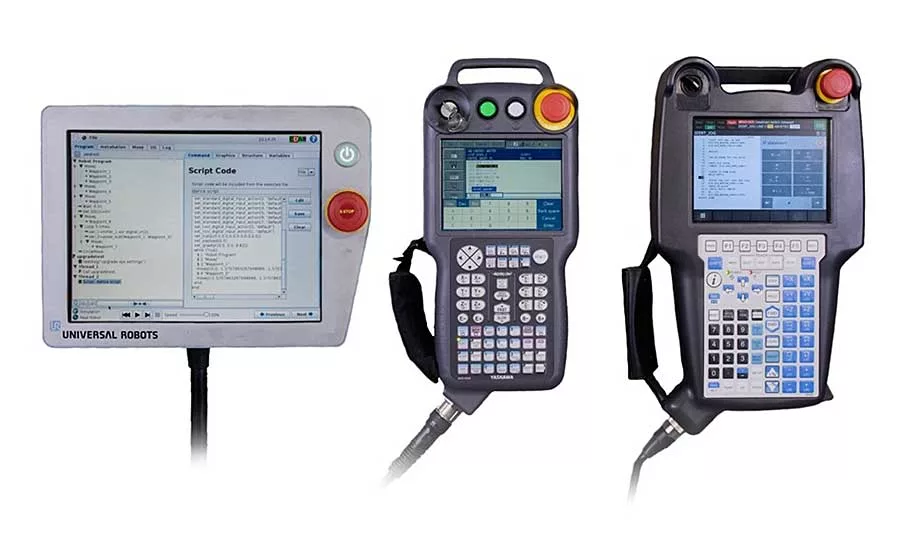
Teach pendants for several popular industrial and collaborative robots have not kept pace with the evolution of modern touch screen interfaces. PHOTO COURTESY READY ROBOTICS
Long Live the Robot Teach Pendant
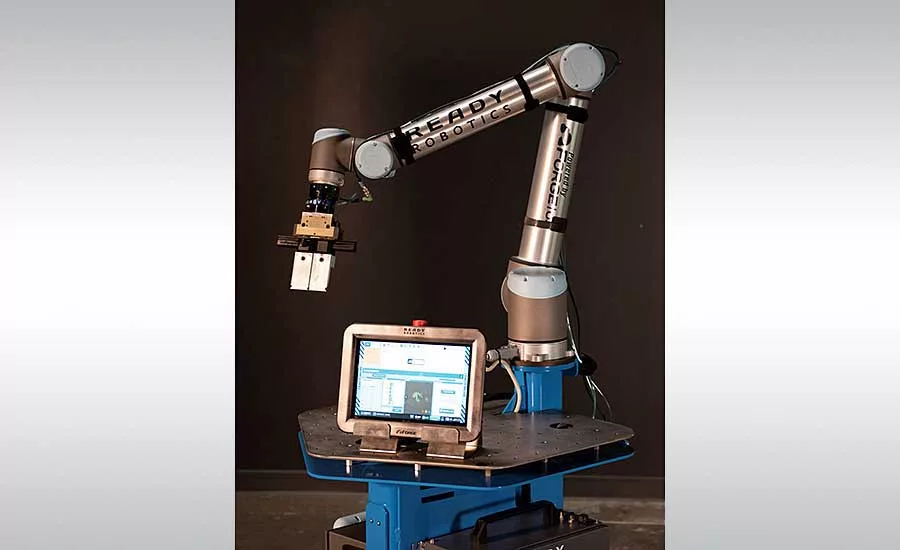
The Forge/ Station features a breadboard fixturing table top that allows customers to easily set up jigs and fixtures for assembly tasks. PHOTO COURTESY READY ROBOTICS
Long Live the Robot Teach Pendant
December 2, 2020

Although many programming and controlling technologies for industrial robots have evolved over the last several years, one component has remained fairly constant—the robot teach pendant. Most pendants today are brand specific, hard to use, and lack the basic functions and features we expect from our everyday devices. Even a simple function such as copy and paste is an impossibility on many current models.

Therefore, it’s time to transform the teach pendant into something befitting the capabilities of modern technology, since direct user control of a robot remains a critical part of robotic operations. This fact is true even in light of tools such as offline robotic programming (OLRP) software.

The transformed teach pendant provides many benefits. It reduces or eliminates the training necessary to work with robotic systems, as well as robot downtime by simplifying analysis and problem resolution. In addition, it allows more robotic systems to be deployed and more quickly programmed, including in industries where they are not present.

With visual programming software, such as the Task Canvass (which runs on READY Robotics’ Forge/Os interface), this pendant becomes versatile enough to control all brands of industrial robots. Compare that with today, when there are more than 70 brands of robots, and each has its own teach pendant and control software. Plus, almost every robot has a unique programming or scripting language that requires extensive training to ensure proper use.

A transformed pendant also eliminates the need for complex robot programming languages, and it has an intuitive touch screen interface rather than complex text-based menus an operator must access through a keypad. This latter feature may be the most important of all, for it makes the teach pendant as easy to use as a smartphone.


Still a Necessity

The percentage of manufacturers that use an advanced robot teach pendant is still relatively small. However, this fact should not be bemoaned, as there are many reasons—10, in fact—that the traditional teach pendant is still a necessity.

The first reason is safety. To program a non-collaborative industrial robot, a three-position switch (also known as a dead man’s switch) is required. The teach pendant enables the user, through the use of a key, to change the operating mode of the robot from a teaching mode to unrestricted operation.

Looking for quick answers on assembly and manufacturing topics? Try Ask ASM, our new smart AI search tool. Ask ASM →

Even with the rise of collaborative robots, there are still times when a robot needs to stop itself. Protective stops that ensure this safety must be cleared by the teach pendant. Because every system is prone to failures, an operator needs to be able to take control of the robot and move it to a safe position so he can enter the workcell cage, or move the robot to any desired location. A teach pendant is still the most efficient way to perform these operations.

Another reason for pendant necessity is to monitor the robot and all equipment in the workcell for any errors and negative trends that result in audible alarms. While a program is running, the teach pendant is the window into the robot’s operation and where it is at in terms of overall program control.

The pendant is also a great way to test a new program for a robot. Whether done on the teach pendant or via a third-party tool such as an OLRP application, a program must be tested at a slow speed under operator supervision. During this testing, the operator checks for clearance between the robot and the hardware (such as machine tools) in the workcell.

Other testing activities performed with the pendant include teaching base frames and tool frames, and walking through lines or program sections one step at a time. The operator can run the robot slowly to confirm how it navigates through the workcell. And, he can validate all of the sections in the workcell that the robot and its tools are acting upon.

A fourth reason that pendants are necessary is to touch up, or make adjustments to, a robot program. This process is needed when the robot begins to mistakenly drift in one direction (resulting in less accuracy), or the simulation does not exactly match the real world. Keep in mind that variations of less than 1 millimeter can often make all the difference between a robot successfully executing a weld and experiencing failure.

One common problem that necessitates touching up is robot end-of-arm tooling (EOAT) that is incorrectly aligned or unable to reach the part. Other problems include those related to workcell simulation. For example, it may not match the workcell’s actual dimensions, or a part’s CAD model. Imperfections in the physical workcell may also occur. A good example is when the robot slightly jogs (i.e., is manually moved via the teach pendant) on the seventh axis rail, whereas the simulation expects the movement to be perfect.

Several programming tasks are more quickly done in the teach pendant than in OLRP. The latter’s software tools are well suited for applications that have hundreds or thousands of points, such as complex paths needed for welding or dispensing. These types of applications justify the upfront invest-ment in software that uses CAD models to setup the workcell before fully simulating its operation.

However, many tasks do not involve such complex movements. For example, machine tending, pick and place, straight line welding and dispensing can often be programmed more easily via the teach pendant. These operations also have to be done quickly, especially in high-mix, low-volume environments to reduce the impact of changeover time.

Reason six is the teach pendant reliably prompts the operator for an input. Especially when starting a new task, the operator may want to pause the program to check the parts or to inspect other areas of the application. He can also use the teach pendant to interact with the task when the application is running. Input prompts are not programmed in OLRP software.

The teach pendant enables integration of many components such as laser scanners, stack lights, and automated workholding devices within a workcell. As a result, once the program is loaded on the robot, subroutines are written that coordinate the robot’s movements with other activities in the workcell.

The coding of these subroutines is also performed by the teach pendant. Many shops have developed specific subroutines, such as for part drop-off, that they easily maintain in the pendant.

In OLRP, it is not practical to perform all aspects of robot programming; for example, determining the robot’s material handling steps before and after its complex movement path.

Another benefit of the teach pendant is it lets users add control logic. Once an operator has created and tested his program, he needs to run tens of parts. With the teach pendant, he can add in the control logic that enables the application to be run unattended, often in coordination with other robots or equipment in the workcell. In contrast, most OLRP software neither has built-in control logic constructs, nor allows it to be added.

Finally, the teach pendant offers a high degree of interaction between configuring an application and executing it. Because there is no need to transfer programs from another device, the operator can quickly and efficiently implement the task.


A Better Pendant

The teach pendant has been, and remains, a key part of the robot ecosystem. But, we believe its capabilities can be expanded, so that it may be used with, and control, all types of industrial robots.

To achieve this goal, we’ve developed the Forge/Station, which features a breadboard fixturing table top, a robot arm, a pendant equipped with Task Canvas visual programming software, and the Forge/OS interface, which controls the arm and all pneumatics.

The software works with any touch screen teach pendant, and it removes the barrier of needing an operator skilled in a particular robot brand. Equally important, it enables more people to use robots, increases the number of robots that can be deployed and eliminates the bottlenecks due to limited skilled labor that exist today.

For more information, call READY Robotics at 833-732-3967 or visit www.ready-robotics.com.


Manufacturer Doubles Production to Meet Skyrocketing Demand for Ventilators

When the COVID-19 pandemic hit earlier this year, Alicat Scientific was already in the midst of automating the tending of its lathes that machine parts for the company’s mass flow meters and controllers, and pressure controllers. All three components are key parts of ventilators, which are in great demand by hospitals nationwide.

Alicat turned to automation to shorten the 45-minute cycle time that its workers needed to machine components on their lathes. This long cycle time had become a choke point in the company’s manufacturing operations and prevented it from meeting steadily growing demand due to COVID-19.

After extensive research, Alicat purchased and installed the Forge/Station from READY Robotics. The station includes a breadboard fixturing table top, a pendant equipped with Task Canvas visual programming software, a robot arm and the Forge/OS interface, which controls the arm and all pneumatics.

Greg Camron, machine shop manager at Alicat Scientific, says that, although the company’s machinists had never previously programmed an industrial robot, they were able to do so in one day without so much as a training class. In addition, they were able to fully deploy their automation tasks in just three days, with no outside support.

According to Camron, the Forge/Station has enabled Alicat to boost its meter and controller output by 74 percent. The company has also added a “lights out” third shift on weekdays and another two “lights out” shifts on the weekend.

“This automation bundle has performed beyond our expectations,” says Camron. “It allowed us to meet the COVID-19-related demand that would have been impossible before. We couldn’t be more pumped, and we’re looking for the next task to automate.”

KEYWORDS: factory automation

Share This Story

Looking for a reprint of this article?
From high-res PDFs to custom plaques, order your copy today!

LUKE TUTTLE — COO // READY ROBOTICS // COLUMBUS, OH

BEN GIBBS — CEO AND COFOUNDER // READY ROBOTICS // COLUMBUS, OH

Recommended Content

JOIN TODAY
To unlock your recommendations.

Already have an account? Sign In

  • Made in the U.S.A.

    Consumer Products Manufacturing: Made in the USA

    Supply chain lessons learned during the coronavirus...
    Automated Assembly Systems
    By: Austin Weber
  • Best Practices for Press-Fit Assembly

    Best Practices for Press-Fit Assembly

    In manufacturing, ironclad formulas for success are hard...
    Assembly Presses
    By: Jim Camillo
  • aem0523leader-tesla1.jpg

    Tesla Rethinks the Assembly Line

    Engineers at Tesla Inc. have developed a new process that...
    Industries
    By: Austin Weber
Manage My Account
  • eMagazine Subscription
  • Assembly Newsletters
  • Online Registration
  • Subscription Customer Service
  • Manage My Preferences

More Videos

Sponsored Content

Sponsored Content is a special paid section where industry companies provide high quality, objective, non-commercial content around topics of interest to the ASSEMBLY audience. All Sponsored Content is supplied by the advertising company and any opinions expressed in this article are those of the author and not necessarily reflect the views of ASSEMBLY or its parent company, BNP Media. Interested in participating in our Sponsored Content section? Contact your local rep!

close
  • ultrasonic welding
    Sponsored bySonobond Ultrasonics

    Engineering Efficiency in High-Performance Assembly: How Ultrasonic Welding Enhances Throughput, Reliability and Quality

  • UV curing system
    Sponsored byDymax

    Why UV Intensity Alone Doesn’t Define Curing Performance

  • wooden pallets
    Sponsored byLEAN Manufacturing Products

    Eliminating Waste on the Shop Floor: Applying Lean Principles to Improve Manufacturing Efficiency

Popular Stories

Ferrari

Ferrari Unveils Four-Door EV

ASSEMBLY News Now, episode-30: Volvo Redesigns EV Manufacturing

Volvo Redesigns EV Manufacturing

Robots working at Toyota Plant in Japan

Toyota Deploys Geekplus Robots for Factory Material Handling

Watch the latest episode of ANN now!

Events

July 24, 2025

From Shop Floor to CFO: How Manufacturers Are Closing the Loop Between Operations and Finance

On Demand Learn how manufacturers are bridging the gap between the shop floor and ERP systems to gain real-time visibility, streamline operations, and kick-start digital transformation—without waiting years.

Sponsored by:

PicoStratusGreen
July 30, 2025

Buffer Analysis and Design Fundamentals for Manufacturing Excellence

On Demand In this presentation, Dr. Herman Tang shares practical insights from his industry experience and research on buffer management in manufacturing operations.

View All Submit An Event

Poll

Difficult Assembly Processes

Which assembly process gives you the most difficulty?
View Results Poll Archive

Products

Manufacturing Cost Policy Deployment (MCPD) Profitability Scenarios: Systematic and Systemic Improvement of Manufacturing Costs

Manufacturing Cost Policy Deployment (MCPD) Profitability Scenarios: Systematic and Systemic Improvement of Manufacturing Costs

See More Products
ebook

Related Articles

  • quadruped robot learns from synthetic data

    ‘Machine Dreams’ Help MIT Engineers Teach Robot Dog New Tricks

    See More
  • 'The Robot Made Me Do It'

    See More
  • Delmia Debuts "The Robot Whisperers" Video Series

    See More

Related Products

See More Products
  • digitalization.jpg

    The Digitalization of the 21st Century Supply Chain

  • foreman.jpg

    The Foreman on the Assembly Line

  • history.jpg

    Faster, Better, Cheaper in the History of Manufacturing: From the Stone Age to Lean Manufacturing and Beyond

See More Products

Related Directories

  • DENSO Robotics

×

Never miss the latest news and trends driving the manufacturing industry

Stay in the know on the latest assembly trends.

JOIN TODAY!
  • RESOURCES
    • Advertise
    • Contact Us
    • Directories
    • Manufacturing Division
    • Store
    • Want More?
  • SIGN UP TODAY
    • Create Account
    • eMagazine
    • Newsletters
    • Customer Service
    • Manage Preferences
  • SERVICES
    • Marketing Services
    • Reprints
    • Market Research
    • List Rental
    • Survey/Respondent Access
  • STAY CONNECTED
    • LinkedIn
    • Facebook
    • Instagram
    • YouTube
    • X (Twitter)
  • PRIVACY
    • PRIVACY POLICY
    • TERMS & CONDITIONS
    • DO NOT SELL MY PERSONAL INFORMATION
    • PRIVACY REQUEST
    • ACCESSIBILITY

Copyright ©2026. All Rights Reserved BNP Media, Inc. and BNP Media II, LLC.

Design, CMS, Hosting & Web Development :: ePublishing