Assembly Magazine logo
search
Ask ASSEMBLY AI
cart
facebook twitter linkedin youtube
  • Sign In
  • Create Account
  • Sign Out
  • My Account
Assembly Magazine logo
  • TRENDS
    • Ask ASSEMBLY AI
    • Trends
    • News
    • New Products
  • INDUSTRIES
    • Aerospace
    • Appliance
    • DFMA Assembly
    • Medical Devices
    • Green Manufacturing
    • Lean Manufacturing
    • Machinery Assembly
    • Electronics Assembly
    • Automotive
  • TECHNOLOGIES
    • Adhesives & Dispensing
    • Assembly Presses
    • Automated Assembly Systems
    • Manufacturing Management
    • Manufacturing Software
    • Motion Control
    • Screwdriving & Riveting
    • Robotics
    • Test & Inspection
    • Plastics & Metal Welding
    • Wire Processing
    • Workstations
  • AUTONOMOUS & ELECTRIC MOBILITY
    • AEM Magazine Archives
    • Autonomy
    • Electrification
    • Mobility Services
    • Assembly & Testing
    • AV/EM News
  • MEDIA
    • Ask ASSEMBLY AI
    • Podcasts
    • Assembly News Now
    • Assembly TV
    • Webinars
    • eBooks
  • EVENTS
    • Calendar
    • The ASSEMBLY Show
  • MORE
    • Exclusives >
      • Plant of the Year
      • Capital Spending
    • Buyers Guide >
      • Supplier Insights
    • Classifieds
    • Featured Products
    • Newsletters
    • Store
    • White Papers
    • Columns
    • Sponsor Insights
  • INFOCENTER
    • Assembly & Test Solutions
  • EMAGAZINE
    • eMagazine
    • Archive Issues
    • Advertise
    • Contact Us
    • Sign Up
ColumnsRobotics AssemblyThe Editorial

'The Robot Made Me Do It'
By John Sprovieri
‘The Robot Made Me Do It’
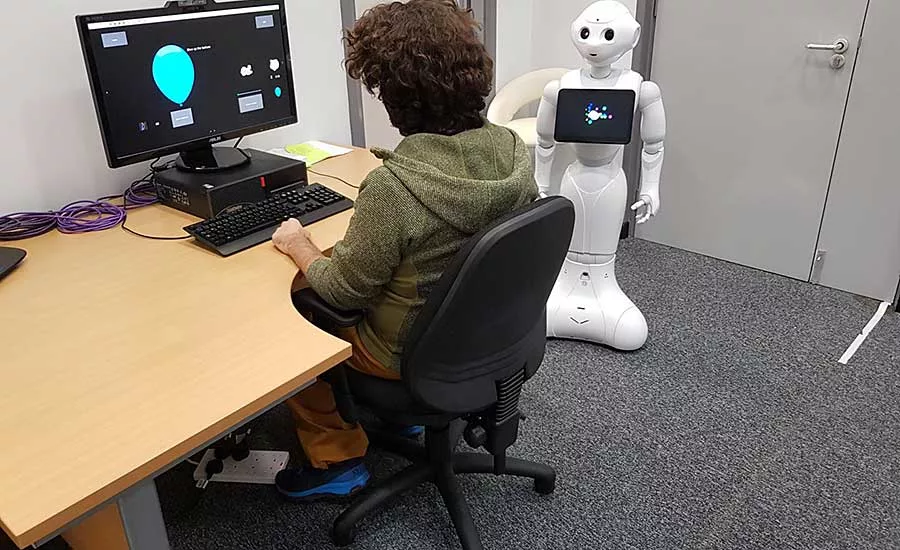
A new study has found that robots can encourage people to take greater risks in a simulated gambling scenario than they would if there was nothing to influence their behaviors. Photo courtesy University of Southampton
April 7, 2021

Robots are becoming nearly as common in assembly plants as nutrunners and conveyors. The advent of collaborative robots is only furthering that trend. However, as robots play a greater role on the line, engineers must ensure that workers remain safe around the technology.

A new study conducted by researchers at the University of Southampton in England shows why. The researchers found that robots can encourage people to take greater risks in a simulated gambling scenario than they would if there was nothing to influence their behaviors. “We know that peer pressure can lead to higher risk-taking behavior,” explains lead researcher Yaniv Hanoch, Ph.D., associate professor of risk management. “With the ever-increasing scale of interaction between humans and technology, both online and physically, it is crucial that we understand more about whether machines can have a similar impact.”

Published in December, the study involved 180 undergraduate students taking the Balloon Analogue Risk Task, a computer assessment that asks participants to press the spacebar on a keyboard to inflate a balloon displayed on the screen. With each press of the spacebar, the balloon inflates slightly, and 1 penny is added to the player’s “temporary money bank.” The balloons can explode randomly, meaning the players lose any money they have won for that balloon. Players have the option to “cash-in” before this happens and move on to the next balloon.

One third of the participants took the test in a room on their own. One third took the test alongside a talking robot that only provided instructions on how to take the test, but was silent the rest of the time. These were the control groups. The remaining participants, the experimental group, took the test with the robot providing instruction, as well as encouraging statements, such as “why did you stop pumping?”

The robot was the Pepper humanoid robot from SoftBank Robotics. Just under 4 feet tall, the robot can recognize human faces and emotions and is designed to interact with people.

The results showed that the group encouraged by the robot took more risks, blowing up their balloons significantly more frequently than those in the other groups. They also earned more money overall. There was no significant difference in the behaviors of the students accompanied by the silent robot and those with no robot.

“We saw participants in the control condition scale back their risk-taking behavior following a balloon explosion, whereas those in the experimental condition continued to take as much risk as before,” says Hanoch. “So, receiving direct encouragement from a risk-promoting robot seemed to override participants’ direct experiences and instincts.”

Looking for quick answers on assembly and manufacturing topics? Try Ask ASM, our new smart AI search tool. Ask ASM →

Hanoch says further studies are needed to see whether similar results would emerge from human interaction with artificial intelligence systems, such as digital assistants or on-screen avatars.

“With the wide spread of AI technology and its interactions with humans, this is an area that needs urgent attention from the research community,” he says.

KEYWORDS: collaborative robots factory automation flexible assembly robot safety

Share This Story

Looking for a reprint of this article?
From high-res PDFs to custom plaques, order your copy today!

John has been with ASSEMBLY magazine since February 1997. John was formerly with a national medical news magazine, and has written for Pathology Today and the Green Bay Press-Gazette. John holds a B.A. in journalism from Northwestern University, Medill School of Journalism.

Recommended Content

JOIN TODAY
To unlock your recommendations.

Already have an account? Sign In

  • Made in the U.S.A.

    Consumer Products Manufacturing: Made in the USA

    Supply chain lessons learned during the coronavirus...
    Automated Assembly Systems
    By: Austin Weber
  • Best Practices for Press-Fit Assembly

    Best Practices for Press-Fit Assembly

    In manufacturing, ironclad formulas for success are hard...
    Assembly Presses
    By: Jim Camillo
  • aem0523leader-tesla1.jpg

    Tesla Rethinks the Assembly Line

    Engineers at Tesla Inc. have developed a new process that...
    Assembly and Testing
    By: Austin Weber
Manage My Account
  • eMagazine Subscription
  • Assembly Newsletters
  • Online Registration
  • Subscription Customer Service
  • Manage My Preferences

More Videos

Sponsored Content

Sponsored Content is a special paid section where industry companies provide high quality, objective, non-commercial content around topics of interest to the ASSEMBLY audience. All Sponsored Content is supplied by the advertising company and any opinions expressed in this article are those of the author and not necessarily reflect the views of ASSEMBLY or its parent company, BNP Media. Interested in participating in our Sponsored Content section? Contact your local rep!

close
  • ultrasonic welding
    Sponsored bySonobond Ultrasonics

    Engineering Efficiency in High-Performance Assembly: How Ultrasonic Welding Enhances Throughput, Reliability and Quality

  • UV curing system
    Sponsored byDymax

    Why UV Intensity Alone Doesn’t Define Curing Performance

  • wooden pallets
    Sponsored byLEAN Manufacturing Products

    Eliminating Waste on the Shop Floor: Applying Lean Principles to Improve Manufacturing Efficiency

Popular Stories

Ferrari

Ferrari Unveils Four-Door EV

ASSEMBLY News Now, episode-30: Volvo Redesigns EV Manufacturing

Volvo Redesigns EV Manufacturing

Robots working at Toyota Plant in Japan

Toyota Deploys Geekplus Robots for Factory Material Handling

Watch the latest episode of ANN now!

Events

July 24, 2025

From Shop Floor to CFO: How Manufacturers Are Closing the Loop Between Operations and Finance

On Demand Learn how manufacturers are bridging the gap between the shop floor and ERP systems to gain real-time visibility, streamline operations, and kick-start digital transformation—without waiting years.

Sponsored by:

PicoStratusGreen
July 30, 2025

Buffer Analysis and Design Fundamentals for Manufacturing Excellence

On Demand In this presentation, Dr. Herman Tang shares practical insights from his industry experience and research on buffer management in manufacturing operations.

View All Submit An Event

Poll

Difficult Assembly Processes

Which assembly process gives you the most difficulty?
View Results Poll Archive

Products

Manufacturing Cost Policy Deployment (MCPD) Profitability Scenarios: Systematic and Systemic Improvement of Manufacturing Costs

Manufacturing Cost Policy Deployment (MCPD) Profitability Scenarios: Systematic and Systemic Improvement of Manufacturing Costs

See More Products
ebook

Related Articles

  • Do-It-Yourself Automation

    See More
  • Do-It-Yourself Automation

    See More
  • Detroit Tries Do-It-Yourself Assembly

    See More

Related Products

See More Products
  • history.jpg

    Faster, Better, Cheaper in the History of Manufacturing: From the Stone Age to Lean Manufacturing and Beyond

  • digitalization.jpg

    The Digitalization of the 21st Century Supply Chain

See More Products

Related Directories

  • Pico MES

    PICO makes error-proofing easy. By integrating with over 200 tools, devices, and systems, we enable instant shop floor connectivity, capturing valuable data for cycle time improvement, product quality, and operator efficiency. Manufacturers are no longer tied to the constraints of brand-specific tools and writing custom scripts for integration. PICO is designed by end users, for future end users
  • Made to Measure Metrology

×

Never miss the latest news and trends driving the manufacturing industry

Stay in the know on the latest assembly trends.

JOIN TODAY!
  • RESOURCES
    • Advertise
    • Contact Us
    • Directories
    • Manufacturing Division
    • Store
    • Want More?
  • SIGN UP TODAY
    • Create Account
    • eMagazine
    • Newsletters
    • Customer Service
    • Manage Preferences
  • SERVICES
    • Marketing Services
    • Reprints
    • Market Research
    • List Rental
    • Survey/Respondent Access
  • STAY CONNECTED
    • LinkedIn
    • Facebook
    • Instagram
    • YouTube
    • X (Twitter)
  • PRIVACY
    • PRIVACY POLICY
    • TERMS & CONDITIONS
    • DO NOT SELL MY PERSONAL INFORMATION
    • PRIVACY REQUEST
    • ACCESSIBILITY

Copyright ©2026. All Rights Reserved BNP Media, Inc. and BNP Media II, LLC.

Design, CMS, Hosting & Web Development :: ePublishing