Assembly Magazine logo
search
Ask ASSEMBLY AI
cart
facebook twitter linkedin youtube
  • Sign In
  • Create Account
  • Sign Out
  • My Account
Assembly Magazine logo
  • TRENDS
    • Ask ASSEMBLY AI
    • Trends
    • News
    • New Products
  • INDUSTRIES
    • Aerospace
    • Appliance
    • DFMA Assembly
    • Medical Devices
    • Green Manufacturing
    • Lean Manufacturing
    • Machinery Assembly
    • Electronics Assembly
    • Automotive
  • TECHNOLOGIES
    • Adhesives & Dispensing
    • Assembly Presses
    • Automated Assembly Systems
    • Manufacturing Management
    • Manufacturing Software
    • Motion Control
    • Screwdriving & Riveting
    • Robotics
    • Test & Inspection
    • Plastics & Metal Welding
    • Wire Processing
    • Workstations
  • AUTONOMOUS & ELECTRIC MOBILITY
    • AEM Magazine Archives
    • Autonomy
    • Electrification
    • Mobility Services
    • Assembly & Testing
    • AV/EM News
  • MEDIA
    • Ask ASSEMBLY AI
    • Podcasts
    • Assembly News Now
    • Assembly TV
    • Webinars
    • eBooks
  • EVENTS
    • Calendar
    • The ASSEMBLY Show
  • MORE
    • Exclusives >
      • Plant of the Year
      • Capital Spending
    • Buyers Guide >
      • Supplier Insights
    • Classifieds
    • Featured Products
    • Newsletters
    • Store
    • White Papers
    • Columns
    • Sponsor Insights
  • INFOCENTER
    • Assembly & Test Solutions
  • EMAGAZINE
    • eMagazine
    • Archive Issues
    • Advertise
    • Contact Us
    • Sign Up
IndustriesColumnsLean Manufacturing AssemblyManufacturing ManagementTest and Inspection AssemblyMind Your Ps and Qs

First-Pass Yield

By Jon Quigley
First-Pass Yield
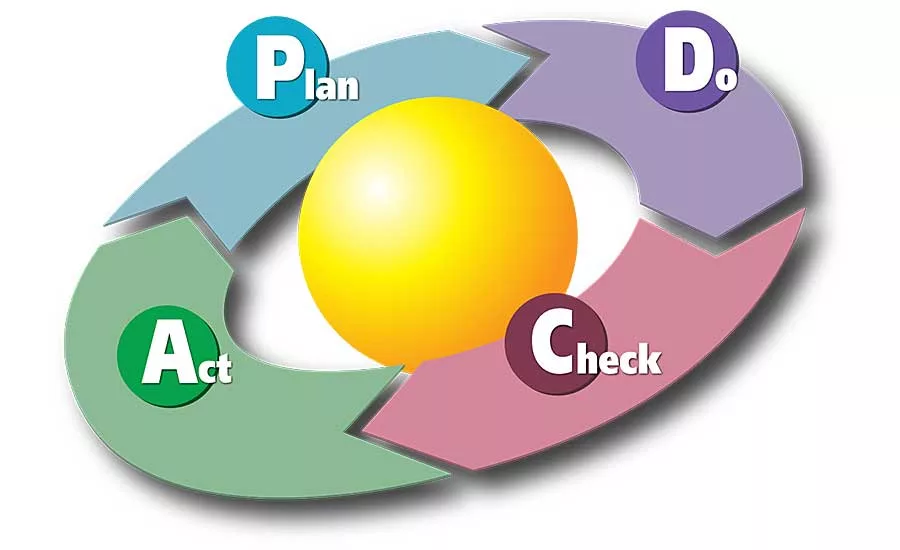
The plan-do-check-act cycle is an iterative four-step management method used for the control and continuous improvement of processes and products. Diagram by Karn G. Bulsuk (http://www.bulsuk.com)
June 8, 2021

First-pass yield is an important manufacturing metric. It measures the effectiveness of a process and provides an indication of how well we are eliminating waste. Other metrics don’t account for the cost of rework, which can be significant at some assembly plants. First-pass yield is also a good measure of the success of continuous improvement activities.

I always like to start with a definition. As an engineer, I like tangible definitions and what better than an equation? First-pass yield is the percentage of parts that are readily usable at the end of a production run. We only need two variables: the number of usable parts (those that do not require rework) and the total number of parts produced. First-pass yield is the ratio of the working parts that come from an assembly line at the end of a run, compared to the total number of parts produced. Put mathematically, first-pass yield = usable parts / total parts built.

For example, if we assemble 100 parts and 90 of them are working right off the line, then first-pass yield would be 90/100 or 90 percent.

First-pass yield should not be confused with scrap rate, which is the percentage of parts that can’t be reworked or become usable. Put mathematically, scrap rate = unusable parts / total parts built.

First-pass yield isn’t a perfect metric. It doesn’t account for downtime, scheduling or capacity, for example. But, it’s a quick and easy one to keep an eye on. First-pass yield can mean the difference between profit and closing, particularly for high-mix, low-volume manufacturers which don’t have the luxury of long production runs to perfect their processes.

For manufacturers to thrive, the aggregate of the products we deliver must provide value to the customer. Value is the difference between the utility of a product and its cost to the customer. If a product’s usefulness is higher than its cost, its value increases. Put mathematically, value = utility / cost.

The business case for a product does not always account for less than 100 percent of the parts produced.

Looking for quick answers on assembly and manufacturing topics? Try Ask ASM, our new smart AI search tool. Ask ASM →

Another way to measure value is quality (short- and long-term) and any associated service costs to support a product compared with its initial cost to the customer. Expressed mathematically, value = (quality + service) / cost.

It is obvious that with increased waste, one of two things will happen. The first is that our margins will erode if we keep the selling price of the product the same. Waste is often an unanticipated byproduct and is seldom included in profitability calculations. That is, the business case for a product does not always account for less than 100 percent of the parts produced. Think about your own experiences. Does the business case for a project and product account for waste? How much is acceptable? An effective and ongoing enterprise will have a strong aversion to waste and may not account for waste when calculating the selling price of a product.

Fortunately, first-pass yield at the start of production need not remain that way forever. We can apply tools and techniques from the total quality management (TQM) arsenal, such as Pareto analysis, scatter plots, control charts, flow charts, histograms, Ishikawa diagrams, checklists and check sheets. Equally important, we must engage our team members in continuous improvement.

This is the essence of the plan-do-check-act cycle made popular by Walter A. Shewhart and W. Edwards Deming:

Plan: Identify an area for improvement and ways to improve it.

Do: Execute the plan.

Check: Review of the results of our actions. Did we get the results we expected? If we got better or worse performance than expected, we will need to explore further. Our predictions were off; something is amiss.

Act: This is where we enact the results from the planning and learning from the previous steps and adjust the process accordingly.

Notice that our production process does not “officially” change until we thoroughly understand it. Uncontrolled change is more like chaos than control. Uncontrolled changes may produce the results we desire by accident, but we won’t know how or why we got there. This is not a repeatable approach to improvement. With TQM, we only change our way of working after we have planned, explored, experimented and understood the impact of a proposed change. Only when all of this is known to a sufficient level are we able to bring the change to fruition.

KEYWORDS: lean engineering Plan-Do-Check-Act

Share This Story

Looking for a reprint of this article?
From high-res PDFs to custom plaques, order your copy today!

The author of numerous books on project management, Jon has held engineering and management positions at Volvo Trucks, PACCAR and other companies. Email Jon at jon.quigley@valuetransform.com

Recommended Content

JOIN TODAY
To unlock your recommendations.

Already have an account? Sign In

  • Made in the U.S.A.

    Consumer Products Manufacturing: Made in the USA

    Supply chain lessons learned during the coronavirus...
    Automated Assembly Systems
    By: Austin Weber
  • Best Practices for Press-Fit Assembly

    Best Practices for Press-Fit Assembly

    In manufacturing, ironclad formulas for success are hard...
    Assembly Presses
    By: Jim Camillo
  • aem0523leader-tesla1.jpg

    Tesla Rethinks the Assembly Line

    Engineers at Tesla Inc. have developed a new process that...
    Industries
    By: Austin Weber
Manage My Account
  • eMagazine Subscription
  • Assembly Newsletters
  • Online Registration
  • Subscription Customer Service
  • Manage My Preferences

More Videos

Sponsored Content

Sponsored Content is a special paid section where industry companies provide high quality, objective, non-commercial content around topics of interest to the ASSEMBLY audience. All Sponsored Content is supplied by the advertising company and any opinions expressed in this article are those of the author and not necessarily reflect the views of ASSEMBLY or its parent company, BNP Media. Interested in participating in our Sponsored Content section? Contact your local rep!

close
  • ultrasonic welding
    Sponsored bySonobond Ultrasonics

    Engineering Efficiency in High-Performance Assembly: How Ultrasonic Welding Enhances Throughput, Reliability and Quality

  • UV curing system
    Sponsored byDymax

    Why UV Intensity Alone Doesn’t Define Curing Performance

  • wooden pallets
    Sponsored byLEAN Manufacturing Products

    Eliminating Waste on the Shop Floor: Applying Lean Principles to Improve Manufacturing Efficiency

Popular Stories

Ferrari

Ferrari Unveils Four-Door EV

ASSEMBLY News Now, episode-30: Volvo Redesigns EV Manufacturing

Volvo Redesigns EV Manufacturing

automated consumer goods assembly system

Best Practices for Cycle Time Optimization

Watch the latest episode of ANN now!

Events

July 24, 2025

From Shop Floor to CFO: How Manufacturers Are Closing the Loop Between Operations and Finance

On Demand Learn how manufacturers are bridging the gap between the shop floor and ERP systems to gain real-time visibility, streamline operations, and kick-start digital transformation—without waiting years.

Sponsored by:

PicoStratusGreen
July 30, 2025

Buffer Analysis and Design Fundamentals for Manufacturing Excellence

On Demand In this presentation, Dr. Herman Tang shares practical insights from his industry experience and research on buffer management in manufacturing operations.

View All Submit An Event

Poll

Difficult Assembly Processes

Which assembly process gives you the most difficulty?
View Results Poll Archive

Products

Manufacturing Cost Policy Deployment (MCPD) Profitability Scenarios: Systematic and Systemic Improvement of Manufacturing Costs

Manufacturing Cost Policy Deployment (MCPD) Profitability Scenarios: Systematic and Systemic Improvement of Manufacturing Costs

See More Products
Register for webinar - Modernizing Automotive Assembly: Why Upgrading Legacy MES is a Business Imperative

Related Articles

  • Boosting First-Pass Yield

    See More
  • process improvement in automotive manufacturing

    Chesterton’s Fence and the Art of Process Improvement

    See More
  • Virtual reality aids design of assembly lines

    Virtual reality aids design of assembly lines

    See More

Related Products

See More Products
  • The First Snap-Fit Handbook 2e: Creating and Managing Attachments for Plastics Parts

  • Kaizen Assembly: Designing, Constructing, and Managing a Lean Assembly Line

  • Laser Welding of Plastics

See More Products

Related Directories

  • FIRST Robotics

  • First Resonance

×

Never miss the latest news and trends driving the manufacturing industry

Stay in the know on the latest assembly trends.

JOIN TODAY!
  • RESOURCES
    • Advertise
    • Contact Us
    • Directories
    • Manufacturing Division
    • Store
    • Want More?
  • SIGN UP TODAY
    • Create Account
    • eMagazine
    • Newsletters
    • Customer Service
    • Manage Preferences
  • SERVICES
    • Marketing Services
    • Reprints
    • Market Research
    • List Rental
    • Survey/Respondent Access
  • STAY CONNECTED
    • LinkedIn
    • Facebook
    • Instagram
    • YouTube
    • X (Twitter)
  • PRIVACY
    • PRIVACY POLICY
    • TERMS & CONDITIONS
    • DO NOT SELL MY PERSONAL INFORMATION
    • PRIVACY REQUEST
    • ACCESSIBILITY

Copyright ©2026. All Rights Reserved BNP Media, Inc. and BNP Media II, LLC.

Design, CMS, Hosting & Web Development :: ePublishing