Leak Testing Battery Packs
In-process and end-of-line tests are equally important.

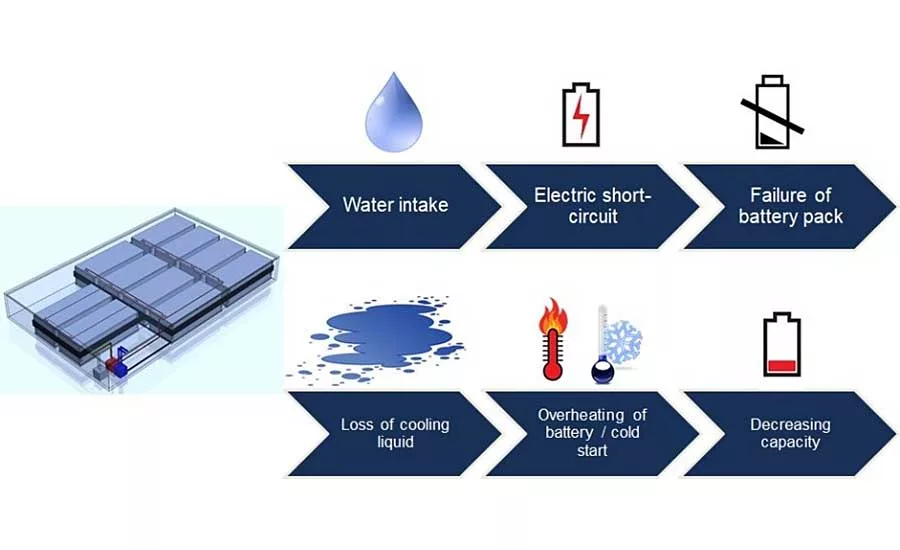
Fire and ice don't mix. The same applies to water and batteries. In an electric vehicle, a tiny bit of water vapor can damage lithium-ion battery cells.
Since most battery pack enclosures are integrated into the chassis of EVs, they are extremely susceptible to water, mud, snow, ice and other forms of moisture that are kicked up from road surfaces.
To address the issue, EV suppliers and automakers must ensure that battery trays and covers are tightly sealed. Leak testing plays a critical role in the assembly of battery cells, modules and packs.
Batteries need to be leak-free and protected from humidity, water and other liquids for 10 years or more.
Reliable leak testing of battery cells is crucial because the highly flammable electrolytes they contain can spark fires. Even small amounts of humidity in a battery module can cause the system to short circuit, reduce service life and degrade performance, including a vehicle’s driving range.
“Leak tests have long been one of the most critical quality control checks performed by automakers and suppliers," says Thomas Parker, North American automotive market sales manager at Inficon Inc. “Electric-powered systems require even more precise testing.
“It’s vital to prevent electrolytes from leaking from the battery cell or coming into contact with water under any circumstances throughout the production process and life of any electric or hybrid-electric vehicle,” explains Parker. “We have been flooded with projects recently, as more OEMs and suppliers scramble to develop EVs.
Looking for quick answers on assembly and manufacturing topics? Try Ask ASM, our new smart AI search tool. Ask ASM
“Atmospheric accumulation tests are widely used, because it’s a repeatable process that has good sensitivity and provides good metrology,” Parker points out. “As production volumes ramp up, more manufacturers are looking for automated equipment, such as robotic sniffers.”’
Lithium-ion battery cells fall into three categories: hard-cased prismatic cells, cylindrical cells and softer pouch cells. Because they are lighter in weight, pouch cells are growing in popularity with automakers, but they also are more difficult to accurately test.
According to Parker, empty hard-case battery cells currently can be checked by filling the cells with helium test gas to detect leaks in a vacuum chamber. Electrolytes are not inserted into a hard-case cell until after it has been dry tested.
Helium bombing is an alternative approach. In this case, battery cells are placed in a vacuum chamber and exposed to helium under pressure. The helium is able to enter through existing leaks, then can be measured when it escapes back into the vacuum chamber.
However, neither test method has provided the reliably consistent results needed to establish industry-wide standards for battery-cell leak detection.
“Tracer-gas test methods are the most suitable for most testing tasks for alternative drive components,” says Parker. “In fact, tracer-gas tests can detect leaks that are 1,000 times smaller than air tests currently in use.”
“Of all the EV components, battery packs pose the most challenges to leak testing,” notes Gordon Splete, global product manager at Cincinnati Test Systems Inc. “Part size is an issue, as it is more difficult to reliably test large volumes. Electric vehicle packs are prone to part expansion at unpredictable rates.
“Variation in temperature and atmospheric pressure also affect the pressure in the parts, resulting in variation of the test results,” explains Splete. “Ballooning parts and flexible components create a significant challenge in leak testing and can compromise results unless the proper test methods and equipment are chosen to address the unique challenges of the application.”
“Many engineers responsible for EV battery testing are learning what is necessary for leak testing a new device, and what a reasonable leak rate and test pressure are for the application,” adds Chuck Hagyard, director of e-mobility business development at Cincinnati Test Systems “The vast majority of OEMs and suppliers are looking for pressure decay or mass-flow based systems. Pressure decay is a simple, low-cost technology that appeals to many manufacturers.
“A select few are using tracer gas to test their battery packs,” explains Hagyard. “The type of leak test equipment necessary is also dependent upon the size of the battery pack, its flexible nature and the leak rate.”
In-Process vs. End-of-Line Testing
Manufacturers use both in-process and end-of-line leak testing. The former tests components and subassemblies during various steps in the production cycle. The latter is the last checkpoint before a finished product leaves the factory floor. When a test correctly identifies a defective unit, it must be reworked or scrapped.
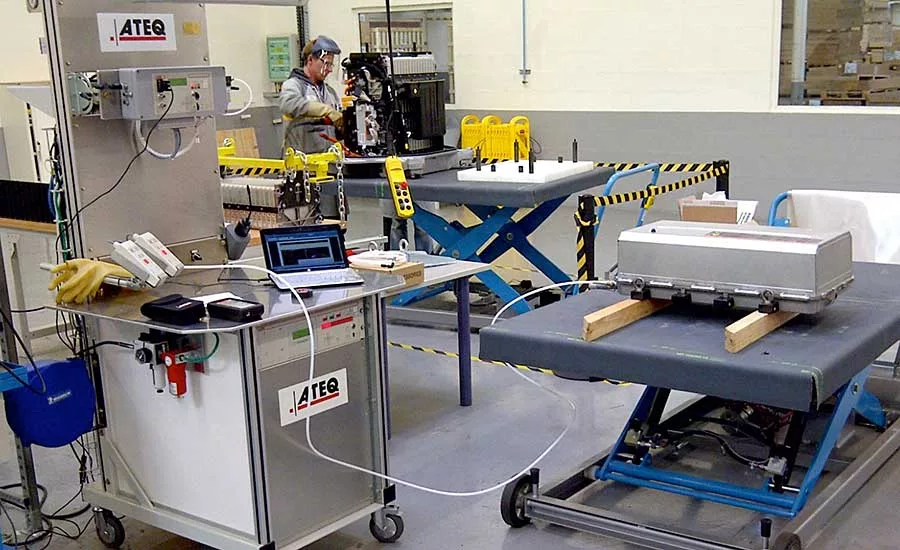
“In-process leak testing catches any quality problem early at component level before putting together a full battery module or pack,” says Anne Marie Dewailly, technical director at ATEQ Corp. “An end-of-line test guarantees that the final assembly of the cooling circuit does not leak coolant inside the battery and that the enclosure is protecting the inside of the battery against water, mud or other types of splashing moisture.
“For EV batteries, there are multiple solutions and no standard practice exists,” explains Dewailly. “The whole battery pack is tested with air after assembly, but its components are tested differently. For instance, the cooling circuit is leak tested with air, while the battery cells are tested with either tracer gas or ionized air methods.
“An in-process leak test is [necessary] to check every battery subassembly, such as cells, cooling plates, cooling circuits, venting valves, trays and covers,” Dewailly points out. “In-process leak tests are fast and provide instant feedback about the processes that affect the leaks. Some components inside the battery, like the cells, are not accessible after final assembly and have to be leak tested beforehand. For cost reasons, you want to know if a battery tray is leaking before putting cells and modules into it.”
“In-process tests enable you to discover things such as defective electrical feedthroughs, cooling circuit piping and tubing, heat exchangers or lids,” adds Inficon’s Parker. “One type of leak test cannot replace the other. You just can’t do in-process testing on individual components and not do a final test on the finished battery pack.
“The biggest benefit of end-of-line leak testing is keeping defective product away from the consumer,” says Parker. “If you don’t do a good final test, the next testing station is going to be at the dealership. Consumers are already weary of EVs, because of range anxiety and fire risks. If you don’t catch a problem in the plant, the end users will catch it at their dealership or in their garage.”
Typically, two leak tests are done on battery packs. First, the cooling circuit is tested before the battery modules are inserted into the tray. The second test is done after the cover or lid is attached.
“The coolant test is typically 1 to 5 sccm (standard cubic centimeters per minute) with cycle times in the 180 to 200 second range,” says Cincinnati Test Systems’ Hagyard. “The battery pack test has a wide range of specifications from as low as 10 sccm to 500 sccm. Cycle times for the battery pack test are in the 15 to 500 second range, depending upon the size of the battery and the leak rate.
“The in-process test is essential, because a leak in the coolant circuit will not be caught while the cover leak test is being performed,” explains Hagyard. “The two tests are essential in verifying the integrity of the battery pack assembly process.”
“In-process testing allows easier repair and replacement of leaking components prior to the completion of a final assembly and finds leaks before more value is added into the product,” adds Splete. “Final assembly testing may still require non-water leak rates, which become more challenging as the assembly is larger than subassembly testing.”
Testing Battery Trays and Lids
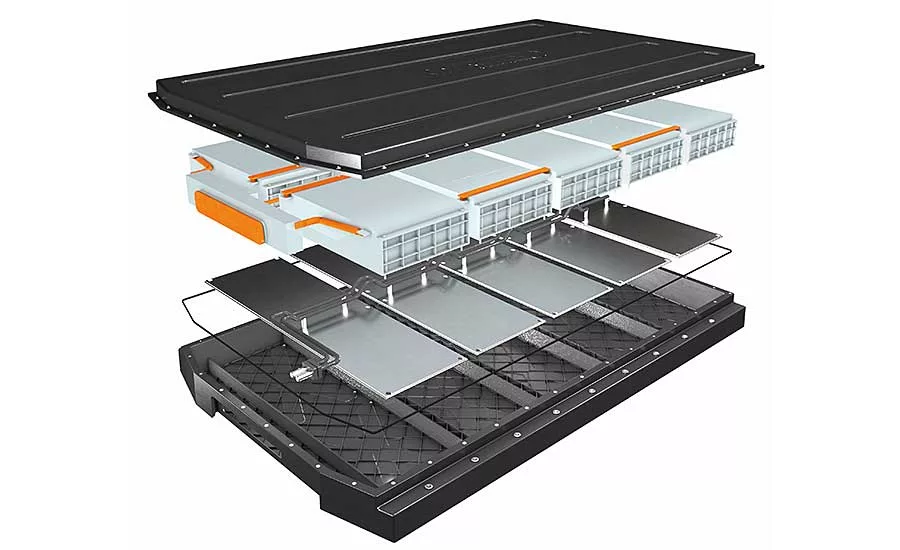
Battery pack housings and enclosures are typically rectangular- or T-shaped and made of aluminum, plastic or steel. Many housings are made out of extruded steel or aluminum profiles. They are assembled with either fasteners, structural adhesives or welded joints.
Traditionally, a metal battery enclosure features about 40 parts. While most enclosures appear similar, designs vary among automakers. For instance, one leading supplier currently produces more than 30 different battery box covers for different OEMs.
“Battery packs can often be as big as a queen-sized mattress and don’t tolerate a high change of pressure,” says Parker. Depending on the vehicle class, housing lengths and widths can be well over 2,000 or 1,500 millimeters, respectively.
“After they are fabricated, trays are inspected empty before battery modules and thermal management systems are installed,” explains Daniel Seikaly, product manager for assembly and leak test equipment at Marposs Corp. “The trays are heavy, so it is difficult to position parts.
“Because these boxes have a lot of volume and are quite flexible, leak testing can be quite a challenge,” warns Seikaly. “Battery trays move and expand, which makes it difficult to get a reliable reading. And, because each tray is different, we must take a different approach from customer to customer.”
The housing can be leak-tested empty or full using the pressure decay, accumulation or sniffing method. The latter approach involves filling the housing with helium and scanning a sniffer probe (attached to a helium leak detector) over the part to measure out-leakage at suspect locations. Production volume typically determines whether a person or a robot manipulates the sniffer probe.
“The large, bulky size of battery trays and lids often creates challenges with leak testing cycle times,” notes Hagyard. “Unique characteristics, such as the flexible nature of battery enclosures, which are typically made out of thin sheet metal or aluminum, can cause deflection. For instance, just the influence of barometric pressure change in a factory can cause deflection that is significant enough to cause variation in the measurement results.”
However, different materials have unique levels of rigidity. That can impact leak testing, because less rigid materials tend to flex and deflect more.
To address lightweighting demands, suppliers such as Continental Structural Plastics Inc. and Magna International Inc. are developing battery enclosures made out of mixed materials, including composites. These alternatives appeal to engineers because they reduce weight, improve strength and stiffness, and improve vehicle safety.
“Battery trays and covers made from composite materials have some fundamental differences compared to metallic enclosures,” says Seikaly. “Welding is not possible, so components are bonded instead. These new materials may not transfer heat as readily as metallic counterparts and this could be an advantage for air leak test systems.”
“Lighter weight and thinner materials are good for EV automakers, because they help improve battery range,” notes Splete. “But, it makes it more challenging from a testing perspective, due to lower leak rates. As a rule of thumb, the thinner or shorter the leak path, the lower the leak rate. The thicker or longer the leak path, the higher the leak rate.”
However, no matter what type of material battery enclosures are made out of, most observers agree that tighter leak testing specs and standards will be needed in the future.
“Right now, standards are inconsistent,” claims Hagyard. “Everyone refers to the IP67 water ingress test requirement, but how OEMs and suppliers interpret that and set their specs can vary from company to company.
“There’s no commonality from one OEM to another when it comes to how they test battery pack cooling circuits and trays,” explains Hagyard. “There’s a broad range of specifications from one company to the next, even among Asian, European and North American manufacturers.”
Looking for a reprint of this article?
From high-res PDFs to custom plaques, order your copy today!


.webp?height=200&t=1666140257&width=200 "inf_logo_2c_high_res (1).jpg")
.webp?height=200&t=1755548746&width=200 "Battery-pack failure modes")