Assessing the Current State
Before attempting to automate an assembly process, engineers should have specific goals to achieve or problems to solve.
Poet and civil rights activist Maya Angelou wrote, “You can’t really know where you are going until you know where you have been.”
In a way, Microsoft co-founder Bill Gates has similar advice: “The first rule of any technology used in a business is that automation applied to an efficient operation will magnify the efficiency. The second is that automation applied to an inefficient operation will magnify the inefficiency.”
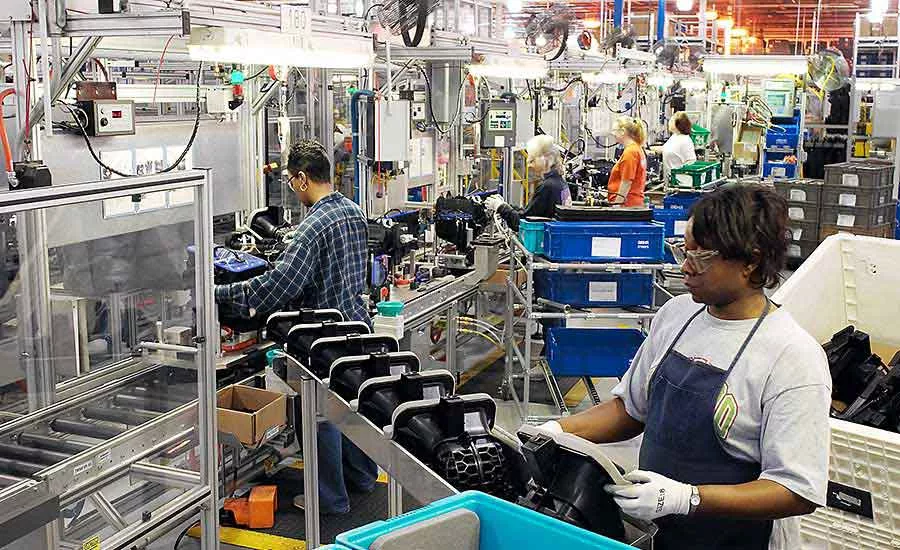
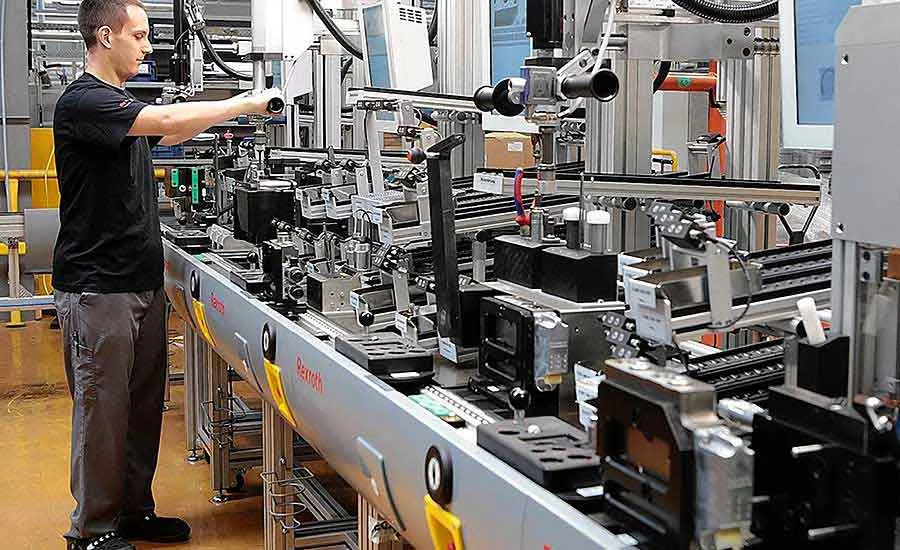
Whether it be a robot or artificial intelligence software, applying automation simply for its own sake is a recipe for disaster. Before attempting to automate an assembly process, engineers should have specific goals to achieve or problems to solve. Identifying those goals starts with a thorough assessment of the assembly line. Ultimately, that assessment may reveal that automation is not even necessary.
Art Smalley, president of the Art of Lean Inc. and a former engineer at Toyota Motor Corp., has seen a lot of assembly lines in the course of his 34-year career in manufacturing. When he assesses a line, he looks at two things initially.
“Space utilization is one,” he says. “A bad assembly line will use too much space, which eventually drives up cost in one form or another. I also look at the flexibility of the line in terms of resources. Can you add or subtract labor efficiently as demand changes up or down? Is there a good layout for material flow and delivery? Are the material handling routines haphazard or designed well for quantity and delivery? How are rejects handled and tracked? How is quality built in at each station?”
Drew Locher, president of Change Management Associates, likes to walk the line with company management, asking questions along the way.
“What is the demand rate for this line, and what is it producing at? If there’s a gap, that’s something that needs to be addressed,” he says. “I’m looking for lack of flow; I’m looking for piles of inventory. If the line is supposed to be assembling, say, 100 units per day, and I count 300 units in various queues, then I know the line is not flowing like it should.
Looking for quick answers on assembly and manufacturing topics? Try Ask ASM, our new smart AI search tool. Ask ASM
“I also look for quality problems. Sometimes, you see piles of scrap and rework,” he continues. “So I’ll ask, ‘What what’s your defect rate?’ I’ve had managers tell me they don’t have one because they fix it all. What they really need to do is address first-pass yield.
“And, I’ll ask about lead time and how long it takes to assemble the product, from the time the first operation starts to when the product is packaged and sent to the customer. There’s usually a big gap between lead time and process time, and the difference between the two is opportunity for improvement.”
For Sammy Obara, senior partner at Honsha Associates and a former manager at Toyota’s assembly plant in Sao Paolo, Brazil, the first thing to do when assessing an assembly line is look at safety.
“If you ask anybody at Toyota, they will say anzendaiichi, which means 'safety first',” says Obara. “You can’t talk about improving any aspect of an operation without first making sure that every worker is safe.”
After that, the next thing to look at is how well material is flowing. “Products must always flow from raw materials to finished goods without interruption and without going backward. It must always be moving forward, always gaining value,” says Obara. “The rate of production must match the rate of customer demand. People or machines should not be overwhelmed.”
Richard Rahn, principal of Leonardo Group Americas, a consulting firm that specializes in lean material handling, likes to look at how each worker is performing.
“You can get a good sense of how a line is performing just by looking at the amount of time that each worker spends actually assembling something as opposed to getting parts, walking around or just waiting for the next unit to arrive at their station,” he says. “The more time workers spend not adding value, the bigger the opportunity to improve.”
Whenever he’s evaluating a line, Rahn always spend time talking to workers. “I like to talk to the people on the line, because they sometimes know things that the engineers don’t. They know what’s actually going on. If you have honest conversations with the people on the line, you might learn some things.”
Key Metrics
A variety of metrics can help when assessing an assembly operation. Safety is foremost. Productivity, quality (scrap, rework, internal defects, external defects), delivery and lead-time are also important.
“You have to grasp the cost per unit and contributing factors that make up cost, such as materials and labor,” says Smalley. “What levers do you have to reduce cost per unit that are in your realm of control.”
In more mechanized operations, metrics such as overall equipment effectiveness are also important.
“I visited a plant that installed automated assembly cells, linked them together, reduced inventory and balanced the line pretty well,” recalls Locher. “However, some cells were not very reliable, so the whole line would shut down. Instead of fixing the reliability issues, engineers broke apart the line and buffered each cell with piles of inventory.”
Obara says the biggest mistake companies make in terms of metrics is not which ones to look at, but how often. “Scrap rate and first-pass yield are great metrics, but many manufacturers only look at them at the end of the week, the end of the month or even the end of a quarter,” he says. “Ideally, you should have andon boards that display these metrics in real time.”
Another mistake companies make with metrics is how they measure them. Obara remembers working with a manufacturer to improve changeover time. Eventually, he determined that, rather than measure the exact amount of time needed for each changeover, workers were rounding up or down to the nearest hour.
“The workers didn’t understand why they were measuring changeover time,” Obara recalls. “For them, it was just a matter of record-keeping, and not data that could be used for continuous improvement.”
Where to Start
Where to start improving depends on the problem to be solved. Do you want to increase safety, boost throughput, improve quality, reduce turnaround time, or all of the above? If capacity is the problem, engineers might want to find and address the biggest constraint on the line. If quality is the problem, engineers might simply need to create an error-proofing jig or fixture.
Depending on the size of the operation, it’s best to take a holistic approach to the line. “You don’t want to suboptimize,” warns Locher. “I’ve seen that many times. People improve efficiency in one area, and it creates a bottleneck downstream.”
Rahn agrees that a holistic approach is best, but concedes that it’s not always feasible to halt production to redesign a line. In the absence of an obvious problem, he likes to start at the end of the line and work backwards, since that part of the line is closest to the customer.
“You don’t want to create a racehorse and place it behind a donkey,” he warns.
Simulation software can help, particularly with large, mixed-model operations. “Simulation allows you to perform experiments,” says Rahn. “It doesn’t necessarily tell you the right answer, but it lets you experiment with changes in model mix and production volume so you can test the robustness of your design.”
How to solve the problems will vary, of course. In some cases, assessments will identify opportunities for automation. But, experts advise engineers to use caution when deploying automation to solve production problems.
“There are so many ways to automate almost everything today that we sometimes pursue automation before we understand the need for it,” observes Obara. “In many cases, automation replaces the great value that is the human element. People can think. People can do kaizen. The other problem with automation is that it can become a monument. It can be difficult to move, and you lose some flexibility.”
Rahn agrees. “Japanese manufacturers do not go overboard with automation,” he points out. “They would rather train employees on standard work and get their ideas for continuous improvement.
“American manufacturers tend to look for a technical solution. If there’s a problem with tightening fasteners, they would rather invest thousands of dollars in computerized torque guns. However, every time you add a layer of technology, your overhead goes up and your support costs go up.”
“If takt time is 20 seconds or less, then you’re looking at automation,” says Locher. “A person just can’t keep up with that kind of repetitiveness. However, if takt time is 60 seconds, do you really need automation?”
Of course, there are other reasons to deploy automation than increasing production volume. For example, robots can improve safety by taking over dirty and dangerous tasks, such as welding, grinding or painting. Similarly, robots can increase quality and reduce waste by performing some tasks, such as screwdriving or dispensing, more precisely and repeatably.
When automation is necessary, “don’t get the biggest, fastest machine that you can,” warns Locher. “Even if you know that you might be producing 10,000 units a day at some point, invest in a machine that will make 2,500 a day. It will be a fraction of the cost, and it will be more reliable. If that greater demand does materialize in the future, you can always get a second machine.”
Looking for a reprint of this article?
From high-res PDFs to custom plaques, order your copy today!