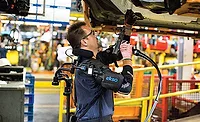
Giving Operators a Lift
In Norman Rockwell's famous painting "Rosie the Riveter, Rosie has biceps and forearms that would be the envy of a pro wrestler. However, modern manufacturers realize that relying on brute strength is not only dangerous, but counterproductive. This is especially the case with today's high throughputs and the increasing emphasis on quality. Whether it's a nutrunner, screwdriver, dispenser, grinder, rivet gun or welder, an operator doesn't have to be working with a tool the size of a .50-caliber machine gun to get hurt on the job.
Then there is the question of organization in the workplace. More and more, manufacturing engineers are realizing that every tool should have its place and every place its tool. In electronics manufacturing, in particular, there can be a lot going on in a small area. No matter what the industry, hunting for tools is an obvious waste of time, even if an operator only spends a few seconds doing it.
To resolve these issues, manufacturers have a variety of tool support systems to both stabilize a tool and, in many cases, lift it out of the way when not in use.
Get Reel
At the most basic level, there are retractors, spring-loaded reels that exert an upward force on a tool, lifting it up and out of the way when it is not in use. (Some models also have a lock, which works like a window shade, allowing a tool to be held in place.) These come in two basic forms: wire reels that are clipped to the tool, which is then powered by a separate umbilical; and line reels, or hose reels, in which the pneumatic umbilical itself supports the tool and is wound and unwound in the retractor.
Although at first glance, the latter may seem the obvious choice for any kind of pneumatic tool, it has its downsides. For example, line reels have a bulkier feel to them, which can bother operators who are continually pulling them down and letting them go. They are also less flexible in that they can only be used with pneumatic tools and removing a tool for maintenance means detaching it from its umbilical.
However, in those instances where a manufacturer knows that only one type of tool is going to be used at a particular workcell or station, a line reel may be the way to go. The same is true if operators won't be repeatedly pulling down and releasing a single tool. On the plus side, line reels make for a very clean setup, without a lot of different lines to get in the way.
By contrast, with a wire reel, tool change-outs take minimal time, but a means has to be found to ensure the umbilical doesn't get in the way. Sometimes, in larger applications, this involves using a second reel to support the hose or cable. Ken Maio, senior product manager for AIMCO (Portland, OR), warns that a separate umbilical can also limit the travel distance of the reel, unlike a line reel where the operator can take full advantage of the system's rated travel.
Looking for quick answers on assembly and manufacturing topics? Try Ask ASM, our new smart AI search tool. Ask ASM
Whatever their exact configuration, retractors are easy to install, using hooks, shackles and clips. Manufacturers can use either an existing overhead structure, or install a variety of different purpose-built devices to support a tool or tools.
Companies like Wampfler Inc. (Florence, KY), Delta Regis Tools Inc. (Fort Pierce, FL) and Ingersoll-Rand Productivity Solutions (Annandale, NJ) all market hinged, single-arm supports, or jib booms, which can be wall-mounted or pedestal-mounted either on the floor or a workbench surface.
AIMCO, Ingersoll-Rand and Bosch Rexroth Corp. (Buchanan, MI) also market a variety of framing systems that can be attached to a wall or workbench. For those cases in which an operator needs even greater mobility, there is the option of an overhead rail system. These can be especially effective when used on a moving assembly line or in a large workcell.
Weightless Assembly
Similar to retractors are balancers. However, whereas retractors will lift a tool up and out of the way once it is released, a correctly sized and adjusted balancer will hold the tool at the exact point where it is released, essentially leaving it hanging in midair. The advantage to this approach is that the operator doesn't have to reach up to retrieve a tool. Obviously, if the tool is used in just one of a number of operations at a given workcell or station, the reaching action won't be overly burdensome. However, if an operator is installing multiple fasteners with a single tool, having it immediately at hand can make a world of difference.
Ryan Link, business development manager for ergonomic handling systems at Ingersoll-Rand, notes that his company's spring balancers can also be fine-tuned to lift a tool partially out of the way without sucking it all the way up to the reel, providing a kind of hybrid performance.
"It really boils down to personal preference. You have to work with the operator," says Maio, adding that ultimately, the system that requires the least amount of movement is generally the one that will provide the best results.
"Lean and balancers go hand in hand," Maio says. "Every movement I can eliminate increases productivity... If you see an operator dropping a tool and then a minute later going to pick it up, that's not good."
Maio notes that having loose tools lying about can incur an additional cost in that dropping tools can cause them to be damaged. He remembers one case in which an assembler was replacing two or three cracked plastic housings on its expensive electric fastening tools every year. Securing these same tools with balancers and retractors eliminated the problem overnight.
Then there is the question of organization and aesthetics. More and more, assemblers are recognizing that a clean, well-thought-out workspace is also a productive one. This concept is a pillar of lean manufacturing and the Toyota Production System.
"You may not be able wrap your hands around a well-qualified number, but these intangibles can save customers a tremendous amount of money," Maio says.
Taking on Torque
Of course, while hanging a tool from a hose or cable means an operator does not have to support its weight, this does nothing to control the tool once it is in use-a concern especially when attaching high-torque threaded fasteners. To solve this problem, manufacturers can implement an articulated or linear torque arm, to both support the tool's weight and help protect operators from harm.
These systems, which can be used with either pneumatic or electric tools, generally hold the tool so that it remains in a vertical orientation, although adapters can be added to set the tool at an angle or even at horizontal.
In the case of a linear arm-like those manufactured by AIMCO or Design Tool Inc. (Conover, NC)-a single-piece arm both revolves around, and travels up and down on a fixed shaft. In the case of an articulated arm, a jointed arm allows the tool cover the entire area within the arm radius.
The latter category includes a number of different products from manufacturers such as Chicago Pneumatic Tool Co. (Rocky Hill, SC), Stanley Assembly Technologies (Cleveland), Ingersoll-Rand, AIMCO, Delta-Regis, Design-Tool and FlexArm (Midwest Specialties Inc., Wapakoneta, OH). These arms are all similar in what they do. But it's important to pay attention to the details.
For example, some arms, like the AIMCO Ergo-Arm, Stanley Assembly Technologies' MAC, or the Ingersoll-Rand Parallel Torque Arm, use an easily adjustable pneumatic system to support the tool's weight. Others depend on a sealed-gas cylinder, like those used in the hatchback of a car, which makes the arm less expensive and can provide excellent performance, but can be trickier to fine-tune.
Even more importantly, construction quality can vary dramatically, which in turn can affect the lifespan of the torque arm. FlexArm manager Dan Sudhoff warns that the torque ratings on many arms are not realistic, which can cause problems down the road. For example, he says FlexArm products are rated for dead-stall torque while other ratings are based on the clutch setting for the intended tool, a much less rigorous standard.
In terms of construction quality, some arm joints are built with high-quality bearings, while others use bushings or even stripper bolts, which wear much faster. Sudhoff suggests that assemblers look for products that come with a warranty. Better still, he says, assemblers should try to arrange a product trial period during which they can get a feel for how the arm will perform. According to Sudhoff, this gives operators a chance to take part in the selection process, which can help ensure success. "The operator tends to be king," he says. "They have to embrace the concept if it is going to work....What we find in most cases is that a trial works well, giving the operator input."
In terms of mounting a torque arm, the options are endless. In many workcells, the arms are simply bolted to the work surface. The FlexArm line includes a sliding base to further increase an arm's working envelope. If space is tight, floor pedestals are available. Manufacturers can also mount an arm on an overhead rail system or to a nearby wall.
Link notes that when using an overhead system, manufacturers need to be aware of how that system is absorbing the forces being translated up the arm, especially in high-torque applications. This includes examining all the different components, including trolleys, bridges and hangers.
"You have to pay attention to how [the torque] is being directed," Link warns. "Rail systems can get sloppy as well."
Rick James, senior project engineer at Stanley Assembly Technologies, says many of his company's torque arms have found work on moving assembly lines at equipment manufacturers like John Deere and Caterpillar. He remembers one application in which a mining equipment manufacturer used a torque arm attached to the front of a mechanized cart to help secure bolts to a 60-foot-long axle.
When to ‘Arm' Yourself
The question as to when a torque arm becomes necessary can be a tricky one. In many cases, assemblers need to consider not only the amount of torque being applied to a given fastener, but the number of fasteners the operator will be installing. If an operator is inserting dozens or even hundreds of fasteners in the course of a shift, that creates a situation in which he or she may need some mechanical help, even if the forces at work are minimal.
James adds that even in those cases where injury is not an issue, a torque arm can improve product quality. Specifically, it ensures the tool is properly oriented with respect to the fastener, which can help prevent problems with cross-threading. Similarly, this fixed orientation means the tool is that much easier to bring to bear on the workpiece. "If you are doing a lot of rapid movements a torque arm [improves] economy of motion," he says.
As an indication of the kinds of torque arms most manufacturers are using, Sudhoff says most of his company's sales are for arms rated for 20 ft-lb or less. Beyond 80 ft-lb, unit sales drop off dramatically. But again, individual needs and standards will vary dramatically. For example, Link says he has had customers implement torque arms in low-torque applications simply to support the weight of the tool.
Another situation in which torque arms may be necessary is one in which operators need to apply a downward force to drive a threaded fastener, as is generally the case when installing a thread-forming, Phillips-head screw.
In this case, assemblers can modify a torque arm by adding a power assist arm from Visumatic Industrial Products (Lexington, KY). This pneumatically powered assist engages when the fastening tool goes to work and then disengages when the tool turns off.
According to Visumatic sales manager Thomas Rougeux, this power assist function has found a number of applications in the electrical component industry, where operators are assembling breaker boxes, terminal strips or drive assemblies. Rougeux notes that some assemblers encounter a progression of problems as they take on the ergonomic difficulties faced by employees.
First they'll rotate operators out of a station because of the stresses involved in handling the torque, he says. To solve that problem they will install a torque arm. Then, over time, the downward force required to install the fasteners begins to take its toll, and that becomes the problem.
Tubular Assembly
Finally, for bigger jobs there are torque tubes and vertical balancers, like those manufactured by Stanley Assembly Technologies. These devices move up and down with the aid of a pneumatic cylinder, and are generally moved to and from a workpiece using an overhead rail system. Vertical balancers are more lightly built and serve primarily to support a tool's weight. Torque tubes, as the name implies, are much beefier and robust enough to absorb the forces involved in high-torque applications.
According to James, torque tubes can be especially effective where an operator is using a multiple-spindle machine. In addition, in a two-spindle nutrunner application, the tube protects the operator in the event a bolt breaks-a situation in which the single remaining bolt could cause serious injury.
Looking for a reprint of this article?
From high-res PDFs to custom plaques, order your copy today!