High-tech motion control aids production of protective packaging
Ohio manufacturer relies on sophisticated motion control technology to produce high-quality protective packaging materials.
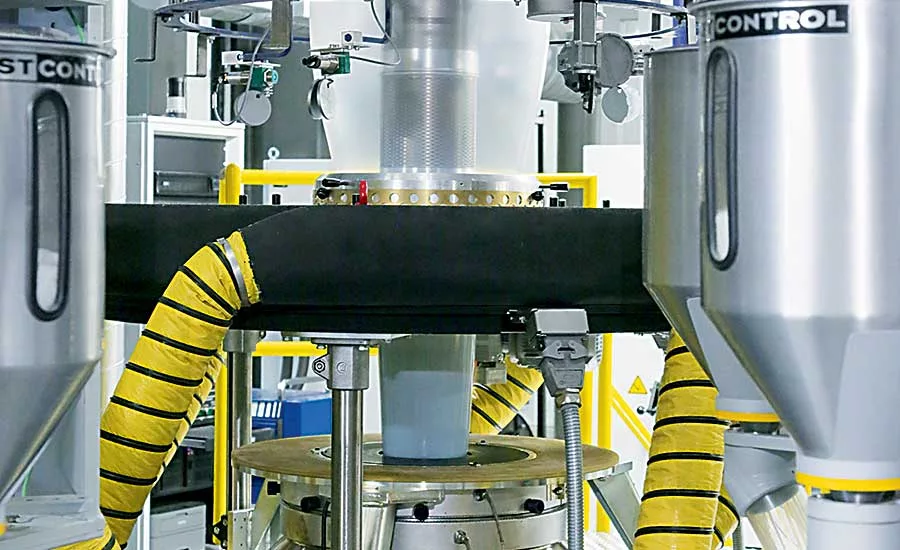
Molten plastic is extruded through an annular die. Hot air is injected through a hole in the center of the die, and the pressure causes the plastic to expand into a columnar bubble. Photo courtesy Festo Corp.
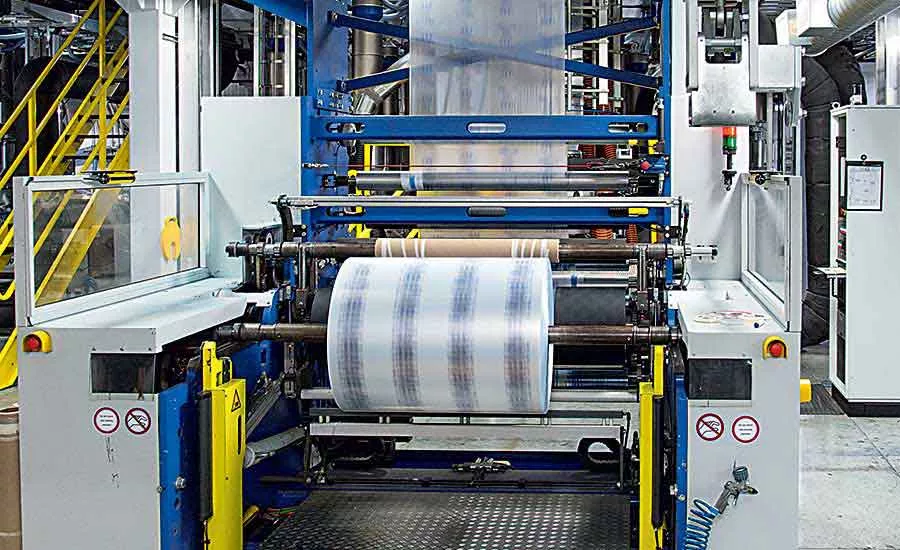
At the end of the extrusion line, the plastic film is wound onto rolls. Photo courtesy Festo Corp.
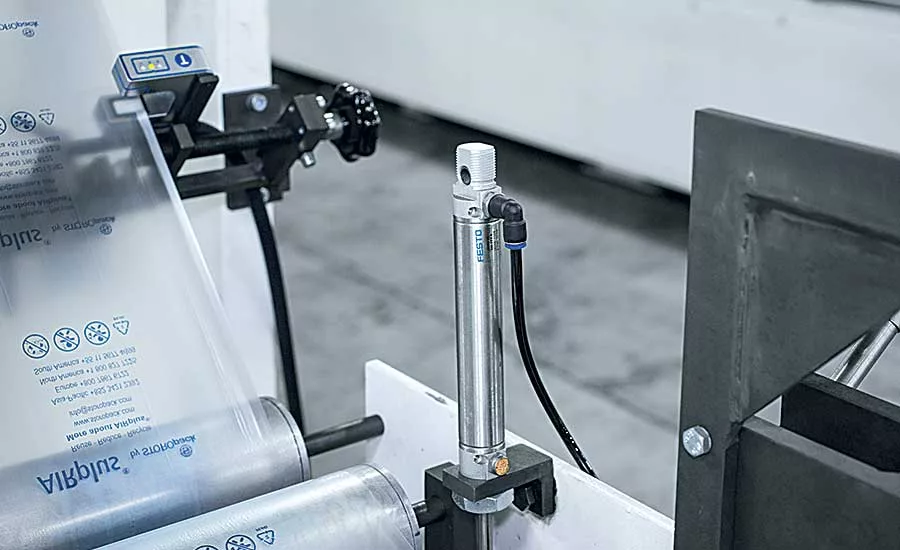
Stamping tools seal and perforate the film as it comes off the roll to form pockets of specific widths and lengths. Pneumatic cylinders ensure the film is at the optimal tension. Photo courtesy Festo Corp.
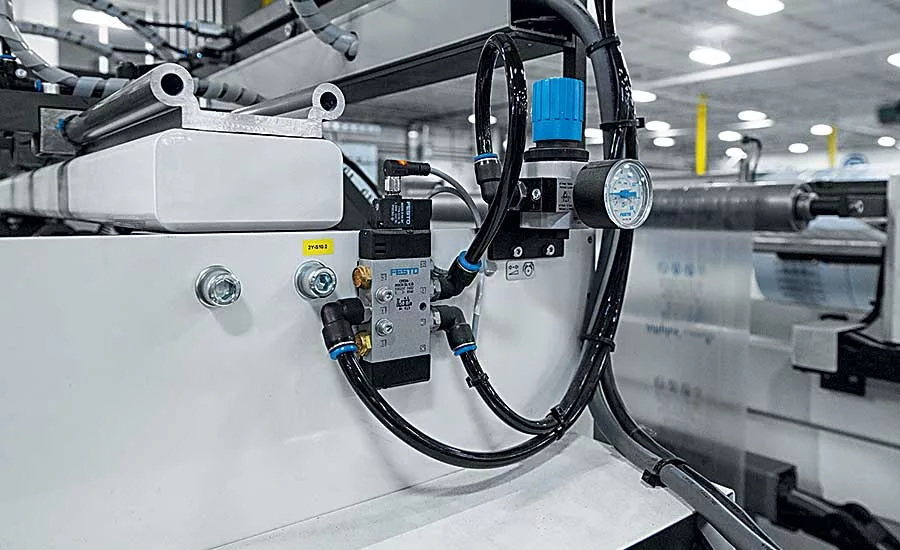
The configurators are equipped with myriad Festo pneumatic components, including DSBC cylinders, DSNU-PPS round cylinders, ADN compact cylinders, ADVC short-stroke cylinders, and CPE 14 control valves. Photo courtesy Festo Corp.
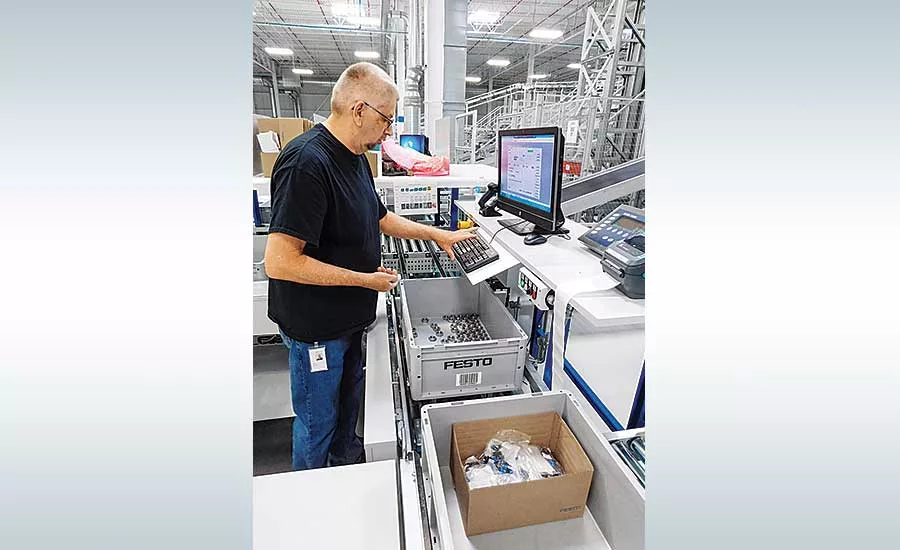
Festo’s highly automated warehouse features seven high-performance picking stations, enabling workers to pick and pack 1,000 items per hour. Photo courtesy Festo Corp.
If you’ve ever received a package from an online retailer, you probably didn’t give the protective packing material a second thought. You opened the box, removed your order, and discarded everything else.
Not Mike Genevro. In fact, it’s safe to say he thinks about protective packing material every day.
Genevro is operations manager at Storopack’s factory in Cincinnati. Headquartered in Metzingen, Germany, Storopack manufactures protective packing material and related equipment at dozens of locations worldwide. The company’s products include AIRplus air cushions, PAPERplus paper cushions, FOAMplus form-in-place packaging, and Pelespan loose-fill packing “peanuts.”
Storopack’s Cincinnati factory specializes in making air cushions—little pillows made from clear plastic film that protect package contents while adding next to nothing in weight.
Last October, editors from various trade magazines around the world got a behind-the-scenes look at the factory during Festo Corp.’s 15th annual International Press Conference. The conference—which was held in the United States for the first time—provides a forum for Festo to discuss new trends and technologies in automation and motion control. It’s also an opportunity for the automation components supplier to showcase its technology in situ at state-of-the-art factories, like Storopack’s Cincinnati plant.
Extruding Film
Storopack’s Cincinnati facility has doubled in capacity since it opened in 2007. Employing 95 people in four 12-hour shifts, the facility operates 24/7. “We try very hard to have the holidays off, but our busiest time is the holiday season,” says Genevro.
The facility consists of three main areas: an 11,000-square-foot extrusion room, a 51,000-square-foot configurator room, and a 64,000-square-foot warehouse area.
Looking for quick answers on assembly and manufacturing topics? Try Ask ASM, our new smart AI search tool. Ask ASM
Air cushions for packaging are not supplied inflated. Rather, they are supplied as rolls of plastic film that have been perforated and preconfigured to produce cushions of a particular size and shape. A special machine in the shipping department of the end-user inflates and seals the cushions as needed as the film comes off the roll.
The film is made from low- and medium-density polyethylene and comes in standard, heavy and static-dissipative versions. Cushions are made in standard widths of 8, 10 and 12 inches. Lengths range from 2.75 to 15 inches.
The process of making the cushions begins with the plastic film. Storopack’s Cincinnati factory used to import the film from Europe or China, but decided to make it in-house for better quality, cost and customer responsiveness.
Making the film begins with the plastic, which is delivered to the factory in bead form via railcar. The beads turn into plastic film on blown-film extrusion lines made by German manufacturer Hosokawa Alpine AG. Storopack’s factory is equipped with six of these systems: three produce three-layer films and three produce five-layer films.
“We can hold very tight tolerances on the film. Film thicknesses range from 0.8 to 8 mils, and we can include barrier layers, like EVOH [ethylene vinyl alcohol] or nylon,” explains Genevro.
To begin, the beads are mixed, compacted and melted to form a viscous liquid. The molten plastic is then extruded through an annular die, which resembles the exhaust end of a jet engine. Hot air is injected through a hole in the center of the die, and the pressure causes the molten plastic to expand into a columnar bubble. The air entering the bubble replaces air leaving it, so that even and constant pressure is maintained. This ensures uniform thickness of the film.
The bubble is pulled upwards from the die three stories high. Rollers help the column keep its shape. Halfway up, a rotating ring blows cooling air onto the film. This reduces the temperature inside the bubble, while maintaining the diameter of the column.
Once the plastic solidifies, the film moves into a set of rollers that collapse the bubble and flatten it into two flat layers. Other sets of rollers take the film past slitting or printing equipment before it is finally wound onto a roll.
“We can print on the film using a one-color, flexographic process,” says Genevro. “We print our logo on the bags, but we can do custom printing, also.”
The winding machines are equipped with standard DSBC pneumatic cylinders from Festo, which precisely adjust the alignment of the rollers depending on the load.
The entire process is fully automated. Sensors monitor variables such as film thickness and air temperature. Based on feedback, an operator may massage the process, adding air or adjusting the temperature.
The extrusion lines can produce approximately eight rolls of film per shift.
Configuring Cushions
From the extrusion line, the film is transferred to the configurating room, which is equipped with 22 high-speed slitting, sealing and perforating machines from German manufacturer Schmidt Verpackungstechnik GmbH & Co. (SVT). These machines create the various-sized pouches in the film that will later be filled with cushioning air.
Stamping tools seal and perforate the film as it comes off the roll to form pockets of specific widths and lengths.
“We have three generations of SVT configurators,” says Genevro. “Two of the machines can do printing. We can convert film rolls from 24 to
31.5 inches wide.”
The configurators are equipped with myriad Festo pneumatic components, including DSBC cylinders, DSNU-PPS round cylinders, ADN compact cylinders, ADVC short-stroke cylinders, and CPE 14 control valves.
The DSNU-PPS round cylinders are a new feature on the machines. These cylinders have self-adjusting pneumatic cushioning, which reduces vibration and enables high speeds and short machine cycles. The cylinders efficiently absorb energy and effectively brake loads, automatically adjusting to changing loads and speeds.
Before, operators had to manually adjust the pneumatic end-position cushioning of the cylinder, at the expense of cycle times and noise generation. Manual cushioning adjustment was also time-consuming, prolonging the commissioning of systems with lots of drives to be cushioned. The self-adjusting cylinders ensure optimum cushioning performance at all times without the need for manual intervention. Incorrect adjustments and accidental readjustments are no longer issues.
“When it comes to reliability and robustness, there is no alternative to standard components from Festo,” says Genevro. “These features are very important, since conditions in our production process are dusty and hot, and the pneumatic automation technology is therefore subject to considerable stresses.”
Workforce Training
Automation components aren’t the only things Storopack gets from Festo. Service and training are also part of the package. “When we were looking for the right cylinder for a certain application and could not find an answer, a whole project team from Festo Automation and Didactic provided us with advice and found the right solution,” recalls Genevro.
Storopack personnel regularly attend technical seminars at Festo’s Learning Center in nearby Mason, OH. By offering training on maintenance and other topics, Storopack aims not only to improve its workforce but to present itself as an attractive employer. Competition for qualified staff is intense in the greater Cincinnati region.
“From the 2017-18 academic year and onwards, we will be taking part in the dual training system offered by Festo’s Didactic division in Mason. The aim is for our younger staff members to qualify as mechatronics technicians after two years of training,” says Daniel Wachter, president of Storopack North America.
New Automated Service Center Offers Fast Delivery
One reason that Festo Corp. held its 15th annual International Press Conference in the United States for the first time was to show off its new regional service center in Mason, OH, which officially opened Oct. 14, 2016.
The German automation components supplier invested some $70 million in the state-of-the-art distribution and manufacturing center, which features a highly automated order-picking system comparable to the sophisticated warehouse systems of major retail brands.
The location of the facility was no accident. Some 70 percent of Festo’s North American customers are within a 10-hour drive of the facility. The facility was built to accommodate Festo’s future growth in the U.S., Canada, and Mexico. The new center has Foreign Trade Zone status, which makes it faster and more efficient to support North American customers from a central U.S. location.
With a storage capacity of 65,000 bins, the highly automated warehouse system features seven high-performance picking stations, enabling workers to pick and pack 1,000 items per hour. The stations were developed according to strict ergonomic specifications. Each workstation can handle up to four customer orders at the same time. A pick-to-light system and an integrated scale ensure accurate order fulfillment.
Components are stored in a ten-aisle automated storage and retrieval system with 73,000 locations. Totes of various sizes are in constant motion along a highway of automated roller conveyors. Buffers provide ordered goods to the workstations at an optimal workload for logistics personnel.
The facility also allows for customized product manufacturing. Because sales parts are stored or delivered here, employees can respond immediately to specific customer requests and have the ordered products assembled and ready for quick shipment. For example, the facility can equip valve manifolds, adjust pressure switches or make cylinders in custom lengths.
The company’s training and apprenticeship program, Festo Didactic, also has space at the center, with classroom facilities and hands-on learning
opportunities. Combining community college instruction, training at the center, and workplace experience, the program launched in August 2016 with 11 students. The program supplies basic and advanced training in automation technology.
Looking for a reprint of this article?
From high-res PDFs to custom plaques, order your copy today!