Assembly Magazine logo
search
Ask ASSEMBLY AI
cart
facebook twitter linkedin youtube
  • Sign In
  • Create Account
  • Sign Out
  • My Account
Assembly Magazine logo
  • TRENDS
    • Ask ASSEMBLY AI
    • Trends
    • News
    • New Products
  • INDUSTRIES
    • Aerospace
    • Appliance
    • DFMA Assembly
    • Medical Devices
    • Green Manufacturing
    • Lean Manufacturing
    • Machinery Assembly
    • Electronics Assembly
    • Automotive
  • TECHNOLOGIES
    • Adhesives & Dispensing
    • Assembly Presses
    • Automated Assembly Systems
    • Manufacturing Management
    • Manufacturing Software
    • Motion Control
    • Screwdriving & Riveting
    • Robotics
    • Test & Inspection
    • Plastics & Metal Welding
    • Wire Processing
    • Workstations
  • AUTONOMOUS & ELECTRIC MOBILITY
    • AEM Magazine Archives
    • Autonomy
    • Electrification
    • Mobility Services
    • Assembly & Testing
    • AV/EM News
  • MEDIA
    • Ask ASSEMBLY AI
    • Podcasts
    • Assembly News Now
    • Assembly TV
    • Webinars
    • eBooks
  • EVENTS
    • Calendar
    • The ASSEMBLY Show
  • MORE
    • Exclusives >
      • Plant of the Year
      • Capital Spending
    • Buyers Guide >
      • Supplier Insights
    • Classifieds
    • Featured Products
    • Newsletters
    • Store
    • White Papers
    • Columns
    • Sponsor Insights
  • INFOCENTER
    • Assembly & Test Solutions
  • EMAGAZINE
    • eMagazine
    • Archive Issues
    • Advertise
    • Contact Us
    • Sign Up
IndustriesColumnsMedical Devices AssemblyAdhesives & Dispensing AssemblyMotion ControlRobotics Assembly

Lab automation depends on accurate motion control
By John Sprovieri
Lab automation depends on accurate motion control

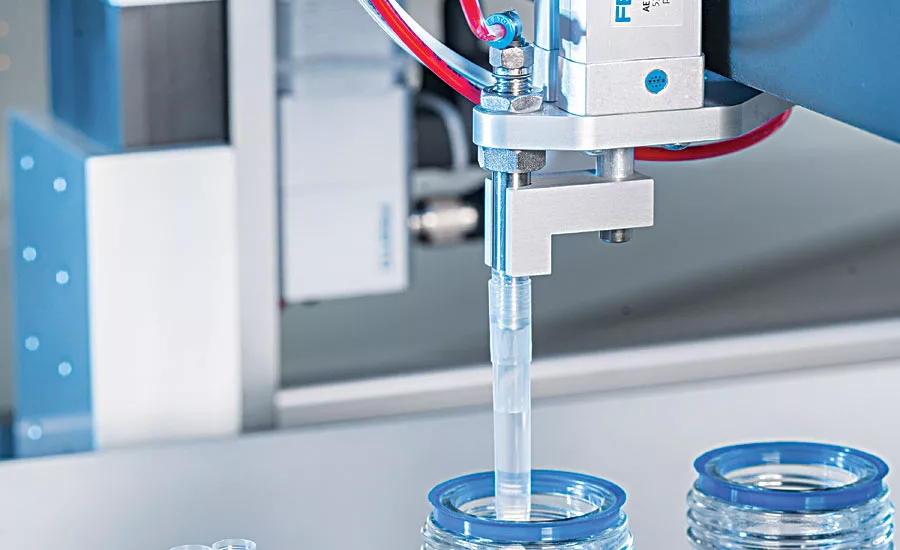
Electric linear actuators ensure precise positioning of a dispensing head in a laboratory automation application. The small pneumatic cylinder automatically ejects the used pipette once a sample has been processed. Photo courtesy Festo Corp.

August 4, 2016

The advent of laboratory automation systems has made a significant impact on clinical diagnostics, drug discovery, food and agricultural research, and forensics. Indeed, consulting firm Markets and Markets predicts that global sales of lab automation will grow at a cumulative annual rate of 6.7 percent over the next five years, topping $5.1 billion by 2020.

Lab automation spares technicians from monotonous, repetitive tasks, and it keeps them from handling hazardous substances. Automation also enables laboratories to operate 24/7, and it increases the quality, reproducibility and traceability of samples.

Among the world’s leading suppliers of laboratory automation is Anton Paar GmbH, based in Graz, Austria. One of the company’s top products is the Modular Sample Processor, a robotic workcell that automatically prepares small samples of liquids, pastes or powders for analysis. The cell is equipped with two gantry robots. One dispenses amounts ranging from a few milliliters to 1 deciliter into small containers. The other transfers containers to and from input and output trays, a scale, and a bar code reader.

The cell can operate as a standalone machine; it can be connected to an analytical instrument; or it can be integrated into a fully automated processing line.

Laboratories use the cell to automate “time-consuming manual work, such as pipetting, sampling, dosing and weighing,” explains Markus Schöllauf, a project manager in Anton Paar’s Automation and Robotics Div.

Motion control components from Fest Corp. ensure the machine meets Anton Paar’s requirements for accuracy, repeatability and smooth motion.

Each gantry robot consists of two electric linear actuators. The X-axis is the Model DGEA cantilevered linear actuator with a toothed-belt drive. The Y axis is the Model EGSK linear actuator with a ballscrew drive. Both axes are powered by Model EMMS-ST stepper motors.

The DGEA cantilevered axis is driven by a pinion fixed in the slide. The belt runs around the pinion, giving it a shape like the Greek letter omega. This allows the actuator to produce high torque. For better dynamic response, the motor, gearing and drive head are permanently mounted—only the main profile moves with the load. The particularly flat design of the drive head reduces vibration.

The device is available in stroke lengths of 800, 900 and 1,000 millimeters. Maximum load ranges from 7 to 27 kilograms, while maximum feed force ranges from 230 to 1,000 newtons. The actuator’s top speed is 3 meters per second. Repeatability is ±0.05 millimeter.

With its compact design and solid steel housing and guide rail, the EGSK is good for short-stroke, high-precision applications requiring high rigidity, long service life and good repeatability. The EGSK has a recirculating ball bearing guide and offers several ballscrew pitches for different performance requirements.

The EGSK comes in five versions. Stroke lengths range from 25 to 800 millimeters. Maximum speed ranges from 330 to 1,050 millimeters per second, and repeatability ranges from 3 to 10 microns.

Besides its linear axes, the dispensing robot is equipped with a small Model AEN pneumatic cylinder. When a pipetting procedure has finished, the cylinder actuates to eject the used pipette into a waste chute.

The AEN cylinder is compact. In fact, it uses up to 50 percent less space compared with standard ISO 6431 cylinders. A unique three-component piston improves running characteristics and cushioning. It also saves on fitting space, which has been used for a longer piston-rod bearing. The result is greater guide precision and higher load capacity to resist lateral forces. The cylinder is available in diameters ranging from 12 to 125 millimeters.

“Festo didn’t just supply us with the axes, but rather a complete system solution, including a CECC Codesys controller,” says Schöllauf. “Without that, it would not have been possible for us to meet our extremely short development deadline of four months.”

Using a single controller to govern all axes of motion ensures that the gantries will never collide even though they move within the same workspace.

KEYWORDS: actuator Cartesian robot gantry robot pneumatic cylinders robotic dispensing

Share This Story

Looking for a reprint of this article?
From high-res PDFs to custom plaques, order your copy today!

John has been with ASSEMBLY magazine since February 1997. John was formerly with a national medical news magazine, and has written for Pathology Today and the Green Bay Press-Gazette. John holds a B.A. in journalism from Northwestern University, Medill School of Journalism.

Recommended Content

JOIN TODAY
To unlock your recommendations.

Already have an account? Sign In

  • Made in the U.S.A.

    Consumer Products Manufacturing: Made in the USA

    Supply chain lessons learned during the coronavirus...
    Automated Assembly Systems
    By: Austin Weber
  • Best Practices for Press-Fit Assembly

    Best Practices for Press-Fit Assembly

    In manufacturing, ironclad formulas for success are hard...
    Assembly Presses
    By: Jim Camillo
  • aem0523leader-tesla1.jpg

    Tesla Rethinks the Assembly Line

    Engineers at Tesla Inc. have developed a new process that...
    Electrification
    By: Austin Weber
Manage My Account
  • eMagazine Subscription
  • Assembly Newsletters
  • Online Registration
  • Subscription Customer Service
  • Manage My Preferences

More Videos

Sponsored Content

Sponsored Content is a special paid section where industry companies provide high quality, objective, non-commercial content around topics of interest to the ASSEMBLY audience. All Sponsored Content is supplied by the advertising company and any opinions expressed in this article are those of the author and not necessarily reflect the views of ASSEMBLY or its parent company, BNP Media. Interested in participating in our Sponsored Content section? Contact your local rep!

close
  • ultrasonic welding
    Sponsored bySonobond Ultrasonics

    Engineering Efficiency in High-Performance Assembly: How Ultrasonic Welding Enhances Throughput, Reliability and Quality

  • UV curing system
    Sponsored byDymax

    Why UV Intensity Alone Doesn’t Define Curing Performance

  • wooden pallets
    Sponsored byLEAN Manufacturing Products

    Eliminating Waste on the Shop Floor: Applying Lean Principles to Improve Manufacturing Efficiency

Popular Stories

ASSEMBLY News Now, episode-30: Volvo Redesigns EV Manufacturing

Volvo Redesigns EV Manufacturing

Boeing CEO Kelly Ortberg announces 1 billion investment

Boeing Plans $1 Billion Wichita Investment, Workforce Training Center

GE Appliances Worker on Line

GE Appliances Expands Factory AI With 800 Gemini Enterprise Agents

Watch the latest episode of ANN now!

Events

July 24, 2025

From Shop Floor to CFO: How Manufacturers Are Closing the Loop Between Operations and Finance

On Demand Learn how manufacturers are bridging the gap between the shop floor and ERP systems to gain real-time visibility, streamline operations, and kick-start digital transformation—without waiting years.

Sponsored by:

PicoStratusGreen
July 30, 2025

Buffer Analysis and Design Fundamentals for Manufacturing Excellence

On Demand In this presentation, Dr. Herman Tang shares practical insights from his industry experience and research on buffer management in manufacturing operations.

View All Submit An Event

Poll

Difficult Assembly Processes

Which assembly process gives you the most difficulty?
View Results Poll Archive

Products

Manufacturing Cost Policy Deployment (MCPD) Profitability Scenarios: Systematic and Systemic Improvement of Manufacturing Costs

Manufacturing Cost Policy Deployment (MCPD) Profitability Scenarios: Systematic and Systemic Improvement of Manufacturing Costs

See More Products
Register for webinar - Modernizing Automotive Assembly: Why Upgrading Legacy MES is a Business Imperative

Related Articles

  • High-tech motion control aids production of protective packaging

    High-tech motion control aids production of protective packaging

    See More
  • Motion Control: Rigid vs. Flexible

    See More

Related Products

See More Products
  • foreman.jpg

    The Foreman on the Assembly Line

  • Assembly Processes: Finishing, Packaging, and Automation

  • Kaizen Assembly: Designing, Constructing, and Managing a Lean Assembly Line

See More Products

Related Directories

  • Sankyo Automation

    Sankyo Automation has been a worldwide leader in cam-driven indexing technology, and continues to develop new and innovative technology in motion control. The high quality of Sankyo products is a direct result of innovative design, strict process control and a continual effort to strive for improvement. These attitudes and technology are managed from our facility located in Sidney, OH.
×

Never miss the latest news and trends driving the manufacturing industry

Stay in the know on the latest assembly trends.

JOIN TODAY!
  • RESOURCES
    • Advertise
    • Contact Us
    • Directories
    • Manufacturing Division
    • Store
    • Want More?
  • SIGN UP TODAY
    • Create Account
    • eMagazine
    • Newsletters
    • Customer Service
    • Manage Preferences
  • SERVICES
    • Marketing Services
    • Reprints
    • Market Research
    • List Rental
    • Survey/Respondent Access
  • STAY CONNECTED
    • LinkedIn
    • Facebook
    • Instagram
    • YouTube
    • X (Twitter)
  • PRIVACY
    • PRIVACY POLICY
    • TERMS & CONDITIONS
    • DO NOT SELL MY PERSONAL INFORMATION
    • PRIVACY REQUEST
    • ACCESSIBILITY

Copyright ©2026. All Rights Reserved BNP Media, Inc. and BNP Media II, LLC.

Design, CMS, Hosting & Web Development :: ePublishing