Assembly Magazine logo
search
Ask ASSEMBLY AI
cart
facebook twitter linkedin youtube
  • Sign In
  • Create Account
  • Sign Out
  • My Account
Assembly Magazine logo
  • TRENDS
    • Ask ASSEMBLY AI
    • Trends
    • News
    • New Products
  • INDUSTRIES
    • Aerospace
    • Appliance
    • DFMA Assembly
    • Medical Devices
    • Green Manufacturing
    • Lean Manufacturing
    • Machinery Assembly
    • Electronics Assembly
    • Automotive
  • TECHNOLOGIES
    • Adhesives & Dispensing
    • Assembly Presses
    • Automated Assembly Systems
    • Manufacturing Management
    • Manufacturing Software
    • Motion Control
    • Screwdriving & Riveting
    • Robotics
    • Test & Inspection
    • Plastics & Metal Welding
    • Wire Processing
    • Workstations
  • AUTONOMOUS & ELECTRIC MOBILITY
    • AEM Magazine Archives
    • Autonomy
    • Electrification
    • Mobility Services
    • Assembly & Testing
    • AV/EM News
  • MEDIA
    • Ask ASSEMBLY AI
    • Podcasts
    • Assembly News Now
    • Assembly TV
    • Webinars
    • eBooks
  • EVENTS
    • Calendar
    • The ASSEMBLY Show
  • MORE
    • Exclusives >
      • Plant of the Year
      • Capital Spending
    • Buyers Guide >
      • Supplier Insights
    • Classifieds
    • Featured Products
    • Newsletters
    • Store
    • White Papers
    • Columns
    • Sponsor Insights
  • INFOCENTER
    • Assembly & Test Solutions
  • EMAGAZINE
    • eMagazine
    • Archive Issues
    • Advertise
    • Contact Us
    • Sign Up
Assembly Presses

advertisement

How To Put a High-Precision Press on Your Robot and Still Minimize Your Work Station’s Footprint
promess
promess
promess
promess
promess
promess
April 27, 2017

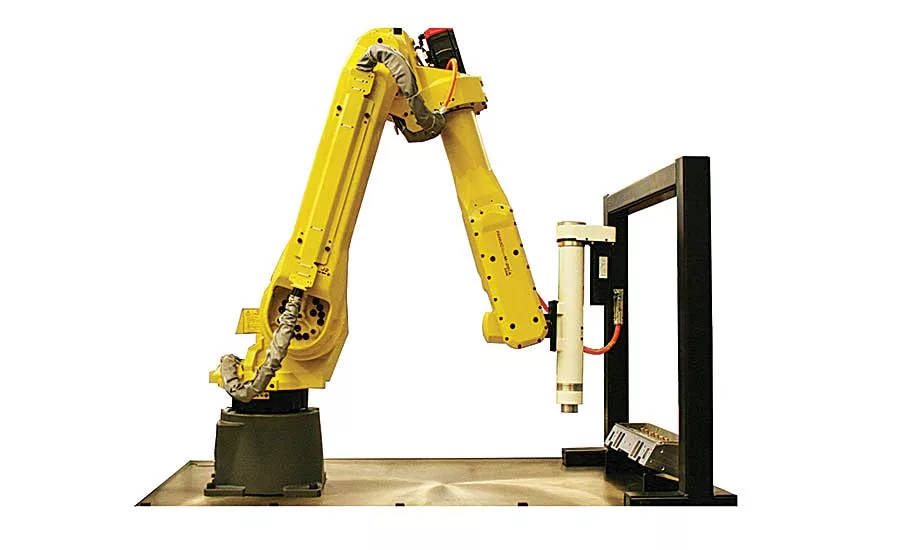
There are literally thousands of assembly operations that require an electro-mechanical assembly press. Traditional methods for assembly involve intricate automated lines that would bring the part to the press, but with the advancements in robotic technology why not simplify the automation and bring the press to the part? The biggest problem we have seen in the marketplace isn’t that there isn’t a robot big enough to mount our press to, but how can we help our customers minimize the footprint of their assembly station.

My company makes presses, servo-controlled electro-mechanical assembly presses, EMAPs. We were asked by several of our customers to help them develop a method that allows them to utilize robotic technology along with Promess’ EMAP technology. We identified three major obstacles as we developed this new method, the robots’ inability to handle large reaction forces, the need for larger robots to handle the weight of larger EMAPs, and that traditional communication between Promess’ controller and robot manufactures technology was too slow.

Realizing the growing demand for a press that could partner with any robot and perform to Promess’ high standard we developed a variation of our standard EMAP, and here is how…

Robots can’t handle reaction force

There is no escape from the laws of physics, for every action there is an equal and opposite reaction. When a Promess EMAP presses to an X-amount of force, the robot must be able to hold X-amount of force. However, typically robots are not designed to hold large amounts of force.

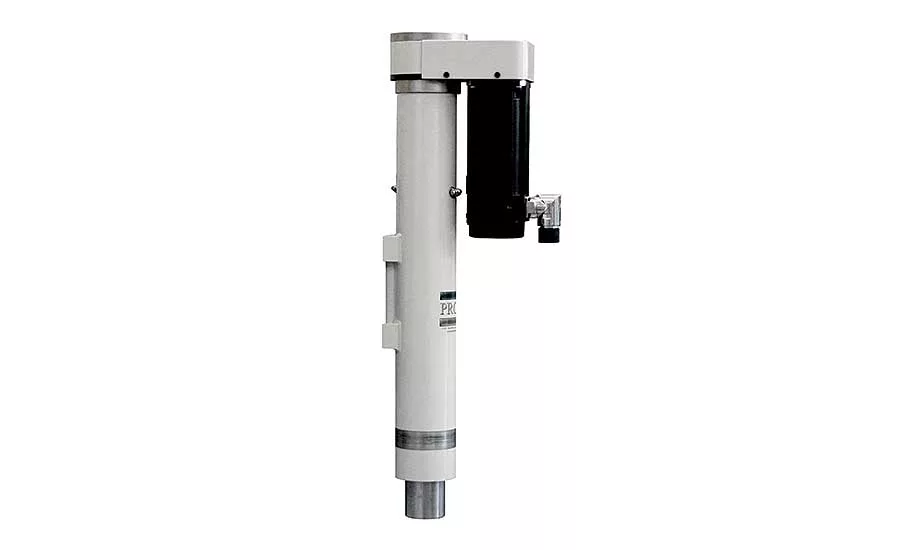
Thus, Promess developed the Integrated Back Stop press add-on, which helps eliminate the need for the robot to take on any of the pressing force. How the process works is that once the robot gets the press into position, it would then enter a float state. This float state would allow the press the ability to move axially backwards until it encountered a reinforced structure. At that point we would begin our pressing application transferring all the reaction force into the structure. This process could then be repeated in several different locations with the same type of structure.

Minimize Weight

With the Integrated Back Stop taking on all the reaction force, the robot’s only responsibility is being able to handle the physical weight of the press. A standard Promess EMAP 20kN unit weighs in at roughly 200lbs, and adding the Integrated Back Stop would add additional weight. Our goal was to optimize components specifically for robotic applications that would help us save on overall weight. We designed more “form-fitting” components, like our motor mounting plate which is traditionally rectangular in shape but now resembles more of a pear shape. We also utilized smaller motors in tandem with gearboxes, as compared to our standard which uses larger motors and no gearboxes. Finally, we were able to eliminate some features like cables and a proximity switch by switch to absolute encoder motors. Also, we removed certain mounting features that wouldn’t necessarily fit into a robotic press design.

By doing these small things we were able to cut the additional weight by more than half, thus helping us minimize the overall press weight allowing for the use of smaller robots.

Looking for quick answers on assembly and manufacturing topics? Try Ask ASM, our new smart AI search tool. Ask ASM →

Optimizing communication

Traditional methods when communicating between a Promess EMAP and a robot would require an intermediate PLC that would relay the information back and forth between the two different controllers. This additional interface can slow the entire process down, and additional problems that are not necessary.

Promess developed in house a synergetic interface that allows direct communication between the Promess controller and the robot controller. This allows both the robot and the press to analyze and process data in real time without any delay. Again, this software interface has been completed and is currently in use within the auto industry.

The Integrated Back Stop would allow one station the ability to handle various part families, and would also allow the same press to be used at multiple stages of assembly without having to back track. Additionally, as production goes up and down it would be simple to add and take away additional presses and robots to accommodate production demand.

Promess developed the EMAP Integrate Back Stop in 2016, and believes that this method for end effector mounting will open several exciting possibilities for flexible agile assembly operations. For we were able to accomplish our goal, which was minimizing our footprint by bringing the press to the part, allowing for the use of smaller robots, and eliminating third party components that ultimately just slow the process down.

Promess

11429 Grand River Road

Brighton, MI 48116

810-229-9334

promess@promessinc.com

www.promessinc.com

Share This Story

Looking for a reprint of this article?
From high-res PDFs to custom plaques, order your copy today!

Recommended Content

JOIN TODAY
To unlock your recommendations.

Already have an account? Sign In

  • Made in the U.S.A.

    Consumer Products Manufacturing: Made in the USA

    Supply chain lessons learned during the coronavirus...
    Automated Assembly Systems
    By: Austin Weber
  • Best Practices for Press-Fit Assembly

    Best Practices for Press-Fit Assembly

    In manufacturing, ironclad formulas for success are hard...
    Assembly Presses
    By: Jim Camillo
  • aem0523leader-tesla1.jpg

    Tesla Rethinks the Assembly Line

    Engineers at Tesla Inc. have developed a new process that...
    Electrification
    By: Austin Weber
Manage My Account
  • eMagazine Subscription
  • Assembly Newsletters
  • Online Registration
  • Subscription Customer Service
  • Manage My Preferences

More Videos

Sponsored Content

Sponsored Content is a special paid section where industry companies provide high quality, objective, non-commercial content around topics of interest to the ASSEMBLY audience. All Sponsored Content is supplied by the advertising company and any opinions expressed in this article are those of the author and not necessarily reflect the views of ASSEMBLY or its parent company, BNP Media. Interested in participating in our Sponsored Content section? Contact your local rep!

close
  • ultrasonic welding
    Sponsored bySonobond Ultrasonics

    Engineering Efficiency in High-Performance Assembly: How Ultrasonic Welding Enhances Throughput, Reliability and Quality

  • UV curing system
    Sponsored byDymax

    Why UV Intensity Alone Doesn’t Define Curing Performance

  • wooden pallets
    Sponsored byLEAN Manufacturing Products

    Eliminating Waste on the Shop Floor: Applying Lean Principles to Improve Manufacturing Efficiency

Popular Stories

ASSEMBLY News Now, episode-30: Volvo Redesigns EV Manufacturing

Volvo Redesigns EV Manufacturing

Boeing CEO Kelly Ortberg announces 1 billion investment

Boeing Plans $1 Billion Wichita Investment, Workforce Training Center

GE Appliances Worker on Line

GE Appliances Expands Factory AI With 800 Gemini Enterprise Agents

Watch the latest episode of ANN now!

Events

July 24, 2025

From Shop Floor to CFO: How Manufacturers Are Closing the Loop Between Operations and Finance

On Demand Learn how manufacturers are bridging the gap between the shop floor and ERP systems to gain real-time visibility, streamline operations, and kick-start digital transformation—without waiting years.

Sponsored by:

PicoStratusGreen
July 30, 2025

Buffer Analysis and Design Fundamentals for Manufacturing Excellence

On Demand In this presentation, Dr. Herman Tang shares practical insights from his industry experience and research on buffer management in manufacturing operations.

View All Submit An Event

Poll

Difficult Assembly Processes

Which assembly process gives you the most difficulty?
View Results Poll Archive

Products

Manufacturing Cost Policy Deployment (MCPD) Profitability Scenarios: Systematic and Systemic Improvement of Manufacturing Costs

Manufacturing Cost Policy Deployment (MCPD) Profitability Scenarios: Systematic and Systemic Improvement of Manufacturing Costs

See More Products
Register for webinar - Modernizing Automotive Assembly: Why Upgrading Legacy MES is a Business Imperative

Related Articles

  • Using Promess Straightening Work Station

    How to Achieve Precision in Manufacturing: A Guide to Using Promess Straightening Work Station

    See More
  • zimmer

    How To How to choose the right type of EAOT for your collaborative robot?

    See More

Related Products

See More Products
  • pocket.jpg

    How To Implement Lean Manufacturing, Second Edition

  • leaner

    Leaner Manufacturing: How to Make the Lean Production Process Easier, Faster, and More Cost-Effective

  • Kaizen Assembly: Designing, Constructing, and Managing a Lean Assembly Line

See More Products

Related Directories

  • HowToRobot

  • Visumatic Industrial Products

    Visumatic Industrial Products - the experts in automated fastening technology. Automatic feed and drive equipment to install screws, nuts, bolts, rings, pins, clips, rivets and specialty fasteners. Engineered products ranging from hand operated guns to machine builder robot EOAT, all robustly built for companies doing product assembly work.
×

Never miss the latest news and trends driving the manufacturing industry

Stay in the know on the latest assembly trends.

JOIN TODAY!
  • RESOURCES
    • Advertise
    • Contact Us
    • Directories
    • Manufacturing Division
    • Store
    • Want More?
  • SIGN UP TODAY
    • Create Account
    • eMagazine
    • Newsletters
    • Customer Service
    • Manage Preferences
  • SERVICES
    • Marketing Services
    • Reprints
    • Market Research
    • List Rental
    • Survey/Respondent Access
  • STAY CONNECTED
    • LinkedIn
    • Facebook
    • Instagram
    • YouTube
    • X (Twitter)
  • PRIVACY
    • PRIVACY POLICY
    • TERMS & CONDITIONS
    • DO NOT SELL MY PERSONAL INFORMATION
    • PRIVACY REQUEST
    • ACCESSIBILITY

Copyright ©2026. All Rights Reserved BNP Media, Inc. and BNP Media II, LLC.

Design, CMS, Hosting & Web Development :: ePublishing