Assembly Magazine logo
search
Ask ASSEMBLY AI
cart
facebook twitter linkedin youtube
  • Sign In
  • Create Account
  • Sign Out
  • My Account
Assembly Magazine logo
  • TRENDS
    • Ask ASSEMBLY AI
    • Trends
    • News
    • New Products
  • INDUSTRIES
    • Aerospace
    • Appliance
    • DFMA Assembly
    • Medical Devices
    • Green Manufacturing
    • Lean Manufacturing
    • Machinery Assembly
    • Electronics Assembly
    • Automotive
  • TECHNOLOGIES
    • Adhesives & Dispensing
    • Assembly Presses
    • Automated Assembly Systems
    • Manufacturing Management
    • Manufacturing Software
    • Motion Control
    • Screwdriving & Riveting
    • Robotics
    • Test & Inspection
    • Plastics & Metal Welding
    • Wire Processing
    • Workstations
  • AUTONOMOUS & ELECTRIC MOBILITY
    • AEM Magazine Archives
    • Autonomy
    • Electrification
    • Mobility Services
    • Assembly & Testing
    • AV/EM News
  • MEDIA
    • Ask ASSEMBLY AI
    • Podcasts
    • Assembly News Now
    • Assembly TV
    • Webinars
    • eBooks
  • EVENTS
    • Calendar
    • The ASSEMBLY Show
  • MORE
    • Exclusives >
      • Plant of the Year
      • Capital Spending
    • Buyers Guide >
      • Supplier Insights
    • Classifieds
    • Featured Products
    • Newsletters
    • Store
    • White Papers
    • Columns
    • Sponsor Insights
  • INFOCENTER
    • Assembly & Test Solutions
  • EMAGAZINE
    • eMagazine
    • Archive Issues
    • Advertise
    • Contact Us
    • Sign Up
Automated Assembly SystemsRobotics Assembly

AI and Machine Learning in Manufacturing

Artificial intelligence and machine learning promise to improve maintenance, quality and supply chain management
By John Sprovieri
AI and Machine Learning in Manufacturing
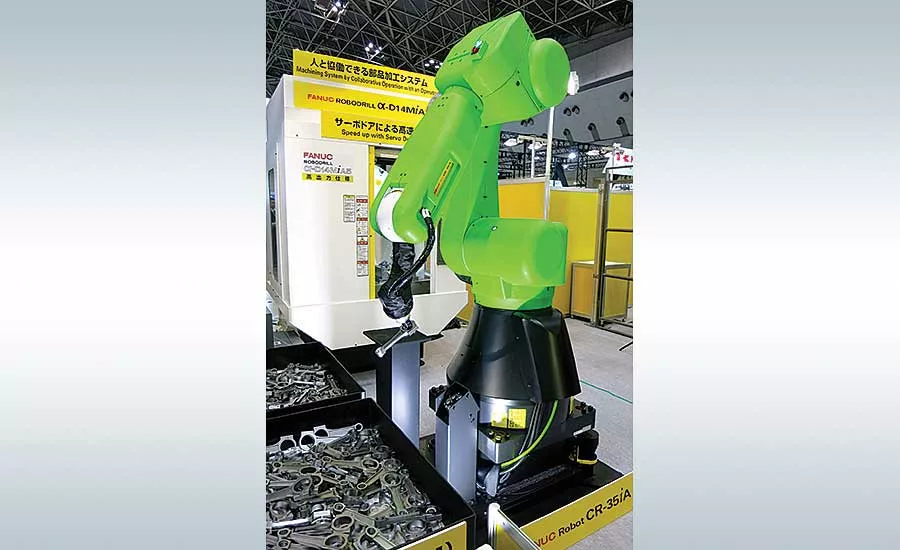
Using AI, this robot can teach itself how to pick parts from a box, tray or conveyor with a high rate of success. Photo courtesy Fanuc
AI and Machine Learning in Manufacturing
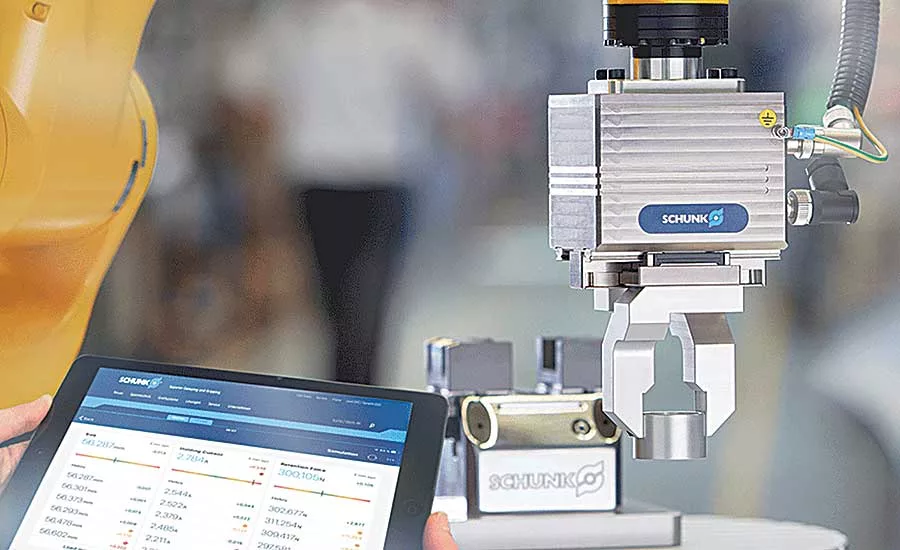
At this year’s Hannover Messe trade show in Germany, SCHUNK and French AI startup AnotherBrain announced an agreement to develop the world’s first autonomously acting gripping system. Photo courtesy SCHUNK
AI and Machine Learning in Manufacturing
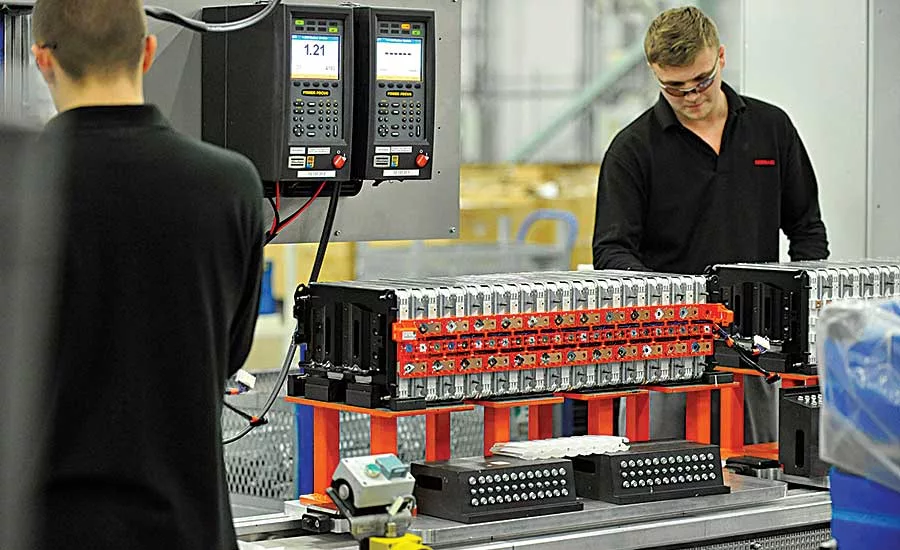
Machine learning is helping battery manufacturers test their products at the end of the assembly line. Photo courtesy Nissan Motor Co. Ltd.
AI and Machine Learning in Manufacturing
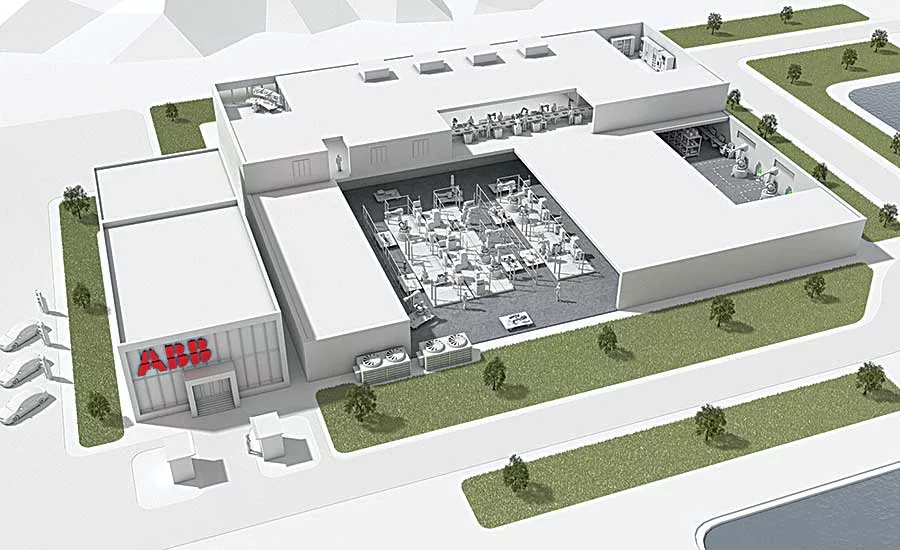
Set to open next year, ABB’s new robot factory in Shanghai will feature various machine learning, digital and collaborative technologies. Photo courtesy ABB
AI and Machine Learning in Manufacturing
May 3, 2019

Robots and other automation technologies have greatly increased productivity in today’s factories. However, they still have one major limitation: They require people to tell them what to do.

But, what if robots and other industrial machinery could teach themselves how to perform a task? This is the goal of a joint venture created in April 2018 by Hitachi, Fanuc and Preferred Networks, a startup specializing in artificial intelligence (AI).

The new company, Intelligent Edge System, will develop fast, real-time control systems for network-linked robots and machine tools. By utilizing deep-learning AI technology, these control systems will learn and become smarter as linked machines manufacture products.

Deep learning is a type of AI technology designed to mimic the human brain’s functions to sift through information more efficiently and speed up data analysis. The technology promises to boost assembly line productivity by making it possible for robots to recognize different parts and adjust their moves accordingly. It could also enable robots to automatically take on the task of an adjacent robot on an assembly line if it breaks down.

Edge computing will also play a major role in the joint venture’s control systems. Instead of centrally processing data, the technology handles the task at the edge of the network, letting machines on assembly line immediately process the massive amount of data collected from vision systems, sensors, grippers and tools.

Already, the new company’s efforts are paying off. For example, Fanuc has introduced an AI-based system to enable robots to pick parts from a box, tray or conveyor with a high rate of success. Using deep learning and a scoring system for 3D objects, the robot automatically determines which parts to pick up, how to pick them up, and in what sequence. Without AI, such an application would require hours of detailed parameter tuning by an experienced engineer.

With AI, the robot trains itself. Each time the robot succeeds or fails to pick up a part, it remembers how the object looked. That data is then used to refine a deep-learning model that controls the robot’s action. With a few hours of practice, the robot eventually learns pick parts with an accuracy of 90 percent or better.

Looking for quick answers on assembly and manufacturing topics? Try Ask ASM, our new smart AI search tool. Ask ASM →

Fanuc is also applying deep-learning software to automatically tune and control servomotors that drive cutting tools in CNC machining centers; to automatically compensate for thermal displacement in electric discharge machining applications; and to accurately predict when valves and other “wear and tear” components on injection molding machines need to be replaced.

AI isn’t only being applied to robots. It’s being applied to robot peripherals, as well. For example, at this year’s Hannover Messe trade show in Germany, SCHUNK and French AI startup AnotherBrain announced an agreement to develop the world’s first autonomously acting gripping system by next year. The gripper will be able to operate independently, without the need for manual programming.

“This promising cooperation will help us to push forward the use of artificial intelligence in the field of handling and assembly, and to create new handling scenarios in the smart factory—and also in the field of service robotics,” says SCHUNK CEO Henrik A. Schunk.

Instead of having an engineer define positions, speeds and gripping forces step by step, autonomous gripping systems will detect their target objects via cameras, and then independently take over the planning of the gripping process and continuously improve it. The quality of the grip can be detected, evaluated, and readjusted as necessary. Sensors in the gripper’s motors and fingers would provide data to on-board intelligence.


Machines Get Smart

A 2018 survey by Forbes magazine found that half of U.S. manufacturers believe AI and machine learning will be “absolutely critical” to their success in the next five years. These technologies are about more than just gathering data from connected systems. They will create smart machines that can use the data to sense, understand, learn and take actions independent of human direction.

Although AI and machine learning are often used interchangeably, they’re not quite the same. AI is the broader concept of simulated human intelligence by machines and computer systems. Machine learning is a form of AI that enables a system to learn from data rather than through programming. Algorithms build a mathematical model of sample data, known as “training data,” to make predictions or decisions without being explicitly programmed to perform the task. This is how spam filters work in email software.

In manufacturing, AI and machine learning are already being applied to vision systems, CAD software and predictive maintenance. The technologies are also being used to aid demand forecasting, personalize manufacturing, optimize manufacturing processes, automate material procurement, and even screen sales leads.

For example, IBM’s Prescriptive Warranty for Manufacturing software applies advanced analytics to warranty-related data to help identify where warranty-eligible defects are arising and determine why they are occurring, enabling companies to respond more quickly and efficiently.

The software looks for conditions that lead to accelerated wear and replacement of manufactured products that are under warranty. Such conditions might include variations in the manufacturing process of the product, variations in the quality of parts and materials that are used in the product, or the ways in which the product is used.


Better Batteries Through AI

In March, scientists at the Massachusetts Institute of Technology, Stanford University and the Toyota Research Institute discovered that combining comprehensive experimental data and artificial intelligence can accurately predict the useful life of lithium-ion batteries before their capacities started to wane.

After the researchers trained their machine learning model with a few hundred million data points, the algorithm predicted how many more cycles each battery would last, based on voltage declines and other factors measured during early cycles. The predictions were within 9 percent of the actual cycle life.

Separately, the algorithm categorized batteries as having either long or short life expectancies based on just the first five charge-discharge cycles. Here, the predictions were correct 95 percent of the time.

This machine learning method could accelerate R&D of new battery designs, and reduce the time and cost of production.

“The standard way to test new battery designs is to charge and discharge the cells until they die. Since batteries have a long lifetime, this process can take many months and even years,” said co-lead author Peter Attia, Stanford doctoral candidate in materials science and engineering. “It’s an expensive bottleneck in battery research.”

Another focus of the project was to find a better way to charge batteries in 10 minutes, a feature that could
accelerate the mass adoption of electric vehicles. To generate the training data set for that application, the team charged and discharged batteries until each one reached the end of its useful life, which they defined as capacity loss of 20 percent. However, the researchers wondered whether it was necessary to run the batteries into the ground. Could the answer to a battery question be found in the information from just the early cycles?

“Advances in computational power and data generation have recently enabled machine learning to accelerate progress for a variety of tasks, including prediction of material properties,” says Richard Braatz, Ph.D., professor of chemical engineering at MIT. “Our results show how we can predict the behavior of complex systems far into the future.”

The researchers’ machine learning algorithms have many applications in battery manufacturing. For example, they can shorten the time for validating batteries with new chemistries, which is especially important given rapid advances in materials. Also, manufacturers can use their software to grade batteries. Units with longer lifetimes could be sold at higher prices for more demanding uses, such as powering electric vehicles. Recyclers can use the method to find cells in used EV battery packs that have enough life in them for secondary uses.

Yet another use is optimizing battery manufacturing. “The last step in manufacturing batteries is called ‘formation’ which can take days to weeks,” says Attia. “Using our approach could shorten that significantly and lower the production cost.”              


AI to Play Key Role in ABB’s New Robot Factory

In October, ABB announced that it will invest $150 million to build a new robot assembly plant in Shanghai, China. The factory will combine ABB’s connected digital technologies, collaborative robots and artificial intelligence to create a sophisticated and environmentally sustainable “factory of the future.”

Scheduled to begin operating by the end of 2020, the factory will feature various machine learning, digital and collaborative technologies, making it one of the most advanced, automated and flexible factories in the robotics industry. Using a new, global design approach, the factory will be able to increase both the number of different types of robots it produces as well as the number of variants of each type.

“The concept behind this factory is the same advice we give our customers every day: Invest in automation solutions that provide flexibility and agility to grow in whichever direction the market goes,” says Sami Atiya, president of ABB’s Robotics and Motion division.

The entire factory will be modeled as a digital twin, which will provide intuitively tailored dashboards to help management, engineers, operators and maintenance experts make good decisions. This includes gathering and analyzing intelligence on the health and performance of ABB robots in the factory through ABB Ability Connected Services.

The new factory will have an innovative, flexible floor plan based on interlinked islands of automation rather than fixed assembly lines. ABB logistics automation technology will be used throughout the plant, including automatic guided vehicles that can autonomously follow robots as they move through production, supplying them with parts from localized stations. This will allow production to adapt and scale efficiently to market changes without additional capacity expansions.

“The concept behind our new factory is to make the smartest and most flexible use of every meter of production space. That comes from combining agile automation solutions with the great capabilities of our people,” says Per Vegard Nerseth, managing director of ABB’s Robotics business.

To aid mass customization in manufacturing and to ensure the highest levels of productivity and flexibility, the factory will make extensive use of ABB’s SafeMove2 software, which allows people and robots to work safely in close proximity. In addition, ABB’s YuMi robots will allow close collaboration on many of the small parts assembly tasks needed to manufacture an ABB robot.

KEYWORDS: Artificial Intelligence (AI) factory automation machine learning

Share This Story

Looking for a reprint of this article?
From high-res PDFs to custom plaques, order your copy today!

John has been with ASSEMBLY magazine since February 1997. John was formerly with a national medical news magazine, and has written for Pathology Today and the Green Bay Press-Gazette. John holds a B.A. in journalism from Northwestern University, Medill School of Journalism.

Recommended Content

JOIN TODAY
To unlock your recommendations.

Already have an account? Sign In

  • Made in the U.S.A.

    Consumer Products Manufacturing: Made in the USA

    Supply chain lessons learned during the coronavirus...
    Automated Assembly Systems
    By: Austin Weber
  • Best Practices for Press-Fit Assembly

    Best Practices for Press-Fit Assembly

    In manufacturing, ironclad formulas for success are hard...
    Assembly Presses
    By: Jim Camillo
  • aem0523leader-tesla1.jpg

    Tesla Rethinks the Assembly Line

    Engineers at Tesla Inc. have developed a new process that...
    Assembly and Testing
    By: Austin Weber
Manage My Account
  • eMagazine Subscription
  • Assembly Newsletters
  • Online Registration
  • Subscription Customer Service
  • Manage My Preferences

More Videos

Sponsored Content

Sponsored Content is a special paid section where industry companies provide high quality, objective, non-commercial content around topics of interest to the ASSEMBLY audience. All Sponsored Content is supplied by the advertising company and any opinions expressed in this article are those of the author and not necessarily reflect the views of ASSEMBLY or its parent company, BNP Media. Interested in participating in our Sponsored Content section? Contact your local rep!

close
  • ultrasonic welding
    Sponsored bySonobond Ultrasonics

    Engineering Efficiency in High-Performance Assembly: How Ultrasonic Welding Enhances Throughput, Reliability and Quality

  • UV curing system
    Sponsored byDymax

    Why UV Intensity Alone Doesn’t Define Curing Performance

  • wooden pallets
    Sponsored byLEAN Manufacturing Products

    Eliminating Waste on the Shop Floor: Applying Lean Principles to Improve Manufacturing Efficiency

Popular Stories

ASSEMBLY News Now, episode-30: Volvo Redesigns EV Manufacturing

Volvo Redesigns EV Manufacturing

Boeing CEO Kelly Ortberg announces 1 billion investment

Boeing Plans $1 Billion Wichita Investment, Workforce Training Center

automated consumer goods assembly system

Best Practices for Cycle Time Optimization

Watch the latest episode of ANN now!

Events

July 24, 2025

From Shop Floor to CFO: How Manufacturers Are Closing the Loop Between Operations and Finance

On Demand Learn how manufacturers are bridging the gap between the shop floor and ERP systems to gain real-time visibility, streamline operations, and kick-start digital transformation—without waiting years.

Sponsored by:

PicoStratusGreen
July 30, 2025

Buffer Analysis and Design Fundamentals for Manufacturing Excellence

On Demand In this presentation, Dr. Herman Tang shares practical insights from his industry experience and research on buffer management in manufacturing operations.

View All Submit An Event

Poll

Difficult Assembly Processes

Which assembly process gives you the most difficulty?
View Results Poll Archive

Products

Manufacturing Cost Policy Deployment (MCPD) Profitability Scenarios: Systematic and Systemic Improvement of Manufacturing Costs

Manufacturing Cost Policy Deployment (MCPD) Profitability Scenarios: Systematic and Systemic Improvement of Manufacturing Costs

See More Products
Register for webinar - Modernizing Automotive Assembly: Why Upgrading Legacy MES is a Business Imperative

Related Articles

  • GMM model created to show a simple classification of fruit.

    Traditional Machine Learning for Practical Machine Vision: It’s Been There All Along

    See More
  • VS 0923 System Integrate Test Setup

    Some Experiences Integrating Machine Learning with Vision and Robotics

    See More
  • worker fastening a part to an assembly

    Machine Learning Detects Fastening Errors

    See More

Related Products

See More Products
  • lean systems.jpg

    Lean Systems Applications and Case Studies in Manufacturing, Service, and Healthcare

  • 9780367532604.jpg

    Nature-Inspired Optimization in Advanced Manufacturing Processes and Systems

  • investment.jpg

    Investment Decisions in Advanced Manufacturing Technology

See More Products

Related Directories

  • Automated Learning

    ALC is a trusted provider of corporate learning solutions and e-learning products designed to improve performance in the workplace. We use criterion referenced objectives, and provide high levels of interactivity, built-in testing, and skilled use of multi-media. Topics include ESD, Lean, RF, ITAR, CGP, safety. Ask about custom development.
  • Assembly & Automation Technology Inc.

    Assembly & Automation Technology delivers intelligent automation systems integrating machine learning, computer vision and smart robotics for industrial, medical and biotechnical applications. Our AI-enhanced assembly machines, robotic systems and vision-guided quality control optimize productivity while reducing human error. We engineer custom automated solutions that learn, adapt and continuously improve manufacturing processes.
×

Never miss the latest news and trends driving the manufacturing industry

Stay in the know on the latest assembly trends.

JOIN TODAY!
  • RESOURCES
    • Advertise
    • Contact Us
    • Directories
    • Manufacturing Division
    • Store
    • Want More?
  • SIGN UP TODAY
    • Create Account
    • eMagazine
    • Newsletters
    • Customer Service
    • Manage Preferences
  • SERVICES
    • Marketing Services
    • Reprints
    • Market Research
    • List Rental
    • Survey/Respondent Access
  • STAY CONNECTED
    • LinkedIn
    • Facebook
    • Instagram
    • YouTube
    • X (Twitter)
  • PRIVACY
    • PRIVACY POLICY
    • TERMS & CONDITIONS
    • DO NOT SELL MY PERSONAL INFORMATION
    • PRIVACY REQUEST
    • ACCESSIBILITY

Copyright ©2026. All Rights Reserved BNP Media, Inc. and BNP Media II, LLC.

Design, CMS, Hosting & Web Development :: ePublishing