Assembly Magazine logo
search
Ask ASSEMBLY AI
cart
facebook twitter linkedin youtube
  • Sign In
  • Create Account
  • Sign Out
  • My Account
Assembly Magazine logo
  • TRENDS
    • Ask ASSEMBLY AI
    • Trends
    • News
    • New Products
  • INDUSTRIES
    • Aerospace
    • Appliance
    • DFMA Assembly
    • Medical Devices
    • Green Manufacturing
    • Lean Manufacturing
    • Machinery Assembly
    • Electronics Assembly
    • Automotive
  • TECHNOLOGIES
    • Adhesives & Dispensing
    • Assembly Presses
    • Automated Assembly Systems
    • Manufacturing Management
    • Manufacturing Software
    • Motion Control
    • Screwdriving & Riveting
    • Robotics
    • Test & Inspection
    • Plastics & Metal Welding
    • Wire Processing
    • Workstations
  • AUTONOMOUS & ELECTRIC MOBILITY
    • AEM Magazine Archives
    • Autonomy
    • Electrification
    • Mobility Services
    • Assembly & Testing
    • AV/EM News
  • MEDIA
    • Ask ASSEMBLY AI
    • Podcasts
    • Assembly News Now
    • Assembly TV
    • Webinars
    • eBooks
  • EVENTS
    • Calendar
    • The ASSEMBLY Show
  • MORE
    • Exclusives >
      • Plant of the Year
      • Capital Spending
    • Buyers Guide >
      • Supplier Insights
    • Classifieds
    • Featured Products
    • Newsletters
    • Store
    • White Papers
    • Columns
    • Sponsor Insights
  • INFOCENTER
    • Assembly & Test Solutions
  • EMAGAZINE
    • eMagazine
    • Archive Issues
    • Advertise
    • Contact Us
    • Sign Up
Autonomous & Electric MobilityElectrification

Assembling Electric Vehicle Charging Stations
By Austin Weber
Assembling EV Charging Stations
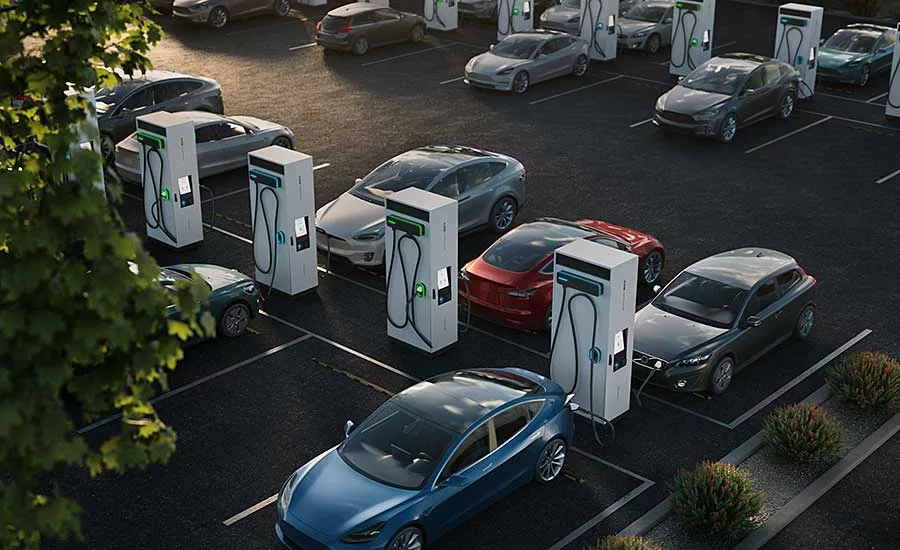
The new Iqon charger is designed for use in parking lots. Photo courtesy EVBox Group
Assembling EV Charging Stations
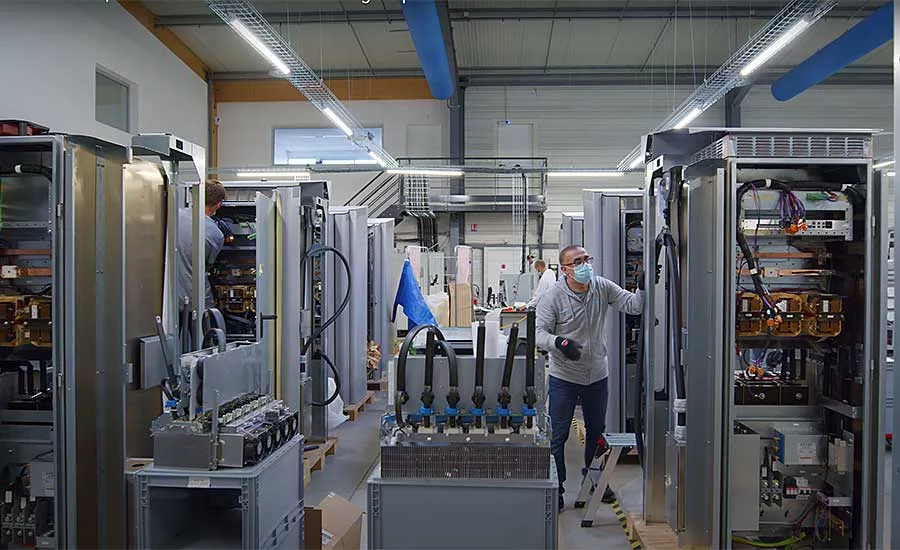
EVBox’s new factory in Libertyville, IL, is patterned after its flagship facility in Bordeaux, France. Photo courtesy EVBox Group
Assembling EV Charging Stations
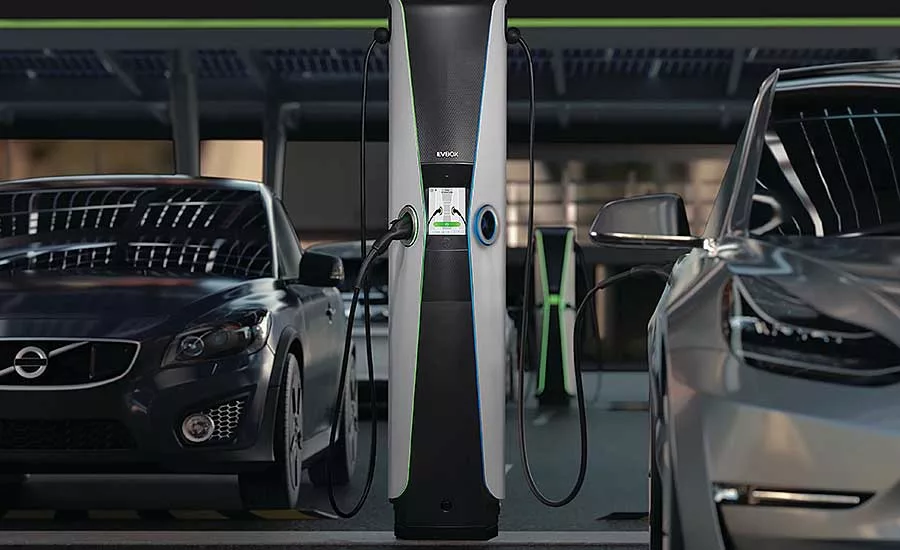
EVBox produces a variety of electric vehicles charging stations. Photo courtesy EVBox Group
Assembling EV Charging Stations
Electric vehicle chargers will soon be just as common as gas pumps are today. Photo courtesy EVBox Group
Assembling EV Charging Stations
September 22, 2021

Today, gas stations are a ubiquitous part of the urban landscape. They are found at numerous intersections and off-ramps. But, once upon a time, service stations were few and far between. As a result, one of the biggest fears of early motorists was running out of gas while on a long-distance road trip.

Today, history is repeating itself when it comes to electric vehicle charging stations. Range anxiety is preventing many consumers from taking the plunge into EVs.

In fact, according to a recent survey conducted by EVBox Group, a European supplier of charging equipment, most EV drivers (78 percent) say they don’t have enough options for charging their cars at work.

But, that may be about to change in the near future, especially if Congress passes President Biden’s controversial $2 trillion infrastructure plan, which calls for 500,000 new public charging stations by 2030. Even if half that number of stations are installed over the next decade, it would go a long way toward spurring widespread EV adoption in the United States.

EVBox believes that electric vehicle chargers will soon be just as common as gas pumps are today. The Dutch company has already installed more than 250,000 charging ports in more than 70 countries, and is aiming for 1 million units by 2023. In Europe, it is the sole supplier of public charging infrastructure in cities such as Amsterdam, Monaco and Rotterdam.

EVBox recently unveiled a Level 2 AC commercial charging station called Iqon that is designed for use in parking lots. The sleek, UL-certified device is 6 feet tall and features an 8-inch LCD touch screen.

“Iqon alleviates many of the common problems faced at EV charging locations at shopping centers, hotels, parking facilities or workplaces, and improves the charging experience for drivers and operators alike,” says Gianpaolo Casciano, head of marketing and growth for North America at EVBox. “By creating Iqon for the North American market, we are expanding our AC charging options and directly responding to the rapidly growing EV charging needs in public spaces across the U.S. and Canada."

Looking for quick answers on assembly and manufacturing topics? Try Ask ASM, our new smart AI search tool. Ask ASM →

EVBox is currently in the process of ramping up its first factory in North America. The facility in Libertyville, IL, a northern suburb of Chicago, will assemble several varieties of chargers.

Autonomous & Electric Mobility recently asked Casciano to discuss his company’s production philosophy and assembly strategy.


AEM: Why did EVBox decide to establish a factory in the Midwest?

Casciano: In February 2020, we leased a 60,000-square-foot facility in Libertyville that is an ideal location, because it is central to both the U.S. and Canada. This will help with product distribution to these markets, and it’s close to Detroit and Indiana, which are hubs for many OEMs and component manufacturers. The proximity to O’Hare International Airport is also key for customers and our employees.


AEM: Did you build a new factory or move into an existing facility?

Casciano: We moved into an existing brownfield facility that was previously owned by Motorola Inc. The facility is ideal for production and warehousing. It’s also an ideal spot to help us meet the current needs of our employees and customers, while offering opportunities for expansion in the future. When complete, our space will provide two distinct areas: a 60,000-square-foot operations center for warehousing and production, and an 8,000-square-foot office suite.


AEM: Will you be building your full product line in the U.S.?

Casciano: This location will enable us to produce around 200 DC fast-charging units per week, which is a level of production we expect will create between 80 and 120 new jobs in the immediate region, if not more. In the future, the factory will produce all AC and DC products for the U.S. market, and we plan to grow as the EV market grows to help meet demand.


AEM: How does your new U.S. facility compare to your existing factory in Bordeaux, France?

Casciano: Our design and manufacturing facility in France helped create a foundation for our Libertyville location. Across all of our facilities, we pool our experience, knowledge and success to sustain consistency, growth and continuous improvement. While we come from European roots, our goal is to grow into a strong U.S.-based manufacturer and distributor of electric vehicle chargers.


AEM: How are you laying out your assembly lines in your new facility and how flexible will they be?

Casciano: Our production lines are linear, based on a single-piece flow principle. Our intention is to have lines capable of producing a maximum diversity of products and product options. Currently, the distinct difference in design and complexity between our AC and DC charging stations means we will operate with separate AC charger and DC charger value streams. However, our development teams are working to significantly reduce assembly time and improve efficiency through modular design and construction. In the future, this will allow for flexibility and options that offer increased efficiency with a production mix tuned to customer needs.


AEM: Approximately how many components are contained in one of your typical chargers?

Casciano: Our basic, external structures for DC fast chargers are a mix of steel and aluminum for maximum strength and durability. Our smaller AC unit casings use high-strength plastic. The number of internal components varies by model. Our typical AC charger holds approximately 100 parts, while our typical high-powered DC charger contains more than 300 components.


AEM: What is the most complex component and assembly step?

Casciano: The electrical architecture of our PC control boards, the on-board control unit and our power converter unit provide a complex and technical mix to offer the best performance results.


AEM: Does one person typically assemble an entire charger from start to finish?

Casciano: No, but we use manual assembly processes. It includes a progressive assembly line, with a 100 percent functional test zone at the end of the line.


AEM: What type of production techniques do you use to assemble your products?

Casciano: The main chassis (structure) is fabricated from a mix of welded galvanized steel sheets, brackets and fasteners. There is no "hot work" or welding in our internal assembly process. The parts requiring this process are subcontracted and supplied to our lines.


AEM: What type of testing do you do at the end of your assembly line?

Casciano: All of our units are fully tested to full power with simulated vehicle charges. In the U.S., we also perform precommissioning checks to simulate customer installation and vehicle charge tests. We have an electric vehicle in our factory with which we functionally test 100 percent of our main charger models.

KEYWORDS: Chicago manufacturing electric vehicle charging units electric vehicles made in the USA

Share This Story

Looking for a reprint of this article?
From high-res PDFs to custom plaques, order your copy today!

Austinweber headshot
Austin has been senior editor for ASSEMBLY Magazine since September 1999. He has more than 21 years of b-to-b publishing experience and has written about a wide variety of manufacturing and engineering topics. Austin is a graduate of the University of Michigan.

Recommended Content

JOIN TODAY
To unlock your recommendations.

Already have an account? Sign In

  • Made in the U.S.A.

    Consumer Products Manufacturing: Made in the USA

    Supply chain lessons learned during the coronavirus...
    Automated Assembly Systems
    By: Austin Weber
  • Best Practices for Press-Fit Assembly

    Best Practices for Press-Fit Assembly

    In manufacturing, ironclad formulas for success are hard...
    Assembly Presses
    By: Jim Camillo
  • aem0523leader-tesla1.jpg

    Tesla Rethinks the Assembly Line

    Engineers at Tesla Inc. have developed a new process that...
    Automotive Assembly
    By: Austin Weber
Manage My Account
  • eMagazine Subscription
  • Assembly Newsletters
  • Online Registration
  • Subscription Customer Service
  • Manage My Preferences

More Videos

Sponsored Content

Sponsored Content is a special paid section where industry companies provide high quality, objective, non-commercial content around topics of interest to the ASSEMBLY audience. All Sponsored Content is supplied by the advertising company and any opinions expressed in this article are those of the author and not necessarily reflect the views of ASSEMBLY or its parent company, BNP Media. Interested in participating in our Sponsored Content section? Contact your local rep!

close
  • ultrasonic welding
    Sponsored bySonobond Ultrasonics

    Engineering Efficiency in High-Performance Assembly: How Ultrasonic Welding Enhances Throughput, Reliability and Quality

  • UV curing system
    Sponsored byDymax

    Why UV Intensity Alone Doesn’t Define Curing Performance

  • wooden pallets
    Sponsored byLEAN Manufacturing Products

    Eliminating Waste on the Shop Floor: Applying Lean Principles to Improve Manufacturing Efficiency

Popular Stories

ASSEMBLY News Now, episode-30: Volvo Redesigns EV Manufacturing

Volvo Redesigns EV Manufacturing

Boeing CEO Kelly Ortberg announces 1 billion investment

Boeing Plans $1 Billion Wichita Investment, Workforce Training Center

GE Appliances Worker on Line

GE Appliances Expands Factory AI With 800 Gemini Enterprise Agents

Watch the latest episode of ANN now!

Events

July 24, 2025

From Shop Floor to CFO: How Manufacturers Are Closing the Loop Between Operations and Finance

On Demand Learn how manufacturers are bridging the gap between the shop floor and ERP systems to gain real-time visibility, streamline operations, and kick-start digital transformation—without waiting years.

Sponsored by:

PicoStratusGreen
July 30, 2025

Buffer Analysis and Design Fundamentals for Manufacturing Excellence

On Demand In this presentation, Dr. Herman Tang shares practical insights from his industry experience and research on buffer management in manufacturing operations.

View All Submit An Event

Poll

Difficult Assembly Processes

Which assembly process gives you the most difficulty?
View Results Poll Archive

Products

Manufacturing Cost Policy Deployment (MCPD) Profitability Scenarios: Systematic and Systemic Improvement of Manufacturing Costs

Manufacturing Cost Policy Deployment (MCPD) Profitability Scenarios: Systematic and Systemic Improvement of Manufacturing Costs

See More Products
Register for webinar - Modernizing Automotive Assembly: Why Upgrading Legacy MES is a Business Imperative

Related Articles

  • Market for Electric Vehicle Charging Stations to Exceed 11 Million Units

    See More
  • Sales of Electric Vehicle Charging Stations to Grow 77 Percent

    See More
  • Assembling Electric Vehicle Motors

    Assembling Electric Vehicle Motors

    See More

Related Products

See More Products
  • assembly march 2020

    ASSEMBLY March 2020 Issue

  • Kaizen Assembly: Designing, Constructing, and Managing a Lean Assembly Line

See More Products

Related Directories

  • Bendix Commercial Vehicle Systems LLC

×

Never miss the latest news and trends driving the manufacturing industry

Stay in the know on the latest assembly trends.

JOIN TODAY!
  • RESOURCES
    • Advertise
    • Contact Us
    • Directories
    • Manufacturing Division
    • Store
    • Want More?
  • SIGN UP TODAY
    • Create Account
    • eMagazine
    • Newsletters
    • Customer Service
    • Manage Preferences
  • SERVICES
    • Marketing Services
    • Reprints
    • Market Research
    • List Rental
    • Survey/Respondent Access
  • STAY CONNECTED
    • LinkedIn
    • Facebook
    • Instagram
    • YouTube
    • X (Twitter)
  • PRIVACY
    • PRIVACY POLICY
    • TERMS & CONDITIONS
    • DO NOT SELL MY PERSONAL INFORMATION
    • PRIVACY REQUEST
    • ACCESSIBILITY

Copyright ©2026. All Rights Reserved BNP Media, Inc. and BNP Media II, LLC.

Design, CMS, Hosting & Web Development :: ePublishing