Robots Automate Disassembly of Chemical Weapons
In just 18 months, automation engineers overhauled how America destroys its most dangerous chemical weapons.
In 1951, at the height of the Cold War, the U.S. Army Chemical Corps and Ordnance Corps initiated a program to develop a new rocket that could deliver chemical weapons over a large area. The result was the M55 rocket, which was equipped with a unitary warhead filled with sarin or VX—highly toxic nerve agents. The rocket was rushed into production, and tens of thousands were produced from 1959 to 1965.
Thankfully, the rockets were never used. Decades later, in 1993, the United States signed the Chemical Weapons Convention, an international treaty that bans the use of chemical weapons and aims to eliminate them throughout the world. The country has been trying to dispose of its stockpiles ever since.
Getting rid of such weapons safely takes time. By January 2012, the U.S. had destroyed 89 percent of its chemical weapons, but there remains a lot of work to be done. Now, a deadline is looming. By law, the U.S. must completely eliminate its chemical weapons by Dec. 31, 2023.
One of the last remaining stockpiles—some 70,000 M55 rockets—is housed at the Blue Grass Army Depot in Richmond, KY. To put that number in perspective, there are twice as many rockets at the depot as there are people in Richmond.
Disarming and disassembling the rockets is not easy, and the task is made even more difficult because of the rocket’s design. The rocket propellant cannot be removed from the warhead without cutting open the rocket, and the propellant itself presents a hazard, because it becomes unstable as it ages. Another danger is leakage of the toxic nerve agents. As sarin decomposes, it forms acids that can corrode the aluminum casing inside the rocket.
Because of this and other hazards, the U.S. National Research Council has called the M55 the most dangerous weapon in the American chemical arsenal. Jeffrey Brubaker, technical adviser for the U.S. government’s Program Executive Office—Assembled Chemical Weapons Alternatives (PEO ACWA), calls the rockets “difficult animals.”
“[Because they were] rushed into production…they weren’t going to do well over time, and that’s what the program has shown,” says Brubaker, noting that many of the M55 rockets have warped over the decades and become prone to leaking.
Looking for quick answers on assembly and manufacturing topics? Try Ask ASM, our new smart AI search tool. Ask ASM
Congress established the PEO ACWA in 1997 to find environmentally friendly alternatives to incineration for destroying the chemical weapons at the Blue Grass depot and another location, the U.S. Army Pueblo Chemical Depot in Colorado.
To do that, the agency contracted with Bechtel Corp.’s Nuclear, Security & Environmental Unit to build plants at each depot to safely destroy the M55s and other chemical weapons. In 2015, Bechtel completed construction of the Blue Grass Chemical Agent-Destruction Pilot Plant, which is now being run by Bechtel Parsons Blue Grass, a joint-venture between Bechtel and Parsons Corp., an engineering firm specializing in defense, security and infrastructure projects. Progress was being made, but there was still a long way to go.
With the 2023 deadline fast approaching, the PEO ACWA took an unprecedented step in mid-2019. The organization’s leadership, which had already approved a destruction plan, decided to rethink the entire process, seeking to create more efficiencies and enhance safety for those involved.
With an ambitious timeline in mind, the government activated a contracting mechanism, known as an “other transaction authority” (OTA), that was established during the space race in the 1950s to get help from industry leaders in the private sector. Specifically, PEO ACWA wanted to automate the disassembly and destruction process using robots and other technologies.
So, the agency reached out to CRG Automation, an engineering firm best known for building packaging lines for the likes of Coca-Cola, Kellogg’s and Kraft. CRG Automation has been designing and building packaging and processing equipment for the food, beverage and consumer products industries for more than 20 years. Over the years, repeat customers approached the firm with more and more complex problems. Today, CRG continues to offer cartoners, case packers and other packaging equipment, but it has expanded its services to include custom automated assembly and manufacturing lines. The firm’s Louisville headquarters includes a modern machine shop and ample space to build and test large automated systems.
“As a past member of the military, this project took on a special importance for me,” says James DeSmet, president of CRG Automation. “The perplexing engineering problems to solve, the rapidly approaching deadline, and the severity of the chemical agents involved all added up to a challenge we wanted to tackle.
“We’ve often talked here at CRG about how our engineers like the kind of problems that leave other R&D teams scratching their heads,” he continues. “We knew this was an opportunity unlike any other, and, even staring down the pandemic, we knew we could do it.”
Challenge No. 1: Creating a Safer, More Efficient Destruction Process
To speed up disposal and enhance worker safety, PEO ACWA sought a way to break down the disposal process into different steps, essentially draining the chemical agent and disposing of it in a separate way. To understand the benefit involves understanding what was required when workers encountered issues during the initial version of the destruction plan.
While the original process was remotely controlled by workers, the system included a number of moving components, sensors and waste streams, so maintenance concerns were top of mind. Maintenance requires workers to wear the most stringent of personal protective equipment—a Level A hazmat suit, which includes a respirator and air hoses, says Ken Ankrom, OTA project manager for Amentum Services Inc., a technical and engineering services firm in Germantown, MD, specializing in defense work and a subcontractor for the project.
The reactors used in the destruction process measure three stories high. “You have a two-hour maximum time in the suit,” Brubaker adds. “By the time you get to your workstation, you’ve expended 30 minutes. So how much can you really get done in an hour?”
In developing the new system, the goal of CRG Automation and the full team was to reduce these maintenance efforts by workers as much as possible.
“When we can take a person out of handling a weapon, we’ve increased safety by magnitudes,” says Terry Staggs, an engineer with Amentum. “We have a cardinal rule—expose the minimum amount of people, to the minimum amount of the hazard, for the minimum amount of time.”
Both Ankrom and Staggs have seen first-hand how advancements in chemical weapons destruction now require fewer and fewer people. Ankrom started working with chemical agents in the mid-1980s, recalling how his first project, which focused on a hallucinogenic, was entirely manual and required 15 people. Even as recently as 2014, workers at the Blue Grass depot had to manually separate the warheads from the rocket motors and then separate the fuses from the warheads to support testing at the Anniston Static Detonation Chamber disposal plant, adds Staggs, who has worked with chemical weapons since 1978.
“Adding the automation with robots has assisted us with reducing people interaction with these aging chemical weapons,” Staggs says. But the Blue Grass depot’s original disposal system plans, even with its robots, presented problems when workers discovered leaking rockets.
“It would take multiple days to recover when a leaking munition was discovered in process and to restart processing again,” Staggs says.
So the full team—PEO ACWA; Amentum; CRG Automation; Bechtel Parsons Blue Grass; DynaSafe, a manufacturer of explosive containment chambers and other equipment for destroying munitions; and Crown Packaging Corp., which supplied conveyors and other equipment for the project—began devising a new system to dispose of the rockets, which are 6 feet long and 4.4 inches in diameter.
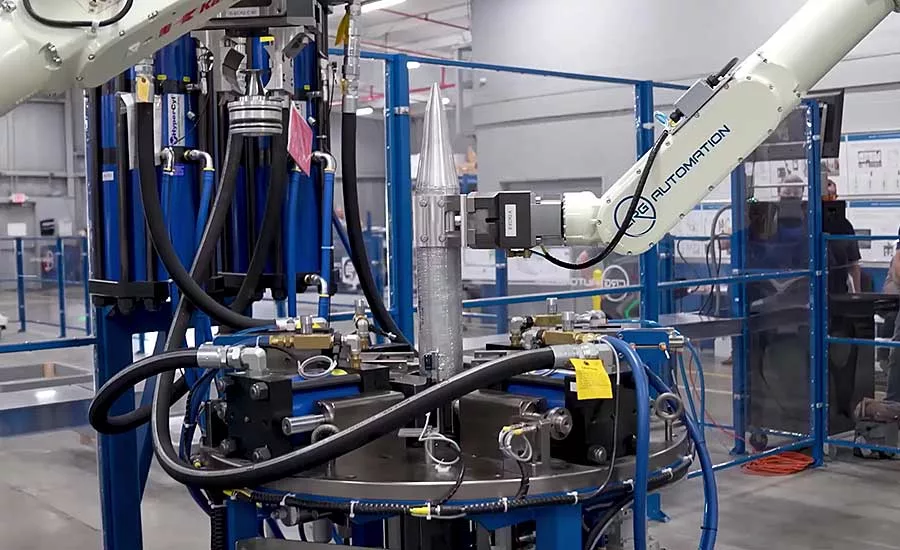
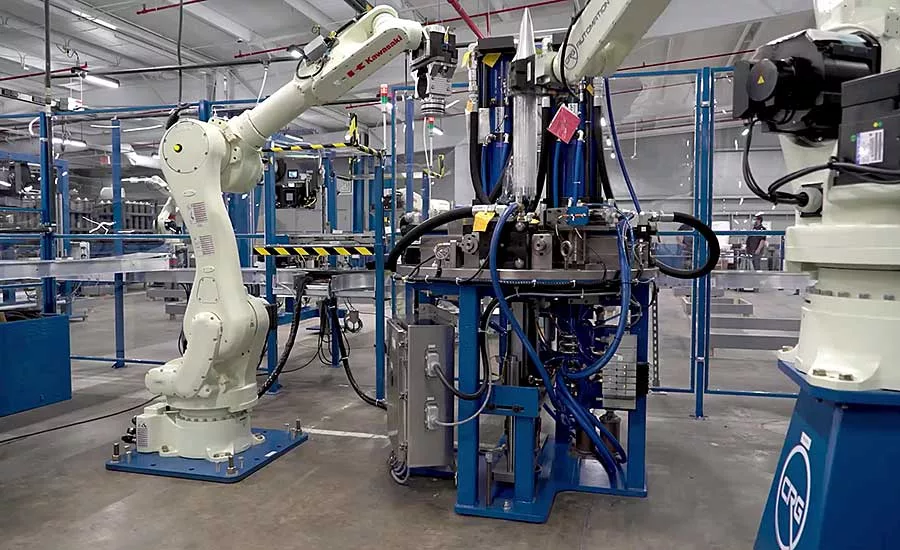
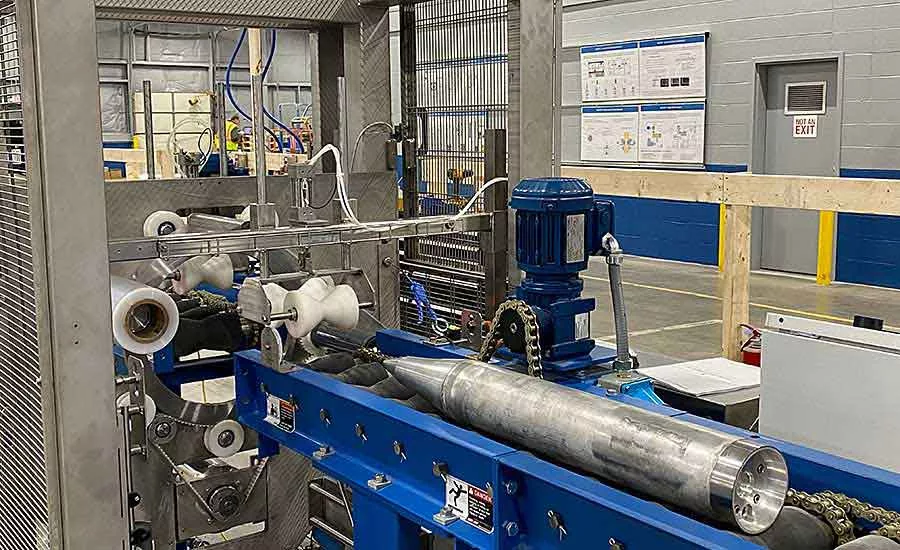
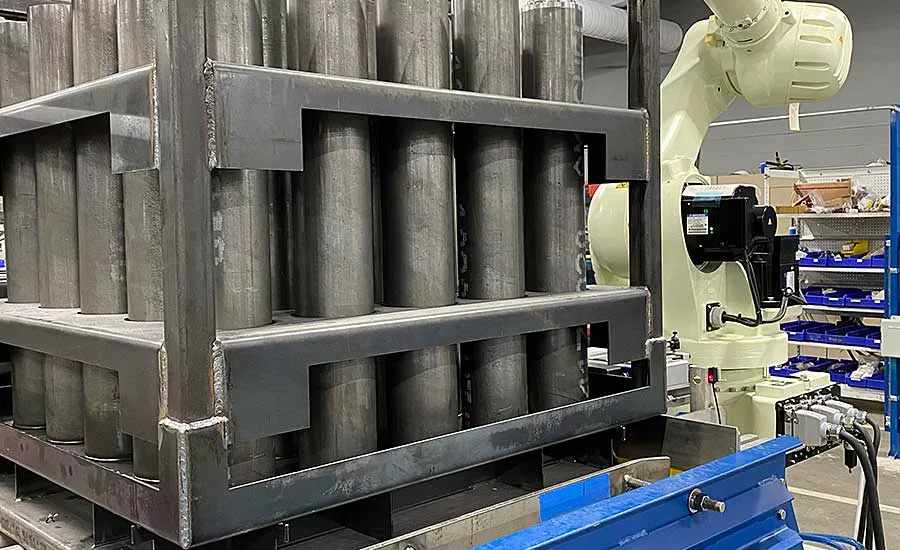
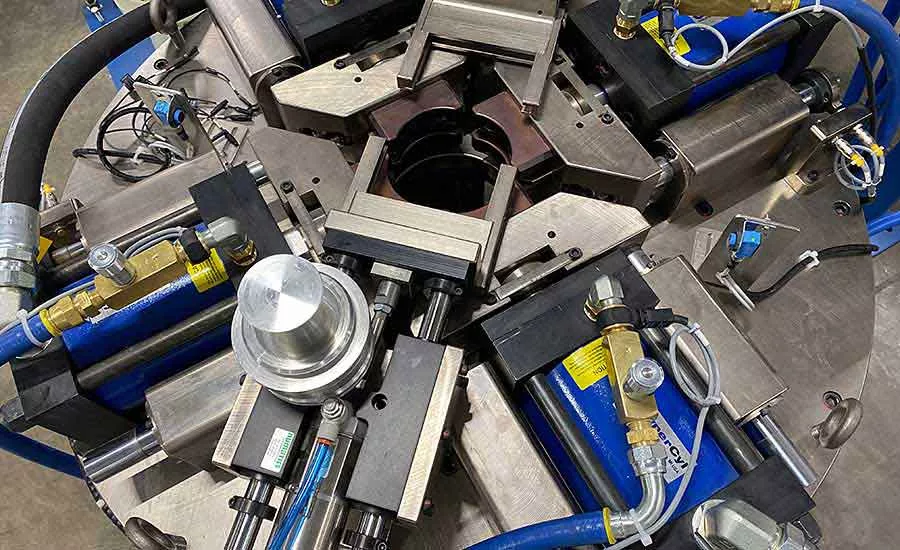
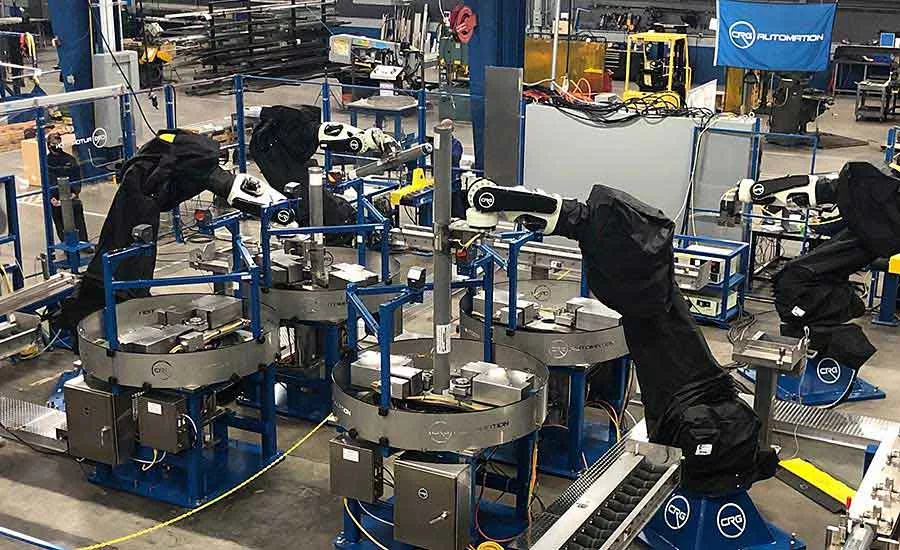
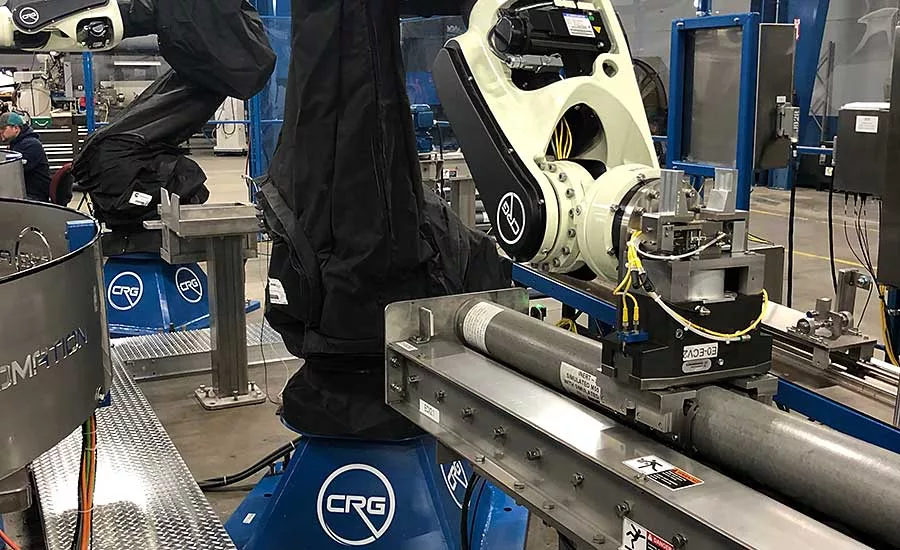
CRG’s automated warhead containerization system takes over the disposal process after the warhead has been separated from the rocket motor and the nerve agent has been drained off. A heavy-duty six-axis robot places the empty warhead into a steel canister that was custom-designed and manufactured by CRG. A second six-axis robot then places a lid onto the canister. Next, a custom-built crimping system, equipped with four 30-ton hydropneumatic presses, crimp the lid in place, creating a tight seal.
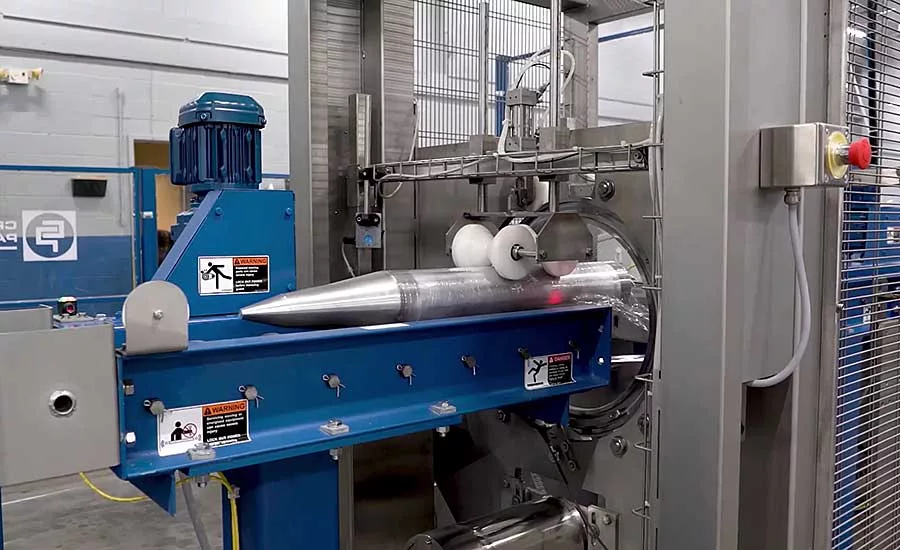
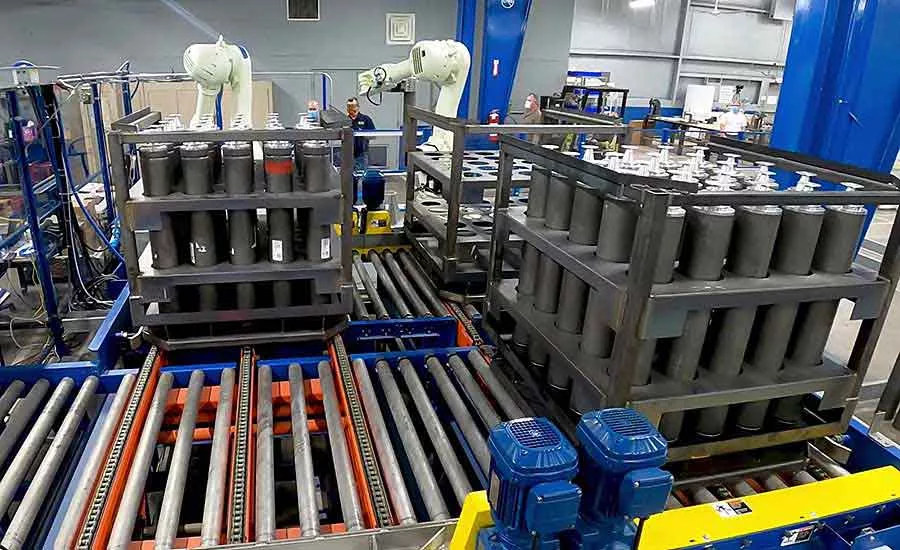
Next, a label is attached to the canister, and a robot loads it onto a custom-built crate that can hold 25 canisters. Each crate is then monitored in an airlock to ensure that there is no nerve agent outside of the canisters. Finally, the canisters are moved to the next step in the process—a static detonation chamber in which intense heat greater than 1,000 F destroys the warhead and the canister.
The drained nerve agent is neutralized in a separate process within the plant.
In designing the system, CRG Automation’s engineers use eight six-axis robots, as well as six autonomous mobile robots. The system can process more than 25 warheads per hour, improving speed and efficiency and reducing downtime.
The group continuously focused on how to improve each aspect of the process. Initial tests found that the system needed even higher temperatures to create enough heat inside the warhead’s fuse to activate the deflagration process.
A series of weekend text messages between DeSmet and Bobby Phillips, a chemist and engineer for PEO ACWA, resulted in a solution they affectionately dubbed “the witch’s hat.” The pair figured out a way to modify the plug and nose end of the munitions to allow for more efficient heat transfer to the fuse area of the warhead.
“That led to a significant increase in how fast it worked,” says Phillips, noting the activation time dropped significantly to just 15 minutes. “That’s right where we wanted it to be.”
Challenge No. 2: Cutting a Path to Success With Warped Rockets
The redefined process impressed the PEO ACWA so much so that the team was presented another problem to tackle.
Because of their age, a significant number of M55 rockets had warped during storage, creating the possibility that their varying dimensions could cause problems with the system. Ankrom estimates that up to 12,500 of the 70,000 rockets may be warped, and each one that enters the line can conceivably stop the process, requiring workers to enter and resolve issues. The consequence? Up to two days added to the overall destruction timeline for every instance the line stops.
In the former system, the rockets were positioned horizontally for the cutting operation to separate the warhead from the motor. The entire assembly was rotated to make the cut. However, cutting the rocket while it was horizontal raised the risk that nerve agent could escape from a warped rocket if it was already leaking.
CRG Automation developed an alternative method by holding the assembly fixed and making the cut with the rocket in a vertical orientation, ensuring that any leaking chemical agent would simply gather in the bottom of a containment device. Cutting the rockets in an upright orientation also meant that the operation could be done more precisely. The cut can be located with an accuracy of 0.001 inch, Ankrom says. Six-axis robots are used to load and unload the cutting machines.
The PEO ACWA was so impressed with CRG’s cutting system that it plans to incorporate the technology at another weapons-destruction center at the Anniston Army Depot in Alabama.
Should a leaking rocket be encountered following the vertical cuts, a pivoting reject station will immediately place the device into a metal container. The new design creates yet another efficiency and safety improvement, as the old system required workers to manually place the rocket into a container.
CRG’s new technology also identifies if the rocket is warped and automatically adjusts the system’s hydraulic gripping system to compensate for the variation. This ensures consistent pressure around the rocket during the cutting process.
“What the robots really lent themselves to was taking the small steps to see the chemical agents and make sure we don’t spread any contamination,” Ankrom says, adding that the new rocket-cutting robots also require far less maintenance than the earlier designs. “That keeps people out of the room, which is always safer.”
Challenge No. 3: Identifying Leaking Rockets Before Disposal
With the rocket cutting system complete, the team turned to developing a system to help identify leaking rockets long before they reach the cutting equipment.
“If we can avoid the leakers before they ever go to the [cutting station], then we’re never having downtime,” says Ankrom. Less downtime is essential to the goal of completing disposal of the rockets by 2023.
The old system used glove boxes to detect chemical agent vapor. Doing so required removing a sample plug, inserting a near real-time monitor, running a test and then restoring the plug. The process added six minutes to the disposal of each rocket. The process was entirely manual and it had limitations, Ankrom says.
Over the course of a few months, CRG Automation and the full team evaluated four technologies to improve the process both in speed and accuracy.
Among them was handheld leak detection technology, like the kind used in petrochemical plants, as well as gamma radiography technology, like the kind used to inspect weld seams. But it was a chance flight and visit through an airport security checkpoint that led to the solution.
Transportation Security Administration personnel pulled Ankrom aside to inspect his backpack. “I was surprised at how much clarity there was on my backpack,” he recalled of the security system imagery. “They could tell my keys, my prescription medications. I was thinking at the time, ‘Heck, if you could look at my backpack like that, there’s got to be something we can do.’”
The team began exploring X-ray technologies similar to what TSA uses, but quickly realized that TSA’s equipment stops the line and takes a snapshot of each person’s carry-on belongings.
To keep the destruction process moving along, it needed to do just that—keep moving.
The team devised a process to scan each rocket while it was moving and focus on the areas where there’s most likely to be leakage. The system also allows technicians to gain a closer look at those rockets that suggest they may have leaks but do not offer complete certainty. CRG Automation’s engineers crafted the ability to tilt each rocket up to 10 degrees for a better look.
“This was another example of how the team not only redefined a complex process but took it a step further to more efficiently dispose of so many chemical weapons in such a short time frame,” says DeSmet.
Collaboration Leads to Speed
Solving the three challenges and developing the revised system took just about 18 months. Multiple tight deadlines throughout the process proved tough, of course, particularly given the coronavirus pandemic and its complications, but the team persevered.
The rocket warhead containerization system took just one year “from preliminary design to final design to actual full-scale production and factory acceptance testing and deploying to the field,” Ankrom says. “That’s fast even in the commercial world, but certainly in government. This has been one of the most cooperative teams I’ve been on.”
Jonathan Weitzel, engineering lead for Bechtel, adds, “Most rewarding is just the opportunity to work on something this fast-paced and this integrated. To go from the starting point of zero to having almost the last piece of it installed now is absolutely incredible. Things don’t move that fast.”
Ankrom complimented CRG Automation’s focus on solving problems. “They’re all about bringing solutions to customers,” he says, adding the company’s attention to detail is top-notch. He recalls how he made a comment just in passing at one point about a robot’s end-of-arm tool, and the company quickly incorporated the suggestion. CRG Automation’s engineers also designed the carts used in the system to be different colors so workers could easily identify inputs and outputs.
“That says something to me,” Ankrom says. “It says they’ve dealt with people before and know situations that may lead to mistakes and want to plan for that. To CRG, details matter.”
CRG Automation’s close proximity to the Blue Grass Army Depot also brought advantages. In less than two hours, the team could convene on site to support the project’s needs.
“Knowing they’re just down the road builds a rapport,” says Phillips. “To come up with something that’s this effective, efficient and safe to operate, it’s just amazing that it came together this quickly. Here’s a group in CRG who were ready to learn about chemical weapons, their specific challenges, and solve the problems with a focus on safety. These guys picked it right up and turned out some great products for us.”
Looking Ahead
With the challenges solved and new system designed, the chemical weapons disposal process has begun anew.
For many years, there was a reluctance to talk openly about the stockpile, Brubaker says, and that led to concerns between the Richmond community and the military.
“It’s been a long time coming to destroy this stockpile. Over 30 years first coming up with the approval to go test technologies and coming up with the necessary funding. These facilities are complex—years of construction and years of testing out the process before we go into operations,” Brubaker says.
“And at the end of that, to realize that we needed to do something different, that we needed a more robust process—and then to accomplish that in just over a year’s time is just fantastic. I got here at the Blue Grass Army Depot in 2009. In 10 years, I’ve seen it go from essentially a grass field to up to 19 acres of a fully robotic, fully automated processing plant.”
Looking for a reprint of this article?
From high-res PDFs to custom plaques, order your copy today!