SIU Project to Develop New Ways to Print Structural Sandwiches
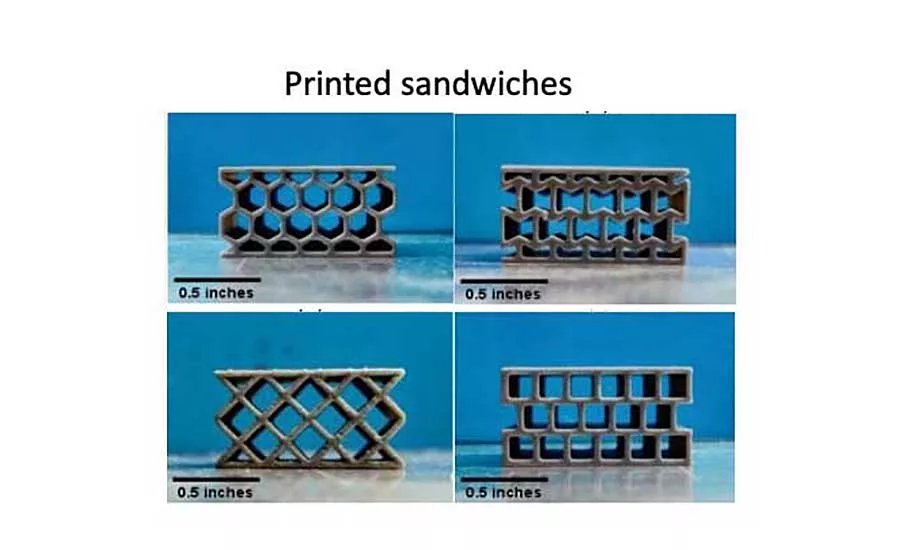
The topology of the sandwich’s middle, or core, has a major impact on the overall performance of the structure, in terms of weight, strength, thermal properties and other factors. Illustration courtesy Sabrina Nilufar/Southern Illinois University
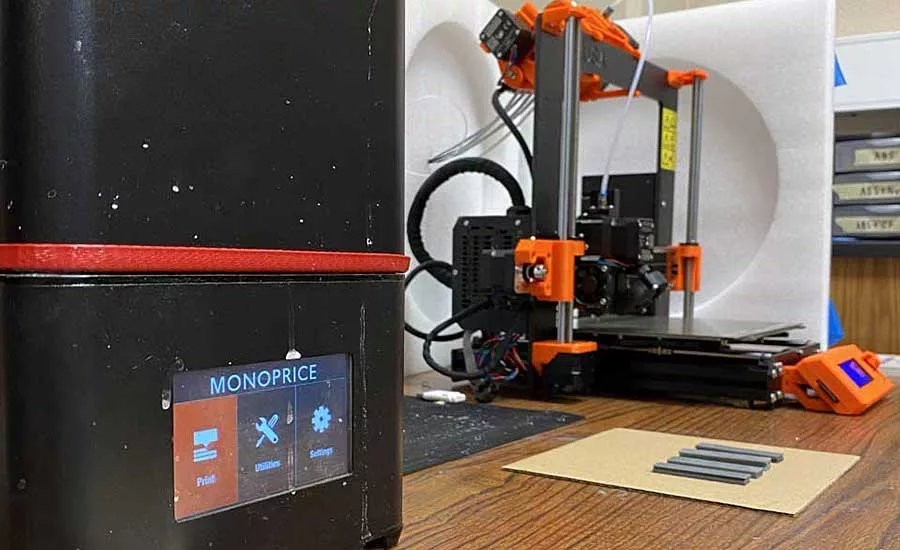
Additive manufacturing may hold the key to both increased efficiency and better quality structural sandwiches, especially when combined with triply periodic minimal surface (TPMS) architecture. Photo courtesy Southern Illinois University
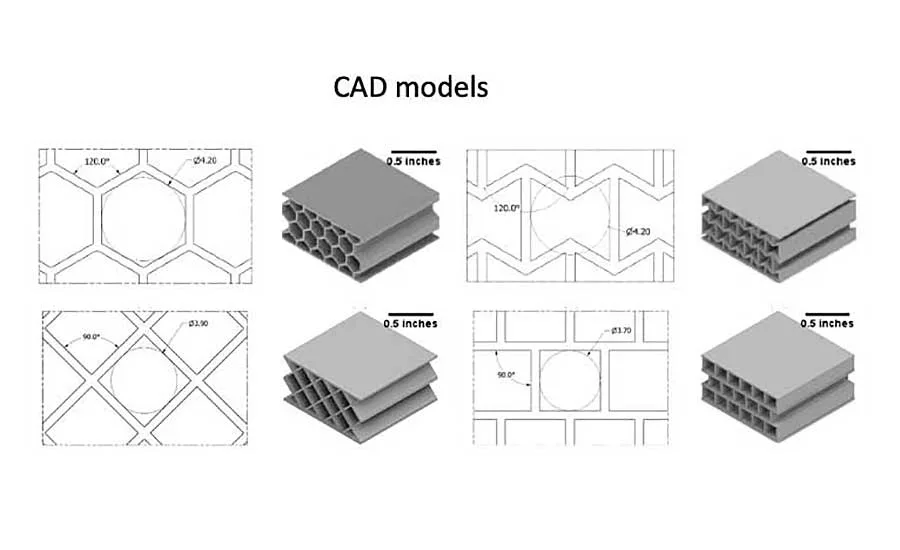
TPMS architecture uses complex geometries found in nature to improve strength and weight ratios. Illustration courtesy Sabrina Nilufar/Southern Illinois University
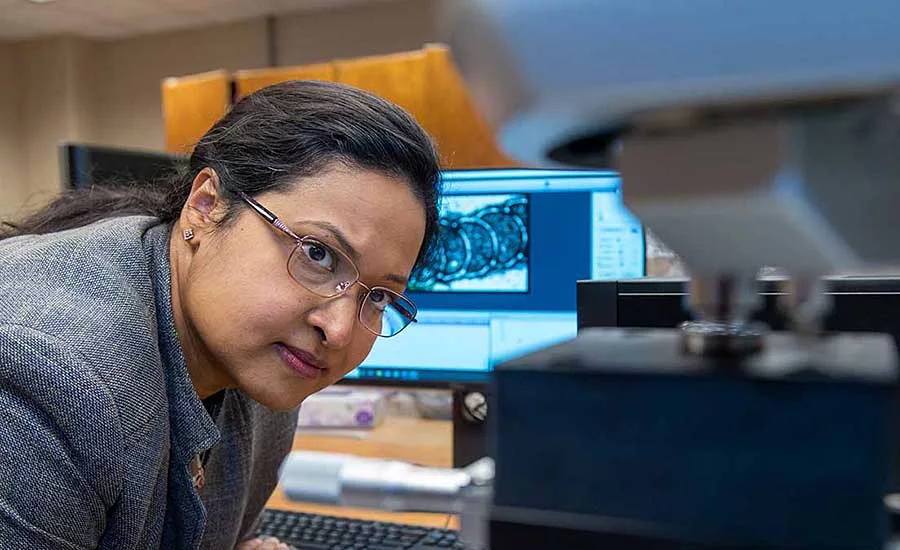
Sabrina Nilufar, Ph.D., is working on ways to more easily and efficiently construct sandwich materials using additive manufacturing technology. Photo courtesy Southern Illinois University
If you’re trying to lose weight, some types of sandwiches are good. In particular, structural sandwiches are popular with engineers engaged in vehicle lightweighting efforts, because they can produce subassemblies that are both light and stiff.
Sandwich structures typically consist of two outer face sheets separated by a lightweight, low-density core structure or foam. Applications include everything from aircraft interiors and car trunk floors to marine deck structures and railcar panels. The material is also used for thermal insulation, vibration and acoustic isolation.
However, the traditional process for producing sandwich materials can be wasteful and limited. Additive manufacturing offers a better alternative, because it enables engineers to fabricate objects or custom tailor parts with complex geometries directly from 3D models to meet specific applications.
Additive manufacturing “prints” solid objects from a digital file by depositing one layer of material on top of another, rather than starting with a piece of metal and cutting or milling it away. It allows engineers to consolidate parts and more easily manufacture complex shapes or structures that have traditionally been difficult to make. There is also less waste compared to traditional manufacturing techniques, which require longer setup times and higher material costs.
Other advantages of additive manufacturing technology include a relatively low cost for acquiring the equipment, improved energy efficiency and easier inventory management. The process also makes it easier to do short runs of rarely needed parts or to create hard-to-find legacy parts for older machines.
The additive manufacturing process may hold the key to both increased efficiency and better quality structural sandwiches, especially when combined with triply periodic minimal surface (TPMS) architecture. TPMS architecture uses complex geometries found in nature to improve strength and weight ratios.
Sabrina Nilufar, Ph.D., an assistant professor of mechanical engineering in the School of Mechanical, Aerospace and Materials Engineering at Southern Illinois University (SIU), recently received a two-year, $200,000 grant from the National Science Foundation to study how to make specially designed structures using additive manufacturing technology.
Looking for quick answers on assembly and manufacturing topics? Try Ask ASM, our new smart AI search tool. Ask ASM
“The aim of my research is to set a solid foundation of manufacturing sandwiches with TPMS-based core lattice for specific engineering applications,” says Nilufar. “We will be using both vat photopolymerization and fused deposition modeling (FDM) in our project.
“We'll focus on vat photopolymerization for fabricating different core architectures, while for the face sheets, we will employ FDM,” explains Nilufar. “Primarily, we will be working with polymers. We will conduct experimental research, as well as numerical simulations, to optimize sandwich structures.”
According to Nilufar, research has been conducted elsewhere in the past to fabricate the cores of sandwiches, as well as complete sandwich structures, with 3D printing technology. “However, very few studies have been done on printing sandwich structures by the vat photopolymerization technique,” she points out. “In addition, our research will be the first to study the thermomechanical response of sandwich structures with TPMS cores and fiber-reinforced face sheets.
“TPMS structures are mathematically conceived structures,” explains Nilufar. “Creating computer-aided design (CAD) models of such intricate architectures [is] challenging. In addition, we are focusing on the feasibility of some high performing polymers that are not generally used for 3D printing.
“It is possible to print sandwich structures with additive manufacturing technology, but the challenge lies in the intricate core architecture,” notes Nilufar. “It's possible when CAD models for those architectures can be created successfully. Also, all materials cannot be used for additive manufacturing.
“The intricate core architecture of the sandwich structures is [complex and unique],” claims Nilufar. “Creating CAD models of sTPMS architectures is the most challenging part. Moreover, we are focusing on the feasibility of some high performing polymers that are not generally used for additive manufacturing.”
Although sandwich structures are used in many manufacturing processes, Nilufar says the main limiting factor lies in what’s between the face sheets, which act as the “bread.” The topology of the sandwich’s middle, or core, has a major impact on the overall performance of the structure, in terms of weight, strength, thermal properties and other factors.
Depending on the core’s geometry, such factors can be improved or diminished in function. Engineers theorize about new core structures, but at this point know little because of limitations in the manufacturing process.
Nilufar hopes to reveal the mechanisms and thermomechanical properties of various core structures that can be created with TPMS architecture. Her approach will integrate numerical and experimental methods to find out what manufacturers might achieve using additive processes.
“We want to fundamentally understand how structured core lattice architecture improves the mechanical and thermal properties of sandwich structures,” explains Nilufar. She and her colleagues plan to focus on core lattice geometries, such as gyroid, diamond and primitive core structures.
As part of the R&D project, the SIU engineers will develop 3D models to predict thermomechanical properties for various core topologies. Their work will identify high-stress and critical sections of various structures and look at how to optimize factors such as the size of each cell and wall thickness.
Nilufar also plans to examine how and why TPMS structures deform under various loads and temperatures. Engineers, including both graduate and undergraduate students, will use an electron microscope to look closely at surface morphology and failure mechanisms.
“We hope the project helps us gain new understandings of how these forces would impact TPMS structures in the real world,” says Nilufar.
In addition, a local outreach component of the project will demonstrate research concepts to high school and middle school students, planting the seeds for future engineers.
Looking for a reprint of this article?
From high-res PDFs to custom plaques, order your copy today!