-Logo.webp?t=1771424659)
USA TrackBusway® manufactures flexible, plug-in overhead power distribution systems for industrial and commercial spaces — helping engineers rethink how electric power is delivered over work areas.


Choosing Busway the Smarter Way
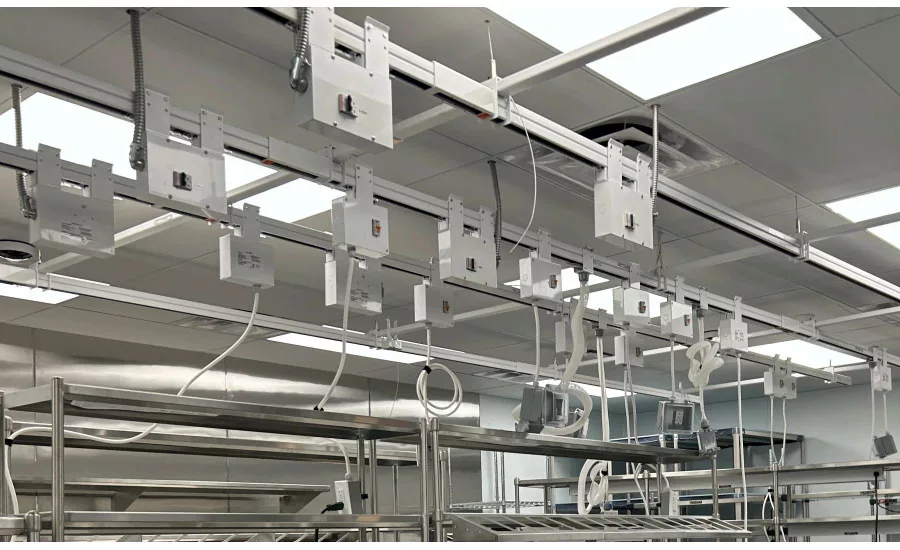
Smarter Power for Flexible Production
Manufacturing never stops moving.
Equipment gets upgraded, robots migrate, and lines get re-balanced to handle new products. Yet in many facilities, the electrical infrastructure remains static—fixed conduit runs that can’t keep up with the pace of change.
That’s where modular, overhead busway systems come in. By moving power distribution off the floor and into the ceiling, engineers gain room to adapt. The goal isn’t just flexibility—it’s smarter, code-compliant design that anticipates the next reconfiguration before it happens.
Let’s talk through what that means in practice.
Step 1 — Right-Sizing the Busway System
Determining a busway system’s ampacity is typically driven by the total connected load. As busway ampacity increases, conductor mass, enclosure size, structural support, and installed cost increase exponentially. But a far more cost-conscious and efficient methodology is instead just adding a few more feed-points—thus reducing the ampacity of the busway system while still meeting total ampacity.
In flexible busway systems like USA TrackBusway®, adjacent segments can be mechanically connected without being electrically continuous. Each section remains electrically isolated until a joiner insert is installed to establish continuity. Every USA TrackBusway® length arrives with factory-installed end-blocks that seal each segment within the run.

Cross-section view illustrating insulated copper busbars within the open channel, along with factory-installed endblocks that electrically isolate each section by default. Credit: Image courtesy of USA TrackBusway®.
Consequently, rather than increasing overall system ampacity to accommodate a small number of heavier loads, engineers can distribute power more intentionally—supplying dedicated feeds only where higher capacity is required instead of oversizing the entire installation.
Individual segments can be fed separately with localized overcurrent protection, avoiding unnecessarily large back panels. Busway feeds can incorporate overcurrent protection while maintaining compliance and preserving a compact infrastructure.
The result: a smaller, lighter system that delivers flexible power without excess copper or complexity.
Step 2 — Choose Between Single-Phase and Three-Phase Configurations
The next design decision comes down to the type of electrical distribution the workspace needs. Both single-phase and three-phase systems have a place on a modern production floor—it’s a matter of matching each to the right application.
Single-Phase Busway: Simple, Fast, and Stackable
For most assembly, fabrication, and general manufacturing spaces, single-phase Track Busway provides more flexibility than most engineers realize.
Each run carries two hot conductors and one neutral, supporting 120V (1-pole) or 240V (2-pole) circuits with ease.

120 V single-phase wiring layout with breaker-protected outlet boxes and line feed connection. Credit: Image courtesy of USA TrackBusway®.
The advantage comes in how those circuits can be expanded. Because each single-phase run supports two separate legs, engineers can stack additional runs above to add up to two more independent circuits.
Equally valuable, the flip circuit capability built into each 1-pole TrackBusway power tap allows teams to change which leg of the busway power is drawn from. Simply rotate the plug to balance the load across circuits—no rewiring, no downtime. It’s clean, fast, and predictable.
Three-Phase Busway: For True Three-Phase Loads
For heavier equipment that genuinely requires balanced three-phase power—typically motors or motor-driven machinery—a three-phase Track Busway is the correct choice.
Each run carries three hot conductors and a neutral, allowing engineers to draw 1-pole, 2-pole, or 3-pole circuits from the same run of busway.
- 1-pole taps supply 120V single-phase equipment.
- 2-pole taps provide 208V line-to-line power for medium loads.
- 3-pole taps deliver 208V three-phase for motors and high-demand equipment.

Typical 3-phase wiring configuration for a double-deck Track Busway system with feed, outlet boxes, and power drops. Credit: Image courtesy of USA TrackBusway®.
However, unless a piece of equipment truly requires three-phase service, single-phase distribution often provides the same functionality with greater modularity.
Design Tip: Keep It Simple Unless Motors Are Involved
In practice, three-phase busway should be reserved for equipment that actually needs it—such as compressors, pumps, or motorized conveyors.
For everything else, single-phase is usually the smarter choice. It’s lighter, easier to expand, and allows you to stack additional runs above to create more circuits as your facility grows.
This mix-and-match strategy keeps the system compact and cost-effective without sacrificing capacity.
Think of single-phase busway as your everyday workhorse—and three-phase as the specialist you call in when motors demand it.
The Payoff: Flexibility Without Compromise
Modular busway isn’t just about convenience—it’s about designing smarter infrastructure that grows with the operation.
By applying NEC tap-rule protection correctly, keeping runs compact, and matching power type to the load, engineers can design leaner systems that deliver both compliance and adaptability.
USA TrackBusway® embodies that approach: a modular, code-approved platform that eliminates unnecessary bulk, simplifies change-outs, and helps teams reconfigure power faster than ever before.

Modular Track Busway layout showing 2.5′ starter sections and joiner lengths available in 3′–10′ increments. Credit: Image courtesy of USA TrackBusway®.
When production changes next month, power won’t be what holds you back.
About USA TrackBusway®
USA TrackBusway® is a modular, plug-in overhead power distribution system engineered for UL 857 Busway compliance.
It delivers flexible, code-approved power wherever it’s needed—supporting applications up to 600 V.
Learn more at trackbusway.com.
Looking for a reprint of this article?
From high-res PDFs to custom plaques, order your copy today!


