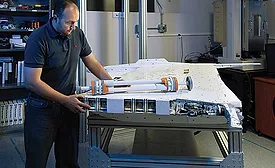
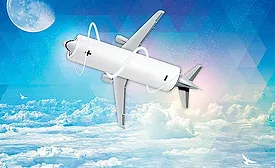
The key to Orville and Wilbur Wright’s historic 1903 flight was wing warping. Today, NASA engineers are developing a similar technique to increase the performance and efficiency of fixed-wing aircraft.
Whenever anyone mentions hybrid-electric vehicles today, most people automatically think of cars, buses and trucks. But, up in the sky, the technology is also getting a lot of attention from aerospace engineers. That’s because electric systems are greener, lighter, quieter and more energy-efficient than traditional alternatives.
HAMPTON, VA—NASA’s Langley Research Center has installed a huge six-axis robot that will be used to deposit epoxy and carbon fibers for making aerospace structures and parts.
WASHINGTON—NASA’s new Vertical Assembly Center, a 170-foot-high machine that will be used to assemble elements of the agency’s Space Launch System, is ready to weld parts for the rocket that will send humans to an asteroid and Mars.
WASHINGTON—NASA has received a patent for devising a “dynamically variable spot size” system for use in laser welding and laser brazing of metal components.
Part of NASA’s New Frontiers Program, the Juno Mission began Aug. 5, 2011, with the launching of United Launch Alliance Atlas V rocket from Cape Canaveral, FL. A solar-powered spacecraft released from the rocket will travel more than 1.9 billion miles over the next four years to reach Jupiter in 2016.
HOUSTON—GM and NASA are jointly developing a robotic glove that auto workers and astronauts can wear to help do their jobs better while reducing the risk of repetitive stress injuries.