BIRMINGHAM, Mich. —
As National Robotics Week highlights advances across automation and AI, manufacturers are seeing those innovations move rapidly from concept to production environments.
Industrial robotics is entering a new phase. What began as fixed automation for repetitive tasks is evolving into flexible systems designed to work alongside people, adapt to changing conditions and take on increasingly complex assembly work. Recent developments across manufacturing show a clear shift: robots are no longer just improving efficiency — they are expanding what can be automated.
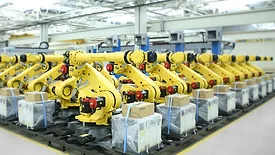
ROCHESTER HILLS, MI — FANUC America is investing $90 million to expand its U.S. manufacturing footprint, with plans to build a new 840,000-square-foot facility in Michigan to support future robot production.
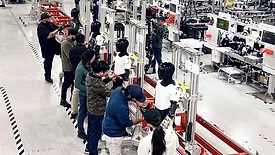
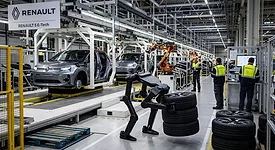
CAMBRIDGE, England—The humanoid robot industry is entering an early commercialization phase, with adoption expected to scale first in industrial environments.
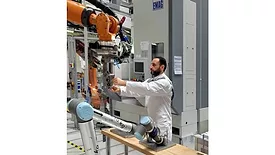
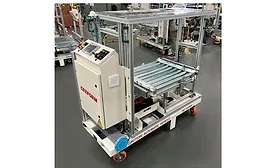
ITZEHOE, Germany—Engineers at the Fraunhofer Institute for Silicon Technology recently developed a system that enables close collaboration between humans and robots.
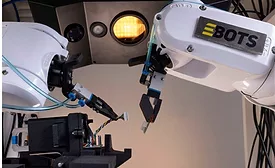
FREMONT, Calif. — Manufacturers have long automated repetitive, high-volume production tasks, but many assembly operations that require dexterity and adaptability have remained difficult to automate. eBots Robotics, a Silicon Valley-based company, is among those focusing on these applications. The company has developed dual-arm robotic systems designed to perform assembly work that traditionally required skilled human operators, particularly in industries such as electronics, semiconductors, medical devices and electric vehicles.
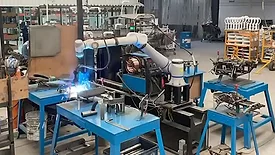
Now, the cobot can weld one component while the operator replaces the completed part, minimizing downtime and maximizing output. By using one robot across multiple stations, PeyMar made the most of its limited floor space. It also reduced costs for labor, capital investment and maintenance.
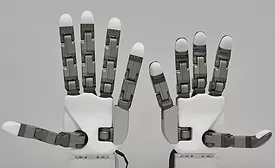
SEONGNAM, South Korea — Tesollo has commercialized a compact five-finger robotic hand designed to enable robots to perform more dexterous manipulation tasks in humanoid and industrial robotics systems. The new DG-5F-S hand features a 20-degree-of-freedom structure intended to support precise grasping and handling of objects in robotic platforms.
 RSS
RSS