Assembly Magazine logo
search
Ask ASSEMBLY AI
cart
facebook twitter linkedin youtube
  • Sign In
  • Create Account
  • Sign Out
  • My Account
Assembly Magazine logo
  • TRENDS
    • Ask ASSEMBLY AI
    • Trends
    • News
    • New Products
  • INDUSTRIES
    • Aerospace
    • Appliance
    • DFMA Assembly
    • Medical Devices
    • Green Manufacturing
    • Lean Manufacturing
    • Machinery Assembly
    • Electronics Assembly
    • Automotive
  • TECHNOLOGIES
    • Adhesives & Dispensing
    • Assembly Presses
    • Automated Assembly Systems
    • Manufacturing Management
    • Manufacturing Software
    • Motion Control
    • Screwdriving & Riveting
    • Robotics
    • Test & Inspection
    • Plastics & Metal Welding
    • Wire Processing
    • Workstations
  • AUTONOMOUS & ELECTRIC MOBILITY
    • AEM Magazine Archives
    • Autonomy
    • Electrification
    • Mobility Services
    • Assembly & Testing
    • AV/EM News
  • MEDIA
    • Ask ASSEMBLY AI
    • Podcasts
    • Assembly News Now
    • Assembly TV
    • Webinars
    • eBooks
  • EVENTS
    • Calendar
    • The ASSEMBLY Show
  • MORE
    • Exclusives >
      • Plant of the Year
      • Capital Spending
    • Buyers Guide >
      • Supplier Insights
    • Classifieds
    • Featured Products
    • Newsletters
    • Store
    • White Papers
    • Columns
    • Sponsor Insights
  • INFOCENTER
    • Assembly & Test Solutions
  • EMAGAZINE
    • eMagazine
    • Archive Issues
    • Advertise
    • Contact Us
    • Sign Up
Assembly Breaking News Robotics Assembly

Robotics

Study Shows Benefits of Self-Scheduling Robot Teams
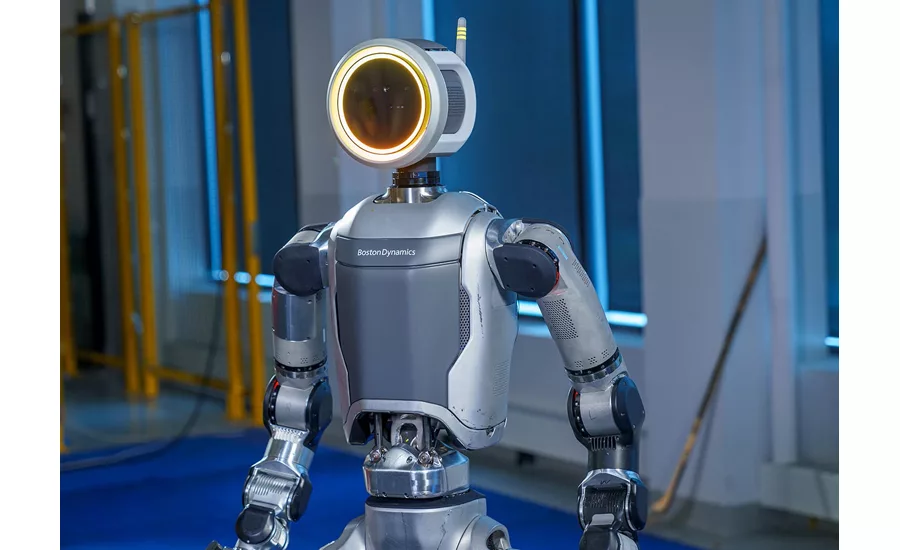
Atlas humanoid robot
July 9, 2024

AMHERST, MA—New research from the University of Massachusetts Amherst shows that programming robots to create their own teams and voluntarily wait for their teammates results in faster task completion, with the potential to improve manufacturing, agriculture and warehouse automation.

“There’s a long history of debate on whether we want to build a single, powerful humanoid robot that can do all the jobs, or we have a team of robots that can collaborate,” says one of the study authors, Hao Zhang, Ph.D., associate professor in the UMass Amherst Manning College of Information and Computer Sciences and director of the Human-Centered Robotics Lab.

In a manufacturing setting, a robot team can be less expensive because it maximizes the capability of each robot. The challenge then becomes: How do you coordinate a diverse set of robots? Some may be fixed in place, others mobile; some can lift heavy materials, while others are suited to smaller tasks.

As a solution, Zhang and his team created a learning-based approach for scheduling robots called learning for voluntary waiting and subteaming (LVWS).

“Robots have big tasks, just like humans,” says Zhang. “For example, they have a large box that cannot be carried by a single robot. The scenario will need multiple robots to collaboratively work on that.”

The other behavior is voluntary waiting. “We want the robot to be able to actively wait because, if they just choose a greedy solution to always perform smaller tasks that are immediately available, sometimes the bigger task will never be executed,” Zhang explains.

To test their LVWS approach, they gave six robots 18 tasks in a computer simulation and compared their LVWS approach to four other methods. In this computer model, there is a known, perfect solution for completing the scenario in the fastest amount of time. The researchers ran the different models through the simulation and calculated how much worse each method was compared to this perfect solution, a measure known as suboptimality. 

Looking for quick answers on assembly and manufacturing topics? Try Ask ASM, our new smart AI search tool. Ask ASM →

The comparison methods ranged from 11.8 to 23 percent suboptimal. The new LVWS method was 0.8 percent suboptimal. “So the solution is close to the best possible or theoretical solution,” says Williard Jose, an author on the paper and a doctoral student in computer science at the Human-Centered Robotics Lab.

How does making a robot wait make the whole team faster? Consider this scenario: You have three robots—two that can lift 4 pounds each and one that can lift 10 pounds. One of the small robots is busy with a different task, and there is a 7-pound box that needs to be moved. 

“Instead of that big robot performing that task, it would be more beneficial for the small robot to wait for the other small robot and then they do that big task together because that bigger robot’s resource is better suited to do a different large task,” says Jose. 

If it’s possible to determine an optimal answer in the first place, why do robots even need a scheduler? “The issue with using that exact solution is to compute that it takes a really long time,” explains Jose. “With larger numbers of robots and tasks, it’s exponential. You can’t get the optimal solution in a reasonable amount of time.” 

When looking at models using 100 tasks, where it is intractable to calculate an exact solution, they found that their method completed the tasks in 22 time-steps compared to 23.05 to 25.85 time-steps for the comparison models.

Zhang hopes this work will help further research on using teams of robots to complete tasks, particularly when the question of scale comes into play. For instance, he says that a single, humanoid robot may be a better fit in the small footprint of a single-family home, while multi-robot systems are better options for a large industry environment that requires specialized tasks.
KEYWORDS: autonomous mobile robot factory automation humanoid robot process optimization

Share This Story

Looking for a reprint of this article?
From high-res PDFs to custom plaques, order your copy today!

Recommended Content

JOIN TODAY
To unlock your recommendations.

Already have an account? Sign In

  • Made in the U.S.A.

    Consumer Products Manufacturing: Made in the USA

    Supply chain lessons learned during the coronavirus...
    Automated Assembly Systems
    By: Austin Weber
  • Best Practices for Press-Fit Assembly

    Best Practices for Press-Fit Assembly

    In manufacturing, ironclad formulas for success are hard...
    Assembly Presses
    By: Jim Camillo
  • aem0523leader-tesla1.jpg

    Tesla Rethinks the Assembly Line

    Engineers at Tesla Inc. have developed a new process that...
    Assembly and Testing
    By: Austin Weber
Manage My Account
  • eMagazine Subscription
  • Assembly Newsletters
  • Online Registration
  • Subscription Customer Service
  • Manage My Preferences

More Videos

Sponsored Content

Sponsored Content is a special paid section where industry companies provide high quality, objective, non-commercial content around topics of interest to the ASSEMBLY audience. All Sponsored Content is supplied by the advertising company and any opinions expressed in this article are those of the author and not necessarily reflect the views of ASSEMBLY or its parent company, BNP Media. Interested in participating in our Sponsored Content section? Contact your local rep!

close
  • ultrasonic welding
    Sponsored bySonobond Ultrasonics

    Engineering Efficiency in High-Performance Assembly: How Ultrasonic Welding Enhances Throughput, Reliability and Quality

  • UV curing system
    Sponsored byDymax

    Why UV Intensity Alone Doesn’t Define Curing Performance

  • wooden pallets
    Sponsored byLEAN Manufacturing Products

    Eliminating Waste on the Shop Floor: Applying Lean Principles to Improve Manufacturing Efficiency

Popular Stories

ASSEMBLY News Now, episode-30: Volvo Redesigns EV Manufacturing

Volvo Redesigns EV Manufacturing

Boeing CEO Kelly Ortberg announces 1 billion investment

Boeing Plans $1 Billion Wichita Investment, Workforce Training Center

GE Appliances Worker on Line

GE Appliances Expands Factory AI With 800 Gemini Enterprise Agents

Watch the latest episode of ANN now!

Events

July 24, 2025

From Shop Floor to CFO: How Manufacturers Are Closing the Loop Between Operations and Finance

On Demand Learn how manufacturers are bridging the gap between the shop floor and ERP systems to gain real-time visibility, streamline operations, and kick-start digital transformation—without waiting years.

Sponsored by:

PicoStratusGreen
July 30, 2025

Buffer Analysis and Design Fundamentals for Manufacturing Excellence

On Demand In this presentation, Dr. Herman Tang shares practical insights from his industry experience and research on buffer management in manufacturing operations.

View All Submit An Event

Poll

Difficult Assembly Processes

Which assembly process gives you the most difficulty?
View Results Poll Archive

Products

Manufacturing Cost Policy Deployment (MCPD) Profitability Scenarios: Systematic and Systemic Improvement of Manufacturing Costs

Manufacturing Cost Policy Deployment (MCPD) Profitability Scenarios: Systematic and Systemic Improvement of Manufacturing Costs

See More Products
Register for webinar - Modernizing Automotive Assembly: Why Upgrading Legacy MES is a Business Imperative

Related Articles

  • Study Shows Midwest Leads in Manufacturing Jobs Growth

    See More
  • Maximize the Benefits of Custom Automated Material Handling Systems

    Maximize the Benefits of Custom Automated Material Handling Systems

    See More

Related Products

See More Products
  • The Basics of Self-Balancing Processes: True Lean Continuous Flow

  • smart.jpg

    Handbook of Smart Manufacturing Forecasting the Future of Industry 4.0

  • history.jpg

    Faster, Better, Cheaper in the History of Manufacturing: From the Stone Age to Lean Manufacturing and Beyond

See More Products

Related Directories

  • Smarter Shows (TARSUS)

  • Team Torque Inc.

  • Applied Robotics, a Co. of Effecto

×

Never miss the latest news and trends driving the manufacturing industry

Stay in the know on the latest assembly trends.

JOIN TODAY!
  • RESOURCES
    • Advertise
    • Contact Us
    • Directories
    • Manufacturing Division
    • Store
    • Want More?
  • SIGN UP TODAY
    • Create Account
    • eMagazine
    • Newsletters
    • Customer Service
    • Manage Preferences
  • SERVICES
    • Marketing Services
    • Reprints
    • Market Research
    • List Rental
    • Survey/Respondent Access
  • STAY CONNECTED
    • LinkedIn
    • Facebook
    • Instagram
    • YouTube
    • X (Twitter)
  • PRIVACY
    • PRIVACY POLICY
    • TERMS & CONDITIONS
    • DO NOT SELL MY PERSONAL INFORMATION
    • PRIVACY REQUEST
    • ACCESSIBILITY

Copyright ©2026. All Rights Reserved BNP Media, Inc. and BNP Media II, LLC.

Design, CMS, Hosting & Web Development :: ePublishing