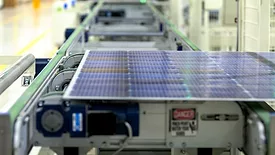
WASHINGTON—Solar, wind and other types of clean energy manufacturing has become an important part of the U.S. industrial economy, according to the American Clean Power Association.
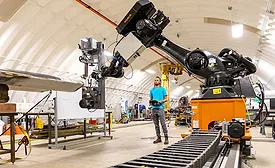
Engineers at the U.S. Department of Energy’s National Renewable Energy Laboratory (NREL) are using robots to improve the consistency of wind turbine blades.
WASHINGTON—The U.S. Department of Energy (DOE) is partnering with the U.S. Department of the Treasury and the Internal Revenue Service (IRS) to provide $10 billion in funding through the Qualifying Advanced Energy Project Credit (48C). The notice released June 5 allocates up to $4 billion to accelerate domestic clean energy manufacturing and ensure no community is left behind in the transition to clean energy technologies.
"The answer, my friend, is blowing in the wind" is a popular lyric from one of Bob Dylan's most famous songs. It's also the central theme behind the Collegiate Wind Competition (CWC), an annual event sponsored by the U.S. Department of Energy (DOE).
Can the length of a wire harness routed in a wind turbine tower 394 feet tall and connected to a control cabinet in a nacelle be precisely determined by a computer? Yes, it can.
PENSACOLA, FL—Jupiter Group, which manufactures nacelles and other components for General Electric wind turbines, has opened a new, larger assembly plant here. The new facility doubles the company’s manufacturing capacity.
RUSSELLS POINT, OH—Just six months after installing two wind turbines at its assembly plant here, Honda Transmission Manufacturing of America Inc. has reported that the machines are producing more electrical power than was anticipated. The turbines have exceeded the projected power output figures by 6.3 percent.
DENVER—To meet customer demand, Vestas expects to add “hundreds” of jobs at its three Colorado factories, including a blade-manufacturing facility in Windsor, during the first half of 2014.
To boost the energy output of wind turbines, manufacturers are developing taller structures with longer blades. That’s because the wind at 100 meters blows more steadily and 4.5 percent faster than it does at 80 meters, with an energy gain of about 14 percent.