Assembly Magazine logo
search
Ask ASSEMBLY AI
cart
facebook twitter linkedin youtube
  • Sign In
  • Create Account
  • Sign Out
  • My Account
Assembly Magazine logo
  • TRENDS
    • Ask ASSEMBLY AI
    • Trends
    • News
    • New Products
  • INDUSTRIES
    • Aerospace
    • Appliance
    • DFMA Assembly
    • Medical Devices
    • Green Manufacturing
    • Lean Manufacturing
    • Machinery Assembly
    • Electronics Assembly
    • Automotive
  • TECHNOLOGIES
    • Adhesives & Dispensing
    • Assembly Presses
    • Automated Assembly Systems
    • Manufacturing Management
    • Manufacturing Software
    • Motion Control
    • Screwdriving & Riveting
    • Robotics
    • Test & Inspection
    • Plastics & Metal Welding
    • Wire Processing
    • Workstations
  • AUTONOMOUS & ELECTRIC MOBILITY
    • AEM Magazine Archives
    • Autonomy
    • Electrification
    • Mobility Services
    • Assembly & Testing
    • AV/EM News
  • MEDIA
    • Ask ASSEMBLY AI
    • Podcasts
    • Assembly News Now
    • Assembly TV
    • Webinars
    • eBooks
  • EVENTS
    • Calendar
    • The ASSEMBLY Show
  • MORE
    • Exclusives >
      • Plant of the Year
      • Capital Spending
    • Buyers Guide >
      • Supplier Insights
    • Classifieds
    • Featured Products
    • Newsletters
    • Store
    • White Papers
    • Columns
    • Sponsor Insights
  • INFOCENTER
    • Assembly & Test Solutions
  • EMAGAZINE
    • eMagazine
    • Archive Issues
    • Advertise
    • Contact Us
    • Sign Up
Automated Assembly Systems

The Three R’s of Analog Position Sensing: Repeatability, Resolution and Response

When specifying a linear position sensor, remember the three R’s
By John Matlack
The Three R’s of Analog Position Sensing
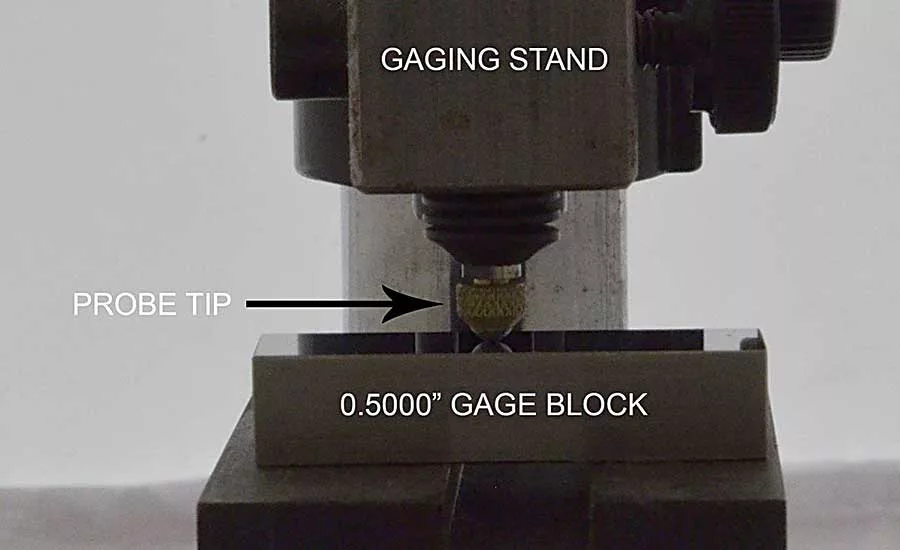
This image shows a spring-loaded position sensor in a typical gauging stand being calibrated with a precision 0.5-inch gauge block. The sensor delivers an output of 0 to 10 VDC fullscale for 0 to 1 inch of probe movement. Photo courtesy Alliance Sensors Group
The Three R’s of Analog Position Sensing
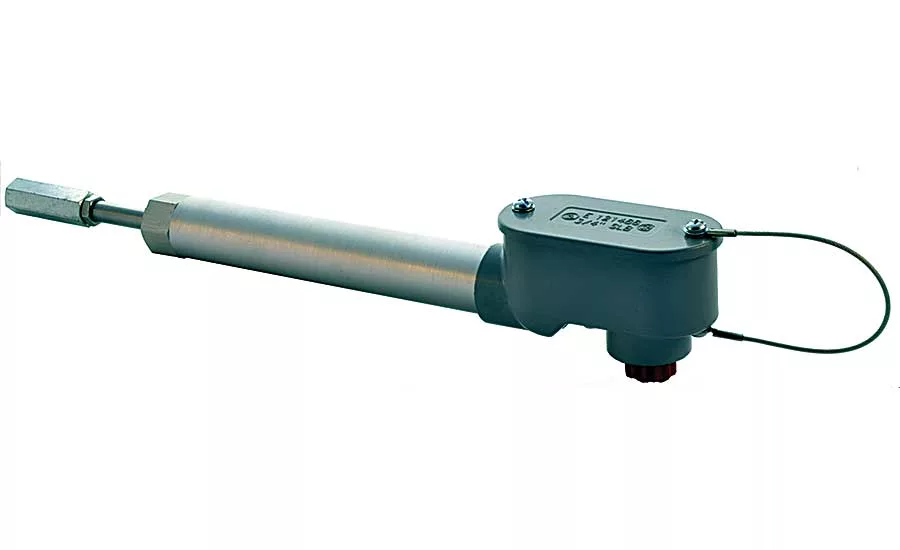
The PG Series of linear variable differential transformers (LVDT) were designed specifically for steam turbine valve position control system applications in electric power plants. The sensor has a heavy-duty terminal block inside an IP-68 sealed housing. A 0.375-inch OD core rod encases the LVDT core so it cannot vibrate loose. Photo courtesy Alliance Sensors Group
The Three R’s of Analog Position Sensing
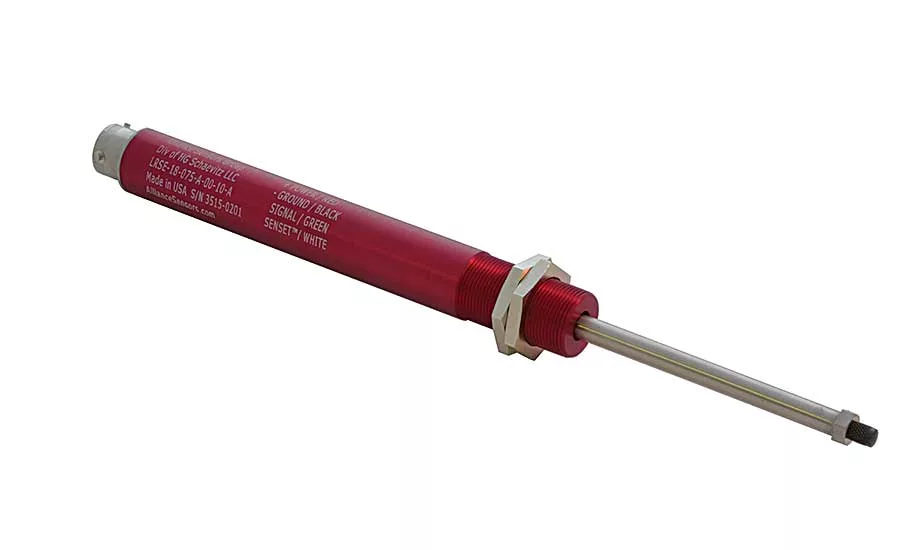
The LRS-18 series of linear variable inductance transducers are spring-loaded position sensors for applications where the sensing element cannot be attached to the object being measured. These include automotive testing, aerospace testing, robotic arms and packaging equipment. Photo courtesy Alliance Sensors Group
The Three R’s of Analog Position Sensing
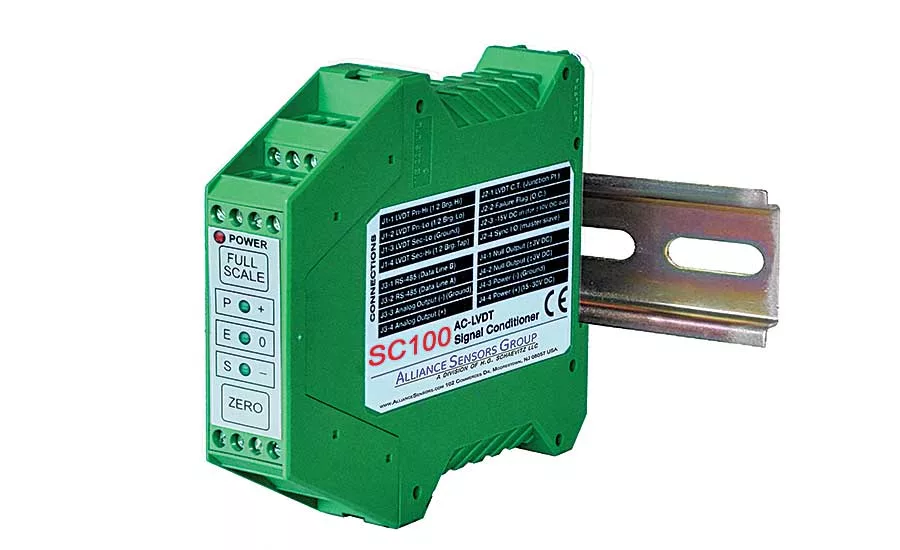
The SC-100 DIN-rail-mounted, smart LVDT signal conditioner simplifies the process of setting up and calibrating an LVDT by offering built-in null indicators and front-panel pushbuttons to set zero and full-scale output. Photo courtesy Alliance Sensors Group
The Three R’s of Analog Position Sensing
November 8, 2019

Those of us old enough to remember the “good old days” recall that grade school focused on learning the three R’s: reading, ’riting, and ’rithmetic. In the world of sensors, there are also three R’s: repeatability, resolution and response. As important as these parameters are, engineers are often confused about exactly what they mean and how the terms are interrelated.

This article will explain the three R’s for position sensors and dispel any confusion that exists.


Repeatability

Repeatability is a measure of the variation between outputs of a sensor-based measuring system for repeated trials of an identical mechanical input in a constant environment. To determine repeatability, common practice is to use at least three repeated inputs, but five or more identical inputs are considered to be an even better sample.

Repeatability is usually evaluated by applying an averaging process to the variations in output values observed for the multiple trials. It is typically specified as a percentage of full-scale output or full-span output (FSO), but sometimes it is specified in absolute terms, such as parts per million (ppm) or fractions of the mechanical units applicable to the actual sensor-based measurement.

A constraint on repeatability measurement is that the trial inputs must be applied in the same way, usually from a lower value to higher value, to eliminate any effects from hysteresis. Hysteresis error is a measure of the difference in system output when the mechanical input is rising up to the desired input value from a lower value compared to an identical input coming down from a higher input value to the desired value. For most contactless position sensors, hysteresis error is smaller than repeatability error.

An example of a repeatability test setup can be seen in figure 1, which shows a spring-loaded position sensor in a typical gauging stand being calibrated with a precision 0.5-inch gauge block. The sensor delivers an output of 0 to 10 VDC full-scale for 0 to 1 inch of probe movement. The tip of the sensor is moved inward to allow the gauge block to be inserted between the tip and a flat base, and then released to contact the block.

In five trials, system outputs are: 5.0012, 5.0016, 5.0013, 5.001 and 5.0015 VDC. The average value is slightly over 5.0013 volts, and the maximum variance is ±0.0003 volt, which is equal to ±30 ppm of FSO, or 0.003 percent of FSO.

Looking for quick answers on assembly and manufacturing topics? Try Ask ASM, our new smart AI search tool. Ask ASM →


Resolution

Resolution is a measure of the smallest change in the input to a sensor-based measuring system that will produce a measurable change in the electrical output from that system.

While this may seem like a fairly simple concept, it is affected by factors external to the sensor itself, the most significant of which is the signal-to-noise ratio of the system’s analog output. Electrical noise present on the system’s output can reduce the effective resolution of the system by masking any small changes in the sensor’s output. For example, if the sensor’s resolution specification is 0.25 millivolt, but the system output noise and ripple is 2 millivolts peak-to-peak, then sensor output changes smaller than 2 millivolts will not be discernable within that noise. Thus, the actual system resolution is only about 12 percent of what the sensor resolution specification offers.

Like repeatability, resolution is often specified as a percentage of full-scale or full-span output, but may also be specified in absolute terms, like fractions of the units of the actual sensor measurement, or, in digitally augmented measurements, in bits, which is just a fractional measure expressed in powers of 2, as found in computers. Thus 10-bit resolution is 1 part in 1,024 (210), 12-bit is 1 part in 4,096 (212), etc.


Response

Response denotes a sensor-based measuring system’s performance under dynamic input conditions, that is, when the system’s mechanical input is changing rapidly. It is particularly important to recognize that response is a measuring system parameter, not merely a sensor parameter or specification.

In practice, there are several ways to characterize response, typically based on whether the system is a first order or second order system. Traditional analog systems have used Bode plots to show frequency response and phase lag for repetitive inputs.

For step function response, three times the system time constant is a typical measure of dynamic performance. In digital sampling systems, the update rate for a specified number of bits is one of the preferred measures of response.

Regardless of the choice of how to specify response, the ultimate purpose is to understand how well the measuring system can respond to a changing input before the system’s output becomes inaccurate, unusable or unstable.


Interactions

From the foregoing definitions, it is easy to see that a system’s repeatability could easily be affected by its resolution. If the measuring system’s resolution is inadequate, it would likely be a significant limiting factor to excellent measurement system repeatability. In practice, sensor repeatability may be excellent, but measuring system repeatability cannot be any better than that permitted by the system’s resolution.

While the interaction of repeatability with resolution in a measuring system is pretty easily understood, the interactions of resolution and response are not so straightforward. When the system’s mechanical input is changing rapidly, the effects of resolution on system output are usually masked by the larger effects of decreased system output due to limitations imposed by the system’s dynamic response. But, if the mechanical input to a position measuring system changes slowly or intermittently, especially in a jerky way, then the effects of stiction (static friction) come into play.

Typically the effects of stiction in position measuring systems can be nonlinear and are often not very repeatable, so determining or characterizing system resolution can be much more complicated or even possible. And, because the system resolution interacts with system repeatability, measurement errors can increase substantially, particularly if the system is providing position feedback for closed-loop control. Of course, any effects caused by stiction will also appear as nonlinearity in the sensor’s output. But because stiction effects are not very repeatable, digital linearization techniques to offset the nonlinear effects will not be practical.

For this reason, efforts to reduce stiction are usually necessary to minimize measurement errors caused by stiction in slow-moving or intermittent-motion positioning systems. These efforts can involve applying techniques such as “dither,” a low-amplitude signal of high frequency that is input into the system to supplant stiction with much reduced dynamic friction, or by decreasing friction on the moving surfaces of the sensor by improving their surface finishes and coating them with a lubricant.        

KEYWORDS: factory automation

Share This Story

Looking for a reprint of this article?
From high-res PDFs to custom plaques, order your copy today!

John Matlack, Vice President of Sales and Marketing, Alliance Sensors Group, Moorestown, NJ, jrm@alliancesensors.com

Recommended Content

JOIN TODAY
To unlock your recommendations.

Already have an account? Sign In

  • Made in the U.S.A.

    Consumer Products Manufacturing: Made in the USA

    Supply chain lessons learned during the coronavirus...
    Automated Assembly Systems
    By: Austin Weber
  • Best Practices for Press-Fit Assembly

    Best Practices for Press-Fit Assembly

    In manufacturing, ironclad formulas for success are hard...
    Assembly Presses
    By: Jim Camillo
  • aem0523leader-tesla1.jpg

    Tesla Rethinks the Assembly Line

    Engineers at Tesla Inc. have developed a new process that...
    Assembly and Testing
    By: Austin Weber
Manage My Account
  • eMagazine Subscription
  • Assembly Newsletters
  • Online Registration
  • Subscription Customer Service
  • Manage My Preferences

More Videos

Sponsored Content

Sponsored Content is a special paid section where industry companies provide high quality, objective, non-commercial content around topics of interest to the ASSEMBLY audience. All Sponsored Content is supplied by the advertising company and any opinions expressed in this article are those of the author and not necessarily reflect the views of ASSEMBLY or its parent company, BNP Media. Interested in participating in our Sponsored Content section? Contact your local rep!

close
  • ultrasonic welding
    Sponsored bySonobond Ultrasonics

    Engineering Efficiency in High-Performance Assembly: How Ultrasonic Welding Enhances Throughput, Reliability and Quality

  • UV curing system
    Sponsored byDymax

    Why UV Intensity Alone Doesn’t Define Curing Performance

  • wooden pallets
    Sponsored byLEAN Manufacturing Products

    Eliminating Waste on the Shop Floor: Applying Lean Principles to Improve Manufacturing Efficiency

Popular Stories

ASSEMBLY News Now, episode-30: Volvo Redesigns EV Manufacturing

Volvo Redesigns EV Manufacturing

automated consumer goods assembly system

Best Practices for Cycle Time Optimization

Boeing CEO Kelly Ortberg announces 1 billion investment

Boeing Plans $1 Billion Wichita Investment, Workforce Training Center

Watch the latest episode of ANN now!

Events

July 24, 2025

From Shop Floor to CFO: How Manufacturers Are Closing the Loop Between Operations and Finance

On Demand Learn how manufacturers are bridging the gap between the shop floor and ERP systems to gain real-time visibility, streamline operations, and kick-start digital transformation—without waiting years.

Sponsored by:

PicoStratusGreen
July 30, 2025

Buffer Analysis and Design Fundamentals for Manufacturing Excellence

On Demand In this presentation, Dr. Herman Tang shares practical insights from his industry experience and research on buffer management in manufacturing operations.

View All Submit An Event

Poll

Difficult Assembly Processes

Which assembly process gives you the most difficulty?
View Results Poll Archive

Products

Manufacturing Cost Policy Deployment (MCPD) Profitability Scenarios: Systematic and Systemic Improvement of Manufacturing Costs

Manufacturing Cost Policy Deployment (MCPD) Profitability Scenarios: Systematic and Systemic Improvement of Manufacturing Costs

See More Products
Register for webinar - Modernizing Automotive Assembly: Why Upgrading Legacy MES is a Business Imperative

Related Articles

  • Figure 1. Common locations for sensors in a refrigerator.

    Position and Level Sensing Applications in Refrigerators and Freezers

    See More
  • Should the G Help the Big Three?

    See More

Related Products

See More Products
  • smart.jpg

    Handbook of Smart Manufacturing Forecasting the Future of Industry 4.0

  • history.jpg

    Faster, Better, Cheaper in the History of Manufacturing: From the Stone Age to Lean Manufacturing and Beyond

  • digitalization.jpg

    The Digitalization of the 21st Century Supply Chain

See More Products

Related Directories

  • ThreeBond International

  • TSG Resolute

×

Never miss the latest news and trends driving the manufacturing industry

Stay in the know on the latest assembly trends.

JOIN TODAY!
  • RESOURCES
    • Advertise
    • Contact Us
    • Directories
    • Manufacturing Division
    • Store
    • Want More?
  • SIGN UP TODAY
    • Create Account
    • eMagazine
    • Newsletters
    • Customer Service
    • Manage Preferences
  • SERVICES
    • Marketing Services
    • Reprints
    • Market Research
    • List Rental
    • Survey/Respondent Access
  • STAY CONNECTED
    • LinkedIn
    • Facebook
    • Instagram
    • YouTube
    • X (Twitter)
  • PRIVACY
    • PRIVACY POLICY
    • TERMS & CONDITIONS
    • DO NOT SELL MY PERSONAL INFORMATION
    • PRIVACY REQUEST
    • ACCESSIBILITY

Copyright ©2026. All Rights Reserved BNP Media, Inc. and BNP Media II, LLC.

Design, CMS, Hosting & Web Development :: ePublishing