Assemblers See Promise—and Challenges—in IIoT
Our exclusive new survey reveals assemblers’ usage, plans and expectations for the Industrial Internet of Things
When you hear the phrase, “Industrial Internet of Things,” what do you think of first?
When we asked subscribers to ASSEMBLY and Quality magazines that question earlier this year, the answers were all over the map:
- “A collection of industrial companies.”
- “A source for technical information.”
- “A site where you can purchase industrial equipment.”
- “Automated and remote manufacturing.”
- “Big Data.”
- “CNC automation.”
- “Connected devices.”
- “Hackers.”
- “Overhyped.”
- “The cloud.”
- “Wireless technologies.”
That’s not surprising. IIoT, Industry 4.0, digital manufacturing, the smart factory—these buzzwords have permeated the manufacturing landscape in recent years in much the same way that pens and pencils suddenly morphed into “writing solutions.” Unfortunately, that has created some confusion and skepticism among manufacturers, who, as always, are simply looking for ways to improve their operations and processes.
And that’s too bad. Because beyond the noise and hype, a genuine manufacturing revolution is unfolding. Thanks to next-generation software, sensors, distributed intelligence and connected devices, manufacturers large and small are improving quality, reducing downtime, and increasing flexibility and responsiveness.
To get an idea of what the IIoT revolution currently looks like—and what the future might hold—ASSEMBLY magazine partnered with Clear Seas Research to survey manufacturers about their involvement with IIoT technologies. Our objectives were to determine:
- How are manufacturers currently using IIoT technology and for what applications?
- What are the challenges associated with implementing IIoT?
- What is the integration process like and who are the key individuals involved?
- How much are companies planning to invest in IIoT technology?
Questionnaires were e-mailed in late January to a random sample of 23,673 active and qualified subscribers of ASSEMBLY and Quality magazines. Some 263 surveys were completed for a response rate of 1.1 percent.
The survey was sent to manufacturers in the following industries: aerospace, computers and electronics, contract manufacturing, electrical equipment and appliances, energy, fabricated metal products, furniture, machinery, medical devices, plastics and rubber products, miscellaneous manufacturing, and primary metals.
More than half our respondents have 21 to 40 years of experience. One-third of respondents come from companies with more than 1,000 employees, while 40 percent come from companies with 100 or fewer workers. Half our respondents come from companies with at least $30 million in annual revenue, while 22 percent work at companies with less than $5 million in annual sales.
Expectations and Benefits
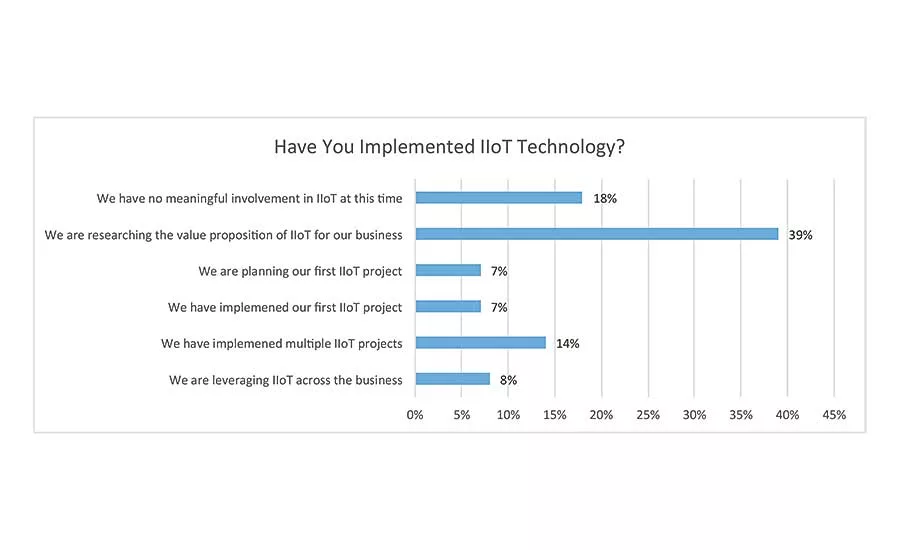
Two-fifths of respondents report that their companies are researching the value proposition of IIoT, while three in 10 report at least some experience with implementing IIoT technologies. Only 18 percent have no meaningful involvement with IIoT at this time.
Looking for quick answers on assembly and manufacturing topics? Try Ask ASM, our new smart AI search tool. Ask ASM
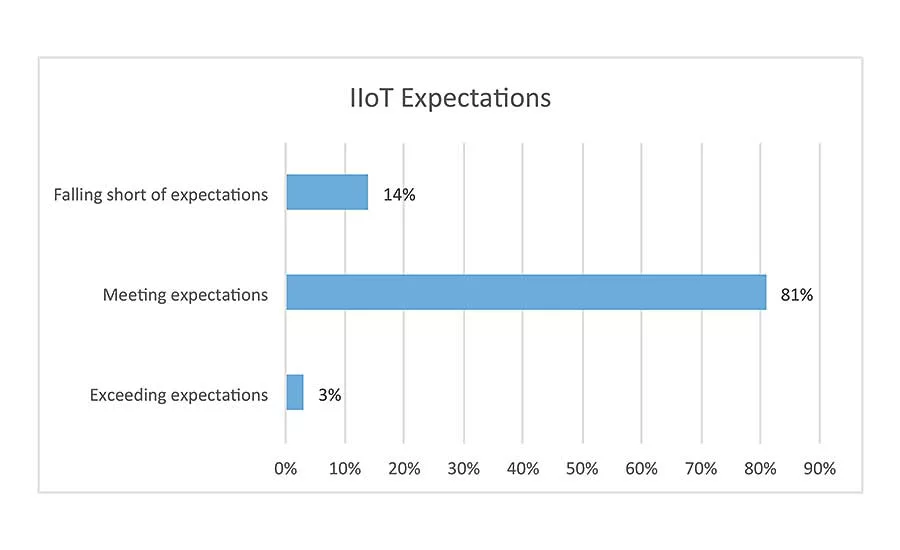
Among those whose companies have implemented IIoT technologies, the overwhelming majority—81 percent—report that those technologies are meeting expectations. Three percent say that IIoT technologies are exceeding expectations, but only 14 percent say the technology is falling short.
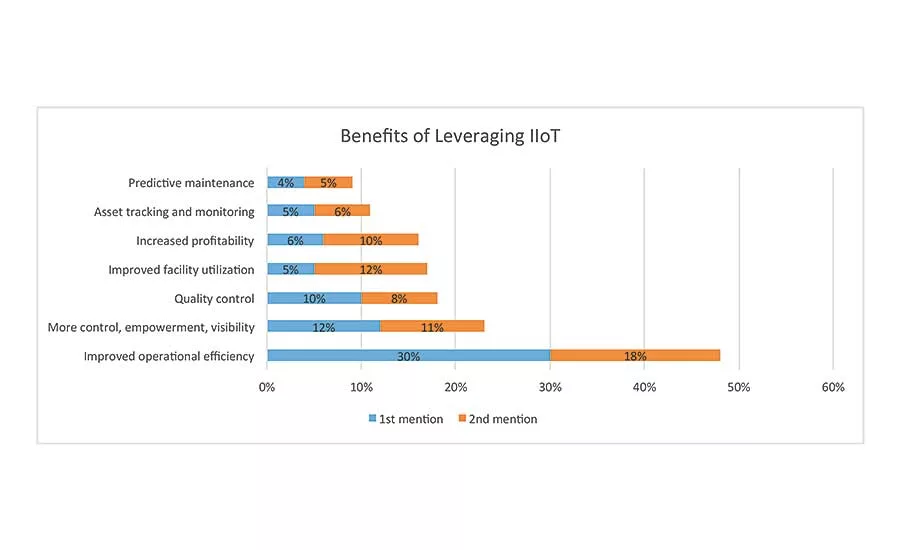
Improved operational efficiency is the most mentioned benefit for nearly half of respondents, followed by nearly one-quarter who mention more control, empowerment and visibility as a primary benefit.
More than half of respondents (57 percent) indicate that the data they collect from their IIoT-enabled systems helps them make better business decisions.
Other benefits mentioned by respondents include quality control (18 percent), improved factory utilization (16 percent), increased profitability (16 percent), asset tracking and monitoring (11 percent), and improved customer service (11 percent).
Low on the list of benefits were improved supplier coordination (3 percent), sustainability (3 percent), and energy efficiency (3 percent).
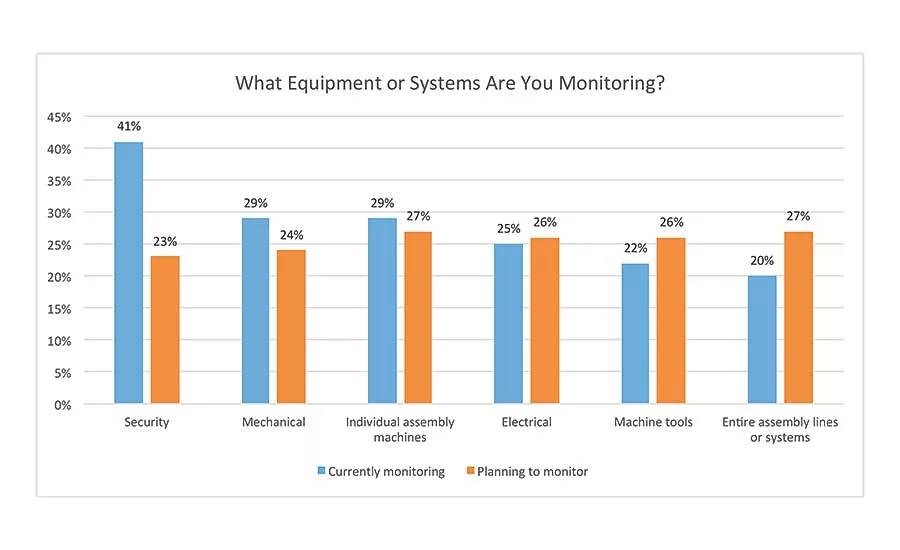
Assemblers are already using IIoT technology to monitor and control a wide variety of machines and systems at their facilities. The most common are security and mechanical systems. Some 41 percent of plants are using IIoT technology to monitor their security systems, and 29 percent have deployed the technology with their mechanical systems.
But, assemblers are monitoring their production equipment, too. Twenty-two percent are using IIoT to monitor machine tools (an additional 26 percent plan to by 2023); 29 percent are using it to monitor individual assembly machines (27 percent plan to); and 20 percent are using it to monitor entire assembly lines (27 percent plan to).
Of those companies that are planning to implement IIoT for some aspect of their manufacturing facilities, half are in the “introductory research” stage and another 21 percent are in the evaluation stage, comparing products and conducting proof of concept testing. Less than 10 percent are at the integration stage.
Test and inspection instruments are the most common devices from which assemblers are collecting data through IIoT technology. Some 29 percent of assemblers are using IIoT to collect data from electrical and electronic test instruments, 26 percent are using it for vision systems, and 14 percent are using it for leak and flow testing instruments.
Assemblers are using IIoT to monitor machines, too. For example, 21 percent of respondents are collecting data from robots and grippers.
“I am not at all surprised to hear that many companies are collecting data from robots,” says Joe Gazzarato, director of Zero Down Time technology at FANUC America Corp. “Over 21,000 robots have been connected to our ZDT IoT service since we introduced it five years ago. Since that time, we have delivered more than $140 million in value to our customers through our predictive analytics. Customers are looking for every opportunity to gain an advantage over their competition, and they can accomplish that with tools like ZDT to prevent unexpected downtime, optimize performance, manage backups, extend equipment life, and remotely support their maintenance teams.”
Assemblers are also collecting data from things like motors, bearings and actuators (20 percent); presses (16 percent); leak and flow testing instruments (14 percent); metal welding equipment (11 percent); and fastening tools (9 percent).
Scott Carlberg, product marketing manager for the Drives & Motion Div. of Yaskawa America Inc., says assemblers are increasingly collecting data from motors, bearings and actuators.
“There is actually a great deal of data that can be collected from these components, and this data can be used to predict future mechanical failures that can disrupt production,” he says. “For instance, motor temperature and energy consumption can be good indicators of how efficiently the machine or assembly line is operating. If you see a 20-degree spike in motor temperature, that could be an indication that some mechanical transmission components need to be serviced or replaced (before they cause a breakdown).
“Fast Fourier transform analysis data taken periodically from a motor can be used to predict faulty mechanical components,” he continues. “All of this data can be collected, analyzed, and built into a preventative maintenance program in an attempt to optimize overall equipment effectiveness. Yaskawa has made a point of making a variety of different types of data from the servomotors, amplifiers and controllers easily accessible, because this data is what our customers are demanding to optimize their manufacturing processes.”
Frank Langro, director of product market management for pneumatic automation at Festo Corp., has been noting the trend in “smart” actuators for some time.
“For a long time, we have looked at how to bring intelligence to our products to enable OEMs to build smarter equipment so engineers can eliminate unplanned downtime and optimize production,” he says. “For example, we offer diagnostic information on products such as valve terminals. This requires customers to take steps to implement this information into their systems. However, they can then take advantage of dashboards that aggregate useful data about those products to facilitate analysis.
“Bringing intelligence into our products has always been something that Festo has considered over the years. Now, however, thanks to enhancements in computing and security, we are seeing more implementation of those smart products.”
Implementation Challenges
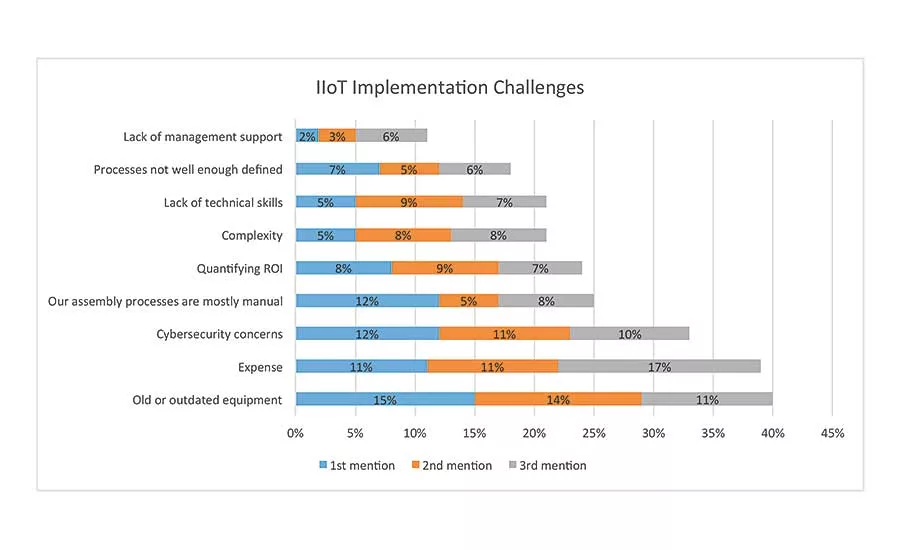
New technologies invariably present challenges to those who must implement them, and IIoT is no exception. Outdated equipment and systems; cost; and cybersecurity concerns are the most common IIoT technology implementation challenges, as reported by one-third or more respondents.
Another challenge, of a sort, is that many assemblers believe their operations don’t merit IIoT investments. For example, 26 percent of respondents say their biggest challenge in implementing IIoT is that their operations are mostly manual. Similarly, 18 percent of respondents say their processes are not well-enough defined to make implementing IIoT worthwhile.
Other assemblers believe they don’t have the technical capability to implement IIoT technologies. Some 21 percent of respondents cite the technology’s complexity or a lack of technical skills as a challenge to implementing IIoT. Another 18 percent cite network support concerns as a challenge.
Solving these challenges requires a team effort. More than four-in-five respondents indicate that engineering roles are involved or will be involved with IIoT technology purchases at their companies. Operations management, corporate management and the information technology team are also part of the decision-making and implementation process.
IT on the Shop Floor
Assembly plants today are driven as much by IT as they are by robots, conveyors and power tools. Our survey results reflect that trend.
More than two-fifths of respondents indicate that their companies have already invested in smartphones or tablet computers for assemblers and engineers, and an additional 24 percent say they will purchase such technology within the next two years. Only 19 percent report they have no plans to invest in such equipment.
Thirty-seven percent have already invested in enterprise resource planning software. And, while 21 percent of respondents are currently using manufacturing execution systems, 26 percent say they’ll purchase the software within the next two years.
“To date, companies have looked at a variety of ways to not only get data from their machines, but more importantly, to actually make sense of that data to drive smart decisions,” says Deb Geiger, vice president of global marketing at Aegis Software. “A flood of ‘smart factory’ solutions have entered the market lately, all claiming to solve manufacturers’ biggest challenge: actionable IIoT data.
“However, after many failed pilots, companies are recognizing that some MES software has the infrastructure to handle this data already. Many platforms will just take that data and dump it somewhere, but do not insert that data into an ontological schema that means something. Most software does not make that data relational or contextual. Our MES software actually has a data contextualization foundation layer to do just that. Any data that comes into our software is related to the CAD design, bill of materials, the process context, the flow—all the variables from the entire process front to back.”
Two IT technologies that are high on assemblers’ wish lists are asset tracking and monitoring technology and data analytics software. Twenty-six percent of assembly plants employ asset tracking and monitoring technology, but 30 percent say they’ll invest in the technology in two years. Similarly, 31 percent currently employ data analytics, but another 28 percent will purchase such software within two years. Less than 20 percent of plants have no plans to invest in data analytics.
Cutting-edge technologies like artificial intelligence, virtual reality and smart glasses are less widely used, at least for now. Less than one-tenth of respondents report that their companies have invested in those technologies, and half or more say they have no plans to do so.
That’s not so surprising. Such technologies may grab headlines, but not that many manufacturers can truly make a use-case for them. Of the three, artificial intelligence appears to be the most intriguing to assemblers, with 20 percent reporting that they’ll invest in the technology within two years.
Regardless of what new technologies assemblers implement in the next few years, chances are good that they’ll be working with at least a few new suppliers. Some 44 percent of assemblers are open to considering IIoT technology vendors that they have not worked with in the past.
Improved operational efficiency is the most mentioned benefit for nearly half of respondents, followed by nearly one-quarter who mention more control, empowerment and visibility as a primary benefit.
To purchase and download the entire report, click here. You can also email info@clearmarkettrends.com with any questions.
Looking for a reprint of this article?
From high-res PDFs to custom plaques, order your copy today!