Inside or Outside?
Greater process control, lower setup costs and simple equipment programming make it easier than ever for manufacturers to build their automation in-house rather than hire a machine builder.
Some questions that manufacturers must address have a simple yes or no answer. Others are not so clear cut. A good example of the latter type is ‘Should we build automation in-house?’
“There are so many variables to consider when deciding whether to build or buy your automation,” says Robert Huschka, vice president of education strategies at the Association for Advancing Automation (A3). “For example, how much experience have you had with automation, and have you successfully implemented projects before? Do you have a good understanding of how you will address the challenges you are attempting to solve, and how complex are those solutions?”
Most manufacturers have three “all-or-some” options when it comes to building automation. Option one is to hire a machine builder. The second approach is to buy components off the shelf. A third way is to build it internally.
There is a fourth option developing in the marketplace, but it is only available to major OEMs. This approach involves buying one or more machine builders wholesale to have complete access to their knowledge, experience and expertise.
Tesla and Hitachi America Ltd. have done this in recent years and greatly benefitted. In 2017, Tesla bought Brooklyn Park, MN-based Perbix and Elgin, IL-based Compass Automation to design, build and service high-volume manufacturing machinery.
Hitachi, meanwhile, completed its acquisition of the robotic systems integration business of Holland, MI-based JR Automation Technologies LLC in December 2019. The private equity firm Crestview Partners completed the transaction at a cost of $1.425 billion.
This staggering price shows just how valuable and important automation is to manufacturers. They know that, when properly built, conveyors, pick-and-place systems, robots, cobots, IIoT-connected machinery and other automation can increase throughput, efficiency, product quality and worker safety.
Looking for quick answers on assembly and manufacturing topics? Try Ask ASM, our new smart AI search tool. Ask ASM
According to ASSEMBLY magazine’s 26th annual capital equipment spending survey (December 2021), manufacturers, on average, meet 40 percent of their assembly system needs with equipment built in-house.
Engineers are quite open to taking the build-it-yourself route when turnkey systems don’t cut it. But, they are also wise enough to know that, without the right game plan, an in-house project can easily turn into an expensive, time-consuming nightmare.
No Place Like Home
There is no official roadmap a manufacturer must follow to be successful at building automation in-house. But, a good place to start is carefully determining the level of automation needed for each manufacturing process. Factors to consider include production volume, quality control, worker safety and ergonomics, availability of skilled labor and budget.
Next, management needs to take an objective look at the project team’s core competencies versus their perceived limitations. Joshua Treter, general manager of Weiss North America, says that managers need to be honest with themselves about how much real-world knowledge, experience and expertise each member of their in-house team has with different levels of automation.
“A couple years ago, an engineer for a small manufacturer had trouble connecting our rotary indexing table to a variable frequency drive,” says Treter. “He tried his best, but still couldn’t figure it out. We had him ship the equipment back to us so we could do the connection. Upon completion of this basic level of support, we suggested he find a system integrator for the completion of his company’s automation project.”
Manufacturers that are able to build quality automation equipment in-house gain many benefits. Some of the main ones, according to Treter, include being able to fully protect intellectual property; maintaining the confidentiality of a new product or a proprietary assembly process; and using the team’s extensive product knowledge to modify or redesign equipment whenever necessary.
The in-house approach fits well with lean manufacturing as well. Lean machine design focuses more on simplifying processes for maximum reliability, reduced operator skill requirements for ease of operation and the flexibility to process a variety of parts.
Building automation in-house also offers greater control over the design and specification of components. Such decisions are not left in the hands of a machine builder or systems integrator.
Another factor that needs to be addressed when building internally is the decision-making process. R. Michael Farrell, senior director of business development and direct sales at Weiss, says that, often, senior management, up to and including the CEO, looks to guide the process.
“Automation projects are dynamic by nature, a characteristic that increases with complexity,” explains Farrell. “The preferred approach is for the technical team or staff to do all the research and then present it to the CTO, who, in turn, meets with the CEO to gain his or her support on how to best handle the building of automation.”
The order in which machines are built and installed will vary from manufacturer to manufacturer, and plant to plant, notes Farrell. Build time for each machine depends on its complexity and the team’s capabilities. However, the recent COVID-19 pandemic and its supply chain disruptions have added an extra challenge to the process.
As for installation, Farrell says the team needs to identify early on where equipment will be located. They must also take into account floor supports and posts.
“Another big challenge that’s often unforeseen is creating system-based data collection, rather than just obtaining data from each machine via sensors and facility-based data collection,” says Farrell. “Data presented at the station and/or machine level can slightly change when it’s presented at the system level, causing it to lag behind production. To ensure accurate real-time data collection, address this issue early in the project.”
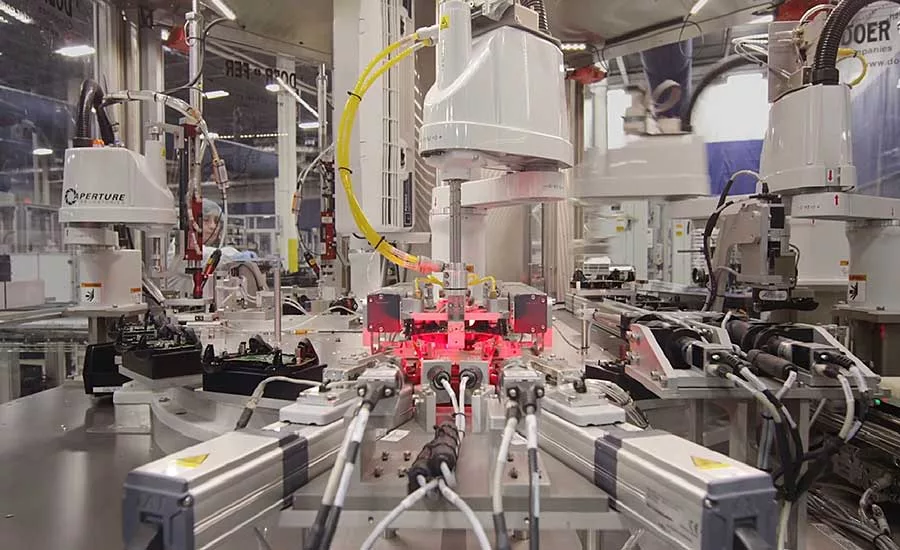
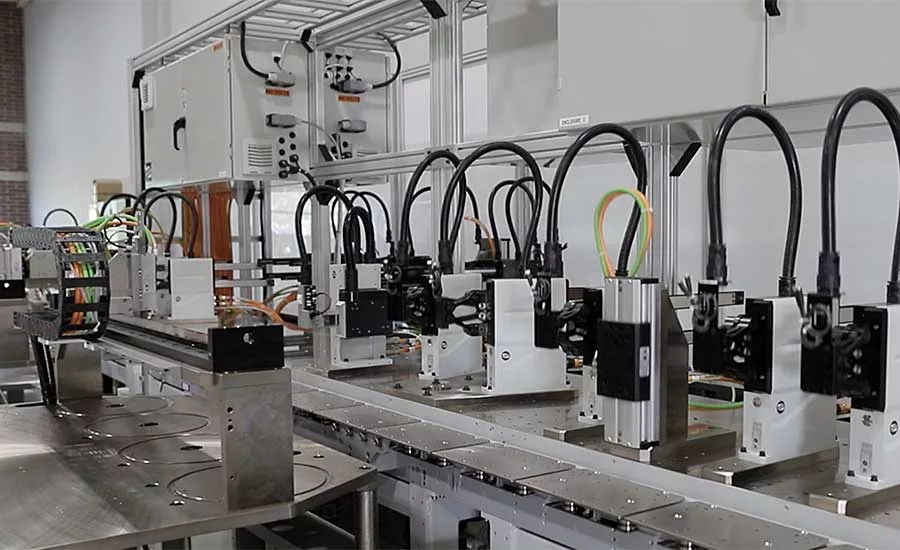
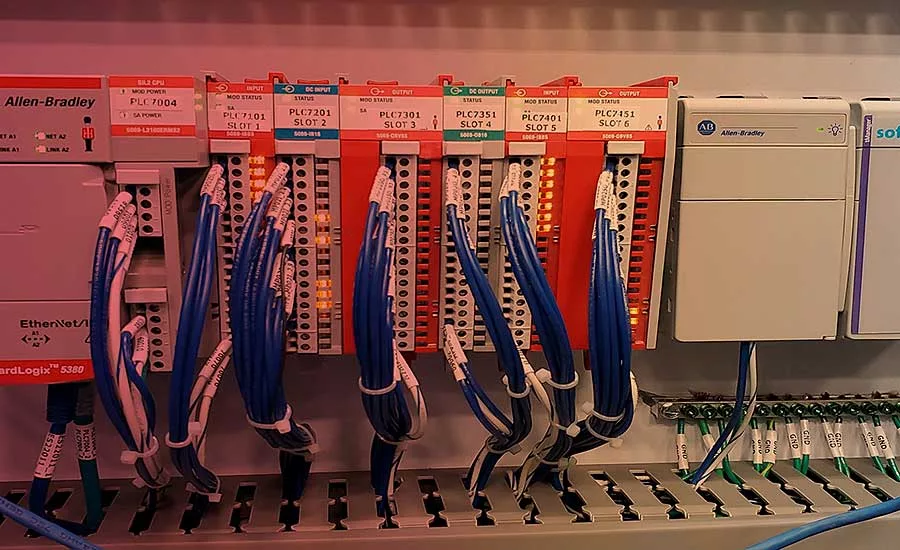
Several equipment suppliers are taking steps to help ease the integration process for manufacturers that choose to buy pre-built automation components. Weiss, for example, makes the LS Hybrid and LS280 linear transfer systems, and the rotary Flex-Dial Chassis, all of which come to the end-user completely hardwired and pretested to meet the customer’s cycle time.
“These advanced platforms are building blocks that teams can use to jumpstart their automation integration,” explains Treter. “After getting a platform, the engineers add the tooling, process controls, adapter plates and other components they need—like a delta or pick-and-place robot—before programming the equipment and plugging it in.”
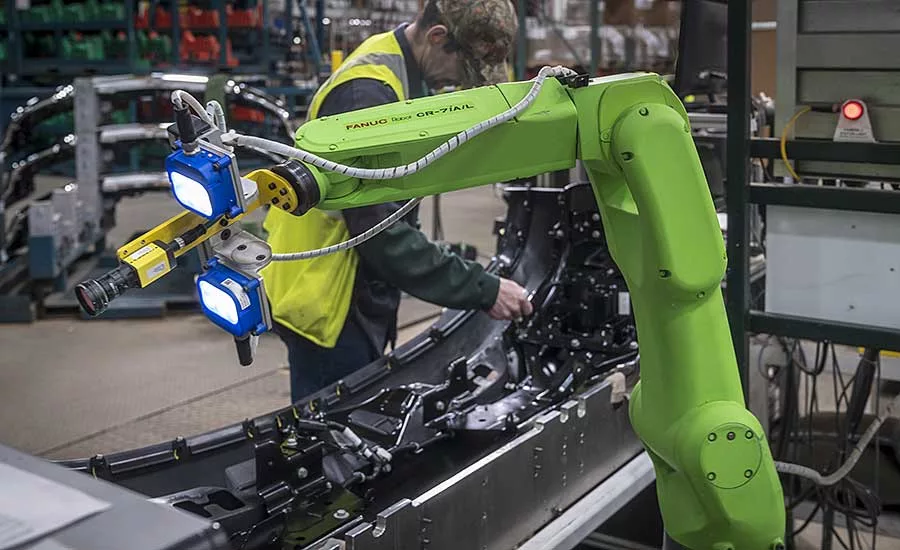
Cobots offer simple customization and integration, especially for automated processes that are repetitive. John Tuohy, national account manager at FANUC America Corp., cites hand guidance, icon-based programming and plug-and-play grippers as key cobot features that allow even small companies to automate simple tasks in as little as 30 minutes.
“Many small to midsize manufacturers take a low-hanging fruit approach to do-it-yourself automation,” notes Tuohy. “They start out with the goal of simply adding some automation to a fully manual process or building a small cell with one or two automated processes. Cobots are attractive for these applications because they often require connecting only one or two cables.”
FANUC offers eight models of cobots in its CRX series, with payload ranging from 4 to 35 kilograms and reach from 550 to 1,813 millimeters. For the past several years, a global manufacturer of lawn-maintenance equipment has been operating an internally built automation system featuring low-payload CRX cobots. Tuohy says the system’s limited production volume didn’t warrant the expense of hiring a machine builder or integrator for the project.
He notes that the company’s six-axis robots can be used in do-it-yourself automation projects. Tuohy cites the example of a major furniture manufacturer using large FANUC robots—those with a capacity of 50 to 85 kilograms—to handle plywood sheets and feed them into various automation systems for cutting, processing and assembly.
Increasingly, manufacturers are renting robots as part of their in-house automation building strategy. This approach, known as “robotics as a service” (RaaS), allows large and small manufacturers in a wide variety of industries to basically treat robots as temp workers.
Companies like Ready Robotics Corp. and Hirebotics Inc. lease out their robots as a service, and look after maintenance and upgrading, as well as providing data services. Manufacturers like RaaS because it requires no upfront costs or huge outlays of capital.
Equally important, companies can bring a robot in-house and see if it actually makes sense for them to automate workstations or processes. If it does, they can always decide to purchase a robot later on.
Straddling Success
Building in-house is not without its disadvantages. One is not being able to tap into the automation expertise of machine builders and systems integrators. Just as important is the objective check-and-balance system that comes with working with these experts.
“Companies build their automation in-house when it makes sense financially and technologically,” notes Ram Devarajulu, director of business at Cambridge Consultants’ Boston office. “Because it’s hard to have the deep, multi-disciplinary resources required for building automation, companies often are forced to look outside for help.”
Founded in 1960 in Cambridge, UK, Cambridge Consultants develops innovative technologies to help customers solve manufacturing and assembly challenges that cannot be handled by off-the-shelf solutions. It also provides business consultancy in technology-critical issues for clients worldwide. Customers include major manufacturers in the automotive, aerospace, white goods, medical, life science, energy and consumer products industries.
“Manufacturing companies sometimes lack expertise in novel sensing, advanced robotics and artificial intelligence (AI) disciplines when building their automation,” says Devarajulu. “So they hire us to develop the technology they need in those areas. We do so in a vendor-agnostic way, being fully aware that every automation project is unique and a high-stakes venture for the client.”
Justin Garski, the OEM segment lead at Rockwell Automation, says that many small in-house build teams fabricate three or four machines per year. He claims that this number is simply not enough runtime to develop a great best practice mechanically or electrically.
“It also distracts from your core business,” notes Garski. “You will always be doing it for the first time, vs. a machine builder who has the benefit of a consistent learning curve that comes with repeatable project experience.”
“Both the in-house team and that of the machine builder face a certain amount of risk when building any piece of automation,” adds Treter. “When it doesn’t work out, troubleshooting the project is always expensive. However, what the machine builders have in their favor to offset this risk is so much more knowledge about the build process and the approval steps.”
Another drawback of building in-house is potentially exposing the limited automation build knowledge and skills of one or more engineers or other team members. Tuohy calls this a ‘slippery slope’ that can prove embarrassing and costly to the company if the current project fails, and undermine its confidence in undertaking future projects.
“Automating a factory isn’t something where you can afford to make guesses,” says Garski. “Having a trusted advisor or subject matter expert working together with you or on your staff, from start to finish, is truly key to making sure any project is successful.”
When the in-house build isn’t going well, manufacturers need to have a backup plan. Devarajulu says smaller companies are usually willing to seek outside help quickly, whereas larger companies tend to dig in and try to solve problems internally before realizing the benefits of working with partners like Cambridge.
“Our involvement begins with a discovery phase, where we find out exactly where they are at in the project and what they want the final automation to be,” explains Devarajulu. “We do work hard at keeping the good they’ve done. Then we propose what we can do to improve the project, because staying on their current course will make things even worse.”
According to Garski, it’s not always easy for a manufacturer to bring in a machine builder or integrator to fix things. This is especially true if the roadblock occurs deep into the project.
“It really depends on the project’s scope,” says Garski. “If you have it divided up into incremental pieces that are easy to modify and change mid-project, bringing in a third party may be feasible.”
FANUC has worked with many large end-users over the years, with some taking on self-integration projects for various reasons. Tuohy points out that robots are not easy to handle, and when misapplied, can be dangerous. He adds that consulting an integrator is always a good idea, and costs nothing for a conversation.
“Early in a project, the build team may have questions amongst themselves about how to make an automation process work,” acknowledges Treter. “But, it’s only when they reach the real world phase of assembly and testing that they know for sure if something works.”
“Manufacturers need to exhaust all their build options to accurately determine why the project didn’t go as planned, although knowing this, unfortunately, doesn’t change the project deadline,” notes Farrell. “Products that were to be made on the planned automation system still need to be made. These parts could be for a new model car or a medical device the OEM has been working on for a long time.
“Going to a machine builder or systems integrator for help is understandable in this situation, but it will definitely prove to be very costly for the manufacturer,” continues Farrell. “This is because the builder or integrator may or may not be able to salvage any work done in-house, and will then charge for their work on a time and materials basis. Also, they may require all machine changes be made on the end-user’s plant floor, potentially disrupting other production there.”
Some manufacturers, regardless of their size and resources, never feel the need to build their automation internally. A good example is Honeywell International Inc., which operates more than 200 manufacturing plants worldwide. The company makes thousands of products for the aerospace, building technologies, performance materials and technologies, and safety and productivity markets. From September 2020 to September 2021, the company tallied sales of more than $34.6 billion.
“Late in 2019, we established a companywide Automation Center of Excellence [ACE] program,” explains Jon Hobgood, vice president of advanced manufacturing and automation at Honeywell. “The program’s main purpose is to establish common standards and practices for our automation. We design and specify it, but have it built by integrators.”
Hobgood notes that the program began pre-pandemic, and was initiated by company vice president and chief supply chain officer Torsten Pilz. Its other goals include using more analytics to improve product quality, lower costs, and determine where more automation makes sense for greater throughput.
Last year, the ACE program lead to the design and specifications for a flexible assembly cell. Many of the cells are currently used in one plant in Mexico to build fire detection and fire protection products for buildings, although the company plans to eventually implement many more cells in factories throughout North America.
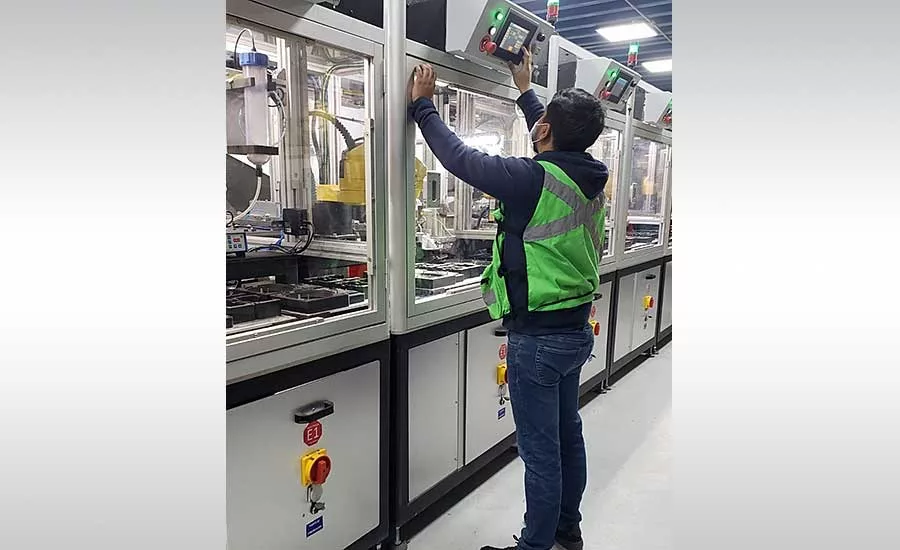
Assembly processes done in the cell include screwdriving and welding, along with part testing. Specified equipment ranges from feeders and hand tools, to robots (exclusively FANUC).
“We carefully design each cell using 3D modeling,” concludes Hobgood. “And we define each assembly process for the product being made to optimize its value.”
Looking for a reprint of this article?
From high-res PDFs to custom plaques, order your copy today!