Smart Manufacturing at Audi
Digital transformation is well underway at Audi’s five assembly plants worldwide.
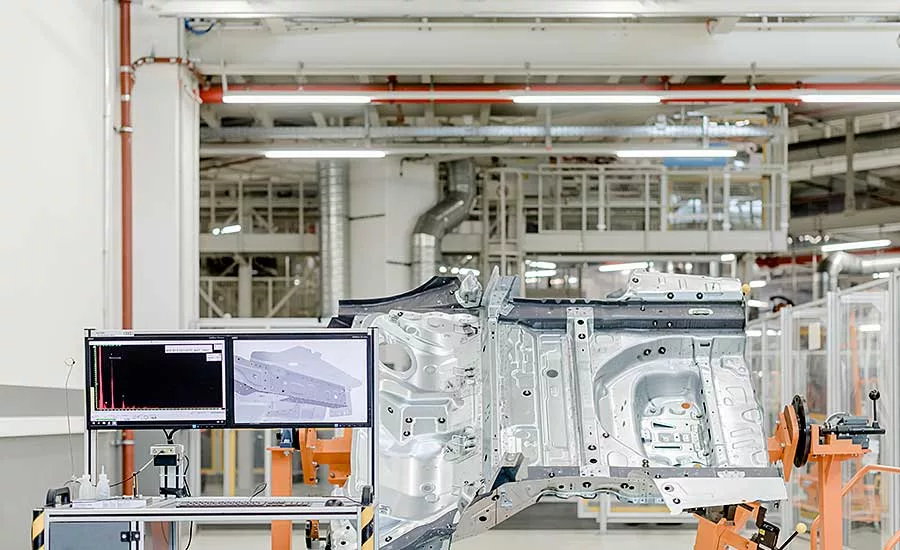
Audi is developing inspection software to visually detect defects in stamped metal parts with the help of artificial intelligence.
Photo courtesy Audi
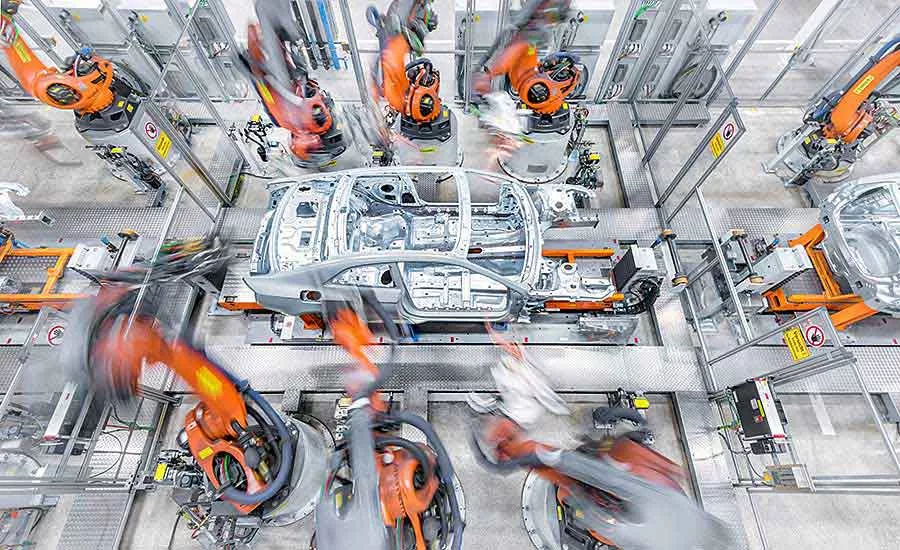
Audi engineers are using artificial intelligence to control the quality of spot welds in high-volume production
Photo courtesy Audi
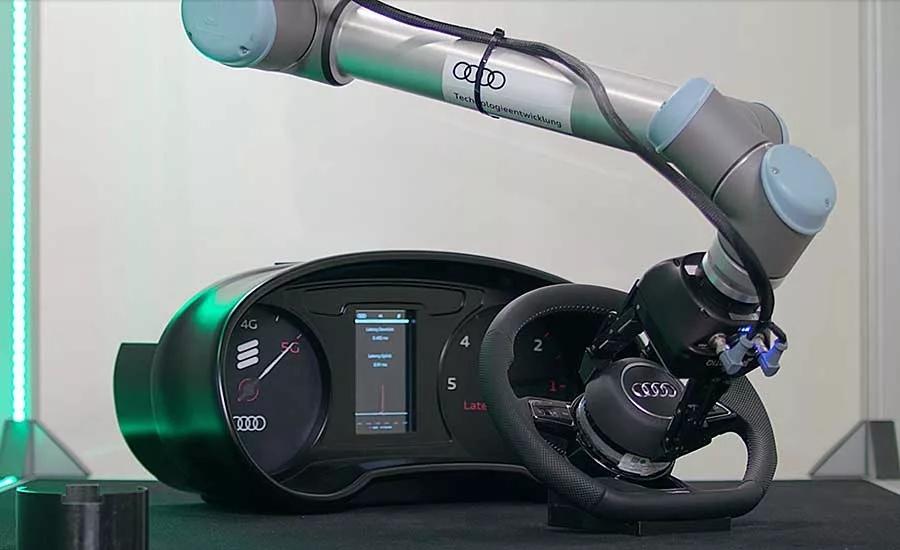
A cobot installs an air bag into a steering wheel assembly. Ordinarily, a high-frequency fieldbus would be needed to connect a light curtain to a robot controller. Now, however, 5G can enable the same task to be done wirelessly.
Photo courtesy Audi
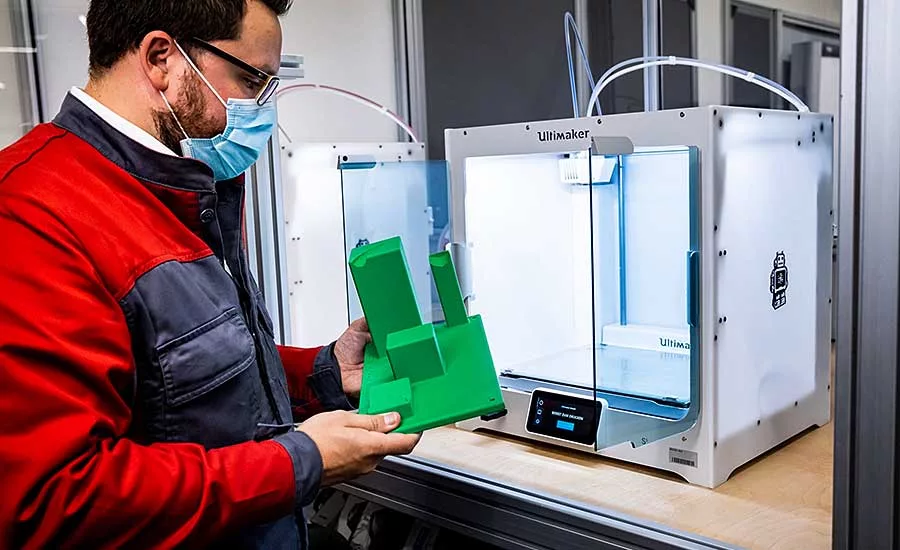
At Audi’s Neckarsulm factory, additive manufacturing being used to quickly make custom jigs and fixtures from plastic.
Photo courtesy Audi
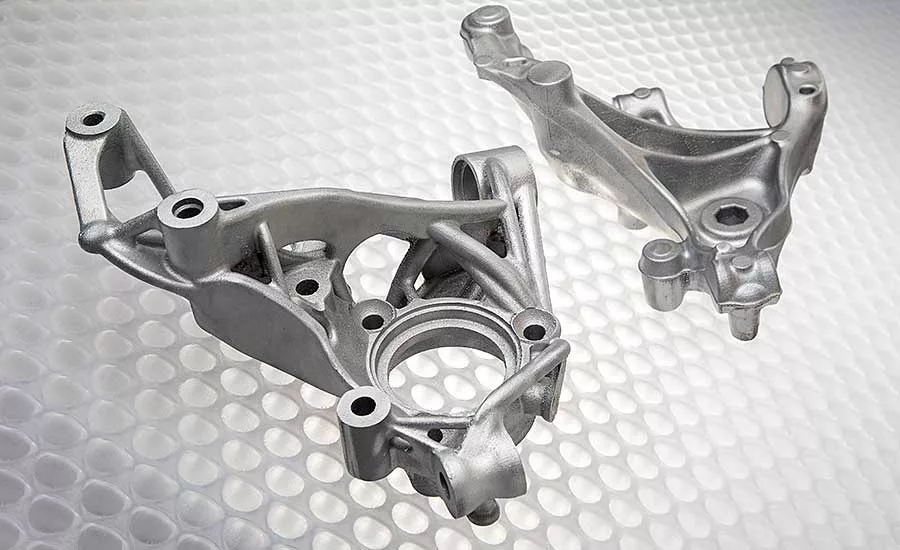
Audi’s Ingolstadt factory is the company’s center of excellence for additive manufacturing with metal.
Photo courtesy Audi
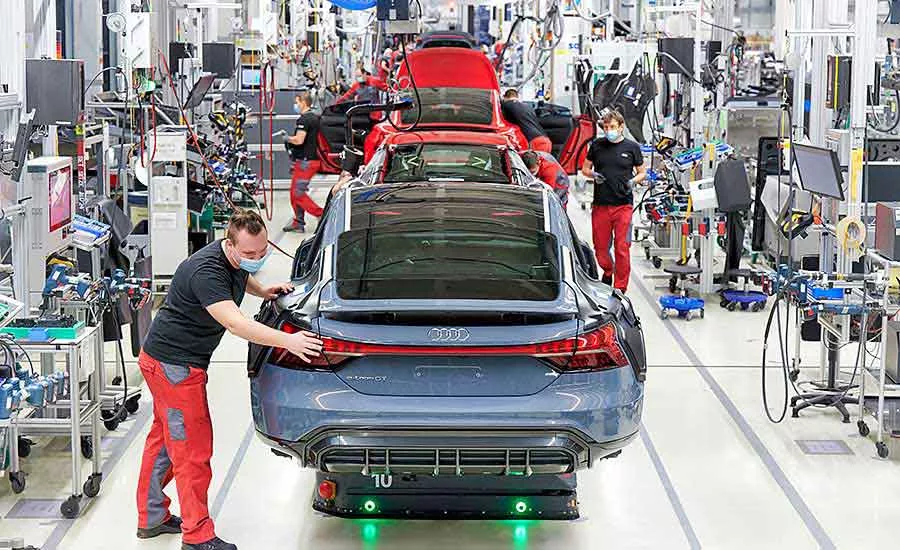
Audi’s maintenance staff can access an app that contains a knowledge database with around 5,000 pages on materials science and recommended actions.
Photo courtesy Audi
Automotive OEMs love to show off their automated body-in-white assembly lines. Commercials invariably feature dozens of six-axis robots producing showers of sparks in choreographed routines. The footage portrays the OEM as a technological leader, even if every auto plant in the world has such a line.
At Audi’s assembly plant in Neckarsulm, Germany, the body-in-white assembly line truly is a technological leader. Engineers there are using artificial intelligence (AI) to control the quality of spot welds in high-volume production.
Some 5,300 spot welds are required to join the parts that make up the body of an Audi A6. Until recently, production staff used ultrasound to manually monitor the quality of spot welds based on random sampling. Now, however, engineers are testing a smarter way of determining weld quality. They are using AI software to detect quality anomalies automatically in real time. The robots collect data on current flow and voltage on every weld. An AI algorithm continuously checks that those values fall within predetermined standards. Engineers monitor the weld data on a dashboard. If a fault is detected, they can then perform manual checks.
Audi is testing the software on the body line for the A6 and A7. In the future, Audi hopes to use the software not just to detect defects, but to control and continuously optimize the weld process automatically.
“The algorithm will serve as a blueprint for further applications in connected manufacturing,” says Mathias Mayer, an automation specialist at Audi. “In addition, it allows us to make advancements to existing digital solutions, such as predictive maintenance.”
If the welding software proves successful, it will be deployed at assembly plants throughout the Volkswagen Group, Audi’s parent company. In fact, the software is already being tested at VW’s assembly plant in Emden, Germany.
Spot welding isn’t the only application for which Audi is testing AI software. At the carmaker’s stamping plant in Ingolstadt, Germany, AI is being used to detect defects such as small cracks in body panels and parts.
Looking for quick answers on assembly and manufacturing topics? Try Ask ASM, our new smart AI search tool. Ask ASM
Increasing demands in terms of design, lightweight construction and functionality have proven to be challenging for the press shop. Sharper lines for exterior parts, as well as the increasing complexity of some components, have created narrow process windows that can occasionally result in cracks during stamping of body components.
To keep quality high, a cross-functional team at Audi is developing inspection software to visually detect defects with the help of artificial intelligence. A machine vision algorithm based on deep neural networks can reliably detect defective parts automatically, in seconds, with maximum precision. To do this, the software is continuously trained and improved with sample images. For this purpose, experts from production mark cracks by hand and photograph them.
The system relies on several cameras, which take photos of newly produced deep-drawn parts. The images are then evaluated in real time by the algorithm. If a crack is identified, a visual signal alerts the workers.
AI is just one example of how Audi is applying Industry 4.0 technology at its five production facilities around the world. Technologies such as additive manufacturing, 5G, RFID and machine learning are being used to improve planning, assembly, logistics, maintenance and quality assurance.
Many of these forward-looking projects originated at Audi’s Production Lab. The P-Lab, as it is known, was set up in 2012 as a think tank for all topics related to production. Here, a core team of 30 employees develops ideas and tests new approaches together with co-workers from production and logistics. The P-Lab has played a key role in helping technologies such as additive manufacturing, human‑robot collaboration, automated guided vehicles, and augmented and virtual reality make their way into large-scale production at Audi.
Another element of the company’s digitalization efforts is the Automotive Initiative 2025, or AI25, which was launched in early 2021. The goal of the initiative is to create a global network of expertise for digital factory transformation and sustainable innovation. Audi’s Neckarsulm plant will play a pivotal role as a pilot factory and real-world laboratory. The factory, which has been making cars for more than 100 years, already has extensive expertise in production IT for both high-volume and small-scale production.
The AI25 initiative is also intended to serve as a source of ideas for transforming production and logistics throughout the Volkswagen Group. Over the next five years, digital solutions for vehicle production and the supply chain will increasingly be tested and developed through to full-scale production via AI25.
Development of IT solutions for smart factories is being supported by academic institutions, such as the Fraunhofer Institute for Industrial Engineering and the Technical University of Munich, as well as technology partners Amazon Web Services and SAP. Custom software and ideas are also expected to come from a joint venture, XL2, based in Heilbronn, Germany, which Audi founded last year with global consulting firm Capgemini. This independent unit is focusing on SAP projects for production, master data management, and the development of cloud-based applications.
5G for Production
For Audi and other manufacturers to achieve the agility and flexibility promised by digital, or smart, manufacturing, a high-performance network infrastructure that can respond in real time will be critical. Audi is betting that 5G wireless technology could fill the bill.
5G offers numerous advantages to manufacturers. It promises data speeds of more than 10 gigabits per second and latency rates of no more than 1 millisecond. Cellular connections are considered robust, they consume very little power, and their reliability is nearly 100 percent. In addition, 5G offers the ability to wirelessly connect a large number of industrial devices. A machine connected via 5G can respond in real time to inputs from the control system.
Since 2018, Audi has been working with Swedish telecommunications corporation Ericsson to test 5G wireless technology for vehicle production.
“5G offers the extremely low latency that meets the performance requirements of industrial automation,” says Marie Hogan, head of mobile broadband and IoT at Ericsson. “Highly developed applications and system-critical IoT networking, combined with the advantages of greater flexibility, mobility and efficiency for production automation, are becoming possible for the very first time. ‘Cutting the cables’ is the actual turning point in the Industry 4.0 era.”
Audi has already launched several 5G pilot projects. For example, the carmaker has long used automated guided vehicles (AGVs) to deliver parts and materials to the assembly line just in time. Now, however, 5G is helping to monitor and safely steer AGVs throughout the Ingolstadt plant, without the need for tape lines or other inflexible infrastructure. An exclusive frequency spectrum—a 5G campus network within the factory—has been in place at Ingolstadt since mid-2020. This local frequency is an important condition for successful 5G deployment in production.
Another pilot project involves applying 5G in a safety network for a robotic assembly application. Because 5G is fast and robust, it is particularly suitable for connecting sensors, machines and devices operated by people. Seamless communication in real time is a prerequisite for allowing robots and people to work together.
In the pilot, a robot installs an air bag module into the steering wheel of a vehicle. The cell is protected by safety sensors. As soon as a human hand breaks through the cell’s light curtain, the robot stops automatically. Ordinarily, a high-frequency fieldbus would be needed to connect the light curtain to the robot controller. Now, however, 5G can enable the same task to be done wirelessly.
“5G combines all points in our production environment, and this leads to enormous improvements in flexibility and connectivity. It also shows how humans and robots can work together safely,” says Arjen Kreis, head of body shop automation technology for Audi.
Additive Manufacturing at Audi
Audi has been using additive manufacturing in production processes for more than 20 years. Originally, the process was mainly used to produce models. Now, the technology is increasingly being used to create jigs, fixtures and even production parts.
Audi’s Ingolstadt factory is the company’s center of excellence for additive manufacturing with metal. A variety of processes are being used to produce complex steel and aluminum parts, as well as tool inserts for forming tools weighing several tons. This makes it easier to implement unusual designs, because additive manufacturing supports open shapes and a wide variety of organic forms. This is a major advantage for tool inserts with cooling channels close to the edge, for example.
Audi’s Neckarsulm factory is the company’s center of excellence for additive manufacturing with plastic. Here, the technology is being used to make custom assembly aids that make work more ergonomic. If employees have optimization ideas, they can simply contact the in-house 3D printing center. Together with a start-up from Berlin, Audi has developed software that reduces the time required to design jigs and fixtures by 80 percent. A sketch is usually all that is needed, and the desired part is available in just a few hours.
Most recently, additive manufacturing with plastic was used to create jigs and fixtures for the Audi e-tron GT. More than 160 3D-printed assembly aids are now in use at Neckarsulm today. One such fixture, for example, is used in the assembly of air-conditioning compressors and cooling lines. The fixture features a built-in clamp and was designed in-house.
Next-Level Maintenance
Audi is employing various technologies to improve maintenance and minimize downtime. For example, a joining system that rivets body components is equipped with sensors that monitor the condition of plastic hoses. The controller uses algorithms to compare the data against preset thresholds and thereby detect traces of wear in the hoses. Sudden system failures have been virtually eliminated as a result, and maintenance work can be carried out during non-production time, which makes the work easier and production more efficient.
Processes are currently being standardized to connect multiple systems and machines to databases. Predictive maintenance technology is set to enter high-volume production and will also be used in other areas.
Audi’s maintenance staff receive further support from the “iMaintenance” app. This app contains a knowledge database with around 5,000 pages on materials science and recommended actions. If a machine displays an error code, the technician simply enters the code into a tablet to receive step-by-step instructions.
Via another app, “Audi Mobile Maintenance,” experts in assembly at the Ingolstadt site and in the paint shop at the Neckarsulm plant receive immediate information about system errors. The app displays all the relevant information via a push notification. Which system in which hall is affected? Which warehouse has a replacement available? Are co-workers possibly already taking care of the situation? This increases transparency, reduces trips, speeds up processes, and enhances data quality. Everything is documented digitally and can be accessed by the entire team from anywhere using a mobile device. Audi plans to roll the app out to other factories in the near future.
Looking for a reprint of this article?
From high-res PDFs to custom plaques, order your copy today!