Assembly Magazine logo
search
Ask ASSEMBLY AI
cart
facebook twitter linkedin youtube
  • Sign In
  • Create Account
  • Sign Out
  • My Account
Assembly Magazine logo
  • TRENDS
    • Ask ASSEMBLY AI
    • Trends
    • News
    • New Products
  • INDUSTRIES
    • Aerospace
    • Appliance
    • DFMA Assembly
    • Medical Devices
    • Green Manufacturing
    • Lean Manufacturing
    • Machinery Assembly
    • Electronics Assembly
    • Automotive
  • TECHNOLOGIES
    • Adhesives & Dispensing
    • Assembly Presses
    • Automated Assembly Systems
    • Manufacturing Management
    • Manufacturing Software
    • Motion Control
    • Screwdriving & Riveting
    • Robotics
    • Test & Inspection
    • Plastics & Metal Welding
    • Wire Processing
    • Workstations
  • AUTONOMOUS & ELECTRIC MOBILITY
    • AEM Magazine Archives
    • Autonomy
    • Electrification
    • Mobility Services
    • Assembly & Testing
    • AV/EM News
  • MEDIA
    • Ask ASSEMBLY AI
    • Podcasts
    • Assembly News Now
    • Assembly TV
    • Webinars
    • eBooks
  • EVENTS
    • Calendar
    • The ASSEMBLY Show
  • MORE
    • Exclusives >
      • Plant of the Year
      • Capital Spending
    • Buyers Guide >
      • Supplier Insights
    • Classifieds
    • Featured Products
    • Newsletters
    • Store
    • White Papers
    • Columns
    • Sponsor Insights
  • INFOCENTER
    • Assembly & Test Solutions
  • EMAGAZINE
    • eMagazine
    • Archive Issues
    • Advertise
    • Contact Us
    • Sign Up

Sponsored Content

How To Select the Right Pick & Place for Your Application

How To Select the Right Pick & Place for Your Application
September 1, 2023

Automated manufacturing systems are typically built around a core part or material transfer system such as a dial indexer, track based linear motion system, or palletized conveyor. These platforms fundamentally impact the system’s output capabilities, as well as the overall footprint. Your decision to use one vs. another will be driven by various factors, such as meeting specific performance criteria, adapting to facility space constraints or overall experience and ease of use.

Once a base transfer system is selected, it’s time to move parts on and off of nests/pallets and perform various handling operations within your stations. How you handle parts coming from feed systems or trays to a pallet, present parts for inspection, and approach offline part processing can dramatically affect some of those important initial key factors.

Here are some considerations to help find the right fit for your applications. 


Performance

The first step when selecting any handling system is understanding the required performance criteria. You may end up prioritizing some functions from the list below to position the best fit for your application:

  • Speed 
  • Precision
  • Working Range/Stroke
  • Payload
  • Space Constraints
  • Fixed Position vs. Freely Programmable
  • Axes of Motion (i.e. XYZΘ)
  • Duty Cycle/Equipment Lifetime 
  • Environmental Requirements
  • Process Requirements


In the following example, the application needed a high-speed system to bring two parts (one from a conveyor shuttle, one from a vibratory feeder) into an ultrasonic welder to be processed, within a very tight space.  
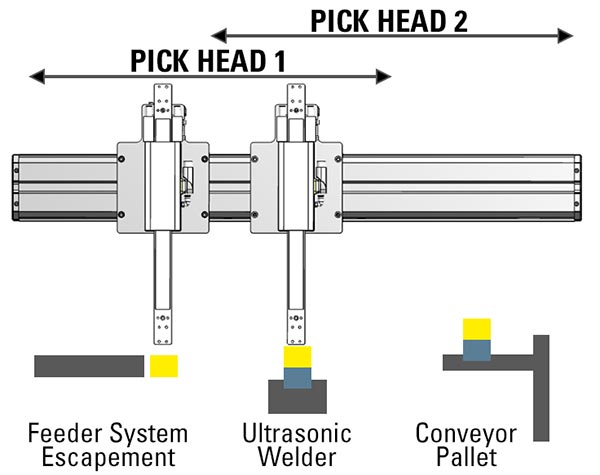
Dual Head Pick & Place
Application example: Dual Head Pick & Place

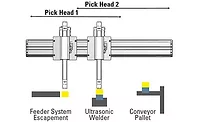
The WEISS handling gantry utilized (2) independently controlled pick heads, operating on a shared Y axis. Pick Head #2 collects the base assembly from the conveyor pallet as Pick Head #1 collects the top part from a vibratory feeder escapement. They orient the parts on top of each other under the welder, clear for the process, and Pick Head #2 moves the assembly back to the conveyor pallet for additional downstream processing. The YZ+YZ handling system achieved the requirements of speeds up to 4 m/s and acceleration up to 40 m/s² - all within a 1,000mm long x 200mm wide form factor. This configuration is commonly used when part orientation, intermediate assembly/processing, or inspection require a step in between the pick and the place positions.

While it is nice to “have it all”, prioritizing critical elements of your motion sequence allows for a focused approach, leading to some innovative solutions.   

Looking for quick answers on assembly and manufacturing topics? Try Ask ASM, our new smart AI search tool. Ask ASM →


Footprint

Linear/Track-based systems allow for a very narrow internal footprint, positioning part feeding or processing equipment around the outside of the system. Pick & Place units, or SCARA robots are commonly deployed on top of the center section, to capitalize on the empty space.    

When developing a machine layout, look to bring the equipment and stations “in” as close as possible, unless manual intervention or part tending is required. Traditional SCARA robots offer a great deal of flexibility, but also tie up a fair amount of real estate in order to manage range of motion and avoid interferences. Smaller, dedicated Pick & Place units can be set up for 2 axes of motion (or upgraded to include a θ rotary axis at end-of-arm), within a very narrow work space.
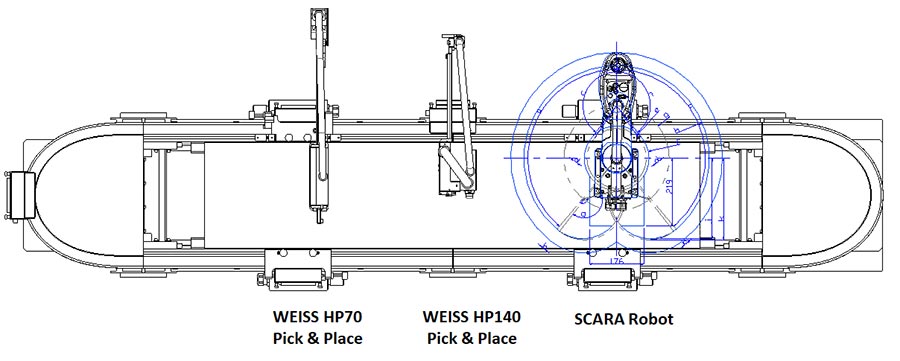
Pick & Place units fit tightly within track-based systems
Application example:  WEISS HP Pick & Place units fit tightly within track-based systems.

In this example, you can see how comparable HP series Pick & Place modules compare to a SCARA robot with equivalent working range. Multiple HP70 units can be set up on a 70mm mounting pitch whereas the HP140’s can be set up on a 140mm mounting pitch. For added versatility, the HP70 can also be mounted overhead. The tight mounting pitch allows you to leverage multiple independent process operations in a compact space.


Modularity/Scalability

Modular automation components allow you to scale up and grow with your manufacturing strategy.  A machine may be originally designed to run with some manual operations and later retrofit to increase throughput or handle next gen products. Utilizing standard off-the-shelf handling units helps to scale a system up or down, provide consistency in operations, and reduce engineering, assembly, and integration efforts.  
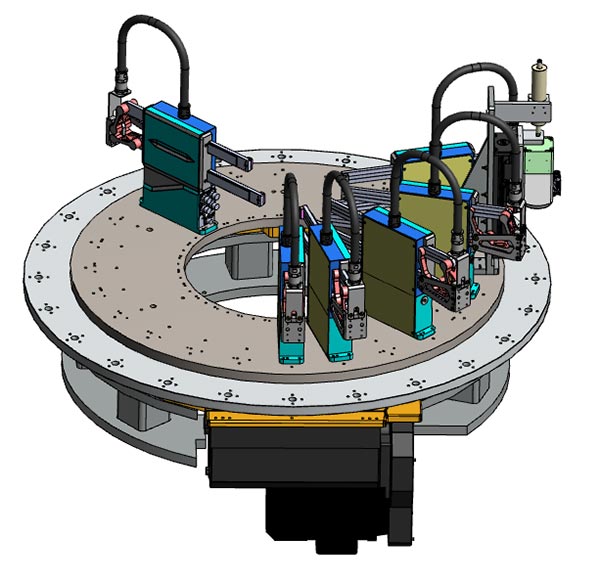
Pick & Place units process parts while mounted to the interior section of a WEISS ring indexing table
Application example: Multiple HP70 Pick & Place units process parts while mounted to the interior section of a WEISS ring indexing table

By utilizing a flexible or freely programmable style of handling system the machine can be easily updated to align with new process parameters like motion profiles or stored positions directly from your machine HMI. In more regulated industries, these smart units can log and output all of the captured data needed for traceability to a single piece.  

If you have existing equipment and have identified a bottleneck in your process, you may decide to retrofit the station with a more reliable or faster unit as a drop-in replacement. With multiple fieldbus interfaces and various control strategies to accommodate any level of users, the HP series Pick & Place units are an exceptional fit.

This flexibility and ability to quickly adapt to changing part requirements or market demands isn’t often considered during the initial design but can payoff big when it matters.


Ease of Use

The last consideration (unfortunately sometimes overlooked) is the ease of use. This largely comes down to two things – “How does it integrate or fit within my controls system?” and “How easy is it going to be to use?”

This ties in to how it will be controlled, and what you can and can’t do natively. A WEISS Handling System uses WEISS Application Software (W.A.S.2) and allows your PLC full control over important inputs and outputs related to machine operation and performance. This can be done over many different fieldbus protocols, I/O options, or sequencing options. This gives you the most opportunity and flexibility to operate the equipment that best suits your application - directly through your PLC or HMI. This can all be achieved without the need for specialized training or onsite support.  

With the user in mind, these platforms are designed to make things easier, more effective and focused on results. This results in reduced cost and effort and increased efficiency across your automation project.


WEISS logoCONTACT INFO:

WEISS North America, Inc.
1-888-WEISSNA (888-934-7762)
www.weiss-world.com
info.us@weiss-world.com

KEYWORDS: factory automation pick and place

Share This Story

Looking for a reprint of this article?
From high-res PDFs to custom plaques, order your copy today!

Recommended Content

JOIN TODAY
To unlock your recommendations.

Already have an account? Sign In

  • Made in the U.S.A.

    Consumer Products Manufacturing: Made in the USA

    Supply chain lessons learned during the coronavirus...
    Automated Assembly Systems
    By: Austin Weber
  • Best Practices for Press-Fit Assembly

    Best Practices for Press-Fit Assembly

    In manufacturing, ironclad formulas for success are hard...
    Assembly Presses
    By: Jim Camillo
  • aem0523leader-tesla1.jpg

    Tesla Rethinks the Assembly Line

    Engineers at Tesla Inc. have developed a new process that...
    Assembly and Testing
    By: Austin Weber
Manage My Account
  • eMagazine Subscription
  • Assembly Newsletters
  • Online Registration
  • Subscription Customer Service
  • Manage My Preferences

More Videos

Sponsored Content

Sponsored Content is a special paid section where industry companies provide high quality, objective, non-commercial content around topics of interest to the ASSEMBLY audience. All Sponsored Content is supplied by the advertising company and any opinions expressed in this article are those of the author and not necessarily reflect the views of ASSEMBLY or its parent company, BNP Media. Interested in participating in our Sponsored Content section? Contact your local rep!

close
  • ultrasonic welding
    Sponsored bySonobond Ultrasonics

    Engineering Efficiency in High-Performance Assembly: How Ultrasonic Welding Enhances Throughput, Reliability and Quality

  • UV curing system
    Sponsored byDymax

    Why UV Intensity Alone Doesn’t Define Curing Performance

  • wooden pallets
    Sponsored byLEAN Manufacturing Products

    Eliminating Waste on the Shop Floor: Applying Lean Principles to Improve Manufacturing Efficiency

Popular Stories

ASSEMBLY News Now, episode-30: Volvo Redesigns EV Manufacturing

Volvo Redesigns EV Manufacturing

Boeing CEO Kelly Ortberg announces 1 billion investment

Boeing Plans $1 Billion Wichita Investment, Workforce Training Center

GE Appliances Worker on Line

GE Appliances Expands Factory AI With 800 Gemini Enterprise Agents

Watch the latest episode of ANN now!

Events

July 24, 2025

From Shop Floor to CFO: How Manufacturers Are Closing the Loop Between Operations and Finance

On Demand Learn how manufacturers are bridging the gap between the shop floor and ERP systems to gain real-time visibility, streamline operations, and kick-start digital transformation—without waiting years.

Sponsored by:

PicoStratusGreen
July 30, 2025

Buffer Analysis and Design Fundamentals for Manufacturing Excellence

On Demand In this presentation, Dr. Herman Tang shares practical insights from his industry experience and research on buffer management in manufacturing operations.

View All Submit An Event

Poll

Difficult Assembly Processes

Which assembly process gives you the most difficulty?
View Results Poll Archive

Products

Manufacturing Cost Policy Deployment (MCPD) Profitability Scenarios: Systematic and Systemic Improvement of Manufacturing Costs

Manufacturing Cost Policy Deployment (MCPD) Profitability Scenarios: Systematic and Systemic Improvement of Manufacturing Costs

See More Products
Register for webinar - Modernizing Automotive Assembly: Why Upgrading Legacy MES is a Business Imperative

Related Articles

  • asb0422how-to-weiss-Dual-Pick.jpg

    How To: Select the Right Pick & Place for your Application

    See More
  • spirol

    How To Select the Proper Pin for your Application

    See More

Related Products

See More Products
  • leaner

    Leaner Manufacturing: How to Make the Lean Production Process Easier, Faster, and More Cost-Effective

  • pocket.jpg

    How To Implement Lean Manufacturing, Second Edition

  • Kaizen Assembly: Designing, Constructing, and Managing a Lean Assembly Line

See More Products

Related Directories

  • HowToRobot

  • GEM Gravure

    At Gem, we are committed to serving all customers with solutions for their product identification needs. From wire & cable marking to food & pharmaceutical packaging, we work with you to determine the right technology and the right ink for your application.
×

Never miss the latest news and trends driving the manufacturing industry

Stay in the know on the latest assembly trends.

JOIN TODAY!
  • RESOURCES
    • Advertise
    • Contact Us
    • Directories
    • Manufacturing Division
    • Store
    • Want More?
  • SIGN UP TODAY
    • Create Account
    • eMagazine
    • Newsletters
    • Customer Service
    • Manage Preferences
  • SERVICES
    • Marketing Services
    • Reprints
    • Market Research
    • List Rental
    • Survey/Respondent Access
  • STAY CONNECTED
    • LinkedIn
    • Facebook
    • Instagram
    • YouTube
    • X (Twitter)
  • PRIVACY
    • PRIVACY POLICY
    • TERMS & CONDITIONS
    • DO NOT SELL MY PERSONAL INFORMATION
    • PRIVACY REQUEST
    • ACCESSIBILITY

Copyright ©2026. All Rights Reserved BNP Media, Inc. and BNP Media II, LLC.

Design, CMS, Hosting & Web Development :: ePublishing