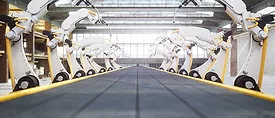
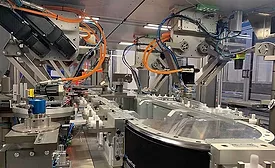
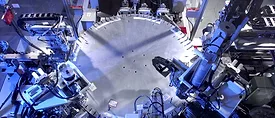
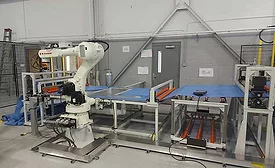
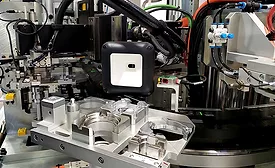
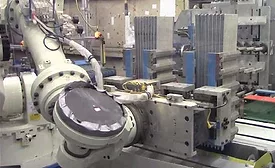
There’s nothing quite like a multistation automated assembly system. Watching robots, actuators and indexers go about their carefully choreographed routines with little or no human intervention can seem nothing short of miraculous.
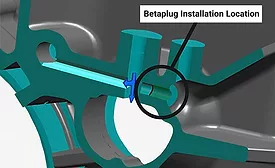
An automatic transmission case is a complex casting that includes a sophisticated valve body with many channels and passages. These channels and passages must be precisely connected to ensure smooth, accurate shifting.
GROB-Werke GmbH & Co. KG creates high-volume production systems for the electric vehicle (EV) market. Based in Mindelheim, Germany, the machine tool manufacturer recently completed a sophisticated system for making hairpins, which form the stator winding rims of electric motors.
Symphoni from ATS Automation is a compact, self-contained, pre-engineered automated assembly cell. Equipped with standard servo-controlled devices, including a high-speed delta robot, the cell can be configured to make a wide range of products, from simple two-piece assemblies to complex products having dozens of components and specialized processes.
Product life cycles are getting shorter. For example, 20 percent of consumers replace their televisions every four to five years; another 5 percent replace their sets every one to three years. Smartphones are even worse. On average, consumers replace their phones about every 2.5 years.
At the start of the COVID-19 pandemic, the healthcare industry faced a large-scale shortage of personal protective equipment (PPE), which put frontline workers at risk of infection.
Saving a penny per part or a millisecond of cycle time might not matter to some manufacturers. But machine builder Eclipse Automation knows that even small gains can offer huge competitive advantages for its customers. Greater flexibility and uptime through predictive maintenance are also crucial.
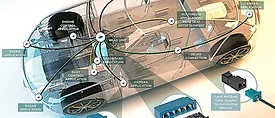
Ethernet cables provide high-speed data transmission for infotainment and driver assistance applications, but they require automated equipment for stripping and crimping.
Electronics in today's vehicles are increasingly complex. With more sensors, controls and interfaces all using higher bandwidth, faster data throughput and more reliable networks are required. The weight of the cables and harnesses in the vehicle is also a concern.
Manufacturers looking to take their operations to the next level often look to automation and robotics to make it happen. This is understandable, for such technology can cost-effectively increase throughput, optimize assembly and testing processes, improve product quality and decrease labor costs.