A manufacturer never achieves success completely on its own. Every company, to some extent, needs help from equipment suppliers, machine builders and integrators.
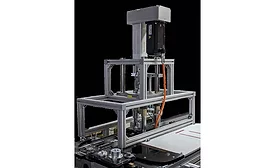
Every process change made by a manufacturer brings with it one or more unique challenges. Consider, for example, the challenges involved when switching from manual or pneumatic presses to servo models for low-force-pressing applications.
With the pandemic subsiding and consumer spending on the rise, manufacturers are investing in their assembly operations.
December 7, 2021
In February 2020, U.S. manufacturers employed nearly 12.8 million people. Then came the COVID-19 pandemic. In an instant, the country lost 1 million manufacturing jobs as governments and businesses scrambled to figure out how best to stop the spread of the disease.
In 1951, at the height of the Cold War, the U.S. Army Chemical Corps and Ordnance Corps initiated a program to develop a new rocket that could deliver chemical weapons over a large area. The result was the M55 rocket, which was equipped with a unitary warhead filled with sarin or VX—highly toxic nerve agents. The rocket was rushed into production, and tens of thousands were produced from 1959 to 1965.
America's newest national park recently opened on the South Side of Chicago. The Pullman National Monument celebrates the unique history of a company that mass-produced freight and passenger rail cars at the site from 1881 to 1981.
Among the factors that limit the growth of electric vehicle (EV) adoption are the relatively long times required to recharge batteries. In most cases, it takes hours to fully recharge an EV, whereas it takes only minutes to refill a gas tank.
Like other transformative technologies, artificial intelligence presents manufacturers with unique challenges to overcome for successful implementation.
Artificial intelligence (AI) is quickly becoming a manufacturing and mainstream technological superstar - a rare achievement indeed. Consider some recent Internet stories highlighting AI's applicability to everyday life.
Industry 4.0 isn't anything new for the manufacturing engineers at Glidewell. The Newport, CA-based manufacturer of crowns, bridges and other dental products has been applying the concept since before it had a name.
Based in Torrington, CT, systems integrator Plastimation has been designing and building robotic automation systems for more than a decade. The company's portfolio ranges from simple projects, such as a machine-tending application in which a cobot unloads stacks of plastic lids from a molding machine, to complex ones, such as an automated line in which four robots assemble and test a medical device.
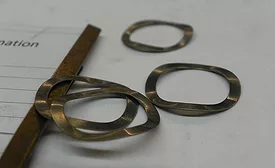
Wave washers, also known as wave springs or coiled wave springs, are used to absorb stress due to axial compressive loads, acting as a cushion. The waves of the wave washer provide three-, four- or six-point contact that results in greater load bearing capacity and a medium range of deflection.