
Cummins Inc., founded in 1919, designs, manufactures, sells and services diesel engines and technology globally. Between its four business units, Cummins has 107 manufacturing plants, 600 company-owned and independent distribution facilities and over 5,000 dealer locations in more than 160 countries.
Medical device manufacturers often use silicone adhesives to assemble products such as catheters, pacemakers, cochlear implants, aesthetic implants and gastric balloons.
"Scratch-resistant plastic parts" is more than a phrase with great appeal to car buyers. It also presents a great challenge to automotive Tier 1s to make sure these parts perform as promised in the real world.
Manufacturers love established assembly line technologies not only because they produce expected results. But, also because they occasionally provide an unexpected benefit.
Some automotive enthusiasts get their fix by building a car themselves. Others thoroughly enjoy watching the pros do it; i.e., assemblers on the production line.
Whether it's a car or a computer, a toy or a toaster, almost every assembled product has at least a few threaded fasteners. Indeed, 62 percent of ASSEMBLY's readers use threaded fasteners of one form or another to assemble their products.
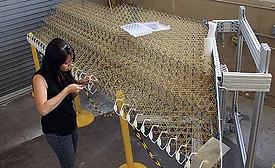
Aircraft wings have been assembled the
same way for decades. But, engineers at
the Massachusetts Institute of Technology
(MIT) and NASA have developed
a flexible aerostructure that is produced
from hundreds of tiny, identical pieces using
composite lattice-based cellular materials.
For Flex, there isn't a question of what can't they do, but what they will do next. The 50-year-old company began manufacturing electronic products, something it still does today, but has expanded to offer end-to-end production across the globe.
Strong and lightweight, carbon-fiber reinforced plastic (CFRP) offers numerous benefits to automotive and aerospace manufacturers. Many engineers are intrigued by potential applications for the material, yet remain frustrated by joining challenges.
A decade or so from now, you may find yourself traveling along an interstate in a caravan. Your automobile is separated by just a few inches from the vehicle in front of you and the one behind as you speed along at 150 miles per hour.