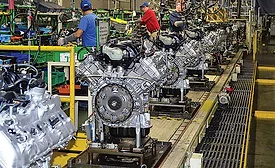
Good news! U.S. manufacturers employed 12,922,000 people in October, according to the Bureau of Labor Statistics (BLS). That’s 4 percent more than in October 2021 and 13 percent more than in April 2020, the manufacturing employment low point of the COVID recession.
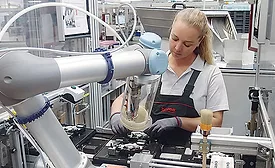
Increasing demand for smart devices and embedded intelligence is driving manufacturers in a variety of industries to invest in new production tools and technologies. Additive manufacturing, advanced sensors, augmented reality, cloud-based computing, collaborative robots and digital twins are just a few of the many trends transforming factory floors today.
The era of digital manufacturing, Industry 4.0 and smart factories is here. It promises to improve productivity, drive operating efficiencies and transform the way many types of products are mass-produced. Benefits include optimized efficiency and reduced assembly line errors.
Manufacturing today is leaner and greener than ever. Many engineers are focusing on lightweight materials and sustainable production initiatives. In addition, additive manufacturing is transforming how a wide variety of products are designed and assembled.
WASHINGTON—The U.S. Supreme Court upheld a decision March 23 that Tyson pork processing workers must be paid for the time they spend putting on their protective material and cleaning their equipment.
WASHINGTON—The Labor Department’s final rule on overtime eligibility isn’t likely to appear before late 2016, Solicitor of Labor Patricia Smith said. In June, the agency proposed raising the salary limit for who is eligible for overtime pay from $23,660 per year to $50,400, a change that would put millions more U.S. workers in line for overtime pay.
DETROIT—In contract talks with the Detroit 3, the UAW will seek to boost the pay of veteran Tier 1 workers, who, union officials point out, haven’t had a wage increase in a decade. But that doesn’t mean their pay hasn’t gone up.