Ergonomics
Workstations: Sitting Down on the Job
The right type of chair or stool can help address ergonomic concerns.
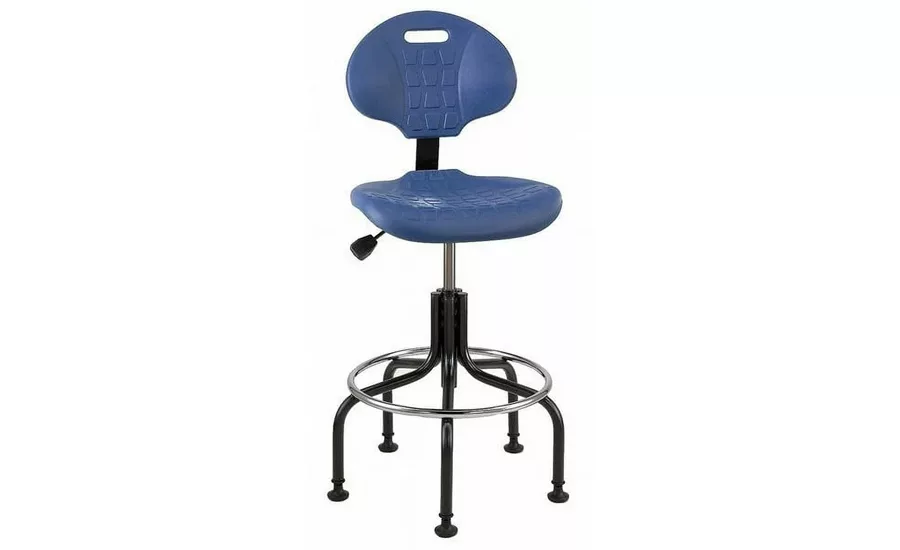
Photo courtesy Bevco Ergonomic Seating
A wide variety of chairs and stools are available for assembly line applications. Options include tilting backs; height-adjustable backs; seats that slide, tilt and raise or lower; and adjustable arms in width, angle and height.
That flexibility allows a seat to accommodate a wide range of different-sized people. Adjustable chairs also let assemblers change positions throughout their shift.
“Sitting is usually less fatiguing than standing and is preferred for fine work or highly visual tasks, such as light assembly work [and test and inspection applications],” says Cynthia Roth, CEO of Ergonomic Technologies Corp.
“However, the human body was not meant to sit for long periods,” warns Roth. “[There are] ergonomic risk factors associated with prolonged sitting, such as lower back stressors on the lumbar and abdominal muscles. Based on the height of the seated work and the necessary visual acuity, the neck, head and shoulders could also be placed at risk from awkward or bent postures.”
To be considered ergonomic, a chair must support a balanced work posture and minimize worker fatigue. A balanced work posture means the torso and hips are supported so that minimal force is exerted to hold the torso stable. A stable torso provides a better anchor for arms, hands and legs, resulting in less fatigue and less risk of cumulative trauma disorders.
“Ergonomics is paramount for keeping the employee safe, comfortable and productive,” says Chris Rudella, marketing manager at Lyon Workspace Products. “When the employee’s posture is off, the result is back and neck pain, [in addition to] constant headaches. Work productivity issues will rise and overall output will diminish. Ergonomics will keep employees safe and healthy through correct posture and body alignment for the work or task.”
“A person needs to use nearly 100 muscles to balance in a seated position,” adds Liz Sworden, marketing manager at BioFit Engineered Products. “Inadequate support can place unnecessary strain on back, leg and stomach muscles. The resulting premature fatigue can promote a decline in productivity.”
According to Sworden, adjustability and durability are the most important features of any chair intended for assembly line applications. Whether it’s a chair or a stool, ergonomic seating should be capable of adapting to both the worker and the work.
“Ideally, chairs should adjust in height and provide adequate and adjustable lumbar support,” notes Julia Abate, senior ergonomist at the Ergonomics Center of North Carolina, which is housed in the Edward P. Fitts Department of Industrial and Systems Engineering at North Carolina State University. “Materials should be durable enough to withstand the work environment. Components such as air cylinders and fabric should also have a warranty that they will last several years.
“Adjustments should be easily made and lock in a manner that is supportive,” adds Abate. “Some adjustments made by tightening a screw, for example, do not stay tight and the worker must constantly make changes.”
While all chairs may look the same, engineers must make sure they choose products that complement different types of workstations. “Just as no two applications are the same, neither should the chair solution be viewed as universal,” warns David Verrill, applications support manager at IAC Industries Inc.
“A chair’s features should complement the workstation,” Verrill points out. “Selecting the correct seat height range is the most important consideration in this respect, whether the workstation is adjustable or not.
“But, I think it’s much more important to focus on complementing the user that will be seated,” adds Verrill. “For instance, if all workstations are set at a 30-inch working height, taller users may require a lower starting height for their chair in order to work comfortably.
“Conversely, a shorter user may require a taller cylinder to bring them up closer to their work,” notes Verrill. “The shorter operator may also require an adjustable footrest that is integrated into the workstation, or possibly a free-standing adjustable footrest.”
Sitting vs. Standing
Sometimes, the best type of chair for an assembly task may be no chair at all. Many different types of assembly tasks can only be done in a standing position.Standing is usually preferred for precision work with employees’ elbows supported. Standing is also the preferred posture for light assembly work or when forces are applied, such as insertion tasks. When standing, an assembler has greater muscular stress throughout the body-especially in the feet, legs and knees or lower torso. Standing also allows the person greater freedom of movement.
“There is an overlap between sitting and standing guidelines,” says Roth. “Different types of tasks can be done sitting or standing, depending on employee preferences, what work is being fed into the workstation, and where the product has to go after the assembly task.
“Rotating between sitting and standing tasks is often a more ergonomic choice, as it gives the employee the ability to choose the postures,” explains Roth. “Other tasks are better performed in more of a sit-stand posture.”
The best of both worlds may be a sit-stand stool. “Sit-stand stools are the new trend on assembly lines today,” claims Rudella. “They are designed to keep [assemblers] standing [while reducing] the weight and stress on their feet by up to 75 percent. The seats swivel side-to-side, which is an ergonomic must on assembly lines when you are rotating your body constantly.”
“These [devices] do not provide back support, but do provide some relief from constant standing,” says Abate. “Stools must be stable, have height adjustability, and allow the worker to get close to the work (vs. those stools that require the operator to lean back when in use). The same rules that apply to seated work apply to the use of sit-stand stools.”
“Promoting a balanced posture by supporting the torso and hips, sit-stands should be engineered to help combat cumulative trauma and soft tissue problems that are often associated with jobs that require extensive standing,” adds Sworden.
Another option being used in more factories are wall- or work-mounted stools that can be moved out of the way when not in use. According to Sworden, the stools are available in many different seating configurations to provide maximum workspace efficiency.
The Ultimate Assembly Line Seat?
Engineers at Honda Motor Co. recently put a new twist on assembly line seating. Assemblers at the automaker’s plant in Sayama, Japan, use an unusual type of chair to eliminate the risk of repetitive-stress-related injuries.
The 6.5 kilogram Bodyweight Support Assist device is designed for people who are capable of walking and maneuvering on their own, but who can benefit from additional leg and body support while performing assembly tasks. It reduces the load on leg muscles and joints (in the hip, knees and ankles) by supporting a portion of the person’s bodyweight.
The ergonomic tool, which operates for 2 hours at a time with a rechargeable lithium-ion battery, has a simple structure consisting of seat, frame and shoes. Each leg contains an electric motor.
The Honda engineers developed a mechanism where the seat and frame follow the movement of the body and legs. The ergonomic tool supports a portion of an end user’s bodyweight by lifting the seat, as the frame between the shoe and seat bends and extends, just like knees, with the force from the motor. As a result, the load on leg muscles and joints is reduced.
An operator activates the device by wearing a pair of high-tech shoes and sitting down. A mechanism directs the assisting force toward the user’s center of gravity. The ability to control the assist force in concert with the movement of the legs makes it possible for the device to provide natural assistance in various postures and motions.
Natural walking is achieved by changing the amount of assisting force applied to the right and left legs through the control of two motors based on the information obtained though sensors embedded in the shoes of the device.
Looking for quick answers on assembly and manufacturing topics? Try Ask ASM, our new smart AI search tool. Ask ASM
Looking for a reprint of this article?
From high-res PDFs to custom plaques, order your copy today!