Automotive
Automaker-Supplier Relations Improve Despite Tariff, EV Pressures
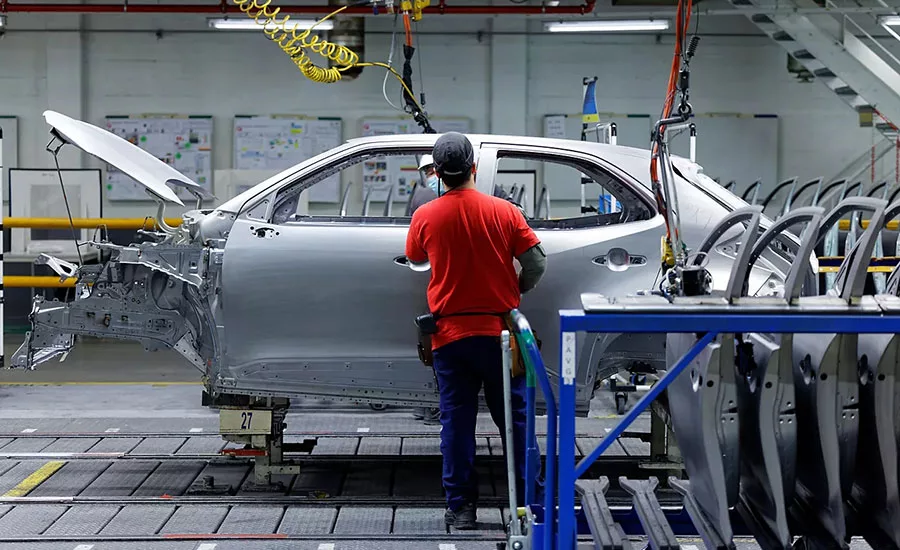
The press shop produces 87 different parts.
Photo courtesy Toyota Motor Corp.
BIRMINGHAM, Mich. — Supplier relations improved for all six major North American automakers in 2026 despite tariff pressures and electric vehicle cost challenges, according to Plante Moran’s annual Working Relations Index study.
The 2026 North American Automotive OEM-Supplier Working Relations Index study found overall improvements across all six major manufacturers for the first time in the survey’s 26-year history, with Ford, Toyota and Stellantis posting the largest gains.
The results reflect the influence of four undercurrents. The WRI scores suggest tariffs and electric vehicle cost recovery shaped suppliers’ perceptions of commercial fairness, as purchasing teams with limited control over how much their OEMs absorbed those costs focused on relationship-related factors within their control. Those efforts were also boosted by return-to-office mandates and “permacrisis” fatigue.
Ford experienced the biggest jump in WRI scores this year, increasing 32 points, while Toyota rose 23 points and Stellantis gained 22 points. Honda added 13 points, General Motors increased eight points and Nissan improved six points.
Despite those gains, the manufacturers’ rank order remained unchanged from last year, with Toyota and Honda continuing to lead the field while Detroit automakers posted some of the largest improvements.
Toyota scored 409 points, surpassing 400 for the first time since 2007 and marking its second-highest score ever. Honda reached its highest score since 2007 at 360 points, pushing it into the study’s “good-very good” range.
General Motors achieved its highest-ever WRI score at 318 points, although it lost ground to Toyota and Honda. Nissan returned to its 2024 score of 255 points, its highest mark since 2014.
Looking for quick answers on assembly and manufacturing topics? Try Ask ASM, our new smart AI search tool. Ask ASM
Ford notched 223 points, marking its second-largest increase in WRI history, while Stellantis reached 163 points, its best score since 2021 amid leadership changes and turnaround initiatives.
The study noted the improvements were significant given the “trust gap” identified in the 2025 survey, which showed widening differences between top-rated and bottom-rated automakers in measures of trust.
“In 2026, all six automakers improved trust scores through enhanced communication, accessibility and their ability to solve problems,” said Dr. Angela Johnson, principal in Plante Moran’s automotive and mobility consulting practice and head of supplier relations analytics. “Also, in the 10,000 supplier comments we received — more than three times the number received in prior years — we saw an emerging collective recognition that working together is the best way to face permacrisis challenges, innovate and grow.”
The improvements were driven largely by better supplier perceptions of long-term profitability, commercial fairness, buyer performance and communication, according to the study.
Toyota remained the leader in supplier confidence around long-term profit opportunity, while Ford, Stellantis and Nissan made significant gains.
Ford and Stellantis posted the largest gains in commercial fairness, while Toyota and Honda led efforts to help suppliers reduce costs. GM made the biggest advances in covering sunk costs and EV cost recovery but faced criticism over supply chain resiliency initiatives.
Buyer accessibility, engagement and responsiveness also improved. Supplier ratings of buyers’ ability to resolve issues improved across all manufacturers.
Toyota and Honda continued to lead in communication and trust, though Ford and Stellantis made the largest gains. Ford purchasing executive Liz Door recorded the largest improvement in trust among purchasing chiefs.
“Suppliers appeared to acknowledge efforts OEMs made over the past year to control what they could and to help suppliers navigate industry uncertainty,” Johnson said. “Even if suppliers didn’t experience their ideal outcome, they credited the OEMs for taking their meetings, listening and acting.”
The survey results also highlighted the importance of what Johnson described as “controllable” behaviors — actions that bridge the gap between purely transactional and relationship-driven interactions.
Johnson said the key differentiators between top- and bottom-performing automakers centered on what she called the “Six Cs”: commercial fairness, consistency, clear expectations, communication, continuity and collaboration.
“The WRI Study suggests a growing emphasis on organizational behaviors,” Johnson said. “And the benefits are bidirectional.”
This year, Plante Moran also analyzed responses from the top 50 North American suppliers separately to identify additional trends.
Those suppliers improved their ratings of all six manufacturers, mirroring the broader survey group. However, the results also reflected longstanding cultural perceptions within the industry.
The top 50 suppliers rated Nissan, Honda and Toyota above their overall averages, while rating GM, Stellantis and Ford below their averages, particularly in trust, communication and profit opportunity.
“Organizational memory is very long,” Johnson said. “The Detroit Three are still fighting to overcome the cultural inertia of historically adversarial purchasing organizations.”
Toyota’s more conservative EV strategy also appeared to reduce commercial strain on suppliers, while GM, Ford, Stellantis and Honda faced greater supplier impacts tied to EV write-offs.
Looking for a reprint of this article?
From high-res PDFs to custom plaques, order your copy today!


.webp?height=200&t=1753282986&width=200 "Tonawanda Propulsion plant employee.jpg")