AI System Trains Robots to Perform Assembly Tasks
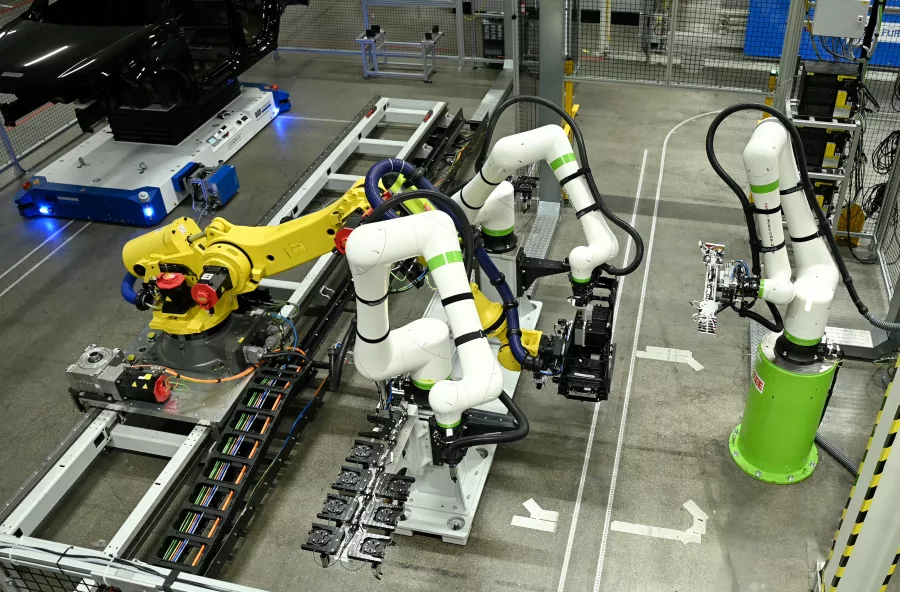
A new AI-based system trains robots to perform assembly tasks. Photo courtesy Audi AG
BIRMINGHAM, England—Engineers at Aston University here have developed an AI-based systems that can train robots how to perform assembly tasks. The breakthrough addresses the “sim-to-real gap,” a longstanding challenge in robotics. It refers to the difference between how industrial robots behave in simulation and how they behave in the real world, where there is variability caused by force, material, noise and other factors.
“Robots are trained for specific tasks using simulation,” says Alireza Rastegarpana, Ph.D., an assistant professor in applied AI and robotics who headed up the R&D project in partnership with the University of Birmingham’s Extreme Robotics Lab. “However, collecting real-world data is expensive, slow and sometimes unsafe, particularly for tasks involving physical interaction.”
The goal of the project was to develop a method that combines the efficiency of simulation with the realism of physical environments, enabling robots to adapt without requiring large amounts of additional data.
By using AI to generate variations in conditions, the new training technique allows robots to transfer skills learned in simulation into the real world much more reliably, using only a small amount of data. A robot can learn a complex task in a virtual environment, such as manipulating materials, and then adapt that knowledge to work effectively in real-world conditions, even when those conditions are uncertain or previously unseen.
According to Rastegarpana, the technique will help make robots more practical, scalable and deployable in a variety of industries. She says it demonstrates that it is possible to achieve stable, efficient and adaptive robot behavior without requiring extensive real-world training. This could significantly reduce development time, cost and risk.
“The impact is particularly strong in areas where robots must operate under uncertainty,” Rastegarpana points out. “This includes recycling and circular economy systems, such as battery disassembly, advanced and flexible manufacturing, and hazardous environments.
“This work shows that we can move beyond purely simulation-based training and achieve reliable performance in real-world conditions with minimal additional data,” claims Rastegarpana. “Our long-term vision is to enable plug-and-play intelligent robotic systems that can be trained in simulation and rapidly deployed in new environments with minimal reconfiguration.
“This could significantly accelerate innovation in areas such as sustainable manufacturing, recycling, and autonomous industrial systems,” says Rastegarpana.
Looking for quick answers on assembly and manufacturing topics? Try Ask ASM, our new smart AI search tool. Ask ASM
Looking for a reprint of this article?
From high-res PDFs to custom plaques, order your copy today!