Stern Pinball Keeps Old-School Fun Alive
June 1, 2026
Stern Pinball Keeps Old-School Fun Alive
June 1, 2026This Pokemon-themed pinball machine features a variety of unique obstacles and toys.

Pinball is a nostalgic world full of bells, buzzers, chimes, flashing lights, metal balls, paddles and other electromechanical gizmos that are intricately packaged inside a glass-topped case. The old-school game once associated with coin-operated arcades is now prized by collectors and “pinheads” who spend thousands of dollars on limited-edition machines.
A handful of companies still make pinball machines in the United States. The largest of them all is Stern Pinball Inc., which operates a modern factory in a suburban Chicago industrial park near O’Hare International Airport.
Stern Pinball was founded in 1999 by Gary Stern, who got his start in the coin-operated game industry with his father in the 1960s. In September 2023, the company moved two blocks from a 106,000-square-foot facility to a state-of-the-art 230,000-square-foot building.
Stern’s new home includes offices, R&D labs, a machine shop and a factory. There’s also a large area that includes a copy of every machine ever made by the company, which employees are encouraged to play during their free time. The new assembly line is laid out more efficiently to enable better communication and material flow.
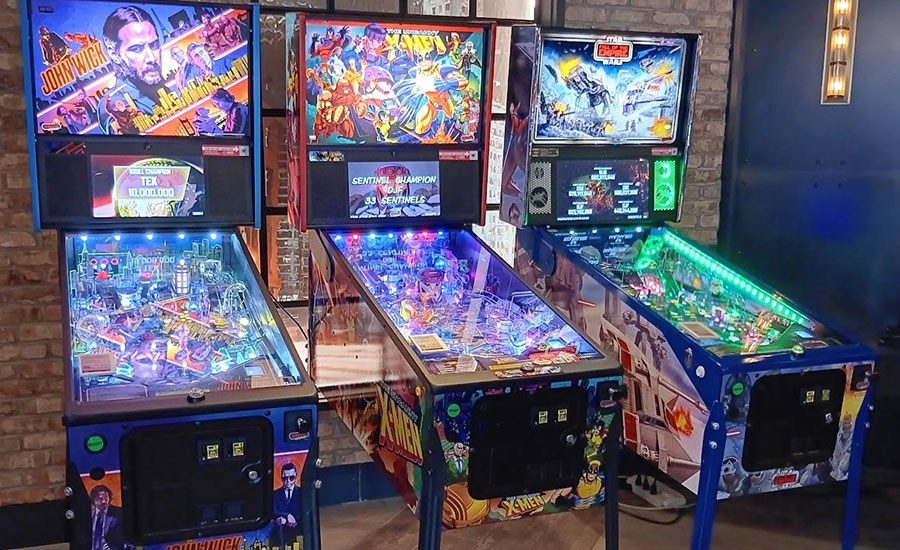
Stern Pinball makes games based on a variety of pop culture themes, including (left to right) John Wick, X-Men and Star Wars. Photo by Austin Weber
Universal Appeal
Pinball is played within the friendly confines of a glass-enclosed cabinet that is approximately 2-feet wide and 6-feet long, weighing up to 300 pounds. Players pull a spring-loaded knob that shoots an 80-gram, 1-inch diameter silver ball into a maze of obstacles, including bumpers, chutes, ramps, spinners and targets. Along the way, lights flash and a cacophony of sounds are emitted as the ball bounces around a colorful playfield and points are automatically calculated.
The object of the game is to keep the ball in play for as long as possible via a pair of finger-activated mechanical flippers. Talented players can keep a ball active for an hour or more at a time while they rack up thousands of points.
Pinball appeals to many people because it’s not a video game. While machines today feature digital displays, LED panels and advanced audio systems, they ooze with a sense of nostalgia.
The game is played on a slightly tilted table, usually raised at the far end from three to seven degrees. This creates an incline for the ball to roll down the playfield, which contains a carefully designed obstacle course covered by a protective pane of glass.
Looking for quick answers on assembly and manufacturing topics? Try Ask ASM, our new smart AI search tool. Ask ASM
Looking for a reprint of this article?
From high-res PDFs to custom plaques, order your copy today!
The rear of the machine is dominated by the “back glass,” a colorful panel that sports artwork, promotional graphics and videos tied into the theme of each game. It also contains a scoring screen with bright numbers that are constantly blinking as points quickly accumulate in the fast-paced game.
Although pinball is skill-based, it’s never fully predictable. The game rewards precision, hand-eye coordination, quick reflexes and timing. There’s a certain amount of fun and organized chaos associated with every machine, due to a variety of hidden magnets and strategically placed shakers, sensors and solenoids that provide sensory feedback.
Unlike video games, pinball is physical, tactile and three-dimensional. Players hear bells, buzzers, chimes and other sounds. They feel vibrations and push buttons to activate mechanical flippers. They see colorful targets, “bash toys,” pop-up obstacles and bright flashing lights.
Modern pinball machines feature digital controls, illuminated back glass and colorful playfields. They cost thousands of dollars and are often made in limited production runs.
Stern has a loyal, cult-like following that’s similar to how some people are enamored by car brands such as Ferrari, Jeep, Porsche or Tesla. Pinball aficionados simply can’t get enough of the company or its well-built products.
In today’s age of artificial intelligence, smartphones, video games and virtual reality, pinball has undergone a resurgence, attracting more fans lately. In fact, competitive pinball tournaments drew more than 40,000 participants last year, which is more than double the turnout in 2015.
“Traditional devices like drop targets, spinner targets and pop bumpers are still used in games, side by side with modern animatronics or more complex targets,” says George Gomez, chief creative officer and lead game designer at Stern Pinball, and a member of the Amusement Industry Hall of Fame.
“The single biggest transformation has been our Insider Connected system, which connects the universe of Stern Pinball machines to the internet,” explains Gomez, who is considered a legend in the coin-operated game industry. “Players can now track their progress, participate in community quests, earn achievements and interact with other players.”
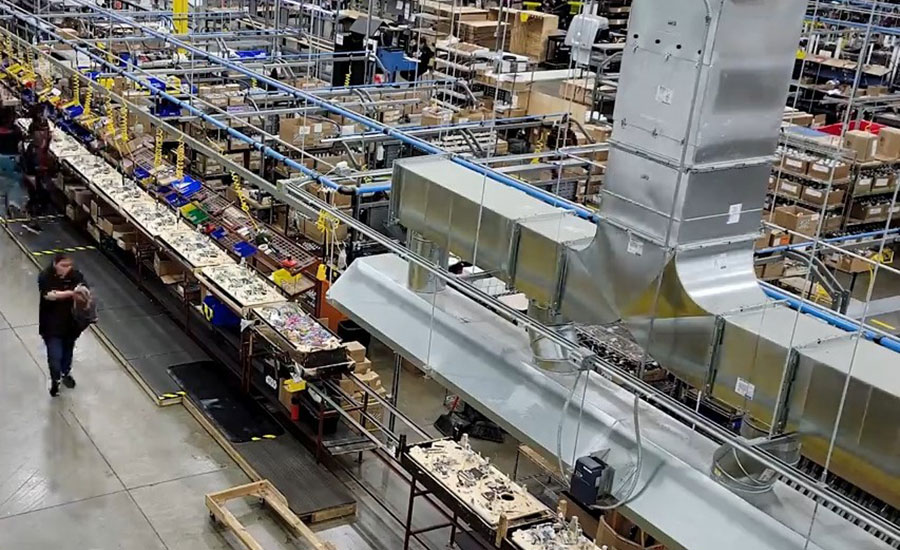
The playfield assembly line is the heart and soul of the Stern Pinball factory. Photo courtesy Stern Pinball Inc.
Marketing Wizards
While some pinball machines end up in neighborhood bars or arcades, more than two-thirds of Stern’s production volume is typically shipped to private individuals who pay up to $13,000 for a limited-edition machine. The price tag of a standard model usually starts around $7,000.
Many games are sold directly to consumers for their basements, garages, man caves or rec rooms. In fact, it’s not uncommon for people to have more than one pinball machine in their collection.
Stern distributes its products through a network of distributors and specialty game retailers, in addition to some local appliance stores and national chains such as Costco. The company also exports pinball machines to more than 50 countries. In most cases, the only difference between a game headed to India, Iowa or Ireland is its power cord.
Stern Pinball prides itself on obtaining lucrative licensing rights to comic books, movie franchises, rock-and-roll bands, television shows and other pop culture icons. Its recent lineup of machines have featured themes such as Batman, Dungeons & Dragons, Game of Thrones, Godzilla, Harry Potter, Jaws, Jurassic Park, King Kong, Kiss, Metallica, Rush, Spider-Man, Star Wars, Stranger Things, Transformers, Walking Dead and X-Men.
Stern releases three new games annually, often via highly anticipated unveilings. Each typically has a five-year production run. The machines are offered in several versions, including pro, premium and limited-edition models.
A new machine can take up to 16 months to develop by Stern’s in-house team of electrical engineers, mechanical engineers, software programmers, graphic artists, machinists and model makers. They specialize in turning concepts into fun, interactive games that appeal to both novice and professional players.
Once a licensing agreement is reached, product designers lay out the playfield and determine the precise angle or geometry of shots. They also try to come up with new concepts or special tweaks that give each machine a unique personality.
Last year, Stern unveiled a next-generation electronics platform dubbed Spike 3. It features a full high-definition display with true color depth, along with a powerful processor and an immersive audio system. The electronics package also provides more efficient power handling, improved Wi-Fi support and wireless headphone capabilities.
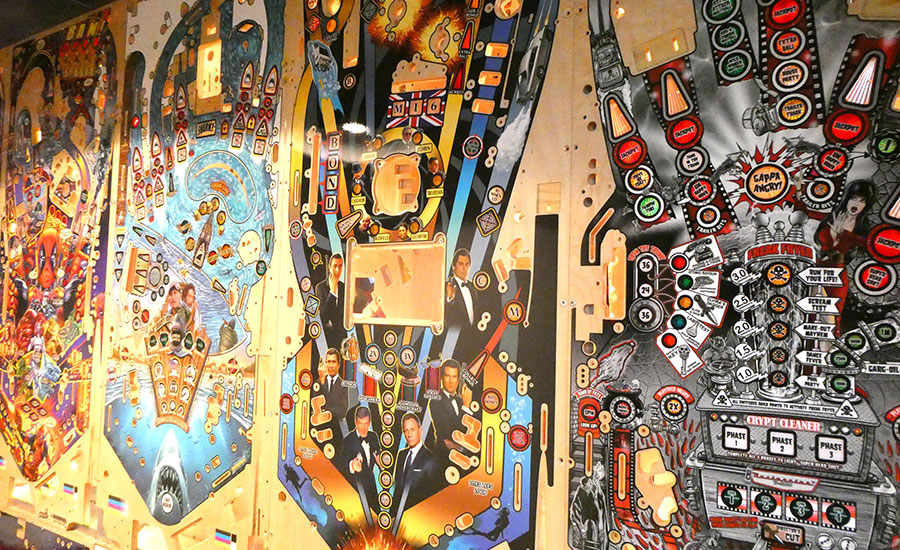
Playfields feature high-definition artwork that gives each game a unique look. Photo by Austin Weber
During a recent visit to the Stern factory, a batch of James Bond 007-themed pinball machines were in production. The sides of the machines are adorned with graphics based on lobby posters from six of the franchise’s most popular films, such as “Diamonds Are Forever,” “Dr. No,” “Goldfinger” and “You Only Live Twice.” The iconic film score, plus memorable clips and sound bites are also integrated throughout the game.
In addition, the game features a variety of action sequences, gadgets, villains and weapons from the films. A colorful playfield is packed with exciting mechanical action. For instance, pinballs get ejected through the roof of a custom-sculpted Aston Martin DB5, while a magnetic jetpack transports a pinball from one side of the machine to the other.
One of Stern’s newest products is inspired by Pokémon, which is the highest-grossing media franchise in the world, according to Guinness World Records.
Pokémon (short for “pocket monsters”) is a Japanese game that has millions of fans and appeals as much to adults as kids. It features small, fuzzy characters, such as Pikachu and Meowth, who chase, catch, battle and tame a variety of monsters.
“This dynamic machine brings the thrill of catching, battling rivals and training Pokémon in the silverball arena for the very first time,” says Seth Davis, president and CEO of Stern Pinball. “Players test their skills as Pokémon trainers, battling rivals and facing off against the menacing Team Rocket in intense encounters.
“Players shoot an illuminated, mechanically animated Poké ball to catch Pokémon, build their ultimate team and complete their Pokémon collection,” explains Davis. “The playfield also features beautifully crafted Pokémon-themed ramps, spinners and targets. An animatronic Pikachu reacts to your gameplay, cheering you on every step of the way.
“Every element has been meticulously crafted with attention to detail, honoring the rich legacy of the beloved franchise,” adds Zachary Sharpe, senior director of marketing at Stern Pinball. “The machine integrates video clips from the original Pokémon animated series, immersing players in the world that started it all.
“Bringing the experience to life even further, custom voiceovers for Pikachu and [other characters] capture the spirit and humor that fans know and love,” says Sharpe.
Hands-On Assembly
Stern Pinball’s machines contain a variety of high-tech content, but they are hand-crafted using old-school tools and processes that haven’t changed much in decades. Assemblers rely on a variety of manual tools and soldering irons, in addition to battery, electric and pneumatic screwdrivers.
The factory floor is divided into five main sections: cabinet assembly; wire harness assembly; component subassembly; playfield assembly; and final assembly and testing. Once the cabinets are assembled, production flows from north to south using a linear assembly line.
While most games are made in large batches, the line is flexible enough to be switched several times a day if necessary, depending on demand.
“Assembly time for each machine varies based on the complexity of the game,” says Gomez. “On average, each requires between 18 and 24 hours of labor.”
Cabinets are assembled from wood panels supplied by a third party. Operators fasten the pieces together and then mount the cabinets on wheeled carts so they can be manually pushed down the line.
Decal sheets are applied to the outside of the cabinets while brackets, coin doors, flipper buttons, hinges, leg guards, leg plates, power switches, shooter rods, speakers and other parts are attached with screwdrivers and staple guns. Then, each cabinet is mated with a matching head.
Wire processing plays an important role at Stern Pinball. That’s why the company manually builds hundreds of harnesses in-house every day. Wire is cut, stripped and terminated using semiautomated equipment.
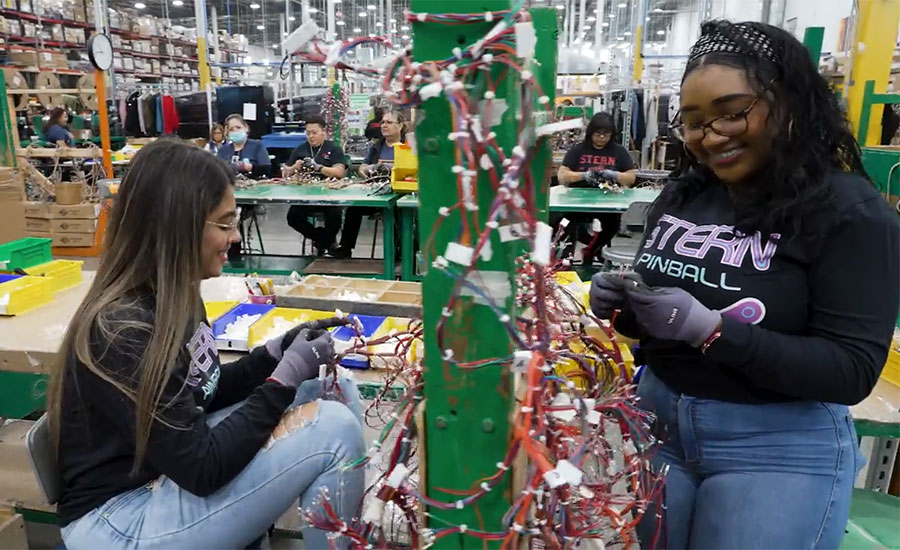
Custom wiring harnesses are built for every machine made by Stern Pinball. Photo courtesy Stern Pinball Inc.
Custom wiring harnesses are built for each machine. In fact, every game uses an average of 1,320 feet of wire.
“We are very passionate about creating the best games,” says Gomez. “We will make last-minute design changes to improve the overall game experience. Due to possible changes, we cannot produce cables too early in the process. Therefore, we must make them in-house.
“Today’s wiring harnesses tend to be less complex than 15 years ago,” explains Gomez. “The old harnesses were two to three times larger overall. However, the introduction of electronics and matrixing has greatly simplified each harness.
“We currently use cable ties to hold the wire harnesses together, unlike the old days when we used wax wire for that purpose,” Gomez points out. “Wax wire was much more time-consuming to apply, but the end results, in my opinion, looked much cleaner.”
Stern Pinball also prides itself on colorful playfields that are custom-designed with high-definition artwork that gives each game a unique look. They are fabricated in-house to ensure quality.
Designs are digitally printed on flexible sheets before they are laid on top of plywood. A maple veneer is added to the top and bottom for extra hardness, because the playfield anchors important components such as bumpers, lights, ramps and targets that are activated by solenoids and switches mounted underneath.
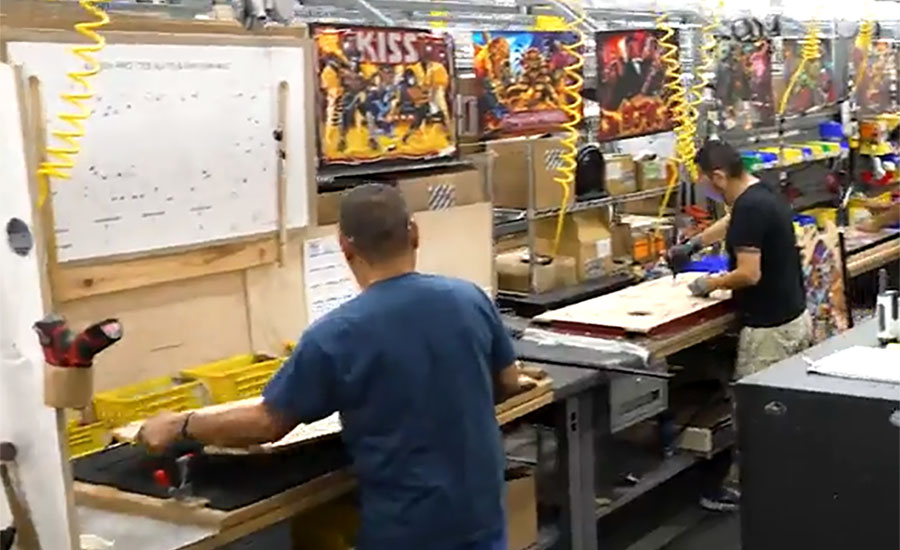
Assemblers use screwdrivers to attach components to playfields. Photo courtesy Stern Pinball Inc.
One of the most revered pieces of equipment on Stern’s factory floor is more than 50 years old. It’s a hydraulic press built in the 1960s and originally used by Gottlieb, a legendary manufacturer of pinball machines (see sidebar below).
“The Hannifin press is used to mark the location where screws need to be inserted on a playfield board,” says Gomez. “Metal plates with sharp pins similar to a bed of nails are laser cut and then the pins are installed. These plates are created from the CAD files for each game.
“When the playfields are installed in the press and the machine is actuated, the pins mark the location of fasteners,” Gomez points out. “These marks appear as dimples in the wood, enabling operators to locate and install screws.”
Larger, standard holes where bumpers and other parts need to be inserted are cut out by a CNC router. But, playfields receive extra holes specific to their game design using custom drill plates and fixtures.
Playfields are manually pushed down the assembly line on sleds. Operators install small metal parts on the topside, such as ball guides, brackets, ramps, side rails, spinners and custom-molded plastic figures or toy accessories. On the backside, assemblers attach motors and wire harnesses with screwdrivers, while node boards and other electronic components are manually soldered in place.
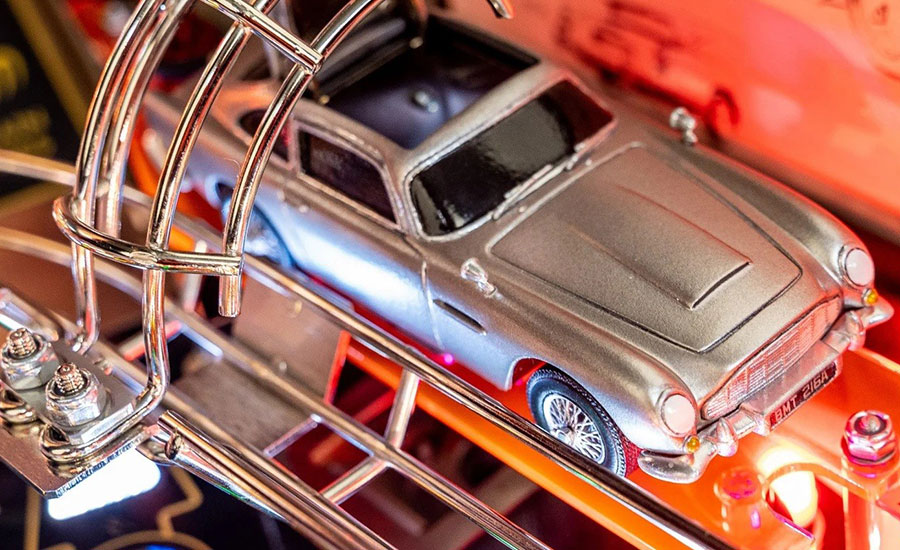
Metal balls are ejected through the roof of this custom-sculpted Aston Martin DB5. Photo courtesy Stern Pinball Inc.
“There are more than 3,500 line items in a standard bill of materials,” says Gomez. “The bulk of these parts go into the subassembly area. We use T-nuts, elastic stop nuts and other hardware to securely fasten mechanisms to the playfield surface, due to the extreme amount of shock and vibration that occurs in pinball games.
“We typically use three to six different varieties of low-voltage motors on a game,” explains Gomez. “They cover many functions, from interactive toys and mechanisms to physical feedback. Examples include DC gear motors for rotating toys, stepper motors for precise movements, and specialized bidirectional motors.”
Another important electromechanical component installed into every pinball machine is a slingshot mechanism. It’s located directly above the flippers that propel balls away from the side lanes using leaf switches and a coil-driven plunger. Slingshots are crucial for accelerating gameplay and providing constant chaotic action.
After all components are assembled, they are mechanically and electrically tested before being attached to the playfield. At the end of the assembly line, each playfield is mounted on a rotisserie fixture that enables operators to test and inspect both sides for functionality. Then, each playfield is inserted into the top of a matching cabinet and the game is packaged for shipping.
Why Chicago Is the Pinball Capital
Chicago has been at the epicenter of the pinball industry for decades. In fact, coin-operated machines were built in the Windy City long before anyone ever flipped a metal ball into an electromechanical playfield.
One of the first big players was the Mills Novelty Co., which mass-produced amusement machines in the early half of the 20th century. Its product lineup included automatic phonographs, fortune tellers, lung testers, punching bags, slot machines and stereoscopes. The company also made the first refrigerated, coin-operated vending machine for Coca-Cola in the 1930s.
Early games sported cast-iron legs and were housed in elaborate upright wooden cabinets that rivaled fine furniture. Machines that typically required pennies or nickels to operate were often found in arcades, bowling alleys, pool halls, railway stations and saloons.
One of Mills Novelty’s most popular products was a violin virtuoso that played classical music. The machine had 123 separate functions, 2,400 individual parts and 27 miles of wire encased in a mahogany and glass cabinet, along with a violin, a piano harp and hammers, and two rollers. Five human fingers were replaced by 64 mechanical ones. The machine was all electric and all its moving parts were set in motion by electric motors and electromagnets.
Mills Novelty operated an eight-story 200,000-square-foot vertically integrated factory on the Northwest Side of Chicago. It featured a state-of-the-art wood shop, in addition to a large machine shop and metal stamping operations. At the height of production in the 1920s, the company claimed that it employed more mechanical engineers than General Motors.
Many other arcade game manufacturers were also based in the City of Big Shoulders, including Chicago Coin Machine Co., Exhibit Supply Co., Genco Manufacturing Co., O.D. Jennings & Co. and Lion Manufacturing Co.
One of the most successful firms, D. Gottlieb & Co., was founded in 1927 and remained in business until 1996. In 1930, it produced Baffle Ball, the world’s first successful coin-operated pinball machine. Gottlieb unveiled a game called Humpty Dumpty in 1947, which was the first machine to feature player-activated, 2-inch-wide bats dubbed “flippers.”
That revolutionized the coin-op industry by transforming pinball from a game of chance into a player-controlled game of skill. Soon, several local competitors were making similar machines, including Bally Manufacturing Corp., Midway Manufacturing Co. and Williams Manufacturing Co.
Bally was founded in Chicago in 1932, taking its name from a flipperless pinball game called Ballyhoo. The company eventually branched out into slot machines. Today, it’s better known for its chain of casinos and health clubs.
Midway originally was a manufacturer of carnival games. During the 1960s and 1970s, it mass-produced pinball machines before later producing arcade games such as Pac-Man. The company was acquired by Bally in 1969.
Williams Manufacturing Co. was founded in 1943. It designed the first electrical pinball machine and devised a “tilt” mechanism that prevented players from shaking or lifting machines to gain an advantage. After dominating the market for decades, Williams stopped producing pinball machines in 1999 to focus on slot machines.
To learn more about other types of coin-operated machines, see Made in Chicago: The Windy City's Manufacturing Heritage.
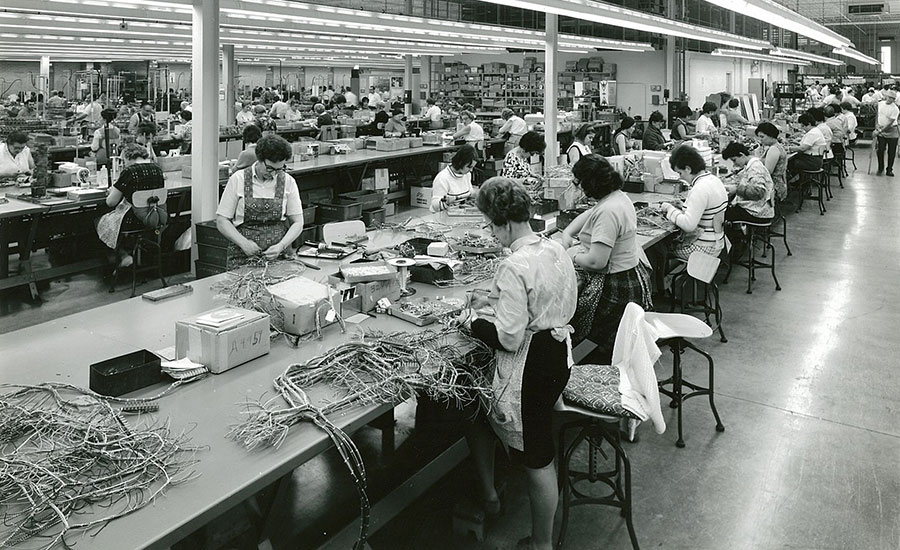
This view from the early 1970s shows pinball machine wiring harnesses being assembled at the Gottlieb factory in Northlake, IL. Photo courtesy A. Epstein and Sons Inc.
For more information on Chicago manufacturing, read these articles: