Automotive
Automotive Manufacturers Expand AI Use in Assembly Operations
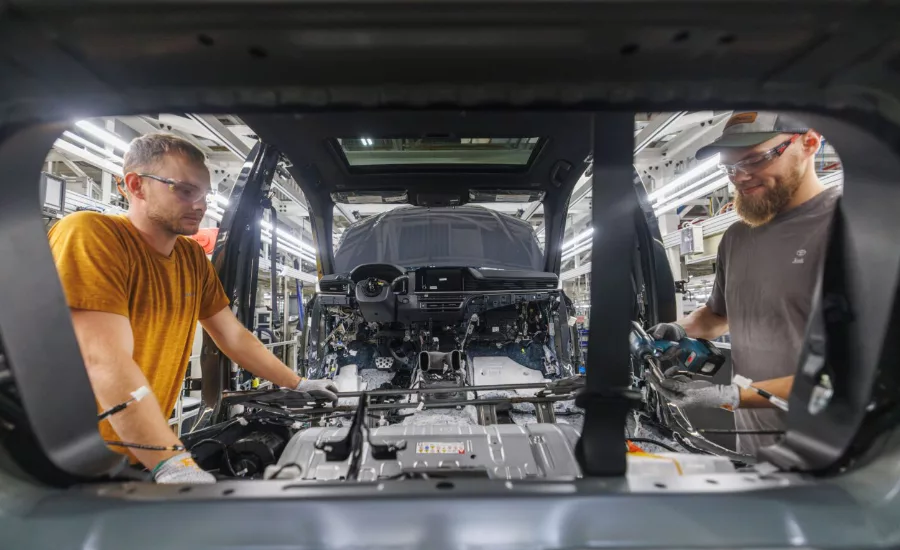
BIRMINGHAM, Mich. — Automotive manufacturers are expanding AI and automation deeper into assembly, validation, inspection and production coordination as mixed powertrains and rising electronics content make vehicle production more complex, according to a new report from Rockwell Automation and the Center for Automotive Research.
The report, “Smart Manufacturing in Automotive: Deployment and Impact,” says automakers and suppliers already have high levels of automation in traditional production areas, but the next phase of adoption is moving into processes that have been harder to automate, including electronics assembly, validation, production coordination and logistics.
The report says manufacturers are under pressure from more complex production environments, ongoing warranty issues, rising costs and global competition. Flexible powertrain strategies, with internal combustion, hybrid and battery-electric vehicles produced on the same assembly lines, have increased the number of process parameters, calibration steps, validation requirements and potential failure points that plants must manage.
AI and machine learning are being used to improve inspection accuracy, predictive maintenance and system performance across existing operations. The report says manufacturers have reported reductions in unplanned downtime of up to 50% in select applications, overall equipment effectiveness improvements of about 5% and throughput gains of 5% to 7% from real-time production analytics.
“The industry has built a strong automation foundation. What is changing now is how manufacturers are using AI and data to manage growing complexity, improve decision-making, and create competitive advantage,” said Edgar Faler, principal mobility analyst and strategy lead at CAR. “Those that move faster are starting to see measurable advantages.”
The report says quality processes are moving closer to the point of production. AI-enabled vision systems, automated electronics validation, in-line anomaly detection and traceability tools are helping manufacturers identify problems earlier and link process parameters to specific vehicle or component builds.
Production coordination also is becoming a target for AI and connected systems. Scheduling, sequencing and disruption response have often depended on experienced production supervisors, but AI and machine learning tools are beginning to support routing, logistics response and production recovery in real time.
Looking for quick answers on assembly and manufacturing topics? Try Ask ASM, our new smart AI search tool. Ask ASM
“Manufacturers are being asked to do more with less while managing greater complexity,” said James Glasson, vice president of global industry for automotive, tire and advanced mobility at Rockwell Automation. “The combination of automation and AI is helping teams identify issues earlier, reduce downtime and improve performance across plants. The difference now is how effectively companies scale these capabilities.”
The report says a performance divide is emerging across the automotive supply base. Large Tier 1 suppliers with global operations and dedicated manufacturing engineering resources generally are further along in deployment, while mid-sized and smaller suppliers face more difficulty adopting smart manufacturing technologies.
According to the report, automakers are increasingly weighing automation capability and manufacturing consistency alongside cost, quality history and capacity in future sourcing decisions.
The report also says onshored production will be more automated and data-intensive than the production that left. Manufacturers planning domestic production moves will need to account for workforce development, facility design and capital investment as automation becomes more central to cost-competitive manufacturing.
Looking for a reprint of this article?
From high-res PDFs to custom plaques, order your copy today!