Assembly In Action: Fastener Lessens Weight of Prototype Military Vehicle
When designing military ground vehicles, lighter is always better. Engineers in the U.S. military are well aware of the challenge of reducing
weight, particularly for the next generation of military vehicles still in
development. One such vehicle is the Joint Light Tactical Vehicle or JLTV.
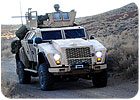
Most military vehicles have more than 15,000 fasteners.
When designing military ground vehicles, lighter is always better-for both fuel efficiency and tactical mobility. Every extra ounce of weight requires more fuel, which is costly and may be difficult to supply in remote locations. Excess weight can even threaten a vehicle’s viability for tactical objectives, such as airborne transport to a drop zone.
Engineers in the U.S. military are well aware of the challenge of reducing weight, particularly for the next generation of military vehicles still in development. One such vehicle is the Joint Light Tactical Vehicle or JLTV. Designed for the U.S. Army and Marine Corps, the JLTV must be light enough to be transported by helicopter or C-130 aircraft. In addition, the JLTV must be durable enough to withstand the shock and vibration of off-road driving and battlefield conditions.
While designing a prototype of the JLTV, engineers hoped to reduce its weight by using fewer fasteners. Most military vehicles have more than 15,000 fasteners, including nuts, bolts, washers, lock wires, cotter pins, brackets or other secondary locking features. When a fastener loses its clamp load, it no longer does its job and safety issues occur. Locking devices are commonly added to retain clamp load, but do not always hold up under shock, vibration, or temperature extremes.
 Eliminating
the weight and complexity of secondary locking features in the JLTV was an
additional challenge for the vehicle engineers. To meet both challenges, the
engineers are using the Spiralock locking fastener. This fastener has a
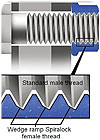
re-engineered thread form, which adds a 30-degree wedge ramp at the root of the
thread and mates with standard 60-degree male thread
fasteners.
Eliminating
the weight and complexity of secondary locking features in the JLTV was an
additional challenge for the vehicle engineers. To meet both challenges, the
engineers are using the Spiralock locking fastener. This fastener has a
re-engineered thread form, which adds a 30-degree wedge ramp at the root of the
thread and mates with standard 60-degree male thread
fasteners.
Traditional locking fasteners have a 60-degree thread form with a gap between the crest of the male and female threads that can lead to vibration-induced loosening. In contrast, the Spiralock fastener’s wedge ramp allows the bolt to spin freely relative to female threads until clamp load is applied.
The crests of the standard male thread form are then drawn tightly against the wedge ramp, eliminating radial clearances and creating a continuous spiral line of contact along the entire length of the thread engagement. This continuous line of contact spreads the clamp force more evenly over all engaged threads, improving resistance to vibrational loosening, axial-torsional loading, joint fatigue and temperature extremes.
The fastener reduces thread galling, or microwelding, and it can be reused up to 50 times, simplifying installation and maintenance. In addition, the fastener retains clamp load even with dissimilar exotic materials, such as composites and titanium.
By using the Spiralock fastener, engineers reduced vehicle weight by 20 to 40 pounds. Weight savings came from eliminating secondary locking features, and reducing the number and size of fasteners used to assemble the vehicle. Despite the reductions, the safety margins on assembled joints are equal or better than joints assembled with standard 60-degree thread form fasteners.
Besides the JLTV, the fastener has been used for military and aerospace applications by such organizations as Oshkosh Truck, BAE, Boeing, Honeywell, NASA, Raytheon, Rocketdyne and Hamilton Sundstrand. Uses include aircraft cockpit instruments and actuators, missile and space shuttle engines, the Saturn Cassini orbiter and Titan Huygens probe, and clamps for circuit boards and generator cables. The fastener is also being used in medical implants, artificial limbs and heart pumps.
For more information on locking fasteners, call 800-521-2688 or visit www.spiralock.com.
Most military vehicles have more than 15,000 fasteners.
When designing military ground vehicles, lighter is always better-for both fuel efficiency and tactical mobility. Every extra ounce of weight requires more fuel, which is costly and may be difficult to supply in remote locations. Excess weight can even threaten a vehicle’s viability for tactical objectives, such as airborne transport to a drop zone.
Engineers in the U.S. military are well aware of the challenge of reducing weight, particularly for the next generation of military vehicles still in development. One such vehicle is the Joint Light Tactical Vehicle or JLTV. Designed for the U.S. Army and Marine Corps, the JLTV must be light enough to be transported by helicopter or C-130 aircraft. In addition, the JLTV must be durable enough to withstand the shock and vibration of off-road driving and battlefield conditions.
While designing a prototype of the JLTV, engineers hoped to reduce its weight by using fewer fasteners. Most military vehicles have more than 15,000 fasteners, including nuts, bolts, washers, lock wires, cotter pins, brackets or other secondary locking features. When a fastener loses its clamp load, it no longer does its job and safety issues occur. Locking devices are commonly added to retain clamp load, but do not always hold up under shock, vibration, or temperature extremes.
This locking fastener has a
re-engineered thread form, which adds a 30-degree wedge ramp at the root of the
thread and mates with standard 60-degree male thread fasteners. Photo courtesy
Spiralock.
Traditional locking fasteners have a 60-degree thread form with a gap between the crest of the male and female threads that can lead to vibration-induced loosening. In contrast, the Spiralock fastener’s wedge ramp allows the bolt to spin freely relative to female threads until clamp load is applied.
The crests of the standard male thread form are then drawn tightly against the wedge ramp, eliminating radial clearances and creating a continuous spiral line of contact along the entire length of the thread engagement. This continuous line of contact spreads the clamp force more evenly over all engaged threads, improving resistance to vibrational loosening, axial-torsional loading, joint fatigue and temperature extremes.
The fastener reduces thread galling, or microwelding, and it can be reused up to 50 times, simplifying installation and maintenance. In addition, the fastener retains clamp load even with dissimilar exotic materials, such as composites and titanium.
By using the Spiralock fastener, engineers reduced vehicle weight by 20 to 40 pounds. Weight savings came from eliminating secondary locking features, and reducing the number and size of fasteners used to assemble the vehicle. Despite the reductions, the safety margins on assembled joints are equal or better than joints assembled with standard 60-degree thread form fasteners.
Besides the JLTV, the fastener has been used for military and aerospace applications by such organizations as Oshkosh Truck, BAE, Boeing, Honeywell, NASA, Raytheon, Rocketdyne and Hamilton Sundstrand. Uses include aircraft cockpit instruments and actuators, missile and space shuttle engines, the Saturn Cassini orbiter and Titan Huygens probe, and clamps for circuit boards and generator cables. The fastener is also being used in medical implants, artificial limbs and heart pumps.
For more information on locking fasteners, call 800-521-2688 or visit www.spiralock.com.
Looking for a reprint of this article?
From high-res PDFs to custom plaques, order your copy today!