Assembly Magazine logo
search
Ask ASSEMBLY AI
cart
facebook twitter linkedin youtube
  • Sign In
  • Create Account
  • Sign Out
  • My Account
Assembly Magazine logo
  • TRENDS
    • Ask ASSEMBLY AI
    • Trends
    • News
    • New Products
  • INDUSTRIES
    • Aerospace
    • Appliance
    • DFMA Assembly
    • Medical Devices
    • Green Manufacturing
    • Lean Manufacturing
    • Machinery Assembly
    • Electronics Assembly
    • Automotive
  • TECHNOLOGIES
    • Adhesives & Dispensing
    • Assembly Presses
    • Automated Assembly Systems
    • Manufacturing Management
    • Manufacturing Software
    • Motion Control
    • Screwdriving & Riveting
    • Robotics
    • Test & Inspection
    • Plastics & Metal Welding
    • Wire Processing
    • Workstations
  • AUTONOMOUS & ELECTRIC MOBILITY
    • AEM Magazine Archives
    • Autonomy
    • Electrification
    • Mobility Services
    • Assembly & Testing
    • AV/EM News
  • MEDIA
    • Ask ASSEMBLY AI
    • Podcasts
    • Assembly News Now
    • Assembly TV
    • Webinars
    • eBooks
  • EVENTS
    • Calendar
    • The ASSEMBLY Show
  • MORE
    • Exclusives >
      • Plant of the Year
      • Capital Spending
    • Buyers Guide >
      • Supplier Insights
    • Classifieds
    • Featured Products
    • Newsletters
    • Store
    • White Papers
    • Columns
    • Sponsor Insights
  • INFOCENTER
    • Assembly & Test Solutions
  • EMAGAZINE
    • eMagazine
    • Archive Issues
    • Advertise
    • Contact Us
    • Sign Up
Robotics Assembly

advertisement

How To Select a Robotic Tool Changer
ati
ati
ati
ati
April 27, 2017

The Purpose of a Robotic Tool Changer

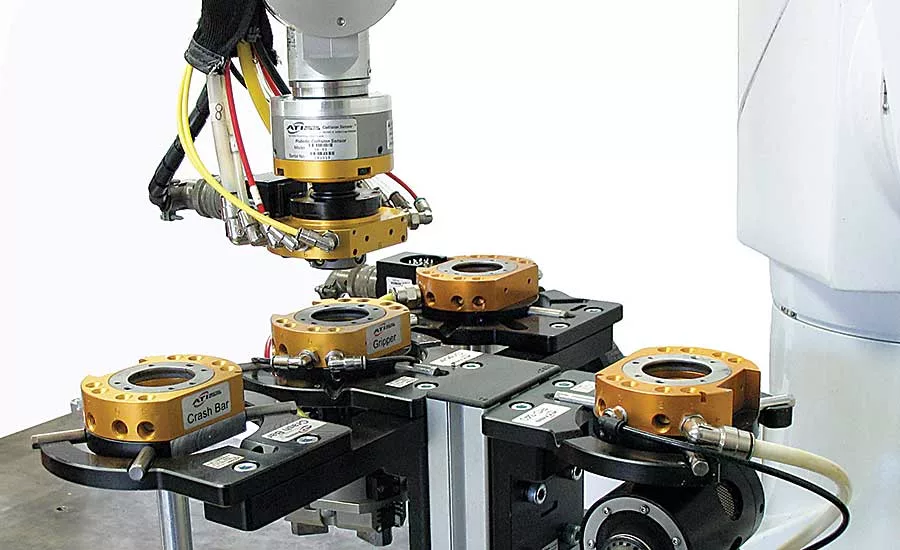
Robotic tool changers provide flexibility to robotic applications by enabling the robot to change end-effectors automatically (e.g.; grippers, vacuum cup tooling, pneumatic and electric motors, weld guns, etc.). Tool changers consist of a master plate, which is mounted to the robot arm, and a tool plate, which is mounted to the end-effector. The tool changer passes utilities such as pneumatics, electrical signals, fluids, and more from the robot arm to the end-effector.

Benefits of Using a Robotic Tool Changer

  • Production lines are changed over in seconds instead of hours.
  • Tools are quickly changed for maintenance and repair, drastically reducing downtime.
  • Flexibility is maximized by using more than one end-effector in an application.
  • Tooling is simplified by replacing heavy and large multi-tool end-effectors with individual tools that are automatically exchanged.

Selecting the Proper Robotic Tool Changer

A key feature to look for when selecting a robotic tool changer is a reliable and repeatable locking mechanism to lock the master plate to the tool plate. Another very important feature to consider is a fail-safe mechanism (preferably one that does not use a spring) to ensure the tool stays coupled to the master in the event that air pressure or power is lost. Tool changers have a payload rating which is compared to the weight of the end-effector and the payload capacity of the robot. Selecting a tool changer based on payload alone will provide a starting point, but the most important factor is moment capacity.

Calculating the Static Moment Load

The most accurate selection of a tool changer model is made by calculating the static moment load of the end-effector.

Looking for quick answers on assembly and manufacturing topics? Try Ask ASM, our new smart AI search tool. Ask ASM →

Use the following to approximate the worst-case static moment:

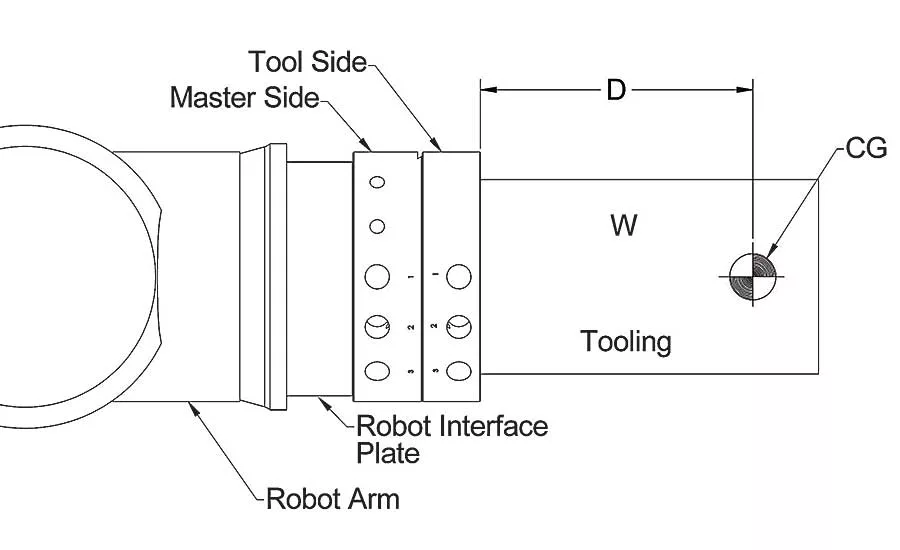
a) Find the approximate center-of-gravity (CG) of the heaviest end-effector to be used.

b) Calculate the distance (D) from the CG to the mounting face of the tool plate (example right).

c) Calculate the weight (W) of the heaviest end-effector.

d) Multiply W by D to get an approximate static moment (M) (or a moment based on one G of acceleration).

e) Select a tool changer with a static moment capacity equal to or greater than M.

Typical robot motion produces moments two to three times higher than the calculated static moment (M) due to their high acceleration. In order to ensure proper functionality and longevity, the selected tool changer must be designed to handle dynamic moments three times higher than their static moment ratings.

Selecting Appropriate Utility Modules and Accessories

Once a tool changer model is selected, it is necessary to determine what utilities must be passed from the robot, through the tool changer, to the end-effector. These may include, but are not limited to: pneumatics, electrical signals, fluids, high power for welding, field bus such as DeviceNet, Ethernet, or PROFINET, servo power and signals, ultrasonic, or hydraulics. Some tool changers are designed to pass utilities through the body, while other utilities are passed through attached modules.

Conclusion

Robotic tool changers save money by increasing robotic productivity and flexibility. They increase run time by facilitating automatic tooling changes and increase manufacturing efficiency. Tool changers minimize downtime by expediting tooling maintenance and replacement. They provide a seamless transition and introduction of new tooling, while minimizing equipment idle time. Selecting a tool changer model and configuration requires application-specific information about the load created by the end-effector and its required utilities. Suppliers can assist with load calculation, tool changer model selection, and utility module selection.

For more information, visit ATI Industrial Automation at www.ati-ia.com

Share This Story

Looking for a reprint of this article?
From high-res PDFs to custom plaques, order your copy today!

Recommended Content

JOIN TODAY
To unlock your recommendations.

Already have an account? Sign In

  • Made in the U.S.A.

    Consumer Products Manufacturing: Made in the USA

    Supply chain lessons learned during the coronavirus...
    Automated Assembly Systems
    By: Austin Weber
  • Best Practices for Press-Fit Assembly

    Best Practices for Press-Fit Assembly

    In manufacturing, ironclad formulas for success are hard...
    Assembly Presses
    By: Jim Camillo
  • aem0523leader-tesla1.jpg

    Tesla Rethinks the Assembly Line

    Engineers at Tesla Inc. have developed a new process that...
    Automotive Assembly
    By: Austin Weber
Manage My Account
  • eMagazine Subscription
  • Assembly Newsletters
  • Online Registration
  • Subscription Customer Service
  • Manage My Preferences

More Videos

Sponsored Content

Sponsored Content is a special paid section where industry companies provide high quality, objective, non-commercial content around topics of interest to the ASSEMBLY audience. All Sponsored Content is supplied by the advertising company and any opinions expressed in this article are those of the author and not necessarily reflect the views of ASSEMBLY or its parent company, BNP Media. Interested in participating in our Sponsored Content section? Contact your local rep!

close
  • ultrasonic welding
    Sponsored bySonobond Ultrasonics

    Engineering Efficiency in High-Performance Assembly: How Ultrasonic Welding Enhances Throughput, Reliability and Quality

  • UV curing system
    Sponsored byDymax

    Why UV Intensity Alone Doesn’t Define Curing Performance

  • wooden pallets
    Sponsored byLEAN Manufacturing Products

    Eliminating Waste on the Shop Floor: Applying Lean Principles to Improve Manufacturing Efficiency

Popular Stories

Ferrari

Ferrari Unveils Four-Door EV

ASSEMBLY News Now, episode-30: Volvo Redesigns EV Manufacturing

Volvo Redesigns EV Manufacturing

Robots working at Toyota Plant in Japan

Toyota Deploys Geekplus Robots for Factory Material Handling

Watch the latest episode of ANN now!

Events

July 24, 2025

From Shop Floor to CFO: How Manufacturers Are Closing the Loop Between Operations and Finance

On Demand Learn how manufacturers are bridging the gap between the shop floor and ERP systems to gain real-time visibility, streamline operations, and kick-start digital transformation—without waiting years.

Sponsored by:

PicoStratusGreen
July 30, 2025

Buffer Analysis and Design Fundamentals for Manufacturing Excellence

On Demand In this presentation, Dr. Herman Tang shares practical insights from his industry experience and research on buffer management in manufacturing operations.

View All Submit An Event

Poll

Difficult Assembly Processes

Which assembly process gives you the most difficulty?
View Results Poll Archive

Products

Manufacturing Cost Policy Deployment (MCPD) Profitability Scenarios: Systematic and Systemic Improvement of Manufacturing Costs

Manufacturing Cost Policy Deployment (MCPD) Profitability Scenarios: Systematic and Systemic Improvement of Manufacturing Costs

See More Products
ebook

Related Products

See More Products
  • leaner

    Leaner Manufacturing: How to Make the Lean Production Process Easier, Faster, and More Cost-Effective

  • pocket.jpg

    How To Implement Lean Manufacturing, Second Edition

  • Kaizen Assembly: Designing, Constructing, and Managing a Lean Assembly Line

See More Products

Related Directories

  • HowToRobot

  • IPR Robotics LLC

    IPR Robotics offers an extensive range of products with innovative systems and components for assembly and handling technology. Our grippers, tool changers, alignment devices and load limiters, 7th-axis and customized solutions are used confidently by customers worldwide. Quality, technical expertise and industry knowledge are our most important factors for success.
×

Never miss the latest news and trends driving the manufacturing industry

Stay in the know on the latest assembly trends.

JOIN TODAY!
  • RESOURCES
    • Advertise
    • Contact Us
    • Directories
    • Manufacturing Division
    • Store
    • Want More?
  • SIGN UP TODAY
    • Create Account
    • eMagazine
    • Newsletters
    • Customer Service
    • Manage Preferences
  • SERVICES
    • Marketing Services
    • Reprints
    • Market Research
    • List Rental
    • Survey/Respondent Access
  • STAY CONNECTED
    • LinkedIn
    • Facebook
    • Instagram
    • YouTube
    • X (Twitter)
  • PRIVACY
    • PRIVACY POLICY
    • TERMS & CONDITIONS
    • DO NOT SELL MY PERSONAL INFORMATION
    • PRIVACY REQUEST
    • ACCESSIBILITY

Copyright ©2026. All Rights Reserved BNP Media, Inc. and BNP Media II, LLC.

Design, CMS, Hosting & Web Development :: ePublishing