Assembly Magazine logo
search
Ask ASSEMBLY AI
cart
facebook twitter linkedin youtube
  • Sign In
  • Create Account
  • Sign Out
  • My Account
Assembly Magazine logo
  • TRENDS
    • Ask ASSEMBLY AI
    • Trends
    • News
    • New Products
  • INDUSTRIES
    • Aerospace
    • Appliance
    • DFMA Assembly
    • Medical Devices
    • Green Manufacturing
    • Lean Manufacturing
    • Machinery Assembly
    • Electronics Assembly
    • Automotive
  • TECHNOLOGIES
    • Adhesives & Dispensing
    • Assembly Presses
    • Automated Assembly Systems
    • Manufacturing Management
    • Manufacturing Software
    • Motion Control
    • Screwdriving & Riveting
    • Robotics
    • Test & Inspection
    • Plastics & Metal Welding
    • Wire Processing
    • Workstations
  • AUTONOMOUS & ELECTRIC MOBILITY
    • AEM Magazine Archives
    • Autonomy
    • Electrification
    • Mobility Services
    • Assembly & Testing
    • AV/EM News
  • MEDIA
    • Ask ASSEMBLY AI
    • Podcasts
    • Assembly News Now
    • Assembly TV
    • Webinars
    • eBooks
  • EVENTS
    • Calendar
    • The ASSEMBLY Show
  • MORE
    • Exclusives >
      • Plant of the Year
      • Capital Spending
    • Buyers Guide >
      • Supplier Insights
    • Classifieds
    • Featured Products
    • Newsletters
    • Store
    • White Papers
    • Columns
    • Sponsor Insights
  • INFOCENTER
    • Assembly & Test Solutions
  • EMAGAZINE
    • eMagazine
    • Archive Issues
    • Advertise
    • Contact Us
    • Sign Up
Assembly Breaking News

Tohoku University Research Group Achieves Breakthrough in Robotics
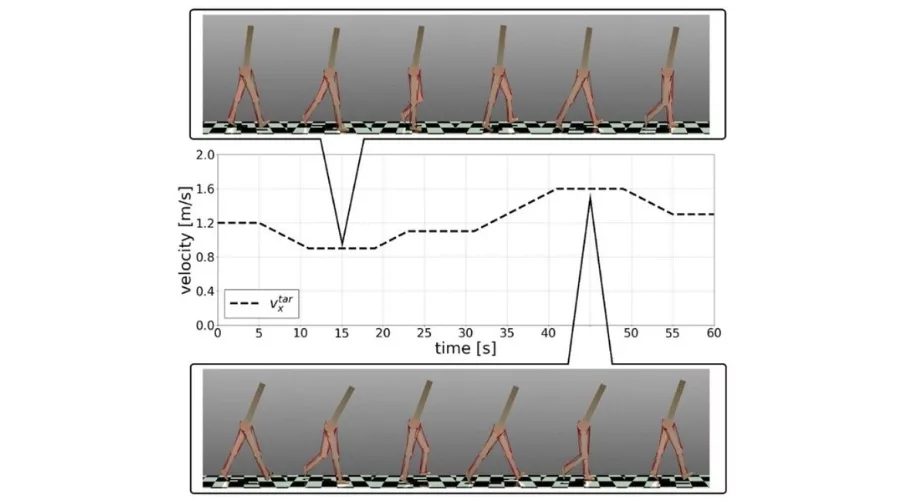
Tohoku University - 900 x 500.jpg
Illustration courtesy Tohoku University

Walking simulation that accurately changes velocity in response to an input target velocity (vxtar) using a musculoskeletal model that mimics a human. The existing reflex control framework could not accurately change the walking speed. Photo courtesy Tohoku University

January 23, 2024

SENDAI, Japan—On January 19, 2024, PLoS Computational Biology published a study titled Identifying essential factors for energy-efficient walking control across a wide range of velocities in reflex-based musculoskeletal systems by a research group from the Tohoku University Graduate School of Engineering. 

The research group has replicated human-like variable speed walking using a musculoskeletal model - one steered by a reflex control method reflective of the human nervous system. It's a breakthrough in biomechanics and robotics that sets a new benchmark in understanding human movement and paves the way for innovative robotic technologies. Replicating this in robotic technologies is no small feat.

"Our study has tackled the intricate challenge of replicating efficient walking at various speeds - a cornerstone of the human walking mechanism," points out Associate Professor Dai Owaki, and co-author of the study along with Shunsuke Koseki and Professor Mitsuhiro Hayashibe. "These insights are pivotal in pushing the boundaries for understanding human locomotion, adaptation, and efficiency."

The achievement was thanks to an innovative algorithm. The algorithm evolved beyond the conventional least squares method and helped devise a neural circuit model optimized for energy efficiency over diverse walking speeds. Intensive analysis of these neural circuits, particularly those controlling the muscles in the leg swing phase, unveiled critical elements of energy-saving walking strategies. These revelations enhance our grasp of the complex neural network mechanisms that underpin human gait and its effectiveness.

Owaki stresses that the knowledge uncovered in the study will help lay the groundwork for future technological advancements. "The successful emulation of variable-speed walking in a musculoskeletal model, combined with sophisticated neural circuitry, marks a pivotal advancement in merging neuroscience, biomechanics, and robotics. It will revolutionize the design and development of high-performance bipedal robots, advanced prosthetic limbs, and state-of-the-art- powered exoskeletons."

Such developments could improve mobility solutions for individuals with disabilities and advance robotic technologies used in everyday life.

A schematic overview of the proposed optimization algorithm (PWLS). The plotted data points show the relationship between control parameter values and reproduced walking speeds. If the function expressing this relationship was obtained using the general least squares method, the data generating energy-efficient and non-energy-efficient gait are not distinguished and treated with the same evaluation. In the proposed PWLS, by adding weights based on evaluation values (energy efficiency) to the data points that generate energy-efficient walking, it is possible to obtain the relationship between the walking speed and the control parameters that realize highly efficient walking and to construct a neural circuit model that enables the generation of more energy-efficient walking.

Looking ahead, Owaki and his team hope to further refine the reflex control framework to recreate a broader range of human walking speeds and movements. They also plan to apply the insights and algorithms from the study to create more adaptive and energy-efficient prosthetics, powered suits, and bipedal robots. This includes integrating the identified neural circuits into these applications to enhance their functionality and naturalness of movement.

Looking for quick answers on assembly and manufacturing topics? Try Ask ASM, our new smart AI search tool. Ask ASM →

Share This Story

Looking for a reprint of this article?
From high-res PDFs to custom plaques, order your copy today!

Recommended Content

JOIN TODAY
To unlock your recommendations.

Already have an account? Sign In

  • Made in the U.S.A.

    Consumer Products Manufacturing: Made in the USA

    Supply chain lessons learned during the coronavirus...
    Automated Assembly Systems
    By: Austin Weber
  • Best Practices for Press-Fit Assembly

    Best Practices for Press-Fit Assembly

    In manufacturing, ironclad formulas for success are hard...
    Assembly Presses
    By: Jim Camillo
  • aem0523leader-tesla1.jpg

    Tesla Rethinks the Assembly Line

    Engineers at Tesla Inc. have developed a new process that...
    Assembly and Testing
    By: Austin Weber
Manage My Account
  • eMagazine Subscription
  • Assembly Newsletters
  • Online Registration
  • Subscription Customer Service
  • Manage My Preferences

More Videos

Sponsored Content

Sponsored Content is a special paid section where industry companies provide high quality, objective, non-commercial content around topics of interest to the ASSEMBLY audience. All Sponsored Content is supplied by the advertising company and any opinions expressed in this article are those of the author and not necessarily reflect the views of ASSEMBLY or its parent company, BNP Media. Interested in participating in our Sponsored Content section? Contact your local rep!

close
  • ultrasonic welding
    Sponsored bySonobond Ultrasonics

    Engineering Efficiency in High-Performance Assembly: How Ultrasonic Welding Enhances Throughput, Reliability and Quality

  • UV curing system
    Sponsored byDymax

    Why UV Intensity Alone Doesn’t Define Curing Performance

  • wooden pallets
    Sponsored byLEAN Manufacturing Products

    Eliminating Waste on the Shop Floor: Applying Lean Principles to Improve Manufacturing Efficiency

Popular Stories

ASSEMBLY News Now, episode-30: Volvo Redesigns EV Manufacturing

Volvo Redesigns EV Manufacturing

Boeing CEO Kelly Ortberg announces 1 billion investment

Boeing Plans $1 Billion Wichita Investment, Workforce Training Center

GE Appliances Worker on Line

GE Appliances Expands Factory AI With 800 Gemini Enterprise Agents

Watch the latest episode of ANN now!

Events

July 24, 2025

From Shop Floor to CFO: How Manufacturers Are Closing the Loop Between Operations and Finance

On Demand Learn how manufacturers are bridging the gap between the shop floor and ERP systems to gain real-time visibility, streamline operations, and kick-start digital transformation—without waiting years.

Sponsored by:

PicoStratusGreen
July 30, 2025

Buffer Analysis and Design Fundamentals for Manufacturing Excellence

On Demand In this presentation, Dr. Herman Tang shares practical insights from his industry experience and research on buffer management in manufacturing operations.

View All Submit An Event

Poll

Difficult Assembly Processes

Which assembly process gives you the most difficulty?
View Results Poll Archive

Products

Manufacturing Cost Policy Deployment (MCPD) Profitability Scenarios: Systematic and Systemic Improvement of Manufacturing Costs

Manufacturing Cost Policy Deployment (MCPD) Profitability Scenarios: Systematic and Systemic Improvement of Manufacturing Costs

See More Products
Register for webinar - Modernizing Automotive Assembly: Why Upgrading Legacy MES is a Business Imperative

Related Articles

  • IFR Report Updates How Nations Invest in Robotics Research

    See More
  • Researchers Claim Breakthrough in Bonding Mixed Materials

    See More

Related Products

See More Products
  • handbook of digital.jpg

    Handbook of Digital Innovation, Transformation, and Sustainable Development in a Post-Pandemic Era

  • investment.jpg

    Investment Decisions in Advanced Manufacturing Technology

  • 9780367532604.jpg

    Nature-Inspired Optimization in Advanced Manufacturing Processes and Systems

See More Products

Related Directories

  • Universal Robots USA Inc.

    Universal Robots aims to empower change in the way work is done using its leading-edge robotics platform. Since introducing the world's first commercially viable collaborative robot (cobot) in 2008, UR has worked with partners to develop a product portfolio used across a wide range of industries and diverse tasks. The company, which is part of Teradyne Inc., is headquartered in Odense, Denmark with 22 offices and over 700 employees worldwide. Universal Robots has installed over 50,000 cobots.
  • One-Off Robotics

    One-Off Robotics is an advanced equipment manufacturer designing and building the world's most innovative robotic fabrication systems. We specialize in robotic metal additive manufacturing and robotic milling, offering both stationary and portable, field-deployable systems engineered for demanding production environments. Our technologies enable additive, subtractive, and hybrid fabrication processes, supporting applications across Defense, Aerospace, Research, and Specialized Production sectors.
×

Never miss the latest news and trends driving the manufacturing industry

Stay in the know on the latest assembly trends.

JOIN TODAY!
  • RESOURCES
    • Advertise
    • Contact Us
    • Directories
    • Manufacturing Division
    • Store
    • Want More?
  • SIGN UP TODAY
    • Create Account
    • eMagazine
    • Newsletters
    • Customer Service
    • Manage Preferences
  • SERVICES
    • Marketing Services
    • Reprints
    • Market Research
    • List Rental
    • Survey/Respondent Access
  • STAY CONNECTED
    • LinkedIn
    • Facebook
    • Instagram
    • YouTube
    • X (Twitter)
  • PRIVACY
    • PRIVACY POLICY
    • TERMS & CONDITIONS
    • DO NOT SELL MY PERSONAL INFORMATION
    • PRIVACY REQUEST
    • ACCESSIBILITY

Copyright ©2026. All Rights Reserved BNP Media, Inc. and BNP Media II, LLC.

Design, CMS, Hosting & Web Development :: ePublishing