Assembly Magazine logo
search
Ask ASSEMBLY AI
cart
facebook twitter linkedin youtube
  • Sign In
  • Create Account
  • Sign Out
  • My Account
Assembly Magazine logo
  • TRENDS
    • Ask ASSEMBLY AI
    • Trends
    • News
    • New Products
  • INDUSTRIES
    • Aerospace
    • Appliance
    • DFMA Assembly
    • Medical Devices
    • Green Manufacturing
    • Lean Manufacturing
    • Machinery Assembly
    • Electronics Assembly
    • Automotive
  • TECHNOLOGIES
    • Adhesives & Dispensing
    • Assembly Presses
    • Automated Assembly Systems
    • Manufacturing Management
    • Manufacturing Software
    • Motion Control
    • Screwdriving & Riveting
    • Robotics
    • Test & Inspection
    • Plastics & Metal Welding
    • Wire Processing
    • Workstations
  • AUTONOMOUS & ELECTRIC MOBILITY
    • AEM Magazine Archives
    • Autonomy
    • Electrification
    • Mobility Services
    • Assembly & Testing
    • AV/EM News
  • MEDIA
    • Ask ASSEMBLY AI
    • Podcasts
    • Assembly News Now
    • Assembly TV
    • Webinars
    • eBooks
  • EVENTS
    • Calendar
    • The ASSEMBLY Show
  • MORE
    • Exclusives >
      • Plant of the Year
      • Capital Spending
    • Buyers Guide >
      • Supplier Insights
    • Classifieds
    • Featured Products
    • Newsletters
    • Store
    • White Papers
    • Columns
    • Sponsor Insights
  • INFOCENTER
    • Assembly & Test Solutions
  • EMAGAZINE
    • eMagazine
    • Archive Issues
    • Advertise
    • Contact Us
    • Sign Up
IndustriesAerospace Assembly

Ford’s Forgotten Chicago Assembly Plant
By Austin Weber
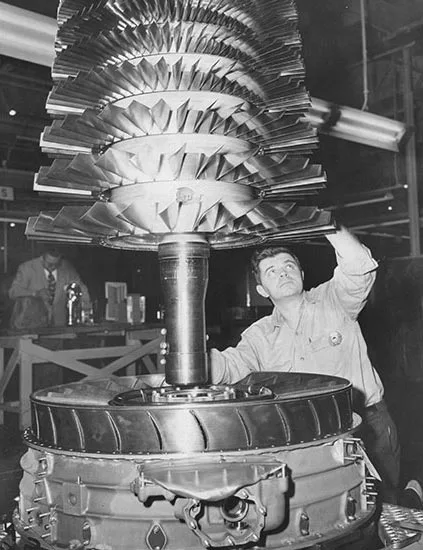
J57 aircraft engine being assembled at the Ford Aircraft Engine Division factory in Chicago
June 4, 2024

During the 1950s, Ford Motor Co. had two assembly plants in Chicago. In addition to the auto factory celebrating its centennial this year, the company operated an even larger facility which produced military aircraft engines. That chapter in history is long forgotten, but Ford’s manufacturing legacy lives on as the namesake of a popular shopping mall on the Southwest Side of Chicago.

The facility located at 7401 S. Cicero Ave. was originally built in 1942 by Chrysler’s Dodge Division to assemble Wright R-3350 Cyclone engines for the Boeing B-29 bomber.  Albert Kahn (the same architect behind the Ford Chicago Assembly Plant) designed the massive facility using new materials and construction techniques.

When it opened in 1943, the $173 million Dodge Chicago Plant comprised 6.3 million square feet of space spread out over 19 buildings. The main facility covered 82 acres and included air conditioning to support precision assembly processes.

The first aircraft engines came off the assembly line in January 1944 and production quickly ramped up to 1,600 units a month. At its peak, the factory operated around the clock and employed more than 10,000 people.

After World War II ended, the fledgling Tucker Corp. acquired the facility to assemble a revolutionary new automobile. The Tucker 48 featured three headlights, a rear-mounted engine and doors that cut into the roof to provide more headroom for passengers getting into or out of the vehicle. After only making 51 cars, the company went bankrupt in 1949 and the huge plant was shuttered.

The U.S. Air Force acquired the building and contracted with the Ford Aircraft Engine Division to assemble a 28-cylinder Pratt & Whitney reciprocating engine for use in bomber and cargo planes.

According to an article in the July 20, 1951, issue of the Chicago Tribune, the large facility included an aluminum foundry, a magnesium foundry and a forge equipped with a 5,000-pound metal stamping hammer and an 8,000-pound hammer. It also contained “6,200 machine tools required to make 227 parts that require more than 9,200 different operations.”

Looking for quick answers on assembly and manufacturing topics? Try Ask ASM, our new smart AI search tool. Ask ASM →

The article claimed the plant “has become one of the Chicago area’s larger employers, with about 6.500 on its payroll.” By 1955, the facility employed more than 10,000 people.

An article in the July 21, 1951, issue of the Chicago Tribune explained that the engines contained “about 2,000 parts of which 1,800 are being subcontracted to outside manufacturers, with up to 70 percent of those firms located in the Chicago area. Ford is producing larger engine parts, such as cylinder barrels, connecting arm, magnesium castings and propeller shafts.”

In early 1952, the U.S. Air Force awarded Ford a $30 million contract to build J57 Pratt & Whitney turbojet engines at the facility. They featured a dual-rotor axial-flow compressor (see photo above), which lowered fuel consumption over a wide operating range and improved the sluggish acceleration characteristic of previous jet engines.

The J57 was the first production jet engine to generate 10,000 pounds of thrust. The engines were used to power a variety of Cold War era military aircraft such as the Boeing B-52 bomber and the North American F-100 Super Sabre fighter.

In 1957, Ford proclaimed that the “mammoth 85-acre defense plant” was “the biggest under-one-roof factory in the United States.” However, it closed the facility in early 1959.

Two years later, the U.S. government sold the massive factory to a real estate developer who planned to open a shopping center. Some buildings were torn down to make room for a parking lot, but Ford City Mall opened in 1965 and still remains in operation today.

To learn more about other factories that made Chicago a production powerhouse in the 19th and 20th centuries, see Made in Chicago: The Windy City’s Manufacturing Heritage.

KEYWORDS: aircraft assembly assembly line history Chicago manufacturing Ford Motor Co. made in the USA manufacturing history World War II manufacturing

Share This Story

Looking for a reprint of this article?
From high-res PDFs to custom plaques, order your copy today!

Austinweber headshot
Austin has been senior editor for ASSEMBLY Magazine since September 1999. He has more than 21 years of b-to-b publishing experience and has written about a wide variety of manufacturing and engineering topics. Austin is a graduate of the University of Michigan.

Recommended Content

JOIN TODAY
To unlock your recommendations.

Already have an account? Sign In

  • Made in the U.S.A.

    Consumer Products Manufacturing: Made in the USA

    Supply chain lessons learned during the coronavirus...
    Automated Assembly Systems
    By: Austin Weber
  • Best Practices for Press-Fit Assembly

    Best Practices for Press-Fit Assembly

    In manufacturing, ironclad formulas for success are hard...
    Assembly Presses
    By: Jim Camillo
  • aem0523leader-tesla1.jpg

    Tesla Rethinks the Assembly Line

    Engineers at Tesla Inc. have developed a new process that...
    Electrification
    By: Austin Weber
Manage My Account
  • eMagazine Subscription
  • Assembly Newsletters
  • Online Registration
  • Subscription Customer Service
  • Manage My Preferences

More Videos

Sponsored Content

Sponsored Content is a special paid section where industry companies provide high quality, objective, non-commercial content around topics of interest to the ASSEMBLY audience. All Sponsored Content is supplied by the advertising company and any opinions expressed in this article are those of the author and not necessarily reflect the views of ASSEMBLY or its parent company, BNP Media. Interested in participating in our Sponsored Content section? Contact your local rep!

close
  • ultrasonic welding
    Sponsored bySonobond Ultrasonics

    Engineering Efficiency in High-Performance Assembly: How Ultrasonic Welding Enhances Throughput, Reliability and Quality

  • UV curing system
    Sponsored byDymax

    Why UV Intensity Alone Doesn’t Define Curing Performance

  • wooden pallets
    Sponsored byLEAN Manufacturing Products

    Eliminating Waste on the Shop Floor: Applying Lean Principles to Improve Manufacturing Efficiency

Popular Stories

Ferrari

Ferrari Unveils Four-Door EV

ASSEMBLY News Now, episode-30: Volvo Redesigns EV Manufacturing

Volvo Redesigns EV Manufacturing

Robots working at Toyota Plant in Japan

Toyota Deploys Geekplus Robots for Factory Material Handling

Watch the latest episode of ANN now!

Events

July 24, 2025

From Shop Floor to CFO: How Manufacturers Are Closing the Loop Between Operations and Finance

On Demand Learn how manufacturers are bridging the gap between the shop floor and ERP systems to gain real-time visibility, streamline operations, and kick-start digital transformation—without waiting years.

Sponsored by:

PicoStratusGreen
July 30, 2025

Buffer Analysis and Design Fundamentals for Manufacturing Excellence

On Demand In this presentation, Dr. Herman Tang shares practical insights from his industry experience and research on buffer management in manufacturing operations.

View All Submit An Event

Poll

Difficult Assembly Processes

Which assembly process gives you the most difficulty?
View Results Poll Archive

Products

Manufacturing Cost Policy Deployment (MCPD) Profitability Scenarios: Systematic and Systemic Improvement of Manufacturing Costs

Manufacturing Cost Policy Deployment (MCPD) Profitability Scenarios: Systematic and Systemic Improvement of Manufacturing Costs

See More Products
ebook

Related Articles

  • manufacturing Ford Crestline sedans and F-100 pickup trucks at the Chicago assembly plant

    Ford’s Chicago Assembly Plant Turns 100

    See More
  • Ford_Plant_Chicago_Torrence_Ave.jpg

    Ford to Invest $400 Million in Chicago Assembly Plant as Part of UAW Deal

    See More
  • Ford to Double Workforce at Chicago Assembly Plant

    See More
×

Never miss the latest news and trends driving the manufacturing industry

Stay in the know on the latest assembly trends.

JOIN TODAY!
  • RESOURCES
    • Advertise
    • Contact Us
    • Directories
    • Manufacturing Division
    • Store
    • Want More?
  • SIGN UP TODAY
    • Create Account
    • eMagazine
    • Newsletters
    • Customer Service
    • Manage Preferences
  • SERVICES
    • Marketing Services
    • Reprints
    • Market Research
    • List Rental
    • Survey/Respondent Access
  • STAY CONNECTED
    • LinkedIn
    • Facebook
    • Instagram
    • YouTube
    • X (Twitter)
  • PRIVACY
    • PRIVACY POLICY
    • TERMS & CONDITIONS
    • DO NOT SELL MY PERSONAL INFORMATION
    • PRIVACY REQUEST
    • ACCESSIBILITY

Copyright ©2026. All Rights Reserved BNP Media, Inc. and BNP Media II, LLC.

Design, CMS, Hosting & Web Development :: ePublishing