Robotics
Automated Bin-Picking: The Latest Way Automakers are Overcoming Manufacturing Challenges
New advancements in vision-guided robotics are enabling auto industry players to eliminate a lingering friction point in an otherwise highly automated, highly efficient process.
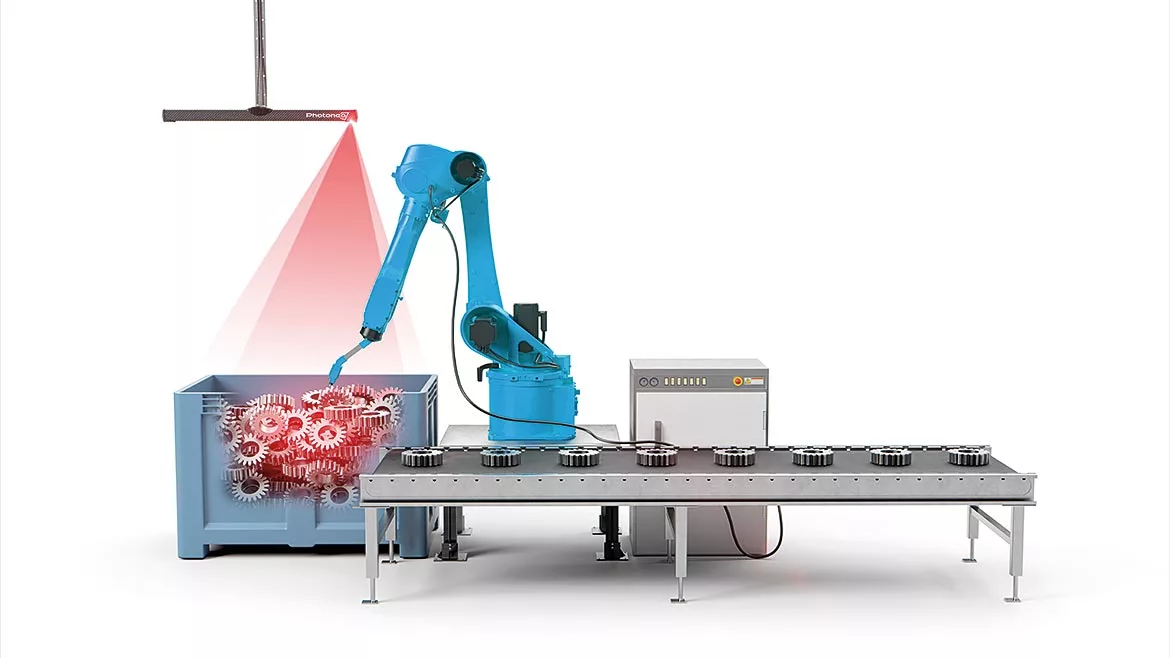
Image Source: Photoneo
Although manufacturers were among the earliest benefactors of robot automation, many of our automotive clients tell us that recent spikes in market demand, combined with rising costs and labor shortages, have created new challenges. This is compelling them to take a second look at how they’re using – or not yet using – this type of technology.
For example, there are still some friction points in otherwise highly automated manufacturing processes. Bin picking is one of them.
It’s difficult to maintain steady production tempos, much less control the pace, when there’s a person responsible for repeatedly reaching into a box to retrieve components or move car doors from the staging area to the line. The speed and consistency of each lift-and-shift action is unpredictable and uncontrollable due to the nature of human body performance. Yet, automakers need their entire production to be precisely timed. A delay at a single assembly point could cause issues both upstream and downstream.
Vision-guided robotics (VGR) is key to creating a more predictable and controllable workflow in production plants, with automated bin-picking at the heart of this critical process improvement.
Why Automated Bin-Picking is Becoming Such a Big Deal – and Priority Investment
Industry analysts predict significant growth in the bin-picking market, with projections suggesting bin-picking adoption will quadruple over the next four years. And there’s a good reason for that.
Automated bin-picking uses advanced vision systems to guide robots that can adapt seamlessly to variations in part orientation and position. With this type of VGR, it becomes easier to automate bin-picking at multiple assembly points and configure a single system to handle multiple components. This well-controlled automated process also minimizes the risk of picking errors while reducing manual labor costs.
Beyond improved accuracy and reduced operational expenses, this type of automation at critical assembly points significantly boosts both utilization rates and production throughput. By operating continuously without breaks or fatigue, robots equipped with advanced vision technology can process significantly more items per day than people can. The utilization rate of the follow-up system also improves as the bin picking system feeds more parts to the machine, ensuring the machine operates at higher efficiency. In our experience, this throughput increase typically ranges from 5-15%, depending on the specific workflow and operational tasks.
Looking for quick answers on assembly and manufacturing topics? Try Ask ASM, our new smart AI search tool. Ask ASM
VGR Efficiency and Limitations
Over my years at Photoneo, I realized that the efficiency of VGR in automotive manufacturing is most evident in three key applications:
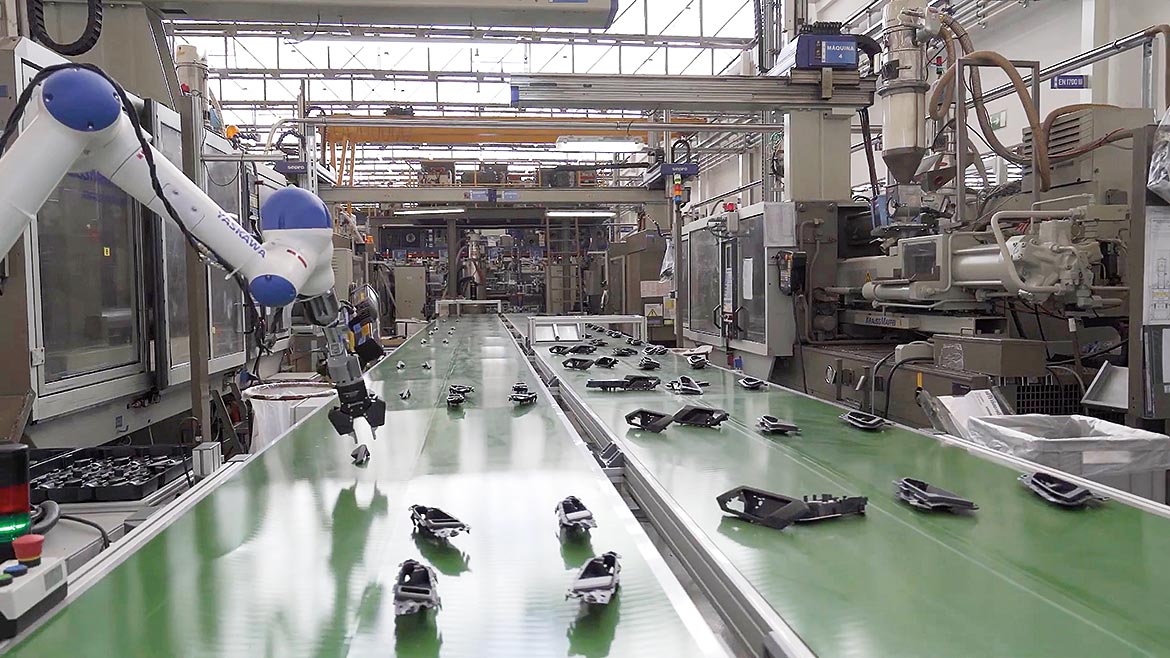
- Handling components: Automated bin-picking systems are vital in efficiently handling components such as brackets, fasteners, body panels, brake disks, bearings, bushings, or shafts. Even parts such as parcels and bags can be identified using AI-based localization, even though their shapes cannot be defined mathematically. Robots equipped with 3D vision are also adaptable to different shapes and sizes of components, allowing them to handle a wide range of parts without the need for extensive reconfiguration.
- Machine loading: Robotic bin-picking systems are widely used for machine-loading tasks, such as feeding parts into stamping or computer numerical control (CNC) machines. These systems offer exceptional flexibility in handling a wide range of shapes and sizes without the need for predefined positioning. Bin-picking systems also excel at managing heavy or irregularly shaped automotive parts, such as gears and engine components. Vision-guided automated processes minimize human error and reduce damage to parts, which is critical in applications requiring high precision. In some cases, the error rate decreases by up to 15%.
- Quality control: Advanced bin-picking systems go beyond simple picking by seamlessly integrating with quality control protocols. The robot can present the picked parts to an additional inspection camera from desired angles. This allows for real-time defect detection and removal, ensuring only perfect parts proceed to assembly. This in-process quality control has led to scrap and waste reduction, with some installations achieving a defect-rate reduction of up to 25%.
I should note, though, that we can see the adoption of VGR extending to all phases of automotive manufacturing in the coming years. We’re already seeing its use range from stamping to body shop, general assembly, and drivetrain production, all the way to inspection jobs.
However, it’s important to understand that not all automated or VGR bin-picking systems share the same capabilities. Manufacturers have reported several challenges and limitations with many traditional systems.
For example, accessing hard-to-reach items – such as those entangled with other parts or positioned in the corners of bins – can be difficult, especially as the bin empties. Such scenarios require sophisticated design and programming strategies to ensure efficient retrieval of even the most challenging components without compromising overall system performance. The good news is that proper gripper design and additional vibration of the bin can lead to nearly 100% bin-emptying rates.
Critical concerns have also been raised about the risk of collisions. The gripper must navigate carefully to avoid contacting the remaining objects in the bin. Achieving this requires precision in both hardware design and control algorithms.
Beyond Traditional Bin-Picking
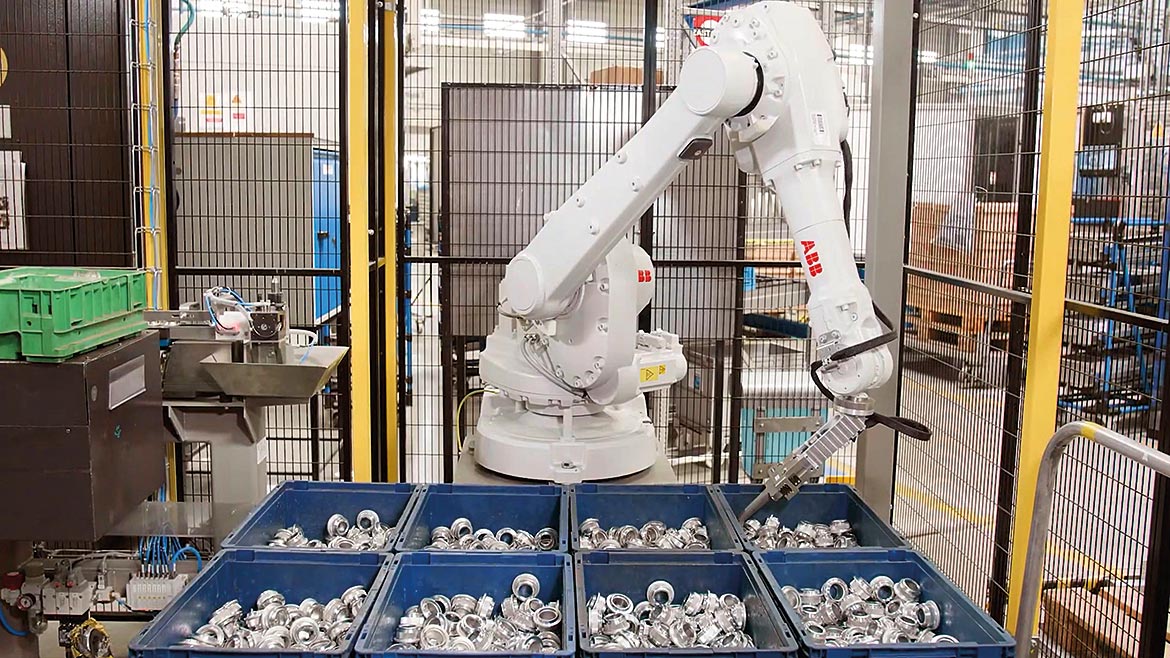
Modern bin-picking solutions are addressing many of these challenges experienced with legacy automation systems by integrating advanced technologies, such as path-planning algorithms and real-time obstacle avoidance systems. These innovations empower system integrators to dynamically adjust the robots' picking strategies, minimizing collision risks while maximizing the success rate of item retrieval.
For these systems to work effectively, however, the vision technologies integrated with the robotics system must overcome one of the most persistent challenges in bin-picking: ensuring reliable and accurate object pose estimation. Robots often struggle to correctly identify and localize thin, reflective, metallic, or irregularly shaped objects.
From my company’s experience, the key hurdle is the camera’s perspective. Traditional single-perspective scanning often fails to capture all necessary details, leading to missed parts and longer cycle times. To overcome this, my team developed a technology module that combines scans from multiple perspectives.
For instance, multiple static sensors can be calibrated to the primary sensor, allowing for sequential scans that cover the entire scene. A primary sensor is calibrated with the robot, while secondary sensors are aligned relative to the primary one. Each sensor captures data sequentially, creating a complete and detailed view of the object.
This approach excels at challenging localization, eliminating blind spots, reducing errors, and speeding up processes. It captures thin, C- or L-shaped metal sheets, shiny or reflective surfaces, bins with compartments, and even self-occluded objects that traditional methods struggle to handle. This way, we can assure a timely 100% rate of bin unloading, which is what automakers have been striving to achieve for many years with legacy automated or human-led bin picking. Addressing this one friction point alone will lead to significant gains in production capacity and output.
3D Scanning in Motion
In my opinion, the most versatile approach to automated bin-picking comes with scanning in motion.
Mounting a 3D camera on a robotic arm in a hand-eye configuration provides the flexibility to scan from virtually any angle. However, until recently, this approach had a major limitation: the robot needed to stop before each scan to ensure accurate data capture.
Thanks to recent advancements in 3D camera technology, cameras can now capture high-quality data while moving relative to the scene. This breakthrough eliminates the need for stops, allowing 3D cameras on robotic arms to perform VGR tasks seamlessly. As a result, tasks that were once impractical due to time constraints or complexity are now achievable. As the robotic arm moves, the sensor collects a continuous stream of 3D data, building a complete and accurate scene in real time. Imagine a bin with 20 compartments each housing a thin metallic part. With traditional scanners, the robot would need to stop and perform at least 40 individual scans, two for each compartment to estimate gripping points. In contrast, using scanning-in-motion technology allows the robot to capture 3D data seamlessly while moving, reducing the scanning cycle time by a factor of 10.
The Anticipated Long-Term Impact of Today’s VGR Systems
Advanced VGR systems are no longer a proof of concept confined to controlled environments. We have implemented numerous advanced bin-picking applications, including many on automotive manufacturing lines.
Our experience delivering VGR solutions to major OEMs and Tier 1 suppliers has shown us the reliability and scalability of bin-picking systems are paramount. They must be easy-to-deploy, have user-friendly interfaces, and include high-quality 3D sensors. That doesn’t diminish the importance of robot performance capabilities. However, the vision system must be of the highest quality to be able to effectively guide the robot, and automating bin-picking to reduce friction is futile if the system integration experience is full of friction.
If you prioritize the right things, you can expect similar gains to those reported by one of the large automakers we have worked with on automated bin-picking. When we first connected with the team here, it faced the challenge of automating a manual car body production process.
In the past, parts were stored loosely in containers on the floor, and workers would retrieve them for insertion into a jig. From there, an industrial robot would take over. The Volkswagen team sought to overcome drawbacks of manual labor by deploying a robot capable of directly picking parts from containers and inserting them into the jig, ensuring greater stability and repeatability in production.
To meet this need, we used a 3D scanner to analyze 3D CAD models of parts to determine their position and orientation. With this precise information, the robot was able to pick up the part, adjust its orientation with a gripper, and place it accurately into the jig. The team automated a bin-picking process using 3D sensors and a collaborative robot (cobot). The cobot can now empty four bins, each containing different parts.
What to Remember
If your production line is struggling to meet the demands of today’s fast-paced market, it might be worth a fresh look at the limitations of your current technology tools and the new capabilities and applications possible with advanced VGR, such as bin-picking. It may not be as difficult as it once was to remove these lingering friction points, and with robots poised to take on even more complex tasks in the years to come, you might find it easier than expected to minimize the impact of labor shortages on your production capacity and throughput.
Looking for a reprint of this article?
From high-res PDFs to custom plaques, order your copy today!