Young Engineers Tackle Robotic Wire Harness Assembly

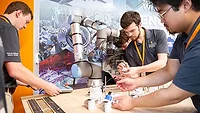
University of Tennessee engineers have developed a robotic wire harness assembly system. Photo courtesy University of Tennessee
Traditionally, automotive wire harness assembly has been a complex process that is labor intensive. However, a group of young engineers at the University of Tennessee are developing a robotic system. The goal is to help automakers and suppliers address labor shortages, rising production volumes, cost efficiency and quality control.
Working with engineers Nissan Group, the interdisciplinary senior design (ISD) team programmed a collaborative robot to automate wiring harness production.
“This is a project that hasn’t been done before,” claims Dylan Woods, an electrical engineering major. “There have been similar projects that have been attempted by different companies, but they’re not all the way complete.”
The wiring fabrication process for automobiles includes seven basic steps. Woods and his colleagues focused on two important tasks—terminal insertion and wire routing.
‘Basically, it’s making sure the end of the wire goes into the correct connector in the harness and then getting that through the correct path from point A to point B,” says Nathan LaCognata, a mechanical engineering major.
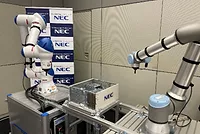
The team started by creating a software program that provides the robot with the information about where the connectors are located and where the wires need to go. Then, the program autogenerates a path for the robot.
“Both ends of the wires have to be inserted into two specific connectors, but there’s a general path the wire has to follow to make the subsequent taping of the harness easier,” explains Ethan Eisenhauer, a mechanical engineering major. “The program knows the location of the connectors and the pegs, and it’ll use that knowledge to generate an optimal path. That’s the software piece. Then, it’s about trying to integrate it so the robot can do it.”
Looking for quick answers on assembly and manufacturing topics? Try Ask ASM, our new smart AI search tool. Ask ASM
Throughout the nearly nine-month process, the ISD students held bi-weekly meetings with Aaron Hall, an engineer at Nissan’s flagship factory in Smyrna, TN.
“Engaging with teams from the University of Tennessee on real-world challenges through ISD projects offers significant benefits,” says Hall. “It brings fresh perspectives and innovative solutions to our projects, helps us build a talent pipeline by identifying and nurturing potential future employees, and enhances our brand visibility and reputation within the academic community.”
“Our work is the start of a multi-year project for Nissan,” adds Eisenhauer. “Once we prove that this process can be automated, [it] will refine and adapt our system to meet their needs. The goal will shift from proving that it’s possible to doing it as fast as possible.”
The ISD program includes students from UT’s Tickle College of Engineering and Haslam College of Business. They work closely with an industry liaison and faculty coaches to design and build real-world products.
Looking for a reprint of this article?
From high-res PDFs to custom plaques, order your copy today!