Scientists Build the World’s First Robotic Assembly Line for Cyborg Insects
.webp?t=1754072956)
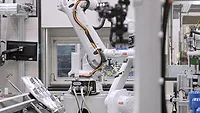
SINGAPORE—Researchers at Nanyang Technological University, Singapore (NTU Singapore) have unveiled an AI-powered “factory line” that automates the creation of cyborg insects—dramatically accelerating the once painstaking process of outfitting live cockroaches with electronic control systems.
Led by Professor Hirotaka Sato from NTU’s School of Mechanical and Aerospace Engineering and supported by Japan’s Moonshot R&D Programme, the project introduces a robotic system that identifies the ideal implantation site using computer vision and a proprietary algorithm, then affixes a lightweight electronic “backpack” in just 1 minute and 8 seconds. Compared to manual methods, which can take over an hour per insect. This system is up to 60 times faster.
In tests, the prototype processed four Madagascar hissing cockroaches in under eight minutes—roughly 30 times quicker than traditional techniques, marking a breakthrough for scalable deployment in real-world environments.
“Our innovation makes the dream of deploying large numbers of cyborg insects in real-life scenarios far more practical,” said Prof Sato. “By automating the process, we eliminate human error, improve consistency, and dramatically reduce preparation time—key factors in urgent missions like post-disaster search and rescue.”
The AI-guided insect-hybrids respond to mild electrical stimulation via electrodes connected to their nervous systems. NTU's latest backpack design also uses 25% less voltage, extending battery life and reducing overstimulation.
While the automated system is still in its prototype stage, cyborg insects outfitted manually have already been used in the field. In March 2025, 10 such insects were deployed with the Singapore Civil Defence Force (SCDF) during a humanitarian mission in Myanmar following a 7.7-magnitude earthquake.
The project reflects Prof Sato’s long-standing leadership in the field—his work has previously been featured in TIME and MIT Technology Review—and marks a critical first step toward the mass production and industrial readiness of biohybrid robotics for rescue, inspection, and future AI-integrated missions.
Backpacks can be removed safely after deployment, ensuring no lasting harm to the insects.
Looking for quick answers on assembly and manufacturing topics? Try Ask ASM, our new smart AI search tool. Ask ASM
Looking for a reprint of this article?
From high-res PDFs to custom plaques, order your copy today!