Assembly Magazine logo
search
Ask ASSEMBLY AI
cart
facebook twitter linkedin youtube
  • Sign In
  • Create Account
  • Sign Out
  • My Account
Assembly Magazine logo
  • TRENDS
    • Ask ASSEMBLY AI
    • Trends
    • News
    • New Products
  • INDUSTRIES
    • Aerospace
    • Appliance
    • DFMA Assembly
    • Medical Devices
    • Green Manufacturing
    • Lean Manufacturing
    • Machinery Assembly
    • Electronics Assembly
    • Automotive
  • TECHNOLOGIES
    • Adhesives & Dispensing
    • Assembly Presses
    • Automated Assembly Systems
    • Manufacturing Management
    • Manufacturing Software
    • Motion Control
    • Screwdriving & Riveting
    • Robotics
    • Test & Inspection
    • Plastics & Metal Welding
    • Wire Processing
    • Workstations
  • AUTONOMOUS & ELECTRIC MOBILITY
    • AEM Magazine Archives
    • Autonomy
    • Electrification
    • Mobility Services
    • Assembly & Testing
    • AV/EM News
  • MEDIA
    • Ask ASSEMBLY AI
    • Podcasts
    • Assembly News Now
    • Assembly TV
    • Webinars
    • eBooks
  • EVENTS
    • Calendar
    • The ASSEMBLY Show
  • MORE
    • Exclusives >
      • Plant of the Year
      • Capital Spending
    • Buyers Guide >
      • Supplier Insights
    • Classifieds
    • Featured Products
    • Newsletters
    • Store
    • White Papers
    • Columns
    • Sponsor Insights
  • INFOCENTER
    • Assembly & Test Solutions
  • EMAGAZINE
    • eMagazine
    • Archive Issues
    • Advertise
    • Contact Us
    • Sign Up
TechnologiesTest and Inspection Assembly

Test & Inspection

Wire Terminal Testing and Onshoring: It’s All About Connections

Quality testing is paramount to preventing costly and dangerous failures.
By Tyler Laravuso, Jennifer Redmond
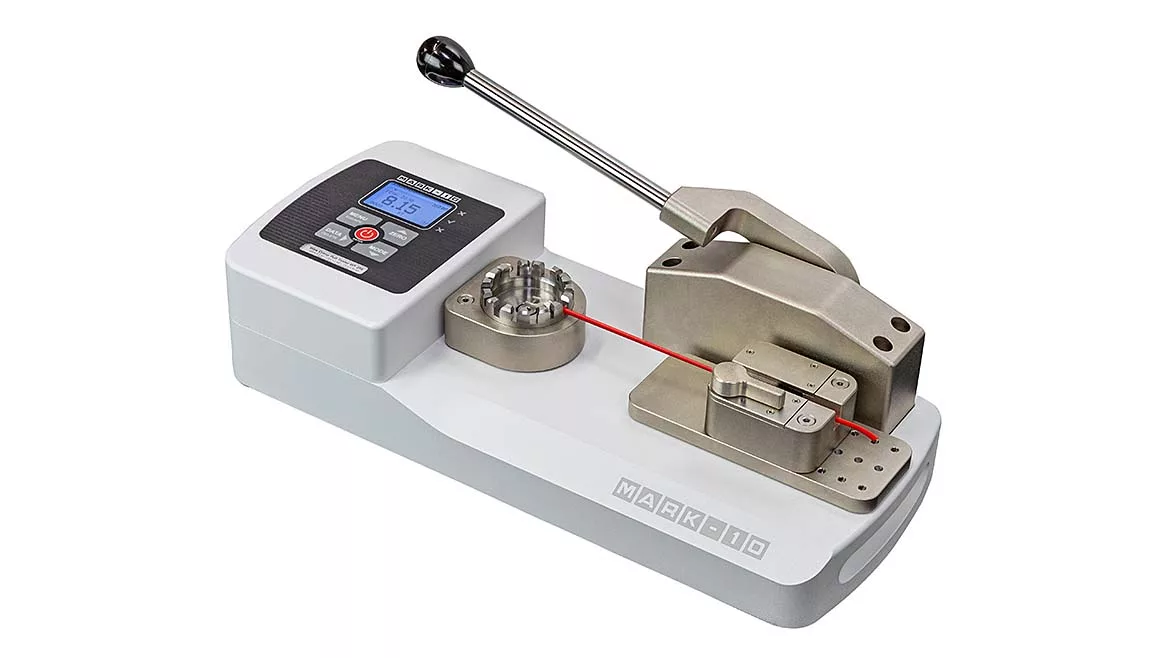
Mark-10 WT-205 with a white background.
Source: Mark-10, Photographs by Roy Mauritsen
August 15, 2025

Force measurement analyzes the amount of compression (push) or tension (pull) an object experiences in order to assess its quality and performance. Testing by hand with a suitable gage or sensor is a simple and quick option, but more reliable data is achieved by benchtop systems that control the angle and speed of force actuation. One force measurement application seeing growing interest is wire terminal testing, in which a controlled pull against a crimped connection produces a force measurement, characterizing its integrity and quality.

Wire terminal testers generally involve a mechanism to apply a test force, a grip to hold the terminal, a grip to hold the wire, and a load cell and electronics to process and display the data. Force results may include a date and time stamp and pass/fail indicator according to pre-configured acceptance limits.

During the test, which can be conducted using either a lever- or wheel-operated manual system or a motorized tester, the actuator speed should be controlled to yield the most repeatable possible results.
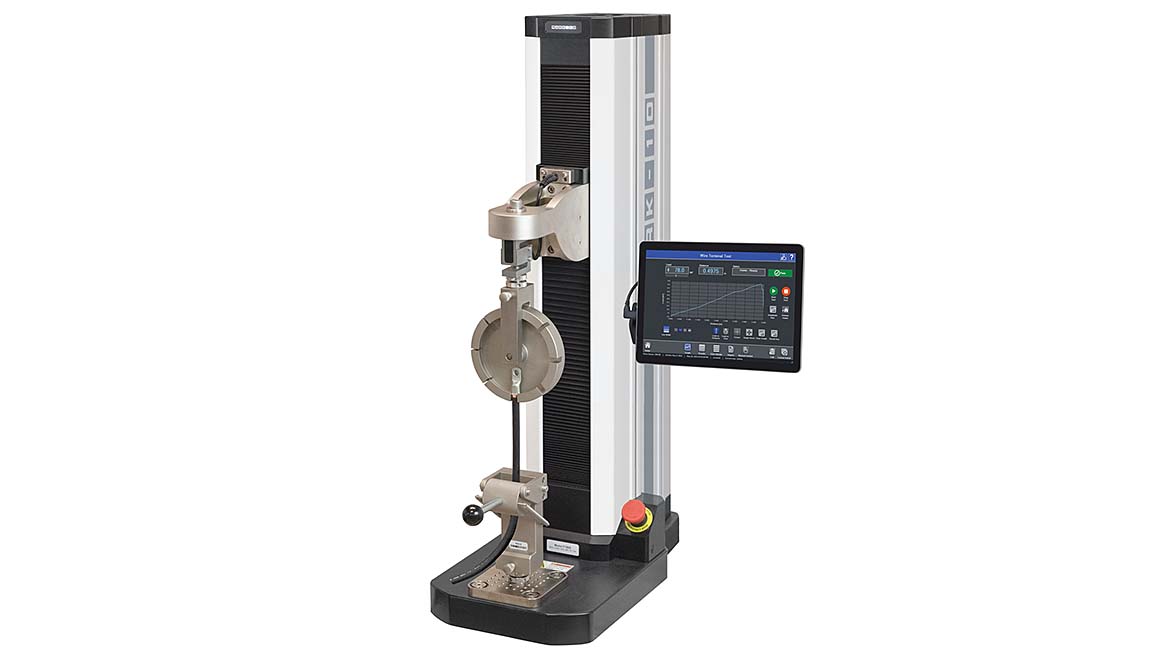
Mark-10 F1505S-IM wire pull with a white background.

Source: Mark-10, Photographs by Roy Mauritsen

Three common test methods are (1) pull-to-failure, a destructive test which applies force until the wire separates from the terminal, (2) pull-to-load, where a sample is deemed acceptable if it remains attached at a target force, and (3) load-hold, where a sample is held at a target force for a specified amount of time. Results for these tests are typically measured in lbF (pound-force), kgF (kilogram-force), or N (Newton) units. Other data that may be included are test speed (in/min or mm/min) and location of failure, which can identify if there is an issue with the crimp or the wire itself. Results depend on several factors like wire gauge, type of terminal, crimping process, and crimping tool condition, type/quality of wire, and environmental factors like temperature and humidity.

Although it may seem logical that a higher force measurement represents higher quality, it’s not always the case. Higher forces may be a symptom of over-crimping, in which incorrect or faulty tools excessively crimp the terminal. Over-crimping can be just as problematic as weak crimping and may lead to a brittle, easily broken connection. Industry testing standards like UL 486A specify the force required to pull a terminal off a wire as well as the speed of the pull. These harmonized processes allow data to be seamlessly shared amongst vendors up and down the supply chain.

Supply chains today are changing. Self-shoring/onshoring, or the process of relocating manufacturing back to or near a company’s home country, has gained traction in recent years, driven not only by the need for stability in the face of external crises such as COVID, but also by a growing emphasis on national security and technological independence. Companies also recognize that onshoring can reduce transportation costs and help to rebuild technical workforces hollowed out in earlier deindustrialization cycles. Challenges remain, such as high costs and limited skilled labor pools, which industries must balance with the opportunities that arise from a more localized approach. Three industries in particular that are self-shoring and rely heavily on wire terminal testing are appliance, automotive, and aerospace manufacturing.
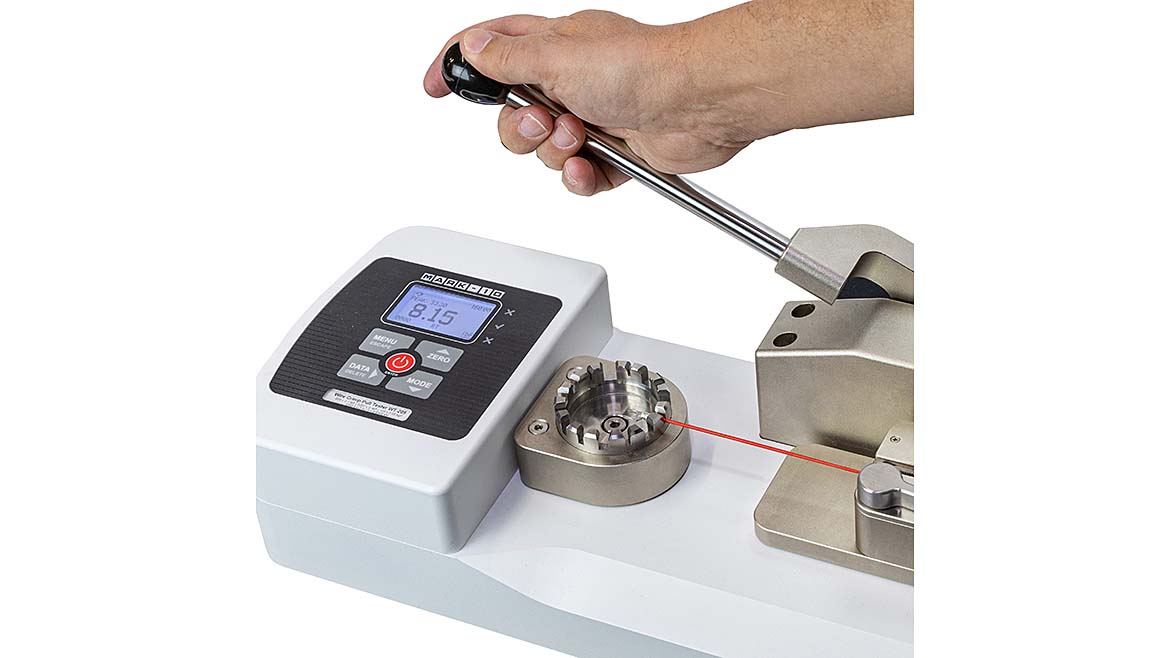
A hand using the Mark-10 handle-pull with a white background.

Source: Mark-10, Photographs by Roy Mauritsen
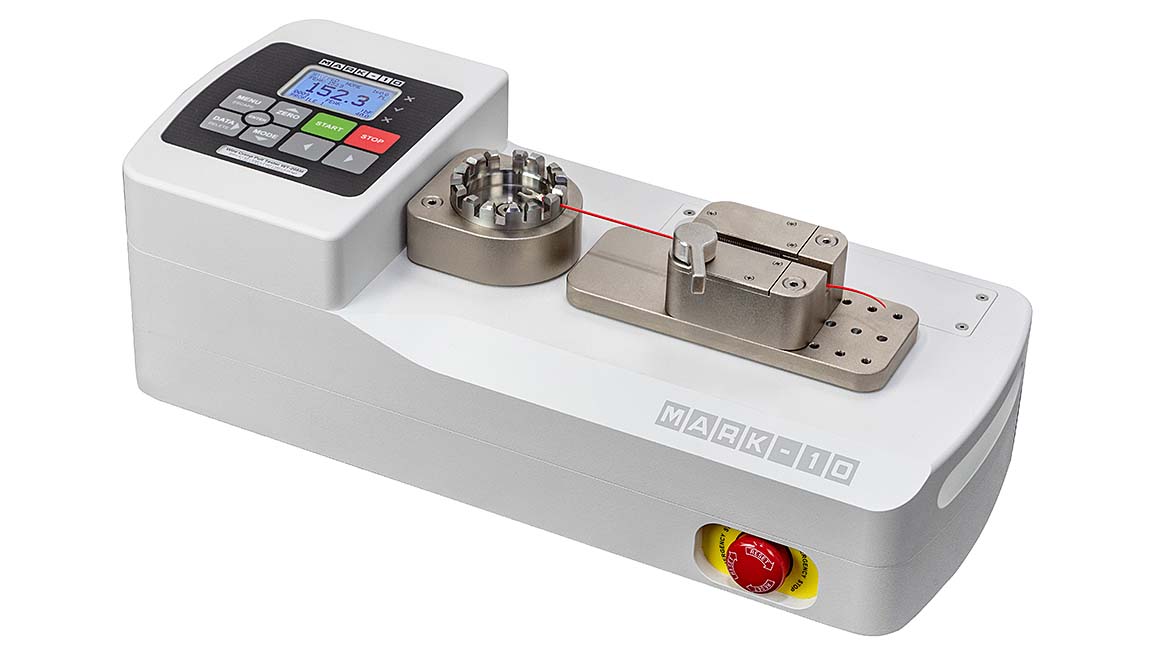
Mark-10 WT3-205M with a white background.

Source: Mark-10, Photographs by Roy Mauritsen

Pull testing is critical in household and commercial appliances where electrical reliability is critical to performance and safety. This includes high-power appliances such as refrigerators, washing machines, dryers, ovens, and dishwashers, as well as smaller devices like microwaves, coffee makers, and vacuum cleaners. In these products, wire harnesses connect motors, heating elements, sensors, and control boards - components that demand secure and consistent electrical connections to function safely. A weak or faulty crimp in any of these appliances can lead to intermittent operation, short circuits, or overheating, posing risks to the user. Crimp pull testing ensures that each terminal can withstand the mechanical stress and thermal cycling over the appliance’s lifetime, helping manufacturers meet UL, IEC, and other relevant standards.

Looking for quick answers on assembly and manufacturing topics? Try Ask ASM, our new smart AI search tool. Ask ASM →

Automobiles are major users of wire harnesses. These must be rigorously tested for safe, dependable connections that can withstand vibrations, temperature fluctuations, and other environmental factors typical in use. Data from these tests directly influence the design and manufacturing phases, enabling engineers to refine their techniques and materials to more stringently comply with industry standards and resolve weaknesses before they reach assembly lines.
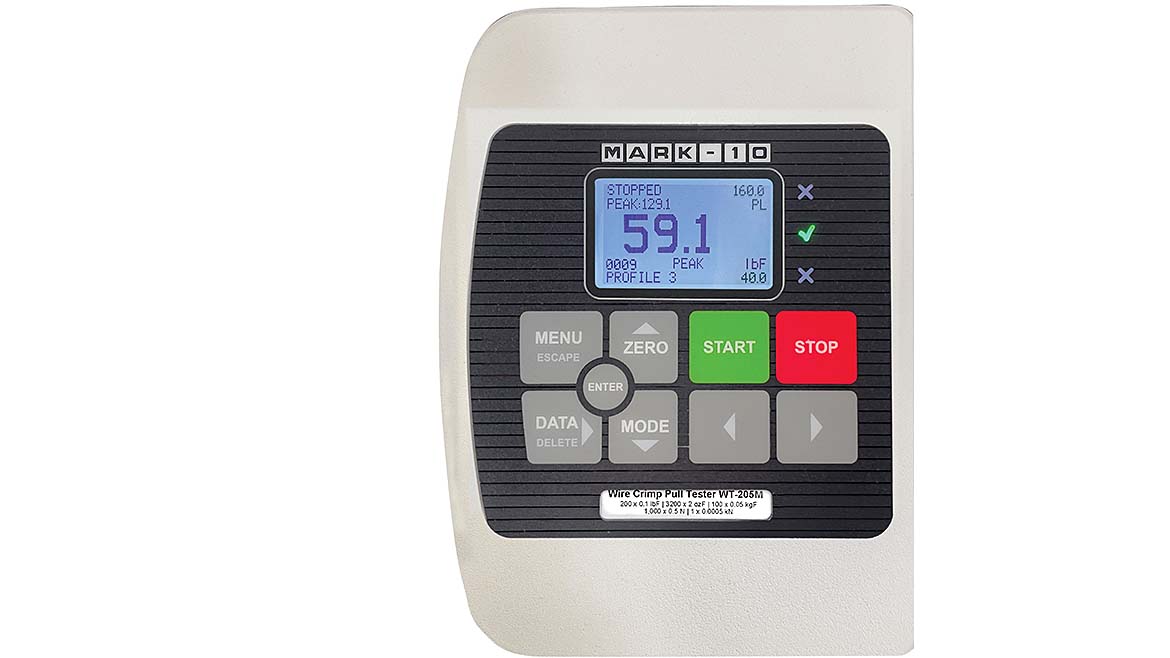
Mark-10 digital display with a white background.

Source: Mark-10, Photographs by Roy Mauritsen

High-voltage electric vehicles (EVs) and batteries are particularly reliant on wire harnesses, where malfunctions can lead to breakdowns and hazardous situations. Successful crimps equal trustworthy connections in battery management systems, drive controls, and other EV components. This ensures proper performance, dependability, and the manufacturer’s reputation in an increasingly competitive market. In the U.S., construction of battery production facilities and EV assembly plants have grown significantly. More long-term growth is expected, despite temporarily softening in the adoptation rate of EVs.

Wire terminal pull testing is vital to the aerospace industry as well. Wire harnesses are employed in navigation, flight controls, hydraulics, engines, and almost every part of an aircraft, including cabin comforts like climate control and entertainment. Military helicopters and fighter jets use wire harnessing for additional purposes like weapons control. Space vehicles and satellites rely on them for dependable communications. These components must perform safely and optimally under extreme conditions. Quality testing is paramount to preventing costly and dangerous failures.

In these examples, localization of production requires opening new production facilities, with all of the associated challenges of construction, tooling up, and staffing. Whether it’s a barbecue or a Boeing, effective wire crimp pull testing, and uniform standards for how to perform it, help identify issues before they become hazards, keeping costs down and ensuring end-user satisfaction as production shifts closer to home.

This article was originally posted on www.qualitymag.com.
KEYWORDS: force measurement onshoring quality control wire harness testing wire terminals

Share This Story

Looking for a reprint of this article?
From high-res PDFs to custom plaques, order your copy today!

Tyler Laravuso is Lead Product Specialist for Mark-10.

Jennifer Redmond is a Customer Service Specialist for Mark-10.

Recommended Content

JOIN TODAY
To unlock your recommendations.

Already have an account? Sign In

  • Made in the U.S.A.

    Consumer Products Manufacturing: Made in the USA

    Supply chain lessons learned during the coronavirus...
    Automated Assembly Systems
    By: Austin Weber
  • Best Practices for Press-Fit Assembly

    Best Practices for Press-Fit Assembly

    In manufacturing, ironclad formulas for success are hard...
    Assembly Presses
    By: Jim Camillo
  • aem0523leader-tesla1.jpg

    Tesla Rethinks the Assembly Line

    Engineers at Tesla Inc. have developed a new process that...
    Industries
    By: Austin Weber
Manage My Account
  • eMagazine Subscription
  • Assembly Newsletters
  • Online Registration
  • Subscription Customer Service
  • Manage My Preferences

More Videos

Sponsored Content

Sponsored Content is a special paid section where industry companies provide high quality, objective, non-commercial content around topics of interest to the ASSEMBLY audience. All Sponsored Content is supplied by the advertising company and any opinions expressed in this article are those of the author and not necessarily reflect the views of ASSEMBLY or its parent company, BNP Media. Interested in participating in our Sponsored Content section? Contact your local rep!

close
  • ultrasonic welding
    Sponsored bySonobond Ultrasonics

    Engineering Efficiency in High-Performance Assembly: How Ultrasonic Welding Enhances Throughput, Reliability and Quality

  • UV curing system
    Sponsored byDymax

    Why UV Intensity Alone Doesn’t Define Curing Performance

  • wooden pallets
    Sponsored byLEAN Manufacturing Products

    Eliminating Waste on the Shop Floor: Applying Lean Principles to Improve Manufacturing Efficiency

Popular Stories

ASSEMBLY News Now, episode 30: Volvo Redesigns EV Manufacturing

Volvo Redesigns EV Manufacturing

ASSEMBLY News Now, Episode 29: Mercedes-Benz to Invest $4 billion in Alabama Assembly Plant

Mercedes-Benz to Invest $4 billion in Alabama Assembly Plant

Boeing CEO Kelly Ortberg announces 1 billion investment

Boeing Plans $1 Billion Wichita Investment, Workforce Training Center

Watch the latest episode of ANN now!

Events

July 24, 2025

From Shop Floor to CFO: How Manufacturers Are Closing the Loop Between Operations and Finance

On Demand Learn how manufacturers are bridging the gap between the shop floor and ERP systems to gain real-time visibility, streamline operations, and kick-start digital transformation—without waiting years.

Sponsored by:

PicoStratusGreen
July 30, 2025

Buffer Analysis and Design Fundamentals for Manufacturing Excellence

On Demand In this presentation, Dr. Herman Tang shares practical insights from his industry experience and research on buffer management in manufacturing operations.

View All Submit An Event

Poll

Difficult Assembly Processes

Which assembly process gives you the most difficulty?
View Results Poll Archive

Products

Manufacturing Cost Policy Deployment (MCPD) Profitability Scenarios: Systematic and Systemic Improvement of Manufacturing Costs

Manufacturing Cost Policy Deployment (MCPD) Profitability Scenarios: Systematic and Systemic Improvement of Manufacturing Costs

See More Products
Register for webinar - Modernizing Automotive Assembly: Why Upgrading Legacy MES is a Business Imperative

Related Articles

  • It's All About the Battery

    See More
  • Fastening Threads: It all Starts With Joint Design

    See More

Related Products

See More Products
  • Testing Adhesive Joints: Best Practices

  • testing.jpg

    Testing Complex and Embedded Systems

  • characterization.jpg

    Characterization, Testing, Measurement, and Metrology

See More Products

Events

View AllSubmit An Event
  • August 20, 2025

    K.I.S.S. MES (Keep It Simple, Stupid): Why Modern Manufacturers Are Choosing Modular MES with Real Shop Floor Control

    On Demand If you’re tired of MES that overpromises and underdelivers, it’s time to simplify. Learn how a modular approach gives you control where it counts—without the baggage.Sponsored by:
View AllSubmit An Event

Related Directories

  • The Test Connection Inc. (TTCI)

    The Test Connection Inc. (TTCI) supplies quality test engineering solutions with complete documentation allow our team to support needs from the earliest design stages to test development to testing of circuit card assemblies (CCAs). Our services range from: In-Circuit Test (ICT) development and board testing services for Keysight (formerly Agilent) 3070 and Teradyne (Formerly GenRad) TestStation/228X test systems, Flying Probe development and board testing services on our Seica Pilot V8 & Digitaltest MTS500 flying probe test systems, Boundary-Scan Test Solutions with the Keysight x1149 Analyser and XJTAG system and custom Functional Test solutions.
×

Never miss the latest news and trends driving the manufacturing industry

Stay in the know on the latest assembly trends.

JOIN TODAY!
  • RESOURCES
    • Advertise
    • Contact Us
    • Directories
    • Manufacturing Division
    • Store
    • Want More?
  • SIGN UP TODAY
    • Create Account
    • eMagazine
    • Newsletters
    • Customer Service
    • Manage Preferences
  • SERVICES
    • Marketing Services
    • Reprints
    • Market Research
    • List Rental
    • Survey/Respondent Access
  • STAY CONNECTED
    • LinkedIn
    • Facebook
    • Instagram
    • YouTube
    • X (Twitter)
  • PRIVACY
    • PRIVACY POLICY
    • TERMS & CONDITIONS
    • DO NOT SELL MY PERSONAL INFORMATION
    • PRIVACY REQUEST
    • ACCESSIBILITY

Copyright ©2026. All Rights Reserved BNP Media, Inc. and BNP Media II, LLC.

Design, CMS, Hosting & Web Development :: ePublishing