New Study Finds Collaborative Robots Pose Hidden Cybersecurity Risks
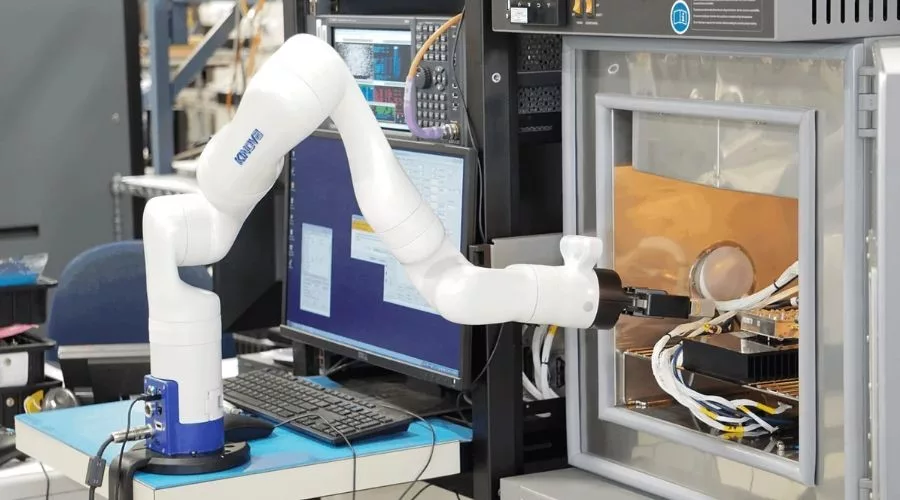
The study utilized a Kinova Gen3 robotic arm to predict actions with 97% accuracy based solely on encrypted data flow.
WATERLOO, Ontario—A new study from the University of Waterloo has revealed that collaborative robots can unintentionally leak sensitive information—even when commands are encrypted—raising urgent concerns for patient privacy and industrial security.
Researchers from Waterloo’s Cybersecurity and Privacy Institute demonstrated that hackers could analyze patterns in robot network traffic to infer private details, such as medical treatments or factory processes.
Using signal-processing techniques, the team identified a Kinova Gen3 robotic arm’s actions with 97% accuracy based solely on encrypted data flow.
“Even if you can’t understand the content of the conversation between a robot and its controller, you can still learn a lot by studying when and how often it talks,” said Cheng Tang, lead author and engineering undergraduate student.
The findings highlight a growing risk as hospitals, manufacturers, and other industries increasingly adopt remotely controlled robots. The researchers propose stronger safeguards, such as adjusting API timing and deploying traffic-shaping algorithms, to prevent leaks.
The study, "On the Feasibility of Fingerprinting Collaborative Robot Network Traffic," earned Best Research Paper honors at the 20th International Conference on Availability, Reliability and Security (ARES) and is published in Lecture Notes in Computer Science.
Looking for quick answers on assembly and manufacturing topics? Try Ask ASM, our new smart AI search tool. Ask ASM
Looking for a reprint of this article?
From high-res PDFs to custom plaques, order your copy today!


